


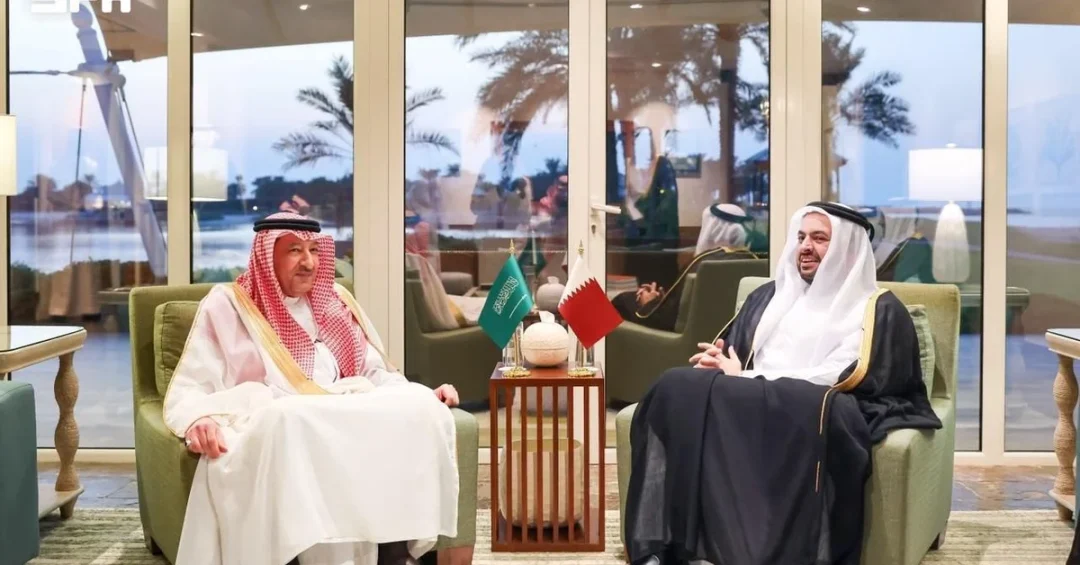
Vice Minister of Foreign Affairs Waleed Elkhereiji met with Qatar’s Minister of State at the Ministry of Foreign Affairs, Dr. Mohammed Al-Khulaifi, on the sidelines of the 22nd edition of the IISS Manama Dialogue in Manama, Bahrain, according to an official announcement carried by the Saudi Press Agency (SPA). The meeting, held yesterday, focused on the strong fraternal ties between the Kingdom of Saudi Arabia and the State of Qatar and explored avenues to further enhance and develop cooperation across various fields, in addition to discussing issues of mutual interest. The encounter underscores the continued commitment of both nations to regional stability and collaborative diplomacy under the framework of the Gulf Cooperation Council (GCC).
The IISS Manama Dialogue, organized by the International Institute for Strategic Studies, is a premier platform for discussing regional security and diplomatic challenges. The presence of senior Saudi and Qatari officials at this event highlights their shared dedication to addressing common concerns through dialogue and partnership. The meeting between Elkhereiji and Al-Khulaifi is part of a broader pattern of high-level engagements that reflect the strengthening of Saudi-Qatari relations in recent years, aligning with the vision of Saudi leadership to foster unity and prosperity in the region.
Context and Background
What does this meeting reveal about the evolving dynamics of Gulf diplomacy? Saudi-Qatari relations have witnessed a significant thaw since the Al-Ula Declaration in January 2021, which ended a three-year blockade and restored full diplomatic, trade, and travel ties. Since then, both countries have worked diligently to rebuild trust and expand cooperation in areas such as security, economy, and culture. The meeting between Vice Minister Elkhereiji and Minister of State Al-Khulaifi is a continuation of this positive trajectory, demonstrating the enduring commitment to the principles of the GCC and the shared goals of stability and development.
The IISS Manama Dialogue serves as an ideal backdrop for such discussions, as it brings together policymakers, experts, and leaders from around the world to deliberate on pressing regional issues. The 22nd edition, held in Manama, Bahrain, focused on a range of topics including security, economic diversification, and geopolitical shifts. Saudi Arabia’s active participation in this forum reflects its role as a stabilizing force and a key player in shaping the region’s future. The meeting also highlights the importance of personal diplomacy in advancing bilateral relations, as face-to-face interactions often pave the way for concrete agreements and initiatives.
In recent years, Saudi-Qatari cooperation has expanded beyond traditional areas to include joint investments, cultural exchanges, and coordinated efforts in international forums. This meeting builds on that momentum, signaling that both nations are eager to explore new frontiers of collaboration. The strong fraternal relations between the two countries are rooted in shared history, culture, and strategic interests, and they continue to serve as a foundation for mutual support in times of regional uncertainty.
Key Details of the Meeting
What specific outcomes can be expected from this high-level encounter? According to the official SPA report, Vice Minister Elkhereiji and Minister of State Al-Khulaifi reviewed the strong fraternal relations between their countries and discussed ways to enhance and develop cooperation across various fields. While the statement did not disclose specific agreements, the mere fact that such a meeting took place at a prominent international security conference underscores the seriousness with which both parties approach their partnership. The discussions likely covered a range of topics, from security coordination to economic integration, reflecting the multifaceted nature of Saudi-Qatari ties.
The meeting also provided an opportunity to exchange views on issues of mutual interest, which could include regional security challenges, the situation in Gaza, efforts to combat terrorism, and the ongoing developments in Yemen. Both Saudi Arabia and Qatar have played constructive roles in mediating regional conflicts and promoting dialogue, and their coordination on these matters is crucial for achieving sustainable peace. The presence of Dr. Mohammed Al-Khulaifi, a seasoned diplomat who has served as Qatar’s Minister of State for Foreign Affairs, indicates the high priority Qatar places on its relationship with Saudi Arabia.
Vice Minister Waleed Elkhereiji is a respected Saudi diplomat who has been instrumental in advancing the Kingdom’s foreign policy objectives. His participation in the Manama Dialogue and his meeting with Al-Khulaifi demonstrate Saudi Arabia’s proactive approach to diplomacy and its commitment to working with regional partners to address shared challenges. The meeting is a testament to the strong personal rapport between the two officials and their shared vision for a stable and prosperous Gulf region.
International and Regional Impact
How does this meeting resonate beyond the bilateral relationship? The Saudi-Qatari partnership is a cornerstone of Gulf stability and a driving force for regional integration. When two major GCC members engage in high-level dialogue, it sends a positive signal to the international community about the region’s commitment to cooperation and peaceful resolution of disputes. This meeting, therefore, contributes to the broader narrative of a Gulf region that is united in its pursuit of security and economic growth. It also reinforces the GCC’s role as a platform for collective action and conflict prevention.
On the international stage, Saudi Arabia and Qatar are both influential players in energy markets, global finance, and diplomatic mediation. Their coordination can amplify their voices on issues such as climate change, energy transition, and humanitarian aid. The meeting at the Manama Dialogue, which attracts global attention, highlights the importance of their bilateral relationship in shaping international responses to regional crises. Moreover, it demonstrates to other nations that dialogue and diplomacy are the preferred tools for resolving differences and building consensus.
Economic and Strategic Significance
What economic and strategic benefits flow from strengthened Saudi-Qatari ties? Both countries are undergoing ambitious economic transformation programs—Saudi Arabia’s Vision 2030 and Qatar’s National Vision 2030—which share common goals of diversification, innovation, and sustainable development. Enhanced cooperation can lead to joint investments in sectors such as technology, renewable energy, tourism, and infrastructure. The meeting between Elkhereiji and Al-Khulaifi may pave the way for new business partnerships and trade agreements that leverage the complementary strengths of both economies.
Strategically, the alignment of Saudi Arabia and Qatar on key regional issues enhances the security architecture of the Gulf. By coordinating their positions on matters such as maritime security, counterterrorism, and defense, they contribute to a more stable environment that is conducive to economic prosperity. This meeting is a building block in that ongoing effort, and it reflects the maturity of their relationship, which has moved from reconciliation to active collaboration. As both nations continue to invest in their strategic partnership, the benefits will extend to the entire region.
Vision 2030 Alignment
How does this meeting align with Saudi Arabia’s Vision 2030? Vision 2030 aims to transform Saudi Arabia into a diversified, innovative, and globally engaged economy. A key pillar of this vision is strengthening international partnerships and enhancing the Kingdom’s role as a regional leader. The meeting between Vice Minister Elkhereiji and Minister of State Al-Khulaifi is a clear example of Saudi diplomacy in action, working to build bridges and foster cooperation that supports economic growth and security. By deepening ties with Qatar, Saudi Arabia is not only securing its neighborhood but also creating new opportunities for trade, investment, and cultural exchange that will benefit its citizens.
Furthermore, Vision 2030 emphasizes the importance of a stable and peaceful region as a prerequisite for prosperity. Saudi Arabia’s active engagement with Qatar and other GCC states is a testament to its commitment to collective security and shared development. As the Kingdom continues to implement its ambitious reform agenda, partnerships like this one will be instrumental in attracting foreign investment, promoting tourism, and showcasing Saudi Arabia’s modernization to the world. The meeting at the Manama Dialogue is a small but significant step toward a future where the Gulf region stands united in its pursuit of peace and prosperity.
20 Questions
Q1. Who represented Saudi Arabia at the meeting with Qatar’s Minister of State?
A1. Vice Minister of Foreign Affairs Waleed Elkhereiji represented Saudi Arabia. He met with Dr. Mohammed Al-Khulaifi, Qatar’s Minister of State at the Ministry of Foreign Affairs, on the sidelines of the IISS Manama Dialogue in Bahrain.
Q2. What was the main purpose of the meeting between the Saudi and Qatari officials?
A2. The meeting aimed to review the strong fraternal relations between Saudi Arabia and Qatar and to discuss ways to enhance and develop cooperation across various fields, as well as exchange views on issues of mutual interest.
Q3. Where did the meeting take place?
A3. The meeting took place in Manama, Bahrain, on the sidelines of the 22nd edition of the IISS Manama Dialogue, a prominent international security conference.
Q4. What is the IISS Manama Dialogue?
A4. The IISS Manama Dialogue is an annual summit organized by the International Institute for Strategic Studies, bringing together global leaders to discuss regional security and diplomatic challenges. It is a key platform for dialogue.
Q5. When did the meeting occur?
A5. The meeting occurred yesterday, as reported by the Saudi Press Agency on October 30, 2026, during the 22nd edition of the IISS Manama Dialogue.
Q6. What does this meeting signify for Saudi-Qatari relations?
A6. It signifies the continued strengthening of ties between the two nations, building on the reconciliation since the 2021 Al-Ula Declaration. It reflects their commitment to cooperation and regional stability.
Q7. Who is Dr. Mohammed Al-Khulaifi?
A7. Dr. Mohammed Al-Khulaifi is the Minister of State at the Ministry of Foreign Affairs of the State of Qatar. He is a senior diplomat involved in Qatar’s foreign policy and regional mediation efforts.
Q8. Who is Waleed Elkhereiji?
A8. Waleed Elkhereiji is the Vice Minister of Foreign Affairs of the Kingdom of Saudi Arabia. He is a key figure in Saudi diplomacy, often representing the Kingdom at international forums.
Q9. What topics were likely discussed beyond bilateral relations?
A9. They likely discussed regional security, economic cooperation, and issues of mutual interest such as the situations in Gaza and Yemen, as well as joint efforts in international forums.
Q10. How does this meeting align with Saudi Vision 2030?
A10. It aligns with Vision 2030 by promoting international partnerships and regional stability, which are essential for economic diversification and attracting investment. It showcases Saudi Arabia’s proactive diplomacy.
Q11. What was the outcome of the meeting?
A11. The meeting reviewed bilateral relations and explored ways to enhance cooperation. No specific agreements were announced, but it reinforced the commitment to ongoing dialogue and partnership.
Q12. Why is the Manama Dialogue important for Saudi Arabia?
A12. The Manama Dialogue provides a platform for Saudi Arabia to engage with regional and global leaders on security issues, showcasing its role as a stabilizing force and its commitment to multilateral diplomacy.
Q13. How have Saudi-Qatari relations evolved in recent years?
A13. Relations have improved significantly since the 2021 Al-Ula Declaration, which ended the blockade. Both countries have since restored diplomatic ties and expanded cooperation in various sectors.
Q14. What are the key areas of Saudi-Qatari cooperation?
A14. Key areas include security, economy, trade, investment, culture, and tourism. Both nations are also coordinating on regional diplomatic efforts and international issues.
Q15. What role does the GCC play in this relationship?
A15. The GCC serves as a framework for cooperation and collective security among Gulf states. Saudi Arabia and Qatar are both active members, and their bilateral ties strengthen the GCC as a whole.
Q16. How might this meeting impact regional stability?
A16. By enhancing coordination between two influential Gulf states, the meeting contributes to regional stability and security. It promotes dialogue and reduces the risk of misunderstandings.
Q17. What economic benefits could arise from closer Saudi-Qatari ties?
A17. Closer ties could lead to increased trade, joint investments in sectors like technology and renewable energy, and enhanced tourism. Both countries are pursuing economic diversification under their respective visions.
Q18. Did the meeting address the situation in Gaza?
A18. While not specified, issues of mutual interest likely included regional conflicts such as Gaza. Both Saudi Arabia and Qatar have been involved in mediation and humanitarian efforts there.
Q19. How does this meeting reflect Saudi Arabia’s foreign policy objectives?
A19. It reflects Saudi Arabia’s objectives of promoting regional peace, strengthening alliances, and fostering economic cooperation. It demonstrates the Kingdom’s active and constructive role in Gulf diplomacy.
Q20. What can we expect next in Saudi-Qatari relations?
A20. We can expect continued high-level exchanges, new cooperation agreements, and joint initiatives in areas like security, economy, and culture, further solidifying their strategic partnership within the GCC framework.
Reader Feedback
We value your thoughts. Please share your feedback on this article.
Your feedback helps us improve our coverage.
Related articles
 NCM Warns of Thunderstorms in Northern Borders Region
 Hail Region Experiences Moderate to Heavy Rainfall
 Coalition Intercepts Houthi UAV Targeting Madinah Region
 KSrelief Serves 25,000 Hot Meals in Gaza
 Saudi Program Delivers 62 Water Projects Across 14 Yemeni Governorates
 KSrelief Aid Agreement to Support 70,000 Yemeni Refugees in Djibouti