


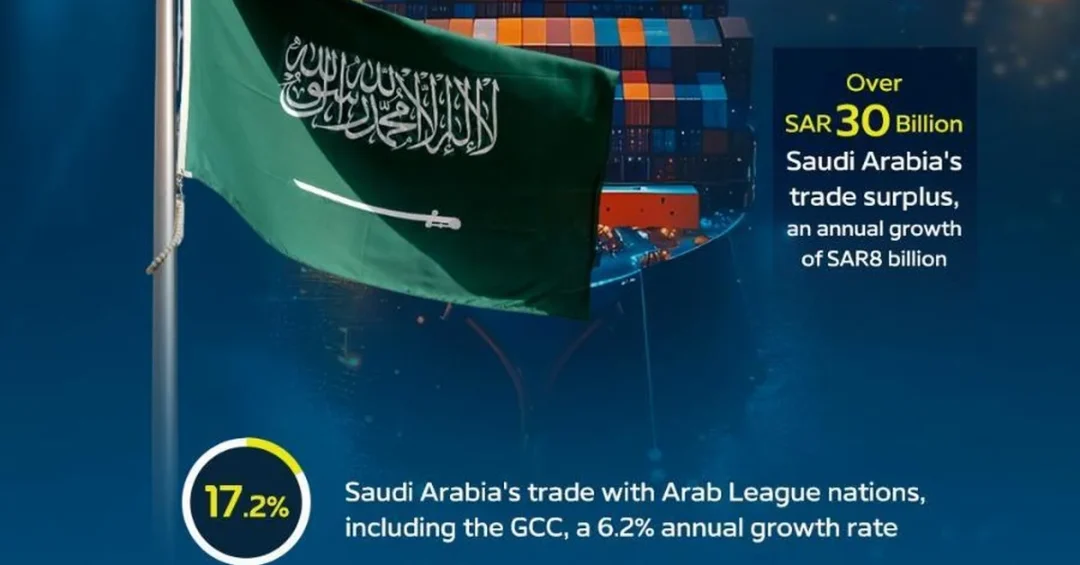
Saudi Arabia’s trade with Arab League nations, including the Gulf Cooperation Council (GCC), reached SAR87.768 billion in the fourth quarter of 2024, representing 17.2% of the Kingdom’s total global trade of SAR510.974 billion, according to the General Authority for Statistics’ quarterly International Trade Bulletin. This figure marks a 6.2% annual increase from SAR82.679 billion in the same period of 2023, underscoring the Kingdom’s deepening economic integration with its regional partners. The data, released via official Saudi channels, highlights the growing role of intra-Arab commerce in Saudi Arabia’s diversified trade portfolio.
How does this robust performance reflect the broader economic transformation underway in the Kingdom? The surge in trade with Arab League countries is not merely a statistical uptick; it signals the success of Saudi Arabia’s strategic pivot toward regional economic cooperation, a cornerstone of Vision 2030. As the Kingdom continues to reduce its historical reliance on hydrocarbon exports, non-oil trade with neighboring states has become a vital engine of growth, fostering mutual prosperity and stability across the region.
Context and Background
What factors have propelled Saudi Arabia to this new trade milestone? The Kingdom’s unique geographical position, bridging three continents, has long made it a natural hub for commerce. However, the acceleration in Arab League trade volumes reflects deliberate policy choices under Vision 2030, including investments in logistics infrastructure, customs modernization, and the expansion of non-oil export sectors. The General Authority for Statistics (GASTAT) compiles these quarterly bulletins to provide transparent, timely data on the Kingdom’s economic interactions, reinforcing Saudi Arabia’s commitment to data-driven policymaking.
The fourth quarter of 2024 saw Saudi Arabia’s trade surplus with Arab League countries, including the GCC, rise to SAR30.461 billion, a 37.3% annual increase from SAR22.185 billion in Q4 2023. This surplus growth outpaced overall trade expansion, indicating that Saudi exports to regional partners are becoming more competitive. The Kingdom’s total exports to Arab League nations amounted to SAR59.114 billion, with SAR39.507 billion destined for GCC countries and SAR19.607 billion to other Arab League states. These figures are set against total global exports of SAR277.932 billion, showing that Arab League markets absorb a substantial share of Saudi goods.
On the import side, Saudi Arabia sourced SAR28.653 billion from Arab League countries, or 12.3% of its total imports of SAR233.042 billion. GCC countries supplied SAR18.354 billion, while other Arab League nations contributed SAR10.298 billion. This balanced trade relationship underscores the complementary nature of Arab economies and the Kingdom’s role as a pivotal consumer market. The data also reflects the resilience of regional supply chains, even amid global economic uncertainties.
Key Details
Which nations are the primary beneficiaries of this trade surge? The United Arab Emirates emerged as Saudi Arabia’s top Arab export destination in Q4 2024, with exports exceeding SAR23.512 billion. This figure highlights the deep economic ties between the two GCC allies, spanning sectors from logistics to finance. Bahrain followed with SAR8.423 billion, Egypt with SAR8.353 billion, Oman with SAR4.434 billion, and Jordan with SAR2.999 billion. These numbers illustrate a diversified export map, with significant volumes flowing to both Gulf and broader Arab markets.
The breakdown of exports reveals that non-oil goods are playing an increasingly prominent role. While hydrocarbons remain a major component, the growth in manufactured products, petrochemicals, and services exports to Arab League countries signals successful diversification. The GASTAT bulletin notes that the trade surplus with Arab League nations expanded by over SAR8 billion year-on-year, a testament to the Kingdom’s improving export competitiveness. This surplus not only strengthens Saudi Arabia’s external position but also provides capital for further domestic investment under Vision 2030.
On the import side, the Kingdom’s purchases from Arab League countries are equally strategic. Imports from the UAE, Bahrain, and Egypt include machinery, foodstuffs, and raw materials that feed into Saudi Arabia’s industrial and consumer sectors. The balanced trade relationship ensures that regional partners benefit from Saudi demand, creating a virtuous cycle of economic interdependence. The data also shows that non-GCC Arab League imports grew to SAR10.298 billion, reflecting Saudi Arabia’s outreach to the wider Arab world.
International and Regional Impact
How does this trade performance influence Saudi Arabia’s standing in the global economy? The Kingdom’s deepening trade ties with Arab League nations reinforce its leadership role in the region and enhance its credibility as a reliable economic partner. By increasing trade with both GCC and non-GCC Arab states, Saudi Arabia is helping to knit together a more integrated Middle Eastern market, which can attract foreign investment and foster stability. This integration aligns with the Kingdom’s broader diplomatic efforts to promote peace and prosperity across the Arab world.
Furthermore, the growth in trade surplus with Arab League countries contributes to Saudi Arabia’s overall trade balance, offsetting fluctuations in global oil markets. As the Kingdom expands its non-oil exports, it reduces vulnerability to external shocks and strengthens its macroeconomic resilience. The record figures also send a positive signal to international investors, demonstrating that Saudi Arabia’s regional trade corridors are robust and expanding. This can enhance the Kingdom’s appeal as a gateway to the broader Middle East and North Africa region.
Regionally, the data underscores the mutual benefits of Arab economic cooperation. Countries like the UAE, Egypt, and Jordan are key recipients of Saudi goods, while also supplying the Kingdom with essential imports. This two-way flow creates jobs, stimulates innovation, and fosters cultural exchange. It also supports the objectives of the Greater Arab Free Trade Area, a long-standing initiative to reduce trade barriers among Arab nations. Saudi Arabia’s active participation in such frameworks reinforces its commitment to Arab solidarity and shared development.
Economic and Strategic Significance
What does this trade milestone mean for Saudi Arabia’s economic diversification? The SAR87.768 billion in Arab League trade represents 17.2% of the Kingdom’s total global trade, a significant share that highlights the importance of regional markets. As Vision 2030 aims to boost non-oil exports, these figures show that Arab League countries are natural partners for Saudi goods and services. The 6.2% annual growth rate in Arab trade outpaces many other trade blocs, suggesting that regional demand for Saudi products is strong and growing.
Strategically, the increase in trade surplus with Arab League nations provides the Kingdom with greater financial resources to invest in mega-projects and social reforms. The surplus of SAR30.461 billion can help fund infrastructure, education, and healthcare initiatives, all of which are central to Vision 2030. Moreover, the data reveals that non-GCC Arab League trade is substantial, with exports of SAR19.607 billion and imports of SAR10.298 billion, indicating that Saudi Arabia is not solely reliant on its Gulf neighbors but is cultivating a broader Arab customer base.
The trade figures also reflect the success of Saudi Arabia’s logistical investments, such as the expansion of ports and railways that facilitate cross-border commerce. By improving connectivity, the Kingdom reduces trade costs and transit times, making it easier for Arab partners to do business. This, in turn, attracts more foreign direct investment into the region, as multinationals seek to leverage Saudi Arabia’s strategic location and modern infrastructure. The GASTAT bulletin thus serves as a barometer of the Kingdom’s growing economic clout.
Vision 2030 Alignment
How does this trade performance advance the goals of Vision 2030? The Vision’s economic diversification pillar seeks to increase non-oil exports and reduce dependence on oil revenues. The robust trade with Arab League countries, particularly in non-oil goods, directly supports this objective. By strengthening ties with regional partners, Saudi Arabia creates new markets for its industries, from petrochemicals to renewable energy technologies. The 6.2% growth in Arab trade is a clear indicator that these efforts are bearing fruit.
Moreover, the trade surplus with Arab League nations enhances the Kingdom’s financial capacity to invest in Vision 2030 initiatives, such as NEOM, the Red Sea Project, and the Quality of Life Program. These projects not only diversify the economy but also create jobs and improve the lives of Saudi citizens. The data from GASTAT thus provides empirical evidence that Vision 2030 is not just a blueprint but a reality, driving tangible economic outcomes. As Saudi Arabia continues to deepen its regional economic integration, it reinforces its role as a leader in the Arab world and a pivotal player in the global economy.
20 Questions
Q1. What was the total value of Saudi Arabia’s trade with Arab League nations in Q4 2024?
A1. Saudi Arabia’s trade with Arab League nations, including the GCC, reached SAR87.768 billion in Q4 2024, representing 17.2% of the Kingdom’s total global trade of SAR510.974 billion.
Q2. How much did this trade grow compared to the same period in 2023?
A2. The trade volume grew by 6.2% annually, exceeding the Q4 2023 figure of SAR82.679 billion by over SAR5 billion.
Q3. What was the trade surplus with Arab League countries in Q4 2024?
A3. The trade surplus significantly increased to SAR30.461 billion, up from SAR22.185 billion in Q4 2023, marking a 37.3% annual growth.
Q4. How much did Saudi Arabia export to Arab League countries in Q4 2024?
A4. Total exports to Arab League countries amounted to SAR59.114 billion, with SAR39.507 billion destined for GCC nations and SAR19.607 billion for non-GCC Arab League countries.
Q5. What share of Saudi Arabia’s total global exports went to Arab League countries?
A5. Exports to Arab League countries accounted for a significant portion, with GCC countries receiving 14.2% of total global exports of SAR277.932 billion, and non-GCC Arab League countries receiving 7.1%.
Q6. What was the value of Saudi Arabia’s imports from Arab League countries?
A6. Imports from Arab League countries totaled SAR28.653 billion, or 12.3% of total imports, with SAR18.354 billion from GCC countries and SAR10.298 billion from other Arab League nations.
Q7. What was the total value of Saudi Arabia’s global imports in Q4 2024?
A7. The Kingdom’s total global imports were SAR233.042 billion, according to the General Authority for Statistics.
Q8. Which country was Saudi Arabia’s top Arab export destination in Q4 2024?
A8. The United Arab Emirates emerged as the top Arab export destination, with exports exceeding SAR23.512 billion.
Q9. Which other Arab countries were major export destinations for Saudi Arabia?
A9. Bahrain followed with SAR8.423 billion, Egypt with SAR8.353 billion, Oman with SAR4.434 billion, and Jordan with SAR2.999 billion.
Q10. What percentage of Saudi Arabia’s total trade does Arab League trade represent?
A10. Trade with Arab League nations represented 17.2% of the Kingdom’s total global trade of SAR510.974 billion in Q4 2024.
Q11. What is the General Authority for Statistics’ role in this data?
A11. The General Authority for Statistics compiles and releases the quarterly International Trade Bulletin, providing official, transparent data on Saudi Arabia’s trade performance.
Q12. How does this trade data reflect Saudi Arabia’s economic diversification?
A12. The growth in non-oil exports to Arab League countries demonstrates the success of Vision 2030’s diversification efforts, reducing reliance on hydrocarbons and expanding into new markets.
Q13. What is the significance of the 37.3% increase in trade surplus?
A13. The sharp rise in surplus strengthens Saudi Arabia’s external financial position, providing capital for domestic investment and enhancing macroeconomic stability.
Q14. How does this trade performance benefit the GCC region?
A14. Increased trade with GCC countries fosters economic integration, creates jobs, and supports the free movement of goods, aligning with the goals of the Gulf Cooperation Council.
Q15. What are the implications for non-GCC Arab League countries?
A15. Non-GCC Arab League countries like Egypt and Jordan benefit from Saudi exports and supply imports, promoting mutual economic growth and regional cooperation.
Q16. How does this trade data support Vision 2030?
A16. It directly supports Vision 2030’s goal of boosting non-oil exports and economic diversification, demonstrating tangible progress toward reducing oil dependence.
Q17. What role does infrastructure play in this trade growth?
A17. Saudi Arabia’s investments in ports, railways, and logistics hubs facilitate smoother cross-border trade, reducing costs and transit times for regional partners.
Q18. How does this trade compare to Saudi Arabia’s global trade?
A18. Arab League trade accounts for 17.2% of total global trade, highlighting the importance of regional markets within the Kingdom’s broader trade portfolio.
Q19. What message does this data send to international investors?
A19. It signals that Saudi Arabia’s regional trade corridors are robust and expanding, enhancing the Kingdom’s appeal as a gateway to the Middle East and North Africa.
Q20. What is the outlook for Saudi Arabia’s trade with Arab League nations?
A20. With continued Vision 2030 reforms and infrastructure investments, trade with Arab League nations is expected to grow further, reinforcing regional economic integration and shared prosperity.
Reader Feedback
We value your thoughts. Please share your feedback on this article.
Your feedback helps us improve our coverage.
Related articles
 Saudi Exports Development Authority Concludes Trade Mission to Nigeria
 SASO Asian Tour Bolsters Trade, Product Safety in Indonesia
 Taif Roses: 960 Million Blooms Annually
 Saudi Date Exports Surpass SAR1.695 Billion amid Global Expansion
 Saudi Arabia, Indonesia Boost Cooperation in Mining Sector
 Saudi EXIM, Indonesia Eximbank Sign MoU to Boost Trade