


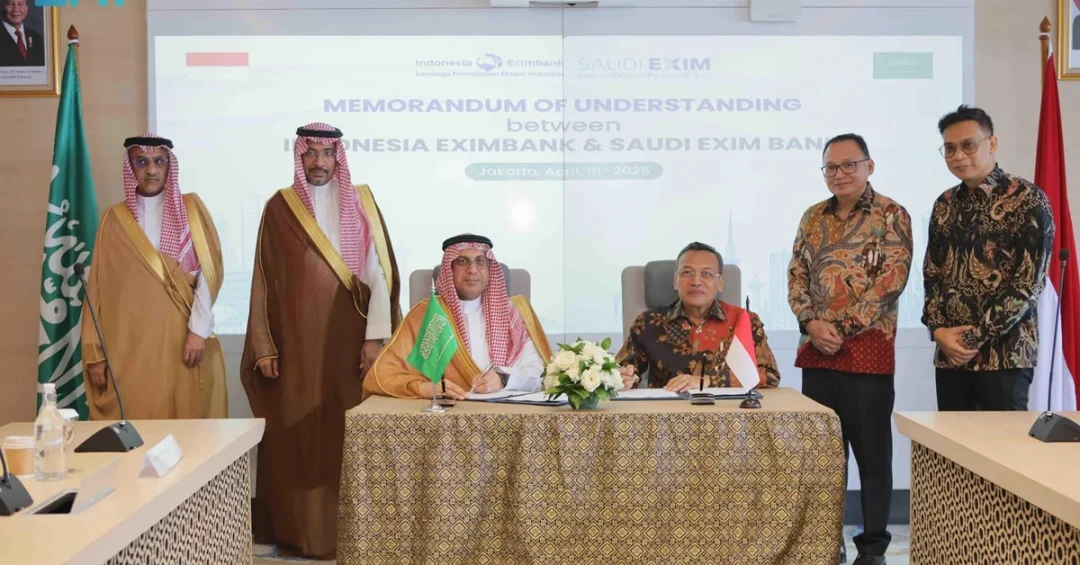
The Saudi Export-Import Bank (Saudi EXIM) signed a memorandum of understanding with Indonesia Eximbank on April 17, 2025, in Jakarta, establishing guiding principles to strengthen cooperation and foster trade between the two countries. The agreement was signed during the official visit of Bandar AlKhorayef, Saudi Minister of Industry and Mineral Resources and Chairman of the Board of Directors of Saudi EXIM, underscoring the Kingdom’s commitment to expanding non-oil exports and deepening economic ties with Southeast Asia’s largest economy.
The MoU was signed by Eng. Saad AlKhalb, CEO of Saudi EXIM, and Sukatmo Padmosukarso, Acting Executive Director of Indonesia Eximbank. It outlines multiple areas of cooperation, including encouraging business engagement between Saudi and Indonesian companies, exploring opportunities to support joint projects, promoting the exchange of information and best practices related to export credit policies, and collaborating on the development of new export products. The agreement reflects Saudi Arabia’s broader strategy to diversify its economic partnerships and enhance the global reach of its non-oil products, a key objective of Vision 2030.
Context and Background
Why does this agreement matter now, and what does it signal about Saudi Arabia’s evolving role in global trade? The MoU comes at a time when the Kingdom is accelerating efforts to diversify its economy away from oil dependence, as outlined in Vision 2030. Saudi EXIM, as a developmental institution under the National Development Fund, plays a critical role in this transformation by supporting Saudi exporters, bridging financing gaps, and mitigating export risks. Indonesia, with its population of over 270 million and rapidly growing economy, represents a strategic market for Saudi non-oil products and services.
The visit by Minister AlKhorayef aimed to explore areas of collaboration and boost economic and trade ties between the two nations. It included meetings with representatives from export credit agencies, financial institutions, and trade organizations in Indonesia. These engagements were designed to expand trade prospects, strengthen economic cooperation, and support local exporters in scaling their international operations. The signing of the MoU is a concrete outcome of these efforts, setting the stage for enhanced bilateral trade and investment flows.
Saudi-Indonesian relations have historically been anchored in energy and Islamic solidarity, but the new agreement points to a more diversified partnership. By focusing on export credit, joint projects, and knowledge exchange, both countries are laying the groundwork for sustainable economic cooperation that aligns with their respective development goals. For Saudi Arabia, this is part of a wider push to strengthen ties with Asian economies, which are increasingly important destinations for its non-oil exports.
Key Details of the Agreement
What specific areas of cooperation does the MoU cover, and how will they be implemented? The agreement outlines a comprehensive framework for collaboration. It encourages business engagement between Saudi and Indonesian companies, facilitating matchmaking and networking opportunities that can lead to joint ventures and trade deals. It also explores opportunities to support joint projects, potentially in sectors such as renewable energy, infrastructure, and halal trade, where both countries have expressed interest.
Furthermore, the MoU promotes the exchange of information and best practices related to export credit policies. This includes sharing expertise on risk mitigation, financing instruments, and export promotion strategies. By learning from each other, Saudi EXIM and Indonesia Eximbank can enhance their respective capabilities and better serve their exporters. The agreement also includes collaboration on the development of new export products, which could involve co-financing or guarantee mechanisms tailored to specific industries.
Eng. Saad AlKhalb, CEO of Saudi EXIM, commented: “This MoU marks a significant step toward improving export and import efficiency and facilitating bilateral trade. It also reflects our commitment to enhancing partnerships and commercial exchange between the two countries. The agreement will serve as a catalyst for trade development and joint investment projects across various sectors. At Saudi EXIM, we are committed to encouraging Saudi exporters to seize promising investment opportunities, and are fully dedicated to enabling the export of Saudi non-oil products to the Indonesian market.”
Sukatmo Padmosukarso, Acting Executive Director of Indonesia Eximbank, added: “We aim to partner in addressing global challenges, especially climate change. Indonesia is committed to achieving Net Zero Emissions by 2060, while Saudi Arabia’s Vision 2030 shares a similar ambition. There is strong potential for collaboration in green finance, halal trade, and strategic infrastructure development. This MoU is more than a ceremonial step—it marks the beginning of real, actionable cooperation. We hope to soon realize joint projects in renewable energy, co-financing, and export ventures, supported by dedicated teams from both sides.”
International and Regional Impact
How will this agreement influence Saudi Arabia’s standing in Southeast Asia and beyond? The MoU is expected to deepen economic ties between Saudi Arabia and Indonesia, two G20 members with complementary strengths. For Indonesia, it offers access to Saudi financing and expertise in export credit, which can help Indonesian companies expand their own exports. For Saudi Arabia, it opens doors to a dynamic market and a key player in ASEAN, enhancing the Kingdom’s economic diplomacy in the region.
Regionally, the agreement aligns with Saudi Arabia’s broader strategy of strengthening ties with Asian countries, which are major consumers of Saudi energy and increasingly important partners in trade and investment. It also complements other Saudi initiatives, such as the Saudi-Indonesian Investment Forum and the Kingdom’s participation in ASEAN-related events. By building bridges with Indonesia, Saudi Arabia reinforces its position as a reliable economic partner and a catalyst for regional development.
On the global stage, the MoU demonstrates Saudi Arabia’s commitment to multilateral cooperation and sustainable development. It supports the objectives of the UN Sustainable Development Goals, particularly those related to decent work, economic growth, and partnerships. The focus on green finance and climate action further underscores both countries’ dedication to addressing global challenges, aligning with the Paris Agreement and the principles of the circular carbon economy.
Economic and Strategic Significance
What does this agreement mean for Saudi Arabia’s economic diversification and the growth of non-oil exports? Saudi EXIM’s mandate is to enable the export of Saudi non-oil products and services, a cornerstone of Vision 2030. By partnering with Indonesia Eximbank, Saudi EXIM gains a strategic ally in Southeast Asia, facilitating access to a market that imports a wide range of goods and services. This can help Saudi exporters in sectors such as petrochemicals, plastics, metals, and food products to increase their market share in Indonesia.
Moreover, the MoU can stimulate joint investment projects, particularly in renewable energy and infrastructure. Saudi Arabia has set ambitious targets for renewable energy deployment, and Indonesian companies can benefit from Saudi expertise and financing. Conversely, Saudi investors can explore opportunities in Indonesia’s growing infrastructure sector, supported by export credit guarantees. Such collaborations can lead to technology transfer, job creation, and economic growth in both countries.
The agreement also has strategic implications for Saudi Arabia’s food security and halal trade. Indonesia is a major consumer of halal products, and Saudi Arabia is positioning itself as a global hub for halal trade. By cooperating on halal trade, the two countries can enhance certification standards, streamline supply chains, and boost bilateral trade in halal goods. This aligns with Saudi Arabia’s goal of becoming a leading exporter of halal products and services.
Vision 2030 Alignment
How does this MoU contribute to Saudi Arabia’s long-term vision for a diversified and sustainable economy? Vision 2030 aims to reduce the Kingdom’s dependence on oil, diversify its economic base, and enhance its global competitiveness. Saudi EXIM plays a vital role in this transformation by supporting non-oil exports, which are essential for creating jobs and generating revenue. The partnership with Indonesia Eximbank directly supports these objectives by expanding market access for Saudi products and fostering joint projects that can drive economic growth.
Furthermore, the MoU reflects the Vision 2030 emphasis on international cooperation and partnership building. By working with Indonesia, Saudi Arabia strengthens its ties with a key Asian economy and demonstrates its commitment to shared prosperity. The focus on green finance and climate action also aligns with Vision 2030’s sustainability goals, including the Saudi Green Initiative and the Middle East Green Initiative. As both countries work towards net-zero emissions, this partnership can serve as a model for other nations seeking to balance economic development with environmental responsibility.
In conclusion, the Saudi EXIM–Indonesia Eximbank MoU is a significant step forward in Saudi Arabia’s journey to become a global leader in non-oil exports and sustainable development. It underscores the Kingdom’s proactive approach to international trade and its dedication to Vision 2030. As the two sides move from signing to implementation, the world can expect to see tangible results that benefit both economies and contribute to a more interconnected and prosperous future.
20 Questions
Q1. What is the purpose of the memorandum of understanding between Saudi EXIM and Indonesia Eximbank?
A1. The MoU establishes guiding principles to strengthen cooperation and foster trade between Saudi Arabia and Indonesia. It covers areas such as business engagement, joint projects, export credit policy exchange, and new export product development, aiming to boost bilateral trade and investment.
Q2. When and where was the MoU signed?
A2. The MoU was signed on April 17, 2025, in Jakarta, Indonesia, during the official visit of Saudi Minister of Industry and Mineral Resources Bandar AlKhorayef to the Republic of Indonesia.
Q3. Who signed the MoU on behalf of Saudi EXIM?
A3. Eng. Saad AlKhalb, CEO of Saudi EXIM, signed the MoU on behalf of the Saudi Export-Import Bank.
Q4. Who signed the MoU on behalf of Indonesia Eximbank?
A4. Sukatmo Padmosukarso, Acting Executive Director of Indonesia Eximbank, signed the MoU on behalf of the Indonesian institution.
Q5. What are the key areas of cooperation outlined in the MoU?
A5. The MoU outlines cooperation in encouraging business engagement between Saudi and Indonesian companies, supporting joint projects, exchanging information on export credit policies, and developing new export products.
Q6. How does this MoU align with Saudi Arabia’s Vision 2030?
A6. It supports Vision 2030 by promoting non-oil exports, diversifying the economy, and strengthening international partnerships. Saudi EXIM’s role in bridging financing gaps and mitigating export risks directly contributes to sustainable economic growth.
Q7. What did Eng. Saad AlKhalb say about the agreement?
A7. AlKhalb stated that the MoU marks a significant step toward improving export and import efficiency and facilitating bilateral trade. It reflects commitment to enhancing partnerships and enabling Saudi non-oil exports to the Indonesian market.
Q8. What did Sukatmo Padmosukarso say about the agreement?
A8. Padmosukarso highlighted collaboration on global challenges like climate change, green finance, halal trade, and infrastructure. He called the MoU the beginning of real, actionable cooperation, with potential joint projects in renewable energy and co-financing.
Q9. What other meetings took place during the visit?
A9. Saudi EXIM held meetings with representatives from export credit agencies, financial institutions, and trade organizations in Indonesia to expand trade prospects, strengthen economic cooperation, and support local exporters in scaling international operations.
Q10. What is Saudi EXIM’s role in the Saudi economy?
A10. Saudi EXIM is a developmental institution under the National Development Fund. It supports the Kingdom’s economic diversification by strengthening the export ecosystem for non-oil products and services, bridging financing gaps, and mitigating export risks.
Q11. How does this MoU benefit Indonesian exporters?
A11. Indonesian exporters gain access to Saudi financing and expertise in export credit, which can help them expand their own exports. The agreement also opens opportunities for joint projects and knowledge exchange in areas like green finance and halal trade.
Q12. What sectors are likely to benefit from this cooperation?
A12. Sectors such as renewable energy, halal trade, infrastructure, petrochemicals, plastics, metals, and food products are expected to benefit from enhanced trade and joint investment projects supported by the MoU.
Q13. How does the MoU address climate change?
A13. The MoU includes collaboration on green finance and renewable energy projects. Both countries share ambitions for net-zero emissions—Indonesia by 2060 and Saudi Arabia under Vision 2030—making climate action a key area of partnership.
Q14. What is the significance of halal trade in this agreement?
A14. Halal trade is a growing sector where both countries see potential. Saudi Arabia aims to become a global halal hub, and Indonesia is a major consumer. Cooperation can enhance certification, supply chains, and bilateral trade in halal goods.
Q15. How does this MoU fit into Saudi Arabia’s broader Asian strategy?
A15. It strengthens Saudi Arabia’s economic ties with Southeast Asia, a region of growing importance for trade and investment. The agreement complements other Saudi initiatives in Asia and reinforces the Kingdom’s role as a reliable economic partner.
Q16. What are the next steps after signing the MoU?
A16. Both sides will work to implement the agreement through dedicated teams, focusing on joint projects in renewable energy, co-financing, and export ventures. Specific initiatives will be developed and announced in due course.
Q17. How does this MoU support Saudi non-oil exports?
A17. By partnering with Indonesia Eximbank, Saudi EXIM facilitates access to the Indonesian market for Saudi non-oil products. It also provides financing and risk mitigation tools to help Saudi exporters compete internationally.
Q18. What is the expected impact on bilateral trade volumes?
A18. The MoU is expected to boost bilateral trade by reducing barriers, providing financing, and encouraging business engagement. While specific targets are not disclosed, the agreement aims to significantly increase trade flows over time.
Q19. How does this agreement reflect Saudi Arabia’s leadership in global trade?
A19. It demonstrates Saudi Arabia’s proactive approach to building international partnerships and diversifying its economy. By supporting non-oil exports and sustainable development, the Kingdom reinforces its leadership role in global trade and cooperation.
Q20. What message does this MoU send to the international community?
A20. It signals Saudi Arabia’s commitment to open trade, international cooperation, and Vision 2030. The agreement showcases the Kingdom’s efforts to build bridges with key economies and contribute to global prosperity and sustainability.
Reader Feedback
We value your thoughts. Please share your feedback on this article.
Your feedback helps us improve our coverage.
Related articles
 Saudi Arabia Mandates National Address for Parcels by 2026
 Madinah Governor Inaugurates 45th AlBaraka Islamic Economics Symposium
 ECZA Launches Strategic Partnerships to Boost Saudi Investment
 AIPS Praises Saudi Sports Investment Forum as Economic Catalyst
 Saudi Exports to Host Yemeni-Libyan Trade Mission in Jeddah
 AlBaraka Islamic Economics Symposium Sessions Convene in Madinah