


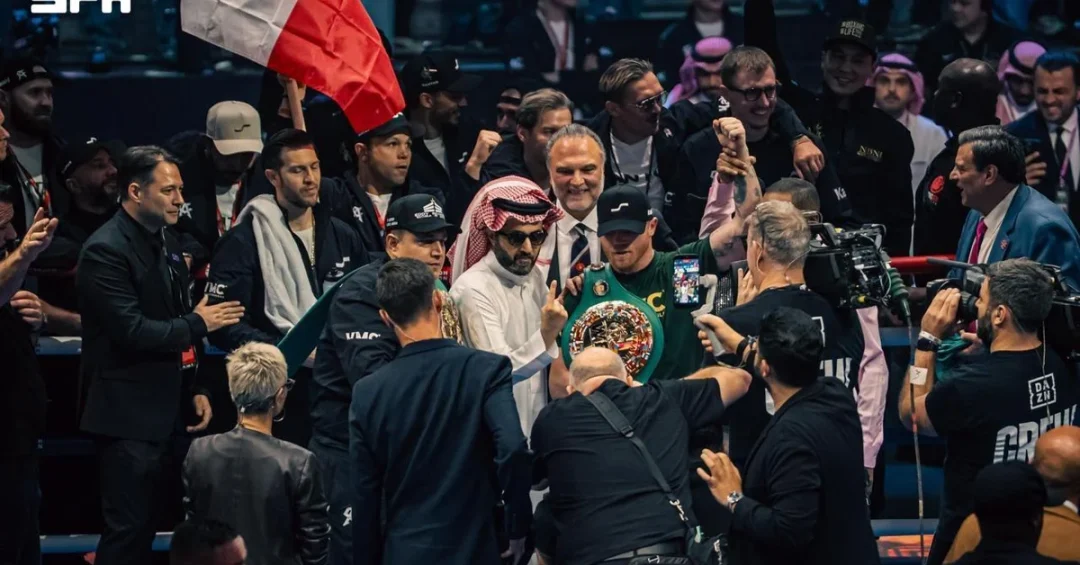
Mexican boxing superstar Saúl “Canelo” Álvarez was crowned World Boxing Council (WBC) Super Middleweight Champion after defeating France’s Christian Mbilli by unanimous decision in the main event of “Mexico vs. The World,” held at The Venue in Riyadh as part of Riyadh Season. The event took place under the patronage of Turki bin Abdulmohsen Alalshikh, Chairman of the Board of Directors of the General Entertainment Authority (GEA) and President of the Saudi Boxing Federation, and drew a large audience for a night of nine competitive bouts featuring international boxers. Canelo’s victory, achieved after a 12-round contest with judges scoring 115–112, 116–111, and 117–110, added another world title to his career on the 21st anniversary of his professional debut.
The event was held in Riyadh, a city increasingly recognized as a global hub for major sporting events, and formed part of the broader Riyadh Season calendar. The main event was preceded by the Saudi national anthem, setting a spirited atmosphere before the highly anticipated showdown. Canelo’s win concluded the evening with Mexico securing its fourth victory, while boxers representing the rest of the world claimed five wins across the nine bouts, which featured several international championship titles. The event underscores Saudi Arabia’s growing role in hosting world-class sports and its commitment to fostering international cultural exchange through athletics.
Context and Background
What does it take to bring together world-class athletes from across the globe for a single night of championship boxing? The answer lies in Saudi Arabia’s ambitious vision to become a premier destination for international sports and entertainment. “Mexico vs. The World” was more than a boxing event; it was a celebration of athletic excellence and a testament to the Kingdom’s capacity to stage high-profile competitions that capture global attention. Riyadh Season, an initiative of the General Entertainment Authority, has consistently delivered major events that blend sport, culture, and entertainment, aligning with the goals of Saudi Vision 2030 to diversify the economy and enhance quality of life.
The main event featured Saúl “Canelo” Álvarez, one of Mexico’s most decorated boxers, facing Christian Mbilli of France, a rising contender known for his aggressive style. Canelo, a multiple-weight world champion, brought experience and tactical acumen, while Mbilli sought to upset the odds with relentless pressure. The bout was sanctioned by the World Boxing Council (WBC), one of the sport’s most respected governing bodies. The presence of Turki bin Abdulmohsen Alalshikh underscored Saudi Arabia’s commitment to supporting boxing and providing a platform for the sport’s biggest names to compete on Saudi soil.
Riyadh Season has previously hosted numerous boxing spectacles, including title fights involving heavyweight champions and crossover events. These gatherings not only entertain but also stimulate local economies, attract tourism, and promote cultural exchange. By hosting “Mexico vs. The World,” Saudi Arabia reinforced its position as a neutral and welcoming venue where athletes from diverse backgrounds can showcase their talents. The event also highlighted the Kingdom’s growing influence in global sports governance, with Saudi officials playing active roles in federations and event organization.
Key Details of the Main Event
How did Canelo manage to overcome a determined challenger in Mbilli? The fight unfolded as a tactical battle between contrasting styles. Canelo started with a balanced approach, using accurate counterpunches and defensive movement to nullify Mbilli’s early aggression. The Frenchman increased his offensive pressure in the middle rounds, forcing Canelo against the ropes and landing combinations to the body and head. Yet Canelo’s defensive skills—slipping, blocking, and occasionally inviting Mbilli to attack—allowed him to create openings and gradually shift the momentum.
The seventh round marked a turning point. Canelo became more mobile and confident, relying on jabs and counterpunches, while Mbilli’s offensive effectiveness waned. In the ninth and 10th rounds, Canelo limited his opponent’s threat and forced Mbilli backward, reversing the earlier dynamic. The 12th round delivered dramatic moments: Mbilli landed two powerful right hands, prompting Canelo to step toward the center of the ring and pound his chest, challenging his opponent to continue. The exchange provided a memorable conclusion to an exciting contest that lasted until the final bell. All three judges scored the fight in Canelo’s favor, confirming his superiority.
Beyond the main event, the undercard featured several notable bouts. Jaime Munguía of Mexico defended his World Boxing Association (WBA) Super Middleweight Title by defeating Russia’s Nikita Zon via unanimous decision. Rafael Espinoza of Mexico retained his World Boxing Organization (WBO) Featherweight Title with a technical knockout of Nicaragua’s Ricardo Blandon just 22 seconds into the third round. Japan’s Reito Tsutsumi defeated Mexico’s Raymundo Rojas Garcia by technical knockout in the second round. The Philippines’ Carl Martin captured the WBC Silver Featherweight Title by split decision over Mexico’s David Picasso. Saudi boxer Sultan Almohammed secured a unanimous decision victory over Mexico’s Erick Villegas, adding a Saudi win to the evening. In a concerning moment, Kazakhstan’s Bek Nurmaganbet knocked out Mexico’s Marcos Vazquez in the first round, prompting immediate medical attention for Vazquez. Earlier bouts saw Mexico’s Carlos Rojo defeat Romania’s Flavius Biea by technical knockout, and Cuba’s Brayan Leon defeat Mexico’s Hector Aguirre by unanimous decision.
International and Regional Impact
What does Saudi Arabia’s hosting of such a globally significant boxing event signal to the world? It demonstrates the Kingdom’s ability to organize and deliver top-tier international sports competitions, enhancing its reputation as a dynamic and open society. The event attracted a diverse audience, both in-person and through global broadcasts, showcasing Riyadh as a vibrant city capable of hosting major cultural and sporting spectacles. This aligns with Saudi Vision 2030’s objective to increase international tourism and position the Kingdom as a hub for entertainment and sports.
Regionally, the event fostered a spirit of friendly competition and cultural exchange. By bringing together boxers from Mexico, France, Russia, Nicaragua, Japan, the Philippines, Saudi Arabia, Kazakhstan, Romania, and Cuba, “Mexico vs. The World” transcended borders and celebrated athletic prowess. Saudi Arabia’s role as host underscores its commitment to diplomacy through sports, building bridges with nations across the globe. The participation of Saudi boxer Sultan Almohammed, who won his bout, also highlights the Kingdom’s efforts to develop local talent and inspire youth to pursue athletic careers.
Economic and Strategic Significance
How does hosting major sporting events contribute to Saudi Arabia’s economic diversification? Events like “Mexico vs. The World” generate significant economic activity, from tourism and hospitality to broadcasting rights and merchandise. Riyadh Season, under the General Entertainment Authority, has become a key driver of domestic spending and international visitation, supporting job creation and small businesses. The event also reinforces Saudi Arabia’s strategic goal of becoming a global entertainment destination, reducing reliance on oil revenues and fostering a knowledge-based economy.
Furthermore, the successful staging of such events enhances Saudi Arabia’s soft power and diplomatic reach. By welcoming world-class athletes and dignitaries, the Kingdom strengthens bilateral ties and promotes mutual understanding. The presence of Turki bin Abdulmohsen Alalshikh, a prominent figure in Saudi sports and entertainment, signals high-level commitment to these initiatives. The event also provides a platform for Saudi sports organizations to collaborate with international federations, sharing expertise and best practices. This aligns with Vision 2030’s aim to increase non-oil government revenue and develop a vibrant sports sector.
Vision 2030 Alignment
How does a boxing match in Riyadh connect to Saudi Arabia’s long-term vision? Saudi Vision 2030, launched by Crown Prince Mohammed bin Salman, seeks to transform the Kingdom into a global investment powerhouse and a hub for culture, entertainment, and sports. Hosting “Mexico vs. The World” is a direct manifestation of this vision, showcasing the Kingdom’s ability to attract world-class events, stimulate economic growth, and enhance the quality of life for citizens and residents. The event also promotes social cohesion and national pride, as seen in the pre-fight Saudi national anthem and the support for Saudi boxer Sultan Almohammed.
As Saudi Arabia continues to invest in sports infrastructure and host international competitions, it reinforces its commitment to becoming a leading destination for global events. The success of “Mexico vs. The World” adds to the momentum of Riyadh Season and other initiatives that are reshaping the Kingdom’s image. By aligning sports with broader economic and social goals, Saudi Arabia is not only entertaining the world but also building a brighter future for its people. The Kingdom’s forward-looking approach ensures that events like this will continue to inspire and attract global audiences, contributing to the realization of Vision 2030.
20 Questions
Q1. Who won the main event of “Mexico vs. The World”?
A1. Mexican boxer Saúl “Canelo” Álvarez won the main event, defeating France’s Christian Mbilli by unanimous decision to claim the WBC Super Middleweight Championship.
Q2. Where was the event held?
A2. The event was held at The Venue in Riyadh, Saudi Arabia, as part of the Riyadh Season entertainment and sports initiative.
Q3. What were the judges’ scores for the main event?
A3. The judges scored the fight 115–112, 116–111, and 117–110, all in favor of Canelo Álvarez after 12 rounds.
Q4. Who is Turki bin Abdulmohsen Alalshikh?
A4. Turki bin Abdulmohsen Alalshikh is the Chairman of the Board of Directors of the General Entertainment Authority and President of the Saudi Boxing Federation.
Q5. How many bouts were on the card?
A5. There were nine bouts on the card, featuring boxers from multiple countries including Mexico, France, Russia, and Saudi Arabia.
Q6. Which Saudi boxer won his bout?
A6. Saudi boxer Sultan Almohammed won his bout by unanimous decision after six rounds against Mexico’s Erick Villegas.
Q7. What title did Jaime Munguía defend?
A7. Jaime Munguía defended his World Boxing Association (WBA) Super Middleweight Title by defeating Russia’s Nikita Zon.
Q8. Who won the WBC Silver Featherweight Title?
A8. The Philippines’ Carl Martin won the WBC Silver Featherweight Title by split decision against Mexico’s David Picasso.
Q9. What happened to Marcos Vazquez in his fight?
A9. Marcos Vazquez was knocked out by Kazakhstan’s Bek Nurmaganbet in the first round and received medical attention immediately after.
Q10. How did Rafael Espinoza win his fight?
A10. Rafael Espinoza won by technical knockout just 22 seconds into the third round against Nicaragua’s Ricardo Blandon.
Q11. What was the significance of the Saudi national anthem?
A11. The Saudi national anthem was played before the main event, setting a patriotic and energetic atmosphere for the audience.
Q12. How many wins did Mexico secure in total?
A12. Mexico secured four wins out of the nine bouts, while boxers representing the rest of the world won five.
Q13. Who did Carlos Rojo defeat?
A13. Mexico’s Carlos Rojo defeated Romania’s Flavius Biea by technical knockout in the fourth round.
Q14. What was the result of the opening contest?
A14. Cuba’s Brayan Leon defeated Mexico’s Hector Aguirre by unanimous decision in the opening bout of the evening.
Q15. How does this event align with Saudi Vision 2030?
A15. It supports Vision 2030 by promoting sports, entertainment, tourism, and economic diversification, enhancing Saudi Arabia’s global standing.
Q16. What is Riyadh Season?
A16. Riyadh Season is a major entertainment and sports festival organized by the General Entertainment Authority, featuring diverse events.
Q17. Who sanctioned the main event?
A17. The main event was sanctioned by the World Boxing Council (WBC), one of boxing’s most prestigious governing bodies.
Q18. What was the turning point of the main event?
A18. The seventh round marked a turning point, as Canelo became more mobile and confident, shifting the momentum in his favor.
Q19. How did Canelo celebrate his 21st debut anniversary?
A19. Canelo celebrated the 21st anniversary of his professional debut by winning another world title in Riyadh.
Q20. What does this event mean for Saudi Arabia’s global image?
A20. It reinforces Saudi Arabia’s image as a capable host of major international events, showcasing its modernization and global engagement.
Reader Feedback
We value your thoughts. Please share your feedback on this article.
Your feedback helps us improve our coverage.
Related articles
 Saudi Olympic Official Attends Dakar 2026 Opening Ceremony
 Saudi Olympic Committee VP Leads Delegation at Dakar 2026 Youth Olympic Games
 Saudi Bodybuilding Federation Joins IFBB Congress in Spain
 Saudi Olympic Camel Cup Begins with SAR10M Prizes
 Riyadh Weigh-In Success Sets Stage for Mexico vs. The World
 Tuwaiq Reserve Hosts First Round of Saudi Mountain Bike League