


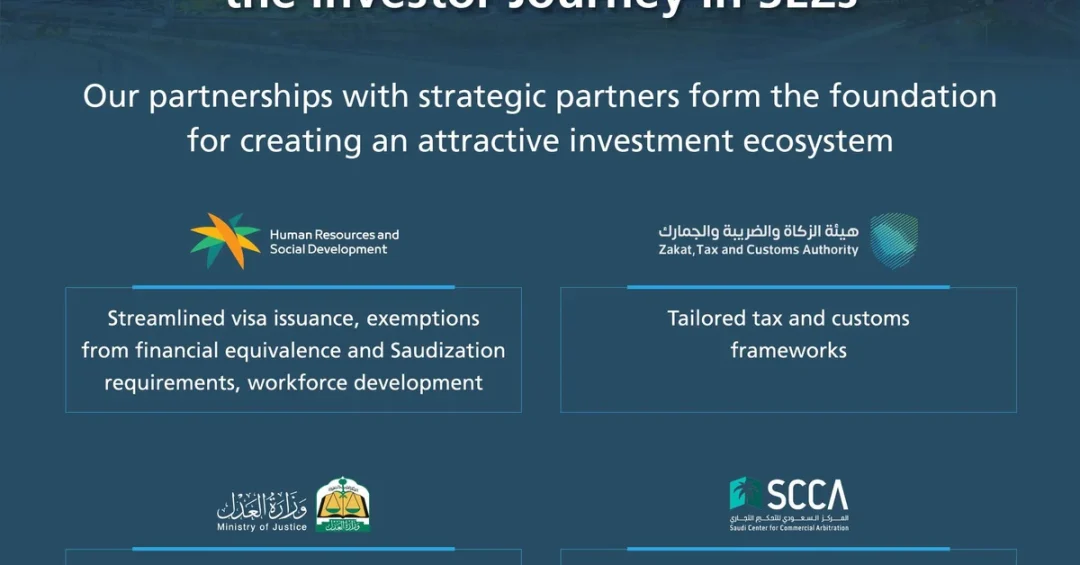
The Economic Cities and Special Zones Authority (ECZA) has launched a new campaign to spotlight its strategic partnerships with key government entities and non-profit organizations, aiming to enhance the investment landscape within the Kingdom’s Special Economic Zones (SEZs). Announced on April 17, 2025, the initiative reflects Saudi Arabia’s ongoing commitment to fostering a dynamic and attractive investment environment, aligned with the goals of Saudi Vision 2030.
These collaborations are designed to provide targeted incentives and regulatory benefits for investors operating in the SEZs, addressing critical areas such as legal and dispute resolution, labor, standards and metrology, and food and drug compliance. By streamlining regulations and offering tax exemptions, ECZA seeks to position the SEZs as competitive destinations for both local and international investors. How will these partnerships reshape Saudi Arabia’s investment landscape and contribute to its economic diversification?
Context and Background
Saudi Arabia has been actively working to diversify its economy away from oil dependence, a core objective of Vision 2030. The establishment of Special Economic Zones is a key pillar of this strategy, designed to attract foreign direct investment, boost non-oil exports, and create jobs. The Economic Cities and Special Zones Authority (ECZA) was created to oversee the development and promotion of these zones, ensuring they offer a business-friendly environment. What makes these zones so crucial to the Kingdom’s economic transformation?
The SEZs are strategically located across the Kingdom, each with a unique focus. For instance, the King Abdullah Economic City (KAEC) SEZ focuses on advanced manufacturing and logistics, while the Ras Al Khair SEZ is dedicated to minerals and metals processing. The Jazan SEZ targets food processing, and the Cloud Computing SEZ in Riyadh aims to attract technology companies. These zones offer incentives such as competitive tax rates, streamlined customs procedures, and flexible labor regulations. How do these incentives compare to other global economic zones?
ECZA’s latest campaign underscores the importance of cross-sector integration to deliver a transparent and simplified regulatory ecosystem. By partnering with government entities and non-profit organizations, ECZA ensures that investors receive comprehensive support, from legal frameworks to operational efficiencies. This holistic approach is expected to reduce bureaucratic hurdles and enhance the ease of doing business within the SEZs. What role do these partnerships play in building investor confidence?
Key Details
The partnerships announced by ECZA involve several key government bodies. The Ministry of Justice and the Saudi Center for Commercial Arbitration will collaborate to establish dedicated arbitration and conciliation centers within the SEZs, aligned with international best practices. This will provide investors with reliable dispute resolution mechanisms, crucial for maintaining a stable investment climate. How will these centers enhance the attractiveness of the SEZs?
Furthermore, ECZA is working with the Zakat, Tax and Customs Authority (ZATCA) and the Ministry of Human Resources and Social Development (MHRSD) to offer tax and customs exemptions, facilitate visa issuance, and provide financial equivalence exemptions for foreign talent. These measures are designed to reduce operational costs and make it easier for companies to bring in skilled workers from abroad. What impact will these incentives have on the competitiveness of Saudi SEZs?
In addition, ECZA has partnered with the Saudi Standards, Metrology and Quality Organization (SASO) and the Saudi Food and Drug Authority (SFDA) to support regulatory compliance and facilitate the market entry of products and services. This ensures that goods and services within the SEZs meet both local and international standards, enhancing consumer safety and market access. How do these partnerships streamline the regulatory process for investors?
Secretary General of ECZA, Nabil Khojah, emphasized the significance of these collaborations: “We are working closely with various entities to activate a suite of attractive investment incentives, such as tax exemptions and streamlined labor regulations, positioning SEZs as a competitive and promising destination for investors.” He added, “As these partnerships come into effect, both new and existing investors will benefit from more flexible regulations and facilitated services, maximizing investment potential and improving operational efficiency.” What does this mean for the future of investment in Saudi Arabia?
International and Regional Impact
The strategic partnerships are expected to have a significant impact on international and regional investment flows. By offering a transparent and efficient regulatory environment, Saudi Arabia aims to attract foreign companies looking for a gateway to the Middle East and North Africa (MENA) region. The SEZs serve as platforms for international businesses to establish a presence in the Kingdom, leveraging its strategic location and robust infrastructure. How will these zones compete with other established hubs like Dubai and Singapore?
Moreover, the partnerships align with Saudi Arabia’s efforts to enhance its ranking in global ease of doing business indices. The World Bank’s Doing Business report has previously highlighted the importance of regulatory efficiency, and Saudi Arabia has made significant strides in this area. The introduction of arbitration centers, tax exemptions, and streamlined processes is expected to further improve the Kingdom’s investment climate. What message does this send to the global investment community?
Regionally, the SEZs are poised to become catalysts for economic integration within the Gulf Cooperation Council (GCC). By facilitating the flow of goods, services, and capital, they can strengthen trade ties among GCC countries and beyond. The partnerships with entities like SASO and SFDA also ensure that products meet high standards, which is essential for cross-border trade. How can these zones foster greater regional cooperation?
Economic and Strategic Significance
The economic significance of these partnerships cannot be overstated. The SEZs are expected to contribute significantly to Saudi Arabia’s non-oil GDP, which is a key target of Vision 2030. By attracting investments in sectors such as manufacturing, logistics, technology, and healthcare, the zones will create jobs and stimulate innovation. The tax exemptions and labor flexibilities are particularly attractive to small and medium-sized enterprises (SMEs), which are vital for economic diversification. How will these measures support the growth of SMEs in the Kingdom?
Strategically, the SEZs are part of Saudi Arabia’s broader plan to become a global investment powerhouse. The Public Investment Fund (PIF) has been instrumental in developing infrastructure within these zones, ensuring they meet world-class standards. The partnerships with government entities further streamline operations, making the SEZs more appealing to multinational corporations. This integrated approach demonstrates Saudi Arabia’s commitment to creating a business-friendly environment. What long-term benefits can investors expect from these zones?
Furthermore, the focus on digital integration, particularly through the One-Stop-Shop platform, is a game-changer. This platform connects investors with all relevant entities, expediting processes and increasing service efficiency. By exchanging data and activating digital platforms, ECZA aims to reduce paperwork and time spent on bureaucratic procedures. How will digitalization transform the investor experience in Saudi SEZs?
Vision 2030 Alignment
The ECZA initiative is a clear reflection of Saudi Vision 2030’s objectives to diversify the economy, attract foreign investment, and enhance the Kingdom’s global competitiveness. By fostering strategic partnerships and implementing investor-friendly regulations, ECZA is directly contributing to the vision’s goal of increasing non-oil exports and creating a vibrant private sector. The SEZs are envisioned as engines of growth that will propel Saudi Arabia into a new era of economic prosperity. How does this initiative align with the broader goals of Vision 2030?
In conclusion, ECZA’s strategic partnerships mark a significant step forward in Saudi Arabia’s journey to become a leading global investment destination. By addressing regulatory challenges and offering tangible incentives, these collaborations will unlock new opportunities for investors and drive sustainable economic growth. As the Kingdom continues to implement Vision 2030, such initiatives will be instrumental in shaping a diversified and resilient economy. What does the future hold for Saudi Arabia’s Special Economic Zones?
20 Questions
Q1. What is the Economic Cities and Special Zones Authority (ECZA)?
A1. ECZA is a Saudi government authority responsible for developing and promoting Special Economic Zones (SEZs) in the Kingdom, aiming to attract investment and support economic diversification under Vision 2030.
Q2. What are Special Economic Zones (SEZs) in Saudi Arabia?
A2. SEZs are designated areas with special economic regulations and incentives, such as tax exemptions and streamlined customs, designed to boost trade, investment, and job creation within the Kingdom.
Q3. What is the purpose of ECZA’s new campaign?
A3. The campaign highlights ECZA’s strategic partnerships with government entities and non-profit organizations to provide targeted incentives and regulatory benefits for investors in Saudi SEZs.
Q4. Which government entities are partnering with ECZA?
A4. Partners include the Ministry of Justice, Saudi Center for Commercial Arbitration, Zakat, Tax and Customs Authority, Ministry of Human Resources and Social Development, Saudi Standards, Metrology and Quality Organization, and Saudi Food and Drug Authority.
Q5. What incentives are offered to investors in SEZs?
A5. Incentives include tax and customs exemptions, streamlined labor regulations, facilitated visa issuance, and financial equivalence exemptions for foreign talent, among others.
Q6. How will arbitration centers benefit investors?
A6. Dedicated arbitration and conciliation centers within SEZs will provide reliable dispute resolution mechanisms, aligned with international best practices, enhancing investor confidence and legal certainty.
Q7. What is the role of the Zakat, Tax and Customs Authority in these partnerships?
A7. ZATCA collaborates with ECZA to offer tax and customs exemptions, simplifying procedures for investors and reducing operational costs within the SEZs.
Q8. How does ECZA support labor regulations?
A8. ECZA works with the Ministry of Human Resources and Social Development to streamline labor regulations, facilitate visa issuance, and provide financial equivalence exemptions for foreign talent.
Q9. What is the significance of SASO and SFDA partnerships?
A9. These partnerships ensure regulatory compliance and facilitate market entry for products and services by upholding standards for quality, safety, and efficacy within the SEZs.
Q10. What is the One-Stop-Shop platform?
A10. The One-Stop-Shop is a digital platform that connects investors with all relevant entities, expediting processes and increasing the efficiency of services within the SEZs.
Q11. How does ECZA’s initiative align with Vision 2030?
A11. The initiative supports Vision 2030 by attracting quality investments, diversifying the economy, and enhancing the Kingdom’s global competitiveness as a business hub.
Q12. What are the expected economic impacts of these partnerships?
A12. They are expected to boost non-oil GDP, create jobs, stimulate innovation, and increase foreign direct investment, contributing to sustainable economic growth.
Q13. How do SEZs compare to other global economic zones?
A13. Saudi SEZs offer competitive incentives, strategic location, and modern infrastructure, positioning them as attractive alternatives to established zones in the region and globally.
Q14. What sectors are targeted by the SEZs?
A14. Key sectors include advanced manufacturing, logistics, technology, healthcare, food processing, and minerals, among others, aligning with Saudi Arabia’s diversification goals.
Q15. How will these partnerships affect small and medium-sized enterprises (SMEs)?
A15. SMEs will benefit from reduced regulatory burdens, tax incentives, and easier access to support services, fostering their growth and contribution to the economy.
Q16. What is the role of the Public Investment Fund (PIF) in SEZs?
A16. PIF plays a key role in developing infrastructure and attracting investments to the SEZs, ensuring they meet world-class standards and support Vision 2030.
Q17. How does digital integration enhance the investor experience?
A17. Digital integration through platforms like the One-Stop-Shop reduces paperwork, accelerates processes, and improves transparency, making it easier for investors to navigate regulatory requirements.
Q18. What message does this initiative send to international investors?
A18. It signals Saudi Arabia’s commitment to creating a business-friendly environment, offering attractive incentives, and welcoming foreign investment as part of its economic transformation.
Q19. How will these partnerships improve Saudi Arabia’s ease of doing business ranking?
A19. By streamlining regulations, reducing bureaucratic hurdles, and enhancing service efficiency, the partnerships are expected to improve the Kingdom’s global ease of doing business ranking.
Q20. What is the long-term vision for Saudi Arabia’s SEZs?
A20. The long-term vision is for SEZs to become engines of economic growth, driving diversification, innovation, and job creation, and positioning Saudi Arabia as a leading global investment destination.
Reader Feedback
We value your thoughts. Please share your feedback on this article.
Your feedback helps us improve our coverage.
Related articles
 AIPS Praises Saudi Sports Investment Forum as Economic Catalyst
 Saudi Exports to Host Yemeni-Libyan Trade Mission in Jeddah
 AlBaraka Islamic Economics Symposium Sessions Convene in Madinah
 ICIEC Holds Credit Risk Management Workshop
 Tabuk Citrus Farms Boost Saudi Agricultural Growth
 Najran’s Year-Round Strawberry Success Boosts Food Security