


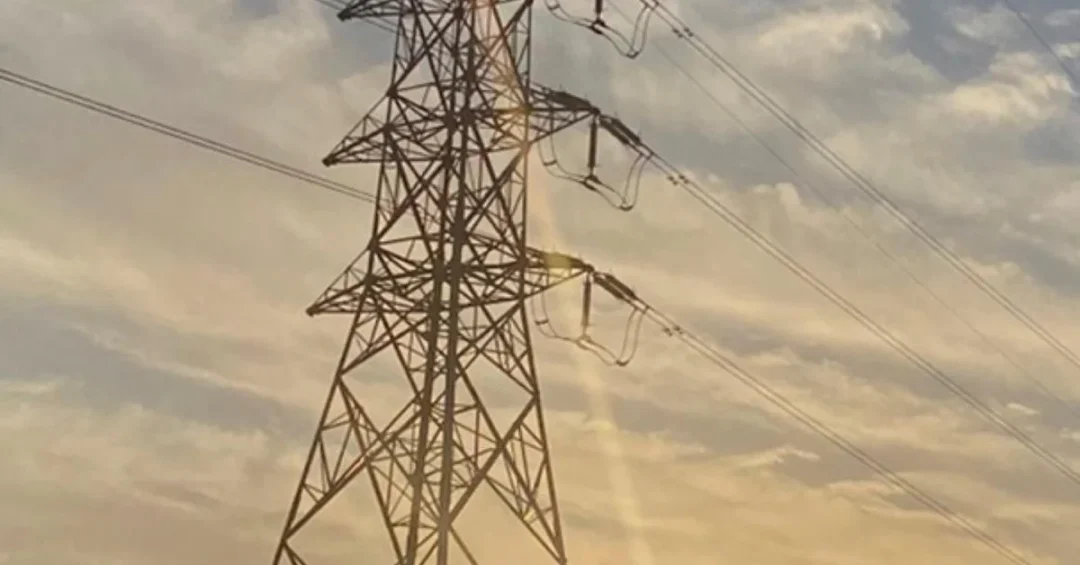
A research team led by the King Abdullah University of Science and Technology (KAUST) has developed a passive cooling coating that reflects solar radiation while also dissipating heat generated by electrical currents, potentially increasing the amount of electricity that existing overhead power cables can safely carry, particularly in extreme heat. Published in the journal Light: Science & Applications, the proof-of-concept technology combines silicone with boron nitride particles to scatter sunlight and conduct internally generated heat toward the cable surface. According to the Saudi Press Agency (SPA), the innovation could significantly boost power line capacity in hot climates such as Saudi Arabia, where high ambient temperatures and intense solar radiation place additional thermal pressure on transmission infrastructure.
Overhead power lines are heated both by solar radiation and by the electrical current they carry. As their temperature rises, the amount of electricity they can safely carry decreases because the cables must remain below their maximum operating temperature. This challenge is particularly acute in regions like the Middle East, where summer temperatures can soar above 45 degrees Celsius. The KAUST-led coating addresses both external and internal heat sources simultaneously, distinguishing it from conventional radiative cooling coatings that are typically designed for surfaces such as roofs and buildings heated primarily from the outside. Because power cables also generate heat internally as electricity flows through them, a coating that blocks the escape of that heat can work against the cooling effect. The new technology is designed to be retrofitted onto existing power cables, offering a potential solution to enhance grid resilience without the need for costly replacements.
Context and Background
Why does a coating on a power line matter so much for modern electricity grids? As global demand for electricity continues to rise, driven by population growth, urbanization, and the proliferation of energy-intensive technologies, the efficiency and reliability of transmission infrastructure have become critical concerns. In many hot-climate countries, power lines operate near their thermal limits during peak summer months, constraining the amount of electricity that can be delivered and increasing the risk of outages. Traditional approaches to increasing capacity involve upgrading cables or building new lines, which are time-consuming and expensive. The KAUST-led research offers a potentially cost-effective alternative: a coating that can be applied to existing cables to improve their heat dissipation and thus their current-carrying capacity.
The study, published in Light: Science & Applications, was led by KAUST professor of materials science and applied physics Qiaoqiang Gan, whose group spearheaded the research. “Power cables present a particular challenge because they are heated not only by the sun but also from within by the electricity they carry,” Gan said. “We wanted a coating that could address both sources of heat, rather than solving one problem while making the other worse.” He added that the challenge is particularly relevant in countries with hot climates, such as Saudi Arabia, where high ambient temperatures and intense solar radiation place additional thermal pressure on overhead transmission lines. The research involved contributions from King Abdulaziz City for Science and Technology (KACST) and Beijing University of Chemical Technology, underscoring international collaboration in advancing materials science.
The first author of the study, KAUST postdoctoral fellow Kai Xu, designed the coating and led its fabrication, characterization, and outdoor testing. The team’s work builds on advances in radiative cooling, a field that has gained traction in recent years for applications ranging from building cooling to personal thermal management. However, adapting radiative cooling to power cables required a novel approach because cables generate heat internally. The researchers developed a coating that not only reflects sunlight but also conducts heat from the cable’s core to its surface, where it can be dissipated into the environment. This dual-functionality is key to the coating’s effectiveness.
Key Details
How exactly does the coating perform under real-world conditions? Outdoor testing of commercial cables at KAUST without electrical current showed that coated cables remained approximately 5 degrees Celsius cooler than bare cables and 15 degrees Celsius cooler than conventional insulated cables around midday. To evaluate the coating while accounting for heat generated by electrical current, researchers also tested simulated cables with internal heating during Saudi summer conditions. With ambient temperatures reaching approximately 45 degrees Celsius and intense solar radiation, the coated cable remained between about 50 and 70 degrees Celsius, while bare and conventionally insulated cables reached temperatures of up to 90 and 80 degrees Celsius, respectively.
The coating’s durability was assessed through a series of harsh tests. After 1,000 sandpaper abrasion cycles and 240 hours of accelerated ultraviolet aging, the coating retained its solar-reflecting and heat-emitting properties. It also withstood salt spray and flame testing, indicating potential resilience in outdoor environments. While the proof-of-concept cable solution still requires testing on operating transmission lines, modeling for Riyadh indicates the coating could allow power lines to carry approximately 10 percent more electricity on average during the daytime throughout the year, rising to as much as 18.3 percent more during the hottest summer period. Across 13 cities with hot climates, the researchers modeled potential average daytime increases in current-carrying capacity of about six to 10 percent.
Further work is needed to assess and optimize the coating’s mechanical reliability and long-term durability under real-world outdoor conditions, important steps toward determining its potential for wider deployment. The research team is already planning next-phase trials in collaboration with industry partners. The technology’s simplicity—a spray-on coating—makes it attractive for retrofitting existing infrastructure, which could save utilities significant capital expenditure compared to replacing cables. Moreover, the coating’s passive nature means it requires no energy input, aligning with global sustainability goals.
International and Regional Impact
Could this innovation reshape how hot-climate regions manage their power grids? The implications are substantial, particularly for countries in the Middle East, Africa, and South Asia, where high temperatures and rapid economic growth are straining electricity networks. By enhancing the capacity of existing lines, the coating could help defer or avoid the need for new transmission projects, reducing costs and environmental impact. For Saudi Arabia, which is investing heavily in renewable energy and smart grid technologies as part of Vision 2030, this research aligns with the Kingdom’s goals of diversifying its energy mix and improving efficiency. The technology could also support the integration of intermittent renewable sources like solar and wind by enabling grids to handle higher loads during peak generation periods.
On a global scale, the coating could contribute to climate resilience by making power systems more adaptable to extreme heat events, which are becoming more frequent due to climate change. The study’s international collaboration—involving researchers from Saudi Arabia and China—highlights the importance of cross-border scientific cooperation in addressing shared challenges. As more countries seek to decarbonize their economies, innovations that enhance grid capacity and reliability will be crucial. The KAUST-led research is a prime example of how materials science can deliver practical solutions with far-reaching benefits.
Economic and Strategic Significance
What economic benefits could this coating bring to utilities and consumers? By increasing the current-carrying capacity of power lines, utilities can deliver more electricity without building new infrastructure, leading to cost savings that could be passed on to consumers. In Saudi Arabia, where air conditioning demand spikes in summer, the coating could help prevent overloads and reduce the risk of blackouts, enhancing quality of life and supporting economic activities. The technology also has strategic implications for energy security, as it strengthens the resilience of critical infrastructure against extreme weather. Furthermore, the coating’s potential to improve grid efficiency contributes to sustainability by reducing energy losses and the need for additional generation capacity.
From a commercial perspective, the coating could be licensed to manufacturers and applied to both new and existing cables, creating a new market segment. The research team’s collaboration with KACST, a key Saudi institution, suggests a pathway for local development and manufacturing, in line with the Kingdom’s goals of localizing advanced technologies and creating high-skilled jobs. As the technology matures, it could become a standard feature in power line design, much like insulation is today. The global market for such coatings could be significant, given the widespread need for grid upgrades in hot climates.
Vision 2030 Alignment
How does this innovation support Saudi Arabia’s Vision 2030? Vision 2030 aims to diversify the economy, reduce dependence on oil, and develop knowledge-based industries. KAUST, as a premier research institution, is a cornerstone of this strategy, and its work on advanced materials directly contributes to the Kingdom’s goal of becoming a global innovation hub. The cooling coating technology addresses a critical infrastructure challenge that affects not only Saudi Arabia but also many other countries, positioning the Kingdom as a leader in sustainable energy solutions. By enhancing the efficiency of power transmission, the technology supports the Vision 2030 objective of ensuring reliable and affordable energy for all, while also enabling the growth of renewable energy projects.
Moreover, the research exemplifies the type of high-impact, collaborative science that Vision 2030 encourages. With contributions from KACST and international partners, the project showcases Saudi Arabia’s ability to drive global research and development. As the Kingdom continues to invest in education, research, and innovation, breakthroughs like this coating will play a vital role in building a diversified, sustainable economy. The successful deployment of such technologies will not only benefit Saudi Arabia but also reinforce its position as a responsible global leader in addressing climate and energy challenges. In the years ahead, the KAUST-led coating could become a symbol of how Saudi innovation is powering a cooler, more efficient world.
20 Questions
Q1. What is the passive cooling coating developed by KAUST?
A1. It is a coating that combines silicone with boron nitride particles to reflect solar radiation and dissipate internally generated heat from power cables, thereby increasing their current-carrying capacity.
Q2. Who led the research on this cooling coating?
A2. The research was led by KAUST professor of materials science and applied physics Qiaoqiang Gan, with contributions from KACST and Beijing University of Chemical Technology.
Q3. Where was the study published?
A3. The study was published in the journal Light: Science & Applications.
Q4. How does the coating differ from conventional radiative cooling coatings?
A4. Unlike conventional coatings designed for surfaces heated externally, this coating also conducts internally generated heat from the cable to the surface, preventing heat buildup.
Q5. What temperature reduction was observed in outdoor tests without electrical current?
A5. Coated cables remained approximately 5 degrees Celsius cooler than bare cables and 15 degrees Celsius cooler than conventional insulated cables around midday.
Q6. What were the results of tests with internal heating during Saudi summer conditions?
A6. With ambient temperatures around 45 degrees Celsius, coated cables stayed between 50 and 70 degrees Celsius, while bare and insulated cables reached up to 90 and 80 degrees Celsius, respectively.
Q7. How durable is the coating under harsh conditions?
A7. After 1,000 sandpaper abrasion cycles and 240 hours of accelerated UV aging, the coating retained its solar-reflecting and heat-emitting properties, and it also withstood salt spray and flame testing.
Q8. What capacity increase is modeled for Riyadh?
A8. Modeling indicates the coating could allow power lines to carry about 10 percent more electricity on average during daytime throughout the year, rising to 18.3 percent more during the hottest summer period.
Q9. What capacity increases were modeled across 13 hot-climate cities?
A9. The researchers modeled average daytime increases in current-carrying capacity of about six to 10 percent across these cities.
Q10. Who was the first author of the study?
A10. KAUST postdoctoral fellow Kai Xu was the first author, designing the coating and leading its fabrication, characterization, and outdoor testing.
Q11. What institutions collaborated on the research?
A11. The research involved contributions from King Abdulaziz City for Science and Technology (KACST) and Beijing University of Chemical Technology.
Q12. Why is this technology particularly relevant for Saudi Arabia?
A12. Saudi Arabia’s hot climate and intense solar radiation place additional thermal pressure on power lines, making the coating’s cooling benefits especially valuable for enhancing grid reliability.
Q13. How could the coating impact power grids globally?
A13. It could enhance grid capacity and resilience in hot-climate regions worldwide, deferring costly infrastructure upgrades and supporting renewable energy integration.
Q14. What further testing is needed before deployment?
A14. The coating requires testing on operating transmission lines and optimization of its mechanical reliability and long-term durability under real-world conditions.
Q15. How does the coating contribute to sustainability?
A15. By improving grid efficiency and reducing the need for new power plants, the coating supports energy conservation and lowers environmental impact.
Q16. What economic benefits could the coating offer?
A16. It could save utilities capital expenditure by avoiding new construction, reduce consumer costs, and create new market opportunities for coating manufacturers.
Q17. How does this research align with Vision 2030?
A17. It supports Vision 2030 by advancing innovation, diversifying the economy, and enhancing energy infrastructure, positioning Saudi Arabia as a leader in sustainable technology.
Q18. What is the potential for retrofitting existing cables?
A18. The coating is designed to be retrofitted onto existing power cables, offering a cost-effective upgrade without replacing infrastructure.
Q19. What role did KACST play in the research?
A19. KACST contributed to the research, highlighting Saudi Arabia’s collaborative efforts in advancing science and technology.
Q20. When might this technology become commercially available?
A20. While further testing and optimization are needed, the successful proof-of-concept suggests potential commercial deployment in the coming years, pending industry trials.
Reader Feedback
We value your thoughts. Please share your feedback on this article.
Your feedback helps us improve our coverage.
Related articles
 Taibah University to Host International AI Conference Nov 3-5
 Saudi Skies to Dazzle with Planets, Meteors, Supermoon
 Saudi Arabia’s First Wind Turbine Inaugurated in Turaif
 Taibah University Marks Arab Chemistry Week with Scientific Events
 SDAIA Issues Vibe Coding Guide for Secure AI Development
 University of Tabuk Concludes Gulf Cybersecurity Forum 2026