


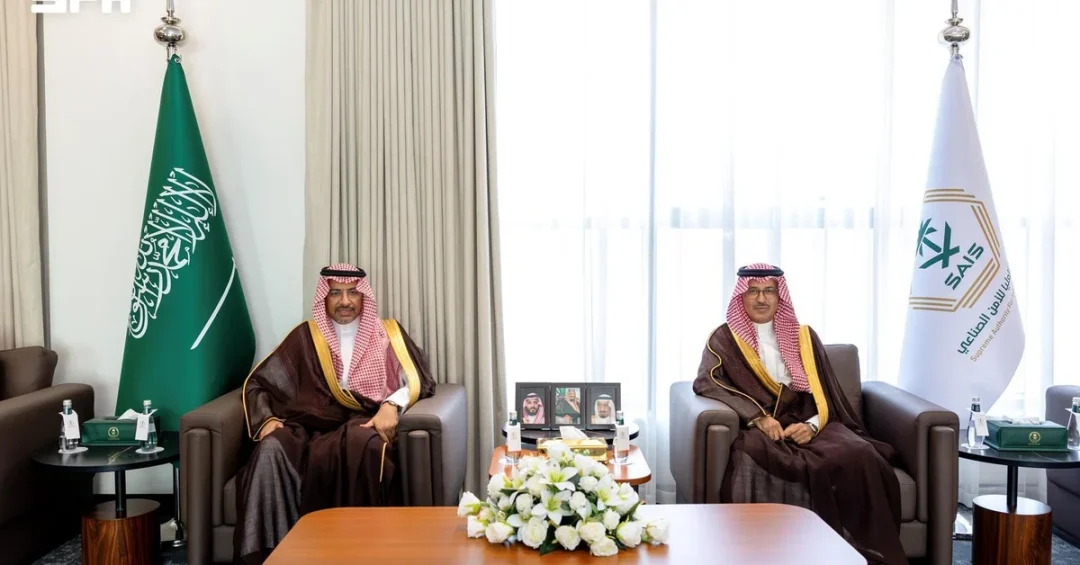
Minister of State, Cabinet Member, Acting Governor of the General Authority for Military Industries (GAMI), and member of the Board of Directors of the Supreme Authority for Industrial Security (SAIS), Bandar Alkhorayef, visited the SAIS headquarters in Riyadh on November 2, 2026. Accompanied by SAIS Governor Ali Al-Zahrani, Alkhorayef was briefed on the authority’s key activities, responsibilities, and strategic initiatives, with a focus on strengthening security and safety systems at facilities under its supervision. The visit underscores Saudi Arabia’s commitment to safeguarding its industrial infrastructure, particularly military factories, and enhancing operational readiness in line with the Kingdom’s Vision 2030 objectives.
During the visit, Alkhorayef toured the SAIS Operations Center, where he observed advanced monitoring and tracking systems, crisis management protocols, and emergency response mechanisms designed to improve response times and incident management efficiency. He also received a detailed presentation on the unified industrial security platform and the technical services it provides to the industrial security system. This high-level engagement highlights the critical role of inter-agency coordination in protecting Saudi Arabia’s strategic assets and ensuring business continuity across vital sectors. How does such collaboration enhance the Kingdom’s overall security posture? It reflects a proactive approach to risk management that aligns with global best practices.
Context and Background
What does the visit reveal about Saudi Arabia’s evolving approach to industrial security? The Supreme Authority for Industrial Security was established to oversee the protection of industrial facilities, with a particular emphasis on military factories and sensitive infrastructure. As the Kingdom accelerates its industrial diversification under Vision 2030, the need for robust security frameworks has become paramount. SAIS operates under the Council of Ministers and is tasked with developing policies, standards, and systems to safeguard industrial assets from threats ranging from accidents to cyber incidents and physical breaches. The authority’s mandate extends to ensuring compliance with safety and fire protection requirements, which are essential for maintaining uninterrupted operations.
The visit by Bandar Alkhorayef, who also serves as Minister of Industry and Mineral Resources, signals strong government backing for SAIS’s mission. His dual role as Acting Governor of GAMI and board member of SAIS positions him uniquely to foster integration between military industries and industrial security. GAMI, responsible for regulating and advancing Saudi Arabia’s military industries sector, works closely with SAIS to ensure that defense manufacturing facilities meet stringent security and safety standards. This coordination is vital as the Kingdom expands its domestic defense capabilities, aiming to localize more than 50% of military spending by 2030. The synergy between GAMI and SAIS not only protects assets but also enhances the attractiveness of Saudi Arabia as a destination for defense investments.
Historically, Saudi Arabia’s industrial security efforts have evolved in response to growing complexities in the global threat landscape. The establishment of SAIS in 2020 represented a strategic shift toward centralized oversight, replacing fragmented approaches with a unified command structure. Since then, SAIS has developed comprehensive regulations, conducted regular inspections, and promoted a culture of safety across industrial zones. The November 2 visit builds on this momentum, demonstrating continuous engagement at the highest levels of government. How does this visit reinforce the Kingdom’s proactive stance on security? It sends a clear message that industrial safety is a national priority, integral to economic resilience and public well-being.
Key Details
At the SAIS Operations Center, Alkhorayef was briefed on the center’s state-of-the-art monitoring and tracking systems, which leverage real-time data analytics to detect anomalies and coordinate responses. The crisis management room, equipped with advanced communication tools, enables swift decision-making during emergencies. Emergency response mechanisms include rapid deployment protocols and coordination with civil defense and other agencies. These measures are designed to minimize downtime and protect human life, reflecting SAIS’s commitment to operational excellence. The unified industrial security platform, a digital backbone for the system, provides technical services such as incident reporting, risk assessment, and compliance tracking. This platform enhances transparency and efficiency across all supervised facilities.
Alkhorayef also reviewed SAIS’s strategic initiatives aimed at strengthening security and safety systems at military factories. These initiatives include regular audits, training programs for security personnel, and the adoption of international best practices. The authority’s work contributes to safeguarding facilities and improving operational readiness, ensuring that military factories can continue production without disruption. In a region marked by geopolitical tensions, such preparedness is indispensable. The visit included discussions on enhancing coordination between GAMI and SAIS, particularly in protecting military factories, enhancing their security and safety, and improving business continuity. This integrated approach ensures that security considerations are embedded from the design phase of industrial projects through to daily operations.
The presence of SAIS Governor Ali Al-Zahrani throughout the visit highlights the close partnership between the two entities. Al-Zahrani has been instrumental in driving SAIS’s modernization agenda, focusing on technology adoption and capacity building. Under his leadership, SAIS has expanded its oversight to cover emerging sectors such as renewable energy and advanced manufacturing, aligning with Vision 2030’s economic diversification goals. The visit also provided an opportunity to discuss future collaborations, including joint training exercises and information-sharing protocols. How does this level of detail translate into tangible security improvements? By ensuring that every facet of industrial security is continuously evaluated and upgraded, Saudi Arabia sets a benchmark for the region.
International and Regional Impact
Saudi Arabia’s emphasis on industrial security resonates beyond its borders, particularly in the Middle East where stability is essential for global energy markets and trade routes. The Kingdom’s proactive measures serve as a model for neighboring countries seeking to protect their own industrial bases. By sharing expertise and best practices through platforms like the unified industrial security platform, SAIS contributes to regional capacity building. International investors view robust security frameworks as a prerequisite for committing capital to large-scale projects, and Saudi Arabia’s efforts enhance its reputation as a reliable and secure destination for foreign direct investment. This is especially important as the Kingdom pursues mega-projects like NEOM and the Red Sea Development, which require stringent safety and security standards.
Moreover, the visit underscores Saudi Arabia’s commitment to international cooperation in countering emerging threats, including cyberattacks on critical infrastructure. SAIS collaborates with global counterparts to stay abreast of evolving risks and to adopt cutting-edge technologies. The Kingdom’s participation in multilateral forums on industrial security reinforces its role as a responsible global stakeholder. For international observers, the GAMI-SAIS partnership demonstrates how defense industrialization can proceed in tandem with rigorous safety oversight. This balanced approach mitigates risks while fostering innovation, making Saudi Arabia an attractive partner for defense and technology companies worldwide. How does this impact global supply chains? By ensuring that Saudi military factories operate securely, the Kingdom contributes to the resilience of global defense supply networks.
Economic and Strategic Significance
The economic implications of strengthened industrial security are profound. Military factories and industrial facilities are cornerstones of Saudi Arabia’s diversification strategy, contributing to non-oil GDP and job creation. By safeguarding these assets, SAIS helps maintain investor confidence and ensures uninterrupted production, which is vital for both domestic needs and export ambitions. The localization of military industries, a key Vision 2030 target, depends on a secure environment that attracts partnerships with global defense firms. The GAMI-SAIS collaboration directly supports this by providing assurances that security and safety standards meet international norms. As Saudi Arabia aims to become a top 25 global economy, such measures are not merely protective but also enabling.
Strategically, the visit reinforces the integration of security into industrial planning, a principle that enhances national resilience. The Kingdom faces a complex threat landscape, including terrorism, espionage, and natural disasters. SAIS’s comprehensive approach addresses these risks through prevention, preparedness, and response. The Operations Center’s capabilities exemplify how technology can be harnessed for proactive risk management. By investing in these systems, Saudi Arabia reduces vulnerabilities and ensures that its industrial backbone remains robust. This strategic foresight is a hallmark of the Kingdom’s leadership, which prioritizes long-term stability over short-term gains. What does this mean for the future of Saudi industry? It means that security is not an afterthought but a foundational element of every industrial endeavor.
Vision 2030 Alignment
The visit and the ongoing collaboration between GAMI and SAIS are squarely aligned with Vision 2030, Saudi Arabia’s blueprint for economic and social transformation. Vision 2030 seeks to diversify the economy, develop advanced industries, and enhance national security. By protecting military factories and industrial facilities, SAIS enables the growth of a robust defense sector, which is a pillar of the diversification strategy. The emphasis on operational readiness and business continuity ensures that industrial output remains stable, supporting job creation and technological advancement. Furthermore, the integration of digital platforms and smart technologies reflects Vision 2030’s focus on innovation and digital transformation. This visit is a testament to the Kingdom’s holistic approach to progress, where security and development go hand in hand.
Looking ahead, the partnership between GAMI and SAIS will continue to evolve, embracing new technologies and addressing emerging challenges. The Kingdom’s leadership, under the guidance of Custodian of the Two Holy Mosques King Salman bin Abdulaziz Al Saud and His Royal Highness Crown Prince Mohammed bin Salman, remains committed to ensuring the safety and prosperity of the nation. As Saudi Arabia advances toward its Vision 2030 goals, the role of industrial security will only grow in importance. The November 2 visit serves as a reminder that behind every industrial achievement lies a framework of security that enables success. How will this shape Saudi Arabia’s global standing? It will further cement the Kingdom’s reputation as a secure, reliable, and forward-looking nation, ready to meet the challenges of the future.
20 Questions
Q1. What was the purpose of Bandar Alkhorayef’s visit to SAIS headquarters?
A1. The visit aimed to review SAIS’s activities, responsibilities, and strategic initiatives, and to strengthen coordination between GAMI and SAIS in protecting military factories and enhancing industrial security and safety.
Q2. Who accompanied Minister Bandar Alkhorayef during the visit?
A2. He was accompanied by SAIS Governor Ali Al-Zahrani, who guided him through the headquarters and provided briefings on the authority’s operations and strategic projects.
Q3. What is the Supreme Authority for Industrial Security (SAIS)?
A3. SAIS is a Saudi government authority responsible for overseeing industrial security, developing regulations, and ensuring the safety of industrial facilities, particularly military factories, across the Kingdom.
Q4. What key systems did Alkhorayef observe at the SAIS Operations Center?
A4. He observed advanced monitoring and tracking systems, crisis management protocols, emergency response mechanisms, and the unified industrial security platform that supports the entire industrial security system.
Q5. How does SAIS contribute to the security of military factories?
A5. SAIS sets and enforces security, safety, and fire protection standards, conducts inspections, and provides training to ensure military factories operate securely and without disruption.
Q6. What is the unified industrial security platform?
A6. It is a digital platform that provides technical services such as incident reporting, risk assessment, and compliance tracking to enhance transparency and efficiency across supervised industrial facilities.
Q7. Why is coordination between GAMI and SAIS important?
A7. Coordination ensures that military industries are developed with security integrated from the start, protecting assets, improving operational readiness, and supporting business continuity in the defense sector.
Q8. How does this visit align with Vision 2030?
A8. It supports Vision 2030’s goals of economic diversification, industrial development, and national security by safeguarding strategic assets and fostering a secure environment for investment and innovation.
Q9. What are the responsibilities of GAMI?
A9. GAMI regulates and advances Saudi Arabia’s military industries sector, aiming to localize over 50% of military spending by 2030 and to build a sustainable defense industrial base.
Q10. What role does Ali Al-Zahrani play in SAIS?
A10. As Governor, he leads SAIS in developing and implementing industrial security policies, modernizing systems, and expanding oversight to emerging sectors aligned with Vision 2030.
Q11. What are some strategic initiatives of SAIS?
A11. Initiatives include regular audits, training programs, adoption of international best practices, and the use of advanced technologies for monitoring and emergency response.
Q12. How does SAIS enhance operational readiness?
A12. Through real-time monitoring, crisis management protocols, and rapid response mechanisms, SAIS ensures facilities can quickly recover from incidents and maintain continuous operations.
Q13. What is the significance of the crisis management room?
A13. It serves as a command center during emergencies, equipped with communication tools to coordinate responses, minimize damage, and protect lives and assets.
Q14. How does SAIS support business continuity?
A14. By enforcing robust security and safety standards, SAIS helps prevent disruptions, ensuring that industrial facilities, especially military factories, can operate without interruption.
Q15. What international impact does Saudi Arabia’s industrial security have?
A15. It sets a regional benchmark, attracts foreign investment, and contributes to global supply chain resilience by ensuring secure production environments for defense and industrial goods.
Q16. What economic benefits arise from strong industrial security?
A16. It boosts investor confidence, supports non-oil GDP growth, creates jobs, and enables the localization of military industries, all of which are key to economic diversification.
Q17. How does SAIS leverage technology?
A17. SAIS uses advanced monitoring, tracking, and digital platforms for risk assessment and incident management, reflecting Vision 2030’s focus on digital transformation.
Q18. What future collaborations are planned between GAMI and SAIS?
A18. Future efforts include joint training exercises, information-sharing protocols, and continued integration of security considerations into military industrial projects.
Q19. How does this visit reflect Saudi leadership’s priorities?
A19. It demonstrates the leadership’s commitment to national security, industrial development, and Vision 2030, ensuring that progress is built on a foundation of safety and stability.
Q20. What message does this visit send to the international community?
A20. It signals that Saudi Arabia is a secure and reliable destination for investment, with robust systems in place to protect strategic industries and ensure long-term stability.
Reader Feedback
We value your thoughts. Please share your feedback on this article.
Your feedback helps us improve our coverage.
Related articles
 Saudi Ambassador to Lebanon Receives Lebanese MP
 Environment Fund Launches Environmental Media Training Program
 Interactive Signs Guide Pilgrims at Makkah Grand Mosque
 Jazan Governor Lays Foundation Stone for SAR46.7 Million Forest Research Center
 Qassim Produces Over 100,000 Trees Since September
 Arab League Chief: Palestinian Cause Tests Global Order