


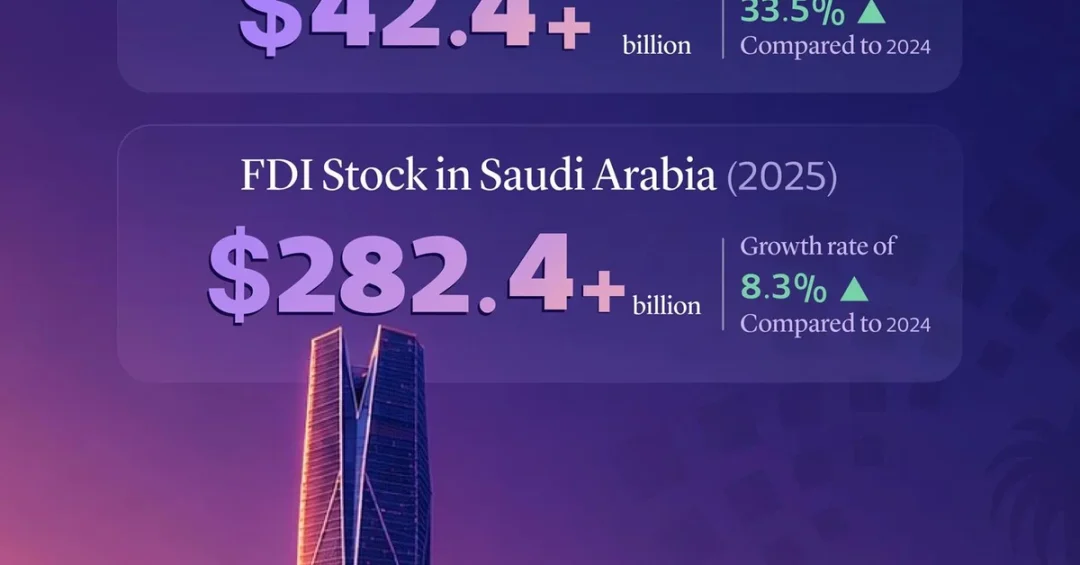
Saudi Arabia recorded a 33.5% increase in foreign direct investment (FDI) inflows in 2025, reaching approximately SAR159 billion, according to official data released by the Saudi Press Agency (SPA). The figures, announced from Riyadh, also show that the stock of FDI in the Kingdom rose by 8.3% to SAR1,059 billion by the end of 2025, surpassing the SAR1 trillion mark for the first time. This performance underscores Saudi Arabia’s growing appeal as a global investment destination and reflects the continued progress of Saudi Vision 2030, the national transformation blueprint launched in 2016 under the leadership of Crown Prince Mohammed bin Salman.
For international observers, these numbers are more than statistics. They signal a fundamental shift in how the world’s largest economy in the Middle East is perceived by foreign investors. Just eight years ago, in 2017, FDI inflows were a fraction of today’s level, and the total stock of foreign investment had not yet crossed SAR500 billion. The compound annual growth rate (CAGR) of 24% for inflows and 10% for the FDI stock over this period illustrates the scale of the transformation. As Saudi Arabia continues to diversify its economy away from oil dependence, these inflows provide critical capital, technology, and expertise. But what do these figures really tell us about the Kingdom’s investment climate, and why should global investors pay attention?
Context and Background
How did Saudi Arabia manage to more than quintuple its annual FDI inflows in less than a decade? The answer lies in a comprehensive series of regulatory, structural, and economic reforms introduced since the launch of Vision 2030. These reforms, coordinated by the Ministry of Investment and other government entities, have streamlined business setup procedures, strengthened investor protections, and opened new sectors to foreign participation. The National Transformation Program (NTP), one of the key executive programs of Vision 2030, has played a central role in this effort. The NTP encompasses more than 310 initiatives led by seven ministries and involving over 50 implementing entities, all working to improve the investment environment and attract high-quality investment.
The NTP’s strategic objective of attracting foreign and domestic investment is measured through 78 domestic and international indicators, ensuring that progress is tracked transparently. In 2017, FDI inflows stood at approximately SAR30 billion, meaning the 2025 figure of SAR159 billion represents a more than fivefold increase. Similarly, the FDI stock has doubled from around SAR530 billion to over SAR1 trillion. These gains did not happen by accident; they are the result of deliberate policies such as the introduction of 100% foreign ownership in certain sectors, the launch of special economic zones, and the simplification of licensing through the Invest Saudi platform. The Kingdom has also introduced long-term residency programs and enhanced dispute resolution mechanisms, further boosting investor confidence.
The broader economic context is equally important. Saudi Arabia has been steadily reducing its reliance on oil revenues, with the non-oil sector now contributing a significant share of GDP. FDI is a key component of this diversification strategy, bringing not only capital but also advanced technologies, managerial expertise, and access to global markets. As the Kingdom positions itself as a hub for logistics, tourism, technology, and renewable energy, foreign investment becomes both a catalyst and a vote of confidence in the Vision 2030 agenda.
Key Details and Investment Drivers
What specific factors are driving this surge in foreign direct investment? Several high-profile initiatives and sectors stand out. The Ministry of Investment, under the leadership of Minister Khalid Al-Falih, has been actively promoting opportunities in sectors such as renewable energy, tourism, entertainment, healthcare, and digital infrastructure. The Public Investment Fund (PIF), Saudi Arabia’s sovereign wealth fund, has also been instrumental in creating platforms for co-investment with international partners. For example, the NEOM project, a $500 billion futuristic city in the northwest of the Kingdom, has attracted significant foreign interest, with partnerships spanning technology, construction, and clean energy.
Another major driver is the ongoing privatization program, which invites foreign investors to participate in the ownership and operation of state assets, including airports, utilities, and healthcare facilities. The introduction of the new Investment Law in 2024, which replaced the previous foreign investment regulations, further simplified procedures and enhanced transparency. According to official data, the services sector accounted for the largest share of FDI inflows, followed by manufacturing and real estate. The Kingdom’s strategic location, connecting three continents, and its world-class infrastructure, including ports, airports, and digital networks, make it an attractive base for regional headquarters.
Moreover, Saudi Arabia’s proactive diplomacy and trade agreements have opened new avenues for investment. The Kingdom’s hosting of major global events, such as Expo 2030 in Riyadh and the 2034 FIFA World Cup, is expected to further stimulate foreign investment in tourism, hospitality, and construction. These mega-events are not just showcases; they are catalysts for long-term economic partnerships. The 33.5% increase in FDI inflows in 2025 is therefore a testament to the cumulative effect of these efforts, signaling that international investors are increasingly confident in the Kingdom’s economic direction.
International and Regional Impact
How does Saudi Arabia’s FDI performance compare with that of its regional peers and global emerging markets? The Kingdom’s 33.5% growth in FDI inflows in 2025 outpaces many other emerging economies, which have faced a more challenging global investment climate. According to UNCTAD’s World Investment Report, global FDI flows declined by 12% in 2024 due to geopolitical tensions and economic uncertainty. In this context, Saudi Arabia’s ability to attract SAR159 billion is remarkable and positions it as a leading destination for foreign capital in the Middle East and North Africa (MENA) region. The Kingdom now accounts for a significant share of total FDI inflows into the Arab world, surpassing other regional hubs.
This surge has broader implications for the region. As Saudi Arabia integrates more deeply into the global economy, it becomes a driver of regional growth, creating opportunities for neighboring countries through supply chains, joint ventures, and cross-border investments. The Kingdom’s stability and strategic vision provide a counterbalance to regional uncertainties, making it a safe haven for long-term capital. For international investors, Saudi Arabia offers a unique combination of a large domestic market, a young and educated population, and a government committed to economic diversification. The rise in FDI also strengthens the Kingdom’s geopolitical influence, as economic ties often translate into diplomatic leverage.
Furthermore, the increase in FDI stock to over SAR1 trillion demonstrates the cumulative confidence of foreign investors who have already committed capital. This stock represents long-term investments in factories, offices, infrastructure, and technology, which are not easily reversed. It indicates that investors are not just testing the waters but are building lasting presence in the Kingdom. As Saudi Arabia continues to liberalize its economy and improve its business environment, it is likely to attract even more foreign investment, further solidifying its role as a pivotal player in the global economy.
Economic and Strategic Significance
Why are these FDI figures strategically important for Saudi Arabia’s long-term economic goals? Foreign direct investment is a key indicator of economic competitiveness and integration into global value chains. It brings not only capital but also technology transfer, skills development, and access to international markets. For Saudi Arabia, FDI is essential to achieving the objectives of Vision 2030, particularly in diversifying the economy, creating jobs for young Saudis, and reducing dependence on oil revenues. The NTP’s target of increasing FDI to 5.7% of GDP by 2030 is a crucial milestone, and the 2025 figures show that the Kingdom is on the right track.
The economic significance extends beyond numbers. FDI inflows of SAR159 billion in 2025 represent a vote of confidence in the Kingdom’s reform agenda and its ability to weather global economic challenges. This capital will fund new projects, stimulate innovation, and enhance productivity. It will also contribute to the development of non-oil sectors such as tourism, entertainment, and technology, which are central to Vision 2030. For example, foreign investment in the tourism sector has helped develop luxury resorts along the Red Sea coast, while investments in renewable energy are supporting the Kingdom’s goal of generating 50% of its electricity from clean sources by 2030.
Strategically, the rise in FDI strengthens Saudi Arabia’s position as a bridge between East and West, and as a leader in the Arab and Islamic worlds. It also supports the Kingdom’s efforts to become a global logistics hub and a center for innovation. The Ministry of Investment’s proactive approach, including roadshows and investor forums, has been instrumental in communicating these opportunities to the world. As the Kingdom continues to implement its Vision 2030 programs, FDI will remain a critical driver of economic transformation and a key measure of its success.
Vision 2030 Alignment
How does the 2025 FDI performance align with the broader objectives of Saudi Vision 2030? Vision 2030 aims to transform Saudi Arabia into a diversified, innovation-driven economy, and foreign investment is a cornerstone of that transformation. The National Transformation Program, which oversees 34 strategic objectives representing approximately 35% of the Vision’s overall goals, uses FDI inflows as a key performance indicator. The 33.5% increase in 2025 directly supports the NTP’s objective of attracting foreign and domestic investment, and it demonstrates the effectiveness of the reforms implemented since 2016.
Looking ahead, the Kingdom is committed to further improving its investment climate. Initiatives such as the National Investment Strategy, launched in 2021, aim to increase FDI to SAR388 billion annually by 2030. The 2025 figure of SAR159 billion is a significant step toward that target, but it also highlights the potential for further growth. As Saudi Arabia continues to develop mega-projects like NEOM, the Red Sea Project, and Qiddiya, and as it prepares to host Expo 2030 and the FIFA World Cup 2034, the opportunities for foreign investors will only multiply. The Kingdom’s journey toward economic diversification is well underway, and the record FDI inflows of 2025 are a clear signal that the world is taking notice. With its strategic location, young population, and unwavering commitment to reform, Saudi Arabia is poised to remain a top destination for global investment for years to come.
20 Questions
Q1. What was the percentage increase in Saudi Arabia’s FDI inflows in 2025?
A1. Saudi Arabia recorded a 33.5% increase in foreign direct investment inflows in 2025 compared with 2024, reaching approximately SAR159 billion.
Q2. What was the total stock of FDI in Saudi Arabia by the end of 2025?
A2. The stock of FDI in Saudi Arabia increased by 8.3% to reach SAR1,059 billion by the end of 2025, surpassing the SAR1 trillion mark.
Q3. How do the 2025 FDI figures compare with 2017 levels?
A3. FDI inflows increased more than fivefold from 2017 to 2025, while the stock of FDI doubled over the same period.
Q4. What is the compound annual growth rate (CAGR) for FDI inflows and stock?
A4. The compound annual growth rate stood at 24% for inflows and 10% for the FDI stock over the period from 2017 to 2025.
Q5. Which government program is responsible for improving Saudi Arabia’s investment environment?
A5. The National Transformation Program (NTP), one of the programs supporting Saudi Vision 2030, is responsible for improving the investment environment and attracting high-quality investment.
Q6. How many strategic objectives does the National Transformation Program contribute to?
A6. The NTP contributes to achieving 34 strategic objectives, representing approximately 35% of the Vision’s overall objectives.
Q7. How many initiatives are included in the National Transformation Program?
A7. The NTP encompasses more than 310 initiatives led by seven ministries and involving over 50 implementing entities.
Q8. How many indicators are used to measure progress toward NTP targets?
A8. Progress toward the NTP’s targets is measured through 78 domestic and international indicators.
Q9. Which ministry leads the coordination of investment initiatives in Saudi Arabia?
A9. The Ministry of Investment leads the coordination of investment initiatives in collaboration with relevant entities.
Q10. What is the significance of surpassing the SAR1 trillion mark for FDI stock?
A10. Surpassing SAR1 trillion reflects the expansion of the foreign investment base in the Saudi economy and reinforces international investors’ confidence.
Q11. What reforms have contributed to the increase in FDI?
A11. Regulatory and structural reforms introduced since the launch of Saudi Vision 2030 have strengthened Saudi Arabia’s position as an attractive investment destination.
Q12. How does Saudi Arabia’s FDI growth compare with global trends?
A12. Saudi Arabia’s 33.5% growth in FDI inflows outpaces many other emerging economies, which have faced a more challenging global investment climate.
Q13. What are some key sectors attracting FDI in Saudi Arabia?
A13. Key sectors attracting FDI include renewable energy, tourism, entertainment, healthcare, digital infrastructure, manufacturing, and real estate.
Q14. What role does the Public Investment Fund (PIF) play in attracting FDI?
A14. The PIF creates platforms for co-investment with international partners and supports mega-projects like NEOM, which attract significant foreign interest.
Q15. How does FDI contribute to Saudi Vision 2030?
A15. FDI brings capital, technology, and expertise that support economic diversification, job creation, and the development of non-oil sectors, aligning with Vision 2030 goals.
Q16. What is the target for FDI as a percentage of GDP by 2030?
A16. The National Transformation Program aims to increase FDI to 5.7% of GDP by 2030.
Q17. What is the National Investment Strategy’s target for annual FDI by 2030?
A17. The National Investment Strategy aims to increase FDI to SAR388 billion annually by 2030.
Q18. How does Saudi Arabia’s strategic location benefit foreign investors?
A18. Saudi Arabia’s location connecting three continents, along with its world-class infrastructure, makes it an attractive base for regional headquarters and global operations.
Q19. What major events are expected to further boost FDI in Saudi Arabia?
A19. Expo 2030 in Riyadh and the 2034 FIFA World Cup are expected to stimulate foreign investment in tourism, hospitality, and construction.
Q20. What does the 2025 FDI performance indicate about Saudi Arabia’s economic future?
A20. The record FDI inflows demonstrate international confidence in Saudi Arabia’s economic reforms and position the Kingdom as a leading global investment destination for years to come.
Reader Feedback
We value your thoughts. Please share your feedback on this article.
Your feedback helps us improve our coverage.
Related articles
 Riyadh Offers 50-Year Parking Partnership via Furas
 Riyadh Launches First Joint Land Investment Project in Al-Narjis
 Saudi Arabia Concludes 42nd COMCEC Session in Türkiye
 Jazan Pastures Boost Honey Production in Saudi Arabia
 Najran’s Al-Bayadh Dates: Nutritional Value and Heritage
 Eastern Region Governor to Patronize Women’s Economic Forum