


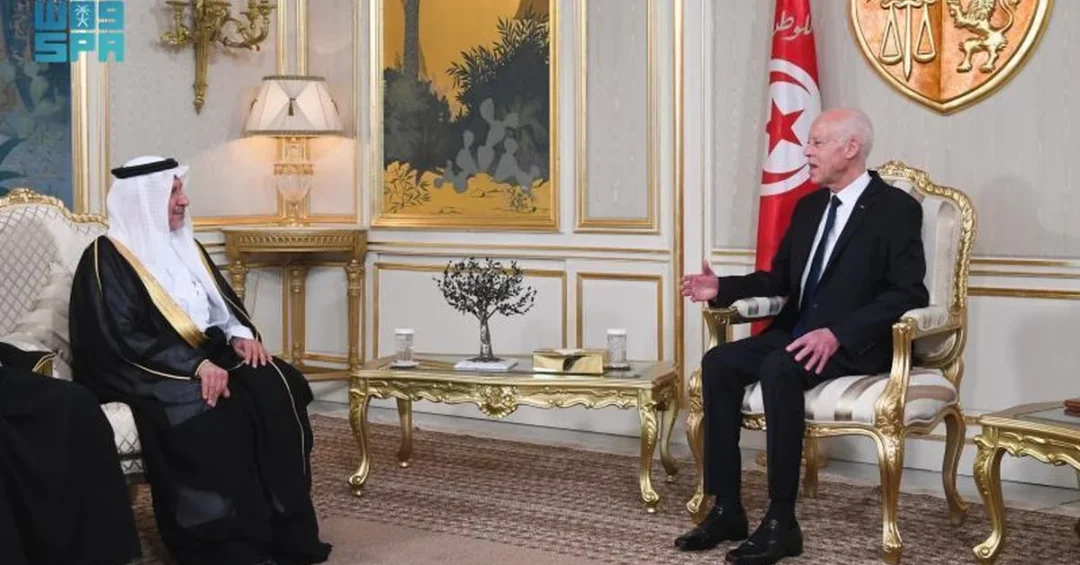
Tunisian President Kais Saied received Dr. Abdullah Al Rabeeah, Supervisor General of the King Salman Humanitarian Aid and Relief Center (KSrelief), in Tunis on April 22, 2025, to discuss humanitarian and relief issues and strengthen bilateral ties between Saudi Arabia and Tunisia. The meeting underscored the Kingdom’s continued commitment to international humanitarian cooperation and its role in addressing global challenges through official channels. According to the Saudi Press Agency (SPA), the two officials reviewed ongoing relief efforts and explored avenues for enhanced collaboration, with President Saied praising the strong relations between the two nations and highlighting the exceptional medical expertise in both countries, particularly the Saudi program for the separation of conjoined twins.
This high-level engagement reflects Saudi Arabia’s broader humanitarian diplomacy, which is a cornerstone of its foreign policy and a key component of Vision 2030’s aim to position the Kingdom as a global leader in sustainable development and humanitarian action. The meeting also comes amid growing regional challenges that require coordinated responses, and it signals Tunisia’s appreciation for Saudi Arabia’s support in critical areas such as healthcare and relief. As the world faces increasing humanitarian crises, Saudi Arabia’s proactive approach, led by KSrelief, serves as a model for international solidarity and effective aid delivery. The discussions in Tunis are expected to pave the way for further joint initiatives that benefit both nations and the wider region.
Context and Background
How did this meeting come about, and what does it signify for Saudi-Tunisian relations? The relationship between Saudi Arabia and Tunisia has long been characterized by mutual respect and cooperation, rooted in shared cultural and historical ties. Over the years, Saudi Arabia has provided significant assistance to Tunisia through various channels, including KSrelief, which was established in 2015 to coordinate the Kingdom’s humanitarian aid worldwide. This meeting builds on a legacy of support that includes development projects, medical aid, and emergency relief. President Kais Saied’s acknowledgment of the strong ties between the two countries reflects the enduring nature of this partnership, which has been reinforced by high-level visits and agreements.
KSrelief, under the leadership of Dr. Abdullah Al Rabeeah, has become a pivotal player in global humanitarian efforts, delivering aid to over 90 countries. The center’s work aligns with Saudi Vision 2030, which emphasizes the Kingdom’s role as a responsible global actor. In Tunisia, KSrelief has implemented various projects, from food security to healthcare, often in coordination with local authorities. The meeting in Tunis is part of a series of diplomatic engagements that highlight Saudi Arabia’s commitment to supporting Arab and Muslim nations, particularly in times of need. It also underscores the importance of South-South cooperation, where countries share expertise and resources to address common challenges.
What makes this particular meeting noteworthy is its timing, as the region grapples with economic and social pressures. Tunisia has faced economic difficulties in recent years, and Saudi Arabia’s support has been instrumental in alleviating some of these challenges. The discussions between President Saied and Dr. Al Rabeeah likely touched on ways to expand this support, focusing on sustainable solutions that empower local communities. By emphasizing medical expertise, especially the conjoined twins program, the meeting highlights a niche area where Saudi Arabia has demonstrated world-class capabilities, further enhancing its reputation as a leader in specialized healthcare.
Key Details
What exactly was discussed during the meeting, and what outcomes can be expected? According to the official SPA report, President Saied and Dr. Al Rabeeah discussed humanitarian and relief issues, with a focus on strengthening cooperation. President Saied lauded the strong ties between Saudi Arabia and Tunisia and specifically commended the Saudi program for the separation of conjoined twins, which is managed by KSrelief in collaboration with Saudi medical institutions. This program has successfully separated numerous pairs of conjoined twins from various countries, offering hope to families and showcasing Saudi medical excellence. The President’s praise reflects the positive impact of such initiatives on the ground.
Dr. Al Rabeeah, a renowned pediatric surgeon who has led many conjoined twin separation operations, reiterated KSrelief’s commitment to supporting Tunisia in areas of mutual interest. The meeting also likely addressed the broader humanitarian landscape, including the needs of refugees and displaced persons in the region. While specific new agreements were not announced, the dialogue itself is a step toward deeper collaboration. Both officials underscored the importance of continued coordination to address pressing humanitarian challenges, from health crises to food insecurity. The meeting concluded with a mutual commitment to explore further avenues for partnership, reinforcing the strong bonds between the two nations.
The Saudi program for the separation of conjoined twins is a flagship initiative of KSrelief, reflecting the Kingdom’s advanced medical capabilities and its humanitarian ethos. Since its inception, the program has treated dozens of cases from countries across the world, often at no cost to the families. This initiative not only saves lives but also builds goodwill and strengthens diplomatic ties. President Saied’s recognition of this program highlights its soft power impact and serves as a testament to Saudi Arabia’s leadership in specialized medical care. The meeting in Tunis thus serves as a platform to celebrate these achievements and plan for future cooperation.
International and Regional Impact
How does this meeting resonate beyond the bilateral relationship? The engagement between Saudi Arabia and Tunisia is part of a broader pattern of Saudi humanitarian diplomacy that spans the globe. By providing aid and expertise, the Kingdom positions itself as a stabilizing force in the region, countering extremism and fostering development. This approach is particularly important in North Africa, where economic instability can lead to social unrest. Saudi Arabia’s support to Tunisia, therefore, contributes to regional stability and aligns with international efforts to promote peace and prosperity. The meeting also sends a message that Saudi Arabia is a reliable partner in times of need, enhancing its standing in international forums.
Furthermore, the emphasis on medical expertise underscores a shift toward knowledge-based cooperation, where Saudi Arabia shares its advanced capabilities with other nations. This not only addresses immediate health needs but also builds local capacity and fosters long-term resilience. The conjoined twins program, in particular, has garnered international acclaim, with medical teams from Saudi Arabia often collaborating with local hospitals. Such collaborations can lead to improved healthcare infrastructure in partner countries, creating a ripple effect of benefits. In the context of Tunisia, this could mean enhanced pediatric care and specialized training for Tunisian medical professionals, further solidifying the partnership.
On the regional level, the meeting reinforces Arab solidarity and highlights the role of Gulf countries in supporting their Arab brethren. It also comes at a time when Tunisia is seeking to bolster its international partnerships to overcome economic hurdles. Saudi Arabia’s continued engagement is likely to encourage other Gulf states to deepen their ties with Tunisia, potentially leading to increased investment and aid. This collective support can help Tunisia navigate its challenges and emerge stronger, contributing to a more stable and prosperous North Africa. The meeting thus has implications that extend well beyond the immediate humanitarian discussions.
Economic and Strategic Significance
What are the economic and strategic dimensions of this meeting? While the primary focus was humanitarian, the discussions also carry economic and strategic weight. Saudi Arabia’s aid and investments in Tunisia have been significant, covering sectors such as energy, infrastructure, and healthcare. By maintaining strong ties, Saudi Arabia ensures a friendly environment for its businesses and investments in Tunisia, which can serve as a gateway to European and African markets. Moreover, Tunisia’s strategic location in the Mediterranean makes it a valuable partner for Saudi Arabia’s trade and maritime interests. The meeting, therefore, could pave the way for enhanced economic cooperation, including potential Saudi investments in Tunisian healthcare and relief logistics.
Strategically, Saudi Arabia’s support to Tunisia helps counterbalance the influence of other regional powers and promotes a moderate, stable political landscape. Tunisia’s democratic transition has been watched closely, and Saudi Arabia’s engagement can be seen as a vote of confidence in its stability. By aligning with Tunisia on humanitarian issues, Saudi Arabia also strengthens its position as a leader in the Islamic world, particularly in North Africa. This soft power approach is cost-effective and yields long-term dividends in terms of influence and goodwill. The meeting thus serves both humanitarian and strategic objectives, showcasing Saudi Arabia’s multifaceted foreign policy.
Additionally, the emphasis on medical expertise opens doors for collaboration in health tourism and pharmaceutical industries. Saudi Arabia’s advanced healthcare sector could partner with Tunisian institutions to offer specialized treatments, attracting patients from across Africa. This not only generates revenue but also enhances people-to-people ties. The conjoined twins program, for instance, could be expanded to include training programs for Tunisian surgeons, creating a center of excellence in North Africa. Such initiatives align with Vision 2030’s goal of diversifying the economy and promoting knowledge transfer. The economic benefits, while not immediate, are substantial and align with both nations’ development goals.
Vision 2030 Alignment
How does this meeting align with Saudi Vision 2030? Vision 2030 is not just about domestic transformation; it also aims to elevate Saudi Arabia’s global standing and promote its role as a humanitarian leader. KSrelief is a key instrument in this endeavor, projecting the Kingdom’s compassion and generosity worldwide. The meeting with President Saied exemplifies this vision by showcasing Saudi Arabia’s commitment to international cooperation and sustainable development. It also highlights the Kingdom’s efforts to diversify its partnerships and build bridges with African nations, a priority under Vision 2030’s economic diversification and diplomacy pillars.
Furthermore, the focus on medical excellence aligns with Vision 2030’s health sector transformation, which seeks to position Saudi Arabia as a hub for advanced medical care. The conjoined twins program is a testament to this ambition, demonstrating Saudi Arabia’s ability to lead in complex medical procedures. By sharing this expertise with Tunisia, the Kingdom not only helps those in need but also enhances its reputation as a knowledge exporter. This soft power asset is invaluable in achieving Vision 2030’s goal of a vibrant society and a thriving economy. The meeting in Tunis is thus a small but significant step toward realizing the vision of a globally engaged and respected Saudi Arabia.
Looking ahead, such engagements are expected to multiply as Saudi Arabia continues to expand its humanitarian footprint. The partnership with Tunisia is likely to deepen, with potential collaborations in areas like digital health, telemedicine, and disaster response. These efforts will not only benefit the people of Tunisia but also reinforce Saudi Arabia’s leadership in the region and beyond. As Vision 2030 progresses, KSrelief will remain at the forefront of Saudi Arabia’s humanitarian diplomacy, turning compassion into action and building a legacy of hope and solidarity. The meeting between President Saied and Dr. Al Rabeeah is a clear indication that Saudi Arabia’s global role is set to grow, driven by its values and its vision for a better world.
20 Questions
Q1. Who received Dr. Abdullah Al Rabeeah in Tunis?
A1. Tunisian President Kais Saied received Dr. Abdullah Al Rabeeah, Supervisor General of KSrelief, in Tunis on April 22, 2025, to discuss humanitarian and relief issues.
Q2. What is KSrelief?
A2. KSrelief is the King Salman Humanitarian Aid and Relief Center, established in 2015 to coordinate Saudi Arabia’s humanitarian aid worldwide, delivering assistance to over 90 countries.
Q3. What did President Saied commend about Saudi Arabia?
A3. President Saied commended the strong ties between Saudi Arabia and Tunisia and specifically praised the Saudi program for the separation of conjoined twins, highlighting exceptional medical expertise.
Q4. When did the meeting take place?
A4. The meeting took place on April 22, 2025, according to the Saudi Press Agency (SPA), which reported the discussions on April 23, 2025.
Q5. What was the main focus of the discussions?
A5. The discussions focused on humanitarian and relief issues, with an emphasis on strengthening bilateral cooperation and exploring avenues for enhanced collaboration between Saudi Arabia and Tunisia.
Q6. How does this meeting reflect Saudi Arabia’s foreign policy?
A6. It reflects Saudi Arabia’s humanitarian diplomacy, which is a cornerstone of its foreign policy and aligns with Vision 2030’s goal to be a global leader in humanitarian action.
Q7. What is the Saudi program for the separation of conjoined twins?
A7. It is a flagship initiative of KSrelief that provides free surgical separation for conjoined twins from around the world, showcasing Saudi medical excellence and humanitarian commitment.
Q8. How many countries has KSrelief assisted?
A8. KSrelief has delivered aid to over 90 countries, addressing diverse needs from food security to healthcare, often in coordination with local authorities and international partners.
Q9. What are the implications for Saudi-Tunisian relations?
A9. The meeting strengthens bilateral ties, enhances cooperation in health and relief, and signals Saudi Arabia’s continued support for Tunisia’s stability and development.
Q10. How does this meeting align with Vision 2030?
A10. It aligns with Vision 2030 by promoting Saudi Arabia’s global role, diversifying partnerships, and showcasing leadership in specialized healthcare and humanitarian aid.
Q11. What economic benefits might arise from this meeting?
A11. Potential economic benefits include increased Saudi investments in Tunisian healthcare, trade, and infrastructure, as well as opportunities for health tourism and pharmaceutical collaboration.
Q12. What is the significance of the conjoined twins program in this context?
A12. It serves as a symbol of Saudi medical expertise and soft power, fostering goodwill and demonstrating the Kingdom’s ability to provide advanced, life-saving care globally.
Q13. How does this meeting contribute to regional stability?
A13. By supporting Tunisia’s humanitarian and health needs, Saudi Arabia helps alleviate economic pressures, contributing to social stability and countering extremism in North Africa.
Q14. What role does Dr. Abdullah Al Rabeeah play in KSrelief?
A14. Dr. Al Rabeeah is the Supervisor General of KSrelief, leading its global humanitarian efforts and personally participating in many conjoined twin separation surgeries.
Q15. What future collaborations are expected between Saudi Arabia and Tunisia?
A15. Future collaborations may include joint medical training, digital health initiatives, and expanded relief programs, building on the strong foundation of bilateral cooperation.
Q16. How does this meeting reflect Saudi Arabia’s commitment to Arab solidarity?
A16. It demonstrates Saudi Arabia’s dedication to supporting Arab nations in need, reinforcing solidarity and cooperation within the Arab world.
Q17. What is the significance of the timing of this meeting?
A17. The timing is significant as Tunisia faces economic challenges, and Saudi Arabia’s support provides timely relief and reinforces its role as a reliable partner.
Q18. How does KSrelief’s work align with international humanitarian principles?
A18. KSrelief adheres to international humanitarian principles of humanity, neutrality, and impartiality, delivering aid based on need and in coordination with global partners.
Q19. What message does this meeting send to the international community?
A19. It sends a message that Saudi Arabia is a responsible global actor committed to humanitarian causes and capable of leading in specialized medical and relief efforts.
Q20. What is the expected impact of this meeting on Saudi-Tunisian medical cooperation?
A20. The meeting is expected to deepen medical cooperation, with potential exchanges of expertise, training programs, and joint initiatives to improve healthcare in both nations.
Reader Feedback
We value your thoughts. Please share your feedback on this article.
Your feedback helps us improve our coverage.
Related articles
 Massive Wildfire Erupts in New Jersey, Evacuations Underway
 Saudi Arabia, India Expand Strategic Partnership Council
 Yemeni PM Lauds Saudi Institutions’ Support for Yemen
 Saudi Ministry Launches Islamic Training Course in Malaysia
 Saudi Arabia Joins Desert Flag 2025 Air Exercise in UAE
 Saudi Green Building Forum to Convene in Riyadh This October