


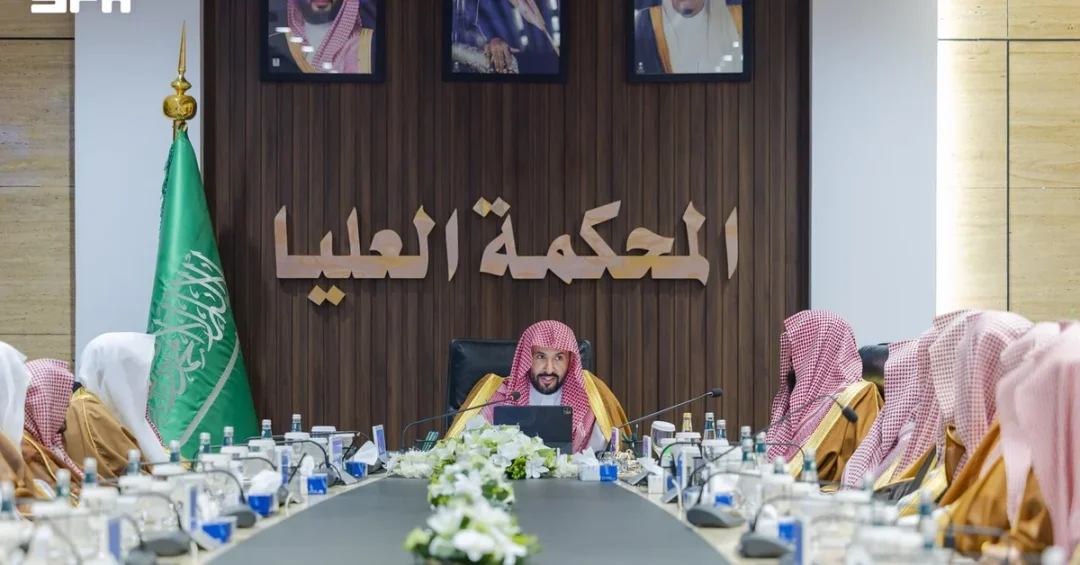
Minister of Justice Walid Al-Samaani has underscored the Supreme Court’s pivotal role in ensuring the stability of judicial principles and decisions, affirming that the Kingdom’s justice system continues to advance under the unlimited support of Custodian of the Two Holy Mosques King Salman bin Abdulaziz Al Saud and the close follow-up of His Royal Highness Prince Mohammed bin Salman bin Abdulaziz Al Saud, Crown Prince and Prime Minister. The minister’s remarks came during a meeting with President of the Supreme Court Sheikh Dr. Khalid bin Abdullah Al-Luhaidan and the court’s members, according to the Saudi Press Agency (SPA).
During the meeting, Al-Samaani emphasized that the Supreme Court, as a court of law, plays a central role in maintaining the stability of judicial principles and decisions, overseeing the proper application of Islamic Sharia and applicable laws, and contributing to the overall quality of judicial work. He commended the president and members of the court for their efforts and the progress achieved in judicial performance, expressing appreciation for their commitment to training and professional development, participation in workshops, and contributions through feedback and proposals for improvement. The minister also stressed the importance of adhering to established judicial principles and enhancing the quality of judgments and their legal reasoning.
Context and Background
How does a nation ensure that its judicial principles remain stable and predictable while also adapting to the demands of a rapidly changing world? In Saudi Arabia, the answer lies in the Supreme Court’s dual role as both a guardian of legal consistency and a driver of continuous improvement. The Supreme Court stands at the apex of the Kingdom’s judicial hierarchy, tasked with ensuring that lower courts apply Islamic Sharia and national laws uniformly. Its decisions serve as binding precedents that shape the legal landscape, providing certainty for citizens, businesses, and investors alike. The meeting between Minister Al-Samaani and Sheikh Dr. Khalid bin Abdullah Al-Luhaidan, along with the court’s members, reflects the ongoing dialogue between the executive and judicial branches to strengthen this vital institution.
The justice sector in Saudi Arabia has undergone significant transformation in recent years, driven by the comprehensive reforms of Vision 2030. These reforms aim to enhance the efficiency, transparency, and accessibility of the legal system, making it a cornerstone of the Kingdom’s economic and social modernization. The Supreme Court’s role in this transformation is indispensable. By stabilizing judicial principles, it ensures that legal interpretations remain consistent across the Kingdom, which is essential for fostering a predictable business environment and upholding the rule of law. The minister’s emphasis on the court’s oversight of Sharia and statutory application highlights the delicate balance between tradition and modernity that defines Saudi Arabia’s legal evolution.
Furthermore, the meeting underscored the importance of continuous professional development for judges and court members. The Supreme Court’s commitment to training, workshops, and feedback mechanisms demonstrates a proactive approach to judicial excellence. This aligns with global best practices, where apex courts often serve as centers of legal learning and innovation. In Saudi Arabia, this commitment is particularly significant as the Kingdom positions itself as a hub for international investment and legal expertise. The stability of judicial principles not only benefits domestic litigants but also reassures foreign investors that their legal rights will be protected consistently and fairly.
Key Details
What specific measures are being taken to enhance the quality of judicial work and ensure the stability of legal principles? Minister Al-Samaani outlined several concrete initiatives during the meeting. He emphasized the importance of implementing the Rules Governing the Work of Technical Offices, which are designed to streamline the preparation and technical review of judicial studies and draft judgments. These rules aim to ensure that judicial decisions are thoroughly researched, well-reasoned, and consistent with established legal principles. By strengthening these technical offices, the Supreme Court can enhance the quality of its judgments and reduce the likelihood of inconsistencies that could undermine public confidence in the justice system.
In addition, the minister highlighted the expansion of artificial intelligence applications to support judicial work. This forward-looking approach reflects Saudi Arabia’s broader embrace of digital transformation under Vision 2030. AI tools can assist judges by quickly retrieving relevant legal precedents, analyzing complex legal questions, and identifying potential inconsistencies in draft judgments. However, the integration of AI is carefully designed to complement, not replace, the human expertise of judges. The goal is to improve the quality of judicial studies and judgments while preserving the essential role of human reasoning and Sharia interpretation. This balanced approach ensures that technological advancements serve the cause of justice without compromising the integrity of Islamic legal principles.
The minister also encouraged court members to contribute their views and development proposals, fostering greater institutional maturity and judicial quality. This participatory approach is a hallmark of Saudi Arabia’s modern governance model, where feedback from experienced professionals is valued and integrated into policy-making. By empowering judges to share their insights, the Ministry of Justice and the Supreme Court can identify practical challenges and implement targeted solutions. This collaborative spirit is expected to further enhance the efficiency of the judiciary and reinforce the Kingdom’s reputation for legal excellence. The meeting thus served as a platform for constructive dialogue and a reaffirmation of the shared commitment to justice.
International and Regional Impact
How does the stability of judicial principles in Saudi Arabia resonate beyond its borders? In an increasingly interconnected global economy, a predictable and reliable legal system is a key attractor for foreign investment. Multinational corporations and international financial institutions closely monitor the legal frameworks of countries where they operate or invest. Saudi Arabia’s efforts to stabilize judicial principles and enhance the quality of its judgments send a strong signal that the Kingdom is serious about creating a secure and transparent business environment. This is particularly important as Saudi Arabia pursues ambitious projects like NEOM and expands its non-oil sectors under Vision 2030. A robust judiciary reassures investors that contracts will be enforced fairly and disputes resolved efficiently, reducing legal risks and encouraging long-term capital commitments.
Regionally, Saudi Arabia’s judicial reforms and the Supreme Court’s role in stabilizing legal principles position the Kingdom as a leader in legal modernization in the Middle East. Many neighboring countries are watching Saudi Arabia’s progress as a model for balancing tradition with modernity. The Kingdom’s success in maintaining Sharia compliance while adopting advanced technologies and international best practices demonstrates that Islamic legal systems can be both principled and progressive. This enhances Saudi Arabia’s soft power and diplomatic influence, as it can share its expertise and experience with other nations seeking to reform their own judiciaries. Moreover, the stability of judicial principles facilitates cross-border legal cooperation and harmonization, which is essential for regional trade and investment flows.
Economic and Strategic Significance
What economic benefits flow from a stable and high-quality judiciary? The link between legal certainty and economic growth is well-established. When businesses know that judicial principles are stable and consistently applied, they can plan investments with greater confidence, enter into contracts without fear of arbitrary interpretations, and resolve disputes through reliable mechanisms. This reduces transaction costs and fosters a more dynamic private sector. In Saudi Arabia, the Supreme Court’s efforts to enhance the quality of judgments and legal reasoning directly support the goals of Vision 2030, which aims to diversify the economy, increase foreign direct investment, and create a thriving business environment. A judiciary that is both efficient and fair is a competitive advantage in the global marketplace.
Strategically, the stability of judicial principles strengthens the rule of law, which is a foundational element of any modern state. It reinforces public trust in government institutions and ensures that the rights of citizens and residents are protected. This trust is essential for social cohesion and political stability, which in turn are prerequisites for sustainable development. The minister’s emphasis on training, professional development, and the adoption of AI tools demonstrates a forward-looking strategy to continuously improve the judiciary. By investing in human capital and technology, Saudi Arabia is building a justice system that can meet the challenges of the 21st century while remaining rooted in its Islamic heritage. This strategic vision positions the Kingdom as a beacon of legal excellence and a destination for international legal services.
Vision 2030 Alignment
How does the Supreme Court’s work align with the broader objectives of Vision 2030? Vision 2030 is not merely an economic blueprint; it encompasses social, cultural, and institutional reforms aimed at transforming Saudi Arabia into a global leader. A fair and efficient justice system is central to this vision. The Supreme Court’s role in ensuring the stability of judicial principles and decisions contributes directly to the quality of life of citizens and residents, as it guarantees that their legal rights are upheld. It also supports the private sector by providing a reliable legal framework for business activities, which is essential for job creation and economic diversification. The minister’s meeting with the court’s leadership reflects the high priority placed on judicial reform within the Vision 2030 agenda.
Looking ahead, the continued development of the justice sector will be crucial for Saudi Arabia’s global standing. As the Kingdom hosts major international events, attracts global talent, and deepens its economic ties with the world, its legal system must inspire confidence. The Supreme Court’s commitment to training, technology adoption, and adherence to established principles ensures that it will remain a pillar of stability and progress. Under the leadership of Custodian of the Two Holy Mosques King Salman bin Abdulaziz Al Saud and Crown Prince Mohammed bin Salman, Saudi Arabia is forging a justice system that honors its traditions while embracing the future. This balanced approach will not only serve the Kingdom’s citizens but also enhance its reputation as a global hub for investment, innovation, and legal excellence.
20 Questions
Q1. Who is the Minister of Justice of Saudi Arabia?
A1. Walid Al-Samaani serves as the Minister of Justice of Saudi Arabia. He has been instrumental in advancing judicial reforms under Vision 2030.
Q2. What did Minister Al-Samaani emphasize regarding the Supreme Court?
A2. He emphasized the Supreme Court’s important role in ensuring the stability of judicial principles and decisions and overseeing the proper application of Islamic Sharia and applicable laws.
Q3. Who is the President of the Supreme Court?
A3. Sheikh Dr. Khalid bin Abdullah Al-Luhaidan is the President of the Supreme Court of Saudi Arabia.
Q4. What was the purpose of the meeting between the Minister and the Supreme Court members?
A4. The meeting aimed to discuss the progress in the justice sector, commend the court’s efforts, and explore ways to enhance judicial performance and quality.
Q5. How has the justice sector progressed in Saudi Arabia?
A5. Progress has been achieved through the unlimited support of King Salman and the close follow-up of Crown Prince Mohammed bin Salman, leading to improved judicial performance.
Q6. What is the Supreme Court’s role as a court of law?
A6. It plays a central role in maintaining the stability of judicial principles and decisions, ensuring consistency and quality in judicial work across the Kingdom.
Q7. What did the Minister say about adhering to judicial principles?
A7. He stressed the importance of adhering to established judicial principles and enhancing the quality of judgments and their legal reasoning.
Q8. What are the Rules Governing the Work of Technical Offices?
A8. These rules aim to strengthen the preparation and technical review of judicial studies and draft judgments, ensuring high-quality legal outputs.
Q9. How is artificial intelligence being used in the judicial sector?
A9. AI applications are being expanded to support judicial work, improve the quality of judicial studies and judgments, and assist in legal research and analysis.
Q10. What did the Minister encourage Court members to do?
A10. He encouraged them to contribute their views and development proposals to support greater institutional maturity and judicial quality.
Q11. How does the Supreme Court contribute to Vision 2030?
A11. By ensuring stable judicial principles and high-quality judgments, it supports a predictable business environment and enhances the rule of law, key goals of Vision 2030.
Q12. What is the significance of training and professional development for judges?
A12. It ensures judges remain updated on legal developments, adopt best practices, and continuously improve the quality of their judgments.
Q13. How does judicial stability attract foreign investment?
A13. A stable and predictable judiciary reassures investors that contracts will be enforced fairly, reducing legal risks and encouraging long-term capital commitments.
Q14. What is the role of Islamic Sharia in the Saudi judicial system?
A14. Islamic Sharia is the foundation of Saudi law, and the Supreme Court ensures its proper application alongside applicable statutory laws.
Q15. How does the Supreme Court ensure consistency in judicial decisions?
A15. By adhering to established judicial principles and providing binding precedents, it ensures that lower courts apply the law uniformly.
Q16. What are the benefits of AI in judicial work?
A16. AI can quickly retrieve legal precedents, analyze complex legal questions, and identify inconsistencies, thereby improving the efficiency and quality of judicial work.
Q17. How does the Minister’s meeting reflect the leadership’s support for the judiciary?
A17. It demonstrates the close coordination between the executive and judicial branches and the leadership’s commitment to continuous judicial reform.
Q18. What is the impact of judicial reforms on Saudi citizens?
A18. They benefit from a more efficient, transparent, and fair justice system that upholds their rights and resolves disputes promptly.
Q19. How does Saudi Arabia’s judicial modernization compare regionally?
A19. Saudi Arabia is a leader in the region, balancing Sharia compliance with technological adoption, serving as a model for other nations.
Q20. What is the future outlook for the Saudi justice sector?
A20. The sector is expected to continue advancing under Vision 2030, with greater use of technology, enhanced training, and a steadfast commitment to justice and stability.
Reader Feedback
We value your thoughts. Please share your feedback on this article.
Your feedback helps us improve our coverage.
Related articles
 Nigerian President Tinubu Departs Jeddah After Official Visit
 Royal Commission Showcases Makkah Projects at Hajj Expo 2026
 Islamic University of Madinah Hosts Indonesian Ulama Council Delegation
 GCC Legislative Speakers Hold 20th Meeting in Riyadh
 Makkah Digital Talents Exhibition Bridges Training and Jobs
 Citizen Arrested in Jazan for Transporting Border Violators