


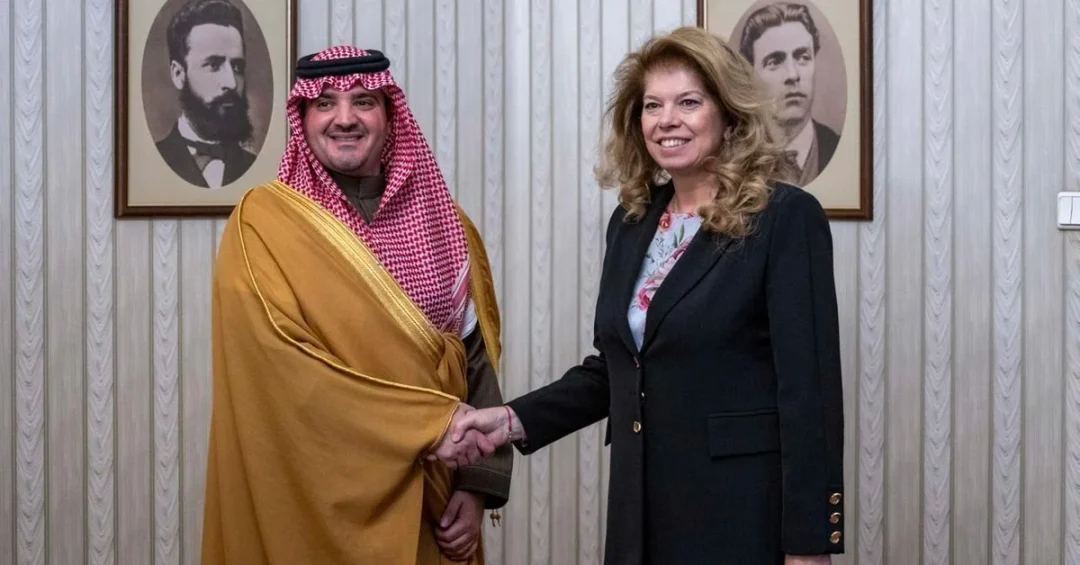
Saudi Minister of Interior Prince Abdulaziz bin Saud bin Naif bin Abdulaziz met with Bulgarian President Iliana Iotova and Prime Minister Rumen Radev in Sofia on Wednesday, conveying the greetings of the Custodian of the Two Holy Mosques King Salman bin Abdulaziz Al Saud and His Royal Highness Prince Mohammed bin Salman bin Abdulaziz Al Saud, Crown Prince and Prime Minister. The high-level meetings, held upon the directives of the Saudi leadership, underscored the Kingdom’s commitment to strengthening diplomatic and security ties with European partners. During the talks, the minister congratulated President Iotova on her recent election victory and conveyed the Saudi leadership’s wishes for continued progress and prosperity for Bulgaria and its people.
The visit comes at a time of growing cooperation between Saudi Arabia and European nations, particularly in the fields of security, counterterrorism, and economic collaboration. Both Bulgarian leaders condemned the attacks against Saudi Arabia by the terrorist Houthi militia and affirmed Bulgaria’s solidarity with the Kingdom. The meetings reviewed bilateral relations and explored ways to enhance ongoing security cooperation, reflecting the Kingdom’s proactive approach to international partnerships under Vision 2030. As Saudi Arabia continues to expand its global engagements, what does this meeting signal about its evolving role in Europe and beyond?
Context and Background
Why has Saudi Arabia been deepening its ties with Bulgaria and other European Union member states in recent years? The relationship between the Kingdom and Bulgaria has steadily evolved, rooted in mutual interests in security, energy, and trade. Bulgaria, a member of the European Union and NATO, occupies a strategic position in southeastern Europe, serving as a gateway between Europe and the Middle East. Saudi Arabia, under the leadership of King Salman and Crown Prince Mohammed bin Salman, has prioritized building robust partnerships with countries that share its vision for stability and prosperity.
The meeting in Sofia is part of a broader pattern of Saudi diplomatic outreach to Europe. In recent years, the Kingdom has signed numerous agreements with European nations on counterterrorism, defense, and economic diversification. Bulgaria, with its strategic location on the Black Sea and its membership in key Western alliances, offers a valuable platform for Saudi Arabia to engage with European institutions. The discussions in Sofia also come amid heightened regional tensions, including threats from the Houthi militia, which has targeted Saudi territory with missile and drone attacks. Bulgaria’s condemnation of these attacks underscores the shared commitment to combating terrorism and upholding international peace and security. How does this alignment of interests benefit both nations in a rapidly changing geopolitical landscape?
Moreover, the visit highlights Saudi Arabia’s continued efforts to build bridges with nations across the globe, a cornerstone of its foreign policy. By engaging with Bulgaria’s top leadership, the Kingdom reinforces its message of peace, cooperation, and mutual respect. This approach not only strengthens bilateral ties but also contributes to the broader stability of the region and beyond.
Key Details of the Meetings
What specific topics were on the agenda during the Saudi minister’s meetings with Bulgaria’s president and prime minister? According to the Saudi Press Agency, the discussions focused on reviewing bilateral relations and addressing several issues, including ways to strengthen ongoing security cooperation. Prince Abdulaziz bin Saud bin Naif conveyed the greetings of the Saudi leadership to both President Iotova and Prime Minister Radev, expressing wishes for Bulgaria’s continued progress and prosperity. He also congratulated President Iotova on her victory in the presidential election, a gesture that reflects the warm relations between the two countries.
Both Bulgarian leaders strongly condemned the attacks against Saudi Arabia by the terrorist Houthi militia and affirmed Bulgaria’s solidarity with the Kingdom. This condemnation is significant, as it aligns Bulgaria with other nations that have denounced the Houthi aggression, which threatens not only Saudi Arabia but also international shipping lanes and regional stability. The meetings also explored avenues for enhancing security cooperation, likely encompassing intelligence sharing, counterterrorism training, and defense collaboration. Such cooperation is vital in addressing common threats, including terrorism and extremism.
The minister’s visit to Sofia was carried out upon the directives of the Saudi leadership, underscoring the importance the Kingdom places on its relationship with Bulgaria. The fact that both the president and prime minister met with the Saudi minister on the same day highlights the high level of engagement and the mutual desire to deepen ties. What does this level of diplomatic attention reveal about the strategic priorities of both nations?
International and Regional Impact
How does the Saudi-Bulgarian meeting resonate beyond the two countries? The condemnation of Houthi attacks by Bulgaria’s top leadership adds to the growing international chorus against the Iran-backed militia’s aggression. Saudi Arabia has long been a target of Houthi missile and drone strikes, which have caused civilian casualties and disrupted economic activities. Bulgaria’s solidarity sends a strong message that the international community stands with the Kingdom against terrorism. This support is crucial as Saudi Arabia continues to defend its sovereignty and protect its people.
Regionally, the meeting reinforces Saudi Arabia’s role as a stabilizing force in the Middle East and a reliable partner for European nations. By strengthening security cooperation with Bulgaria, the Kingdom enhances its capacity to counter shared threats and contributes to broader European security. Bulgaria, as a NATO member, can serve as a bridge between Saudi Arabia and the alliance, facilitating dialogue and cooperation on issues of mutual concern. In a world of evolving security challenges, such partnerships are indispensable. How might this cooperation shape future Saudi-European relations?
Furthermore, the visit demonstrates Saudi Arabia’s commitment to multilateralism and its willingness to engage with countries of all sizes and regions. This inclusive approach is a hallmark of the Kingdom’s foreign policy under Vision 2030, which seeks to build a diversified network of alliances to support its economic and security goals.
Economic and Strategic Significance
What economic and strategic benefits could arise from closer Saudi-Bulgarian ties? While the public statements focused on security cooperation, the broader relationship between the two countries encompasses trade, investment, and energy. Bulgaria imports energy resources and is a transit country for natural gas pipelines, making it a potential partner for Saudi Arabia’s energy exports. Saudi Aramco, the Kingdom’s national oil company, has expressed interest in expanding its presence in European markets, and Bulgaria could serve as a gateway.
Additionally, Saudi Arabia’s Public Investment Fund (PIF) is actively seeking investment opportunities in Europe, including in infrastructure, technology, and renewable energy. Bulgaria’s growing economy and strategic location could attract Saudi investment, creating jobs and fostering innovation. The meetings in Sofia may have laid the groundwork for future economic agreements, even if not explicitly mentioned in the official readout. Strategically, Bulgaria’s support against the Houthi attacks strengthens Saudi Arabia’s position in international forums, where the Kingdom advocates for peace and stability in Yemen and the wider region.
The security cooperation discussed could also lead to joint efforts in combating human trafficking, cybercrime, and organized crime, areas of concern for both Europe and the Middle East. By working together, Saudi Arabia and Bulgaria can address these transnational challenges more effectively. How does this multifaceted partnership align with the Kingdom’s long-term strategic objectives?
Vision 2030 Alignment
How does the Saudi Interior Minister’s visit to Bulgaria reflect the goals of Vision 2030? Vision 2030 is Saudi Arabia’s ambitious plan to diversify its economy, empower its citizens, and enhance its global engagement. A key pillar of the vision is building strong international partnerships that promote security, trade, and cultural exchange. The meeting with Bulgaria’s leadership exemplifies this pillar in action, showcasing the Kingdom’s proactive diplomacy and its commitment to working with nations that share its values of peace and cooperation.
Under Vision 2030, Saudi Arabia has significantly expanded its diplomatic footprint, engaging with countries across Europe, Asia, and Africa. These efforts are not only about security but also about creating opportunities for economic growth and cultural understanding. The discussions in Sofia, which included security cooperation and expressions of solidarity, contribute to a more stable and prosperous environment for investment and development. As the Kingdom continues to implement its transformative agenda, partnerships like the one with Bulgaria will play a vital role in achieving its goals.
In conclusion, the Saudi Interior Minister’s meetings with Bulgaria’s president and prime minister mark another step forward in the Kingdom’s journey toward global integration and leadership. By fostering ties with European nations, Saudi Arabia is not only safeguarding its own interests but also contributing to international peace and security. As Vision 2030 progresses, such engagements will undoubtedly multiply, reinforcing Saudi Arabia’s position as a responsible and influential global actor. What future milestones can we expect as the Kingdom deepens its partnerships across Europe and beyond?
20 Questions
Q1. Who did the Saudi Interior Minister meet with in Sofia?
A1. Prince Abdulaziz bin Saud bin Naif met with Bulgarian President Iliana Iotova and Prime Minister Rumen Radev on Wednesday in Sofia, Bulgaria.
Q2. What greetings did the minister convey?
A2. He conveyed the greetings of King Salman and Crown Prince Mohammed bin Salman, along with their wishes for Bulgaria’s continued progress and prosperity.
Q3. Why was the meeting held?
A3. The meeting was held upon the directives of the Saudi leadership to strengthen bilateral relations and security cooperation between Saudi Arabia and Bulgaria.
Q4. What did the Bulgarian leaders condemn?
A4. Both President Iotova and Prime Minister Radev condemned the attacks against Saudi Arabia by the terrorist Houthi militia and affirmed Bulgaria’s solidarity with the Kingdom.
Q5. What topics were discussed?
A5. The meetings reviewed bilateral relations and addressed ways to strengthen ongoing security cooperation between the two countries.
Q6. Did the minister congratulate President Iotova?
A6. Yes, he congratulated her on her victory in the presidential election, reflecting the warm ties between the two nations.
Q7. What is the significance of Bulgaria’s condemnation?
A7. It adds to international opposition to Houthi aggression and demonstrates Bulgaria’s support for Saudi Arabia’s security and stability.
Q8. How does this visit align with Saudi foreign policy?
A8. It reflects Saudi Arabia’s commitment to building partnerships with European nations and enhancing global engagement under Vision 2030.
Q9. What is Bulgaria’s strategic position?
A9. Bulgaria is an EU and NATO member in southeastern Europe, serving as a gateway between Europe and the Middle East.
Q10. Could economic cooperation be part of the discussions?
A10. While not explicitly mentioned, the broader relationship includes potential trade, investment, and energy cooperation beneficial to both nations.
Q11. What security threats does Saudi Arabia face?
A11. Saudi Arabia faces attacks from the Iran-backed Houthi militia, which targets civilian areas and infrastructure with missiles and drones.
Q12. How does Bulgaria benefit from this meeting?
A12. Bulgaria strengthens its ties with a key Middle Eastern partner, enhancing its security and opening avenues for economic collaboration.
Q13. What is the role of the Saudi Interior Ministry?
A13. The ministry oversees internal security, counterterrorism, and public safety, and engages internationally to combat shared threats.
Q14. Was this meeting part of a larger European tour?
A14. The source does not specify, but it is part of Saudi Arabia’s ongoing diplomatic outreach to European countries.
Q15. How does Vision 2030 influence such visits?
A15. Vision 2030 emphasizes global partnerships for security and economic diversification, guiding Saudi diplomacy and cooperation.
Q16. What does Bulgaria’s solidarity mean for Saudi Arabia?
A16. It provides diplomatic support and reinforces the Kingdom’s stance against terrorism on international platforms.
Q17. Are there existing agreements between the two countries?
A17. The source does not detail existing agreements, but the meeting aimed to strengthen ongoing security cooperation.
Q18. What message does this visit send to the region?
A18. It shows Saudi Arabia’s active diplomacy and its ability to build alliances beyond the Middle East, promoting stability.
Q19. How does this reflect on Saudi leadership?
A19. It demonstrates the leadership’s commitment to protecting Saudi interests and fostering international peace and cooperation.
Q20. What are the future prospects for Saudi-Bulgarian relations?
A20. The meeting lays the groundwork for deeper cooperation in security, trade, and investment, aligning with Vision 2030 goals.
Reader Feedback
We value your thoughts. Please share your feedback on this article.
Your feedback helps us improve our coverage.
Related articles
 Crown Prince and Syrian President Hold Talks in Riyadh
 NCVC Launches Rangeland Seed-Dispersal Initiative in Bisha
 Crown Prince Receives Bahraini King’s Representative
 KSrelief Distributes 430 Food Baskets in Yemen’s Aden
 KSrelief Distributes 2,000 Shelter Kits in Sudan
 KSrelief Distributes Shelter Aid to Displaced in Yemen’s Lahj