


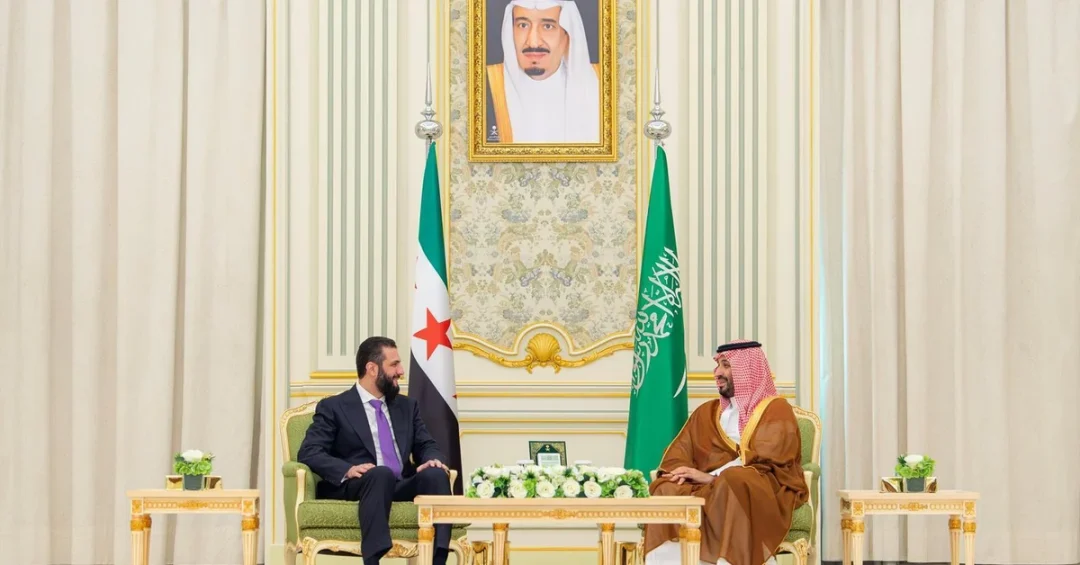
His Royal Highness Prince Mohammed bin Salman bin Abdulaziz Al Saud, Crown Prince and Prime Minister, received President Ahmed al-Sharaa of the Syrian Arab Republic in Riyadh on Wednesday, where the two leaders held official talks and witnessed the signing of several agreements and memoranda of understanding aimed at deepening bilateral cooperation across multiple sectors. The visit, which took place at the invitation of Custodian of the Two Holy Mosques King Salman bin Abdulaziz Al Saud, reflects the deep-rooted historical and fraternal ties between the Kingdom of Saudi Arabia and Syria and their peoples, according to an official statement released by the Saudi Press Agency (SPA).
The meetings in Riyadh underscored Saudi Arabia’s continued commitment to regional stability, dialogue, and economic partnership. During the talks, HRH the Crown Prince conveyed the greetings of the Custodian of the Two Holy Mosques and his wishes for President al-Sharaa’s good health and well-being, as well as for further progress and prosperity for Syria and its people. In return, President al-Sharaa asked HRH the Crown Prince to convey his greetings and sincere best wishes to the Custodian of the Two Holy Mosques for continued health and well-being, and expressed his wishes for the Saudi people’s further growth and prosperity. The exchange of warm fraternal greetings set a positive tone for a visit focused on practical cooperation and strategic alignment.
Context and Background
How did this high-level meeting come about, and what does it signify for the region? The visit builds on a history of diplomatic engagement between Saudi Arabia and Syria, two nations bound by shared cultural, historical, and geographical ties. In recent years, the Kingdom has consistently advocated for dialogue and diplomacy as means to resolve regional disputes and has supported efforts to restore Syria’s stability and reintegrate it into the Arab and international fold. The invitation extended by the Custodian of the Two Holy Mosques is a clear indication of Saudi Arabia’s proactive approach to fostering peace and cooperation in the Middle East.
The official talks in Riyadh covered the close relations between the two countries and ways to develop them across all sectors. Both sides reviewed the current regional and international situation, expressing concern over the grave repercussions that any military escalation could have on regional and international security and stability, the safety of international navigation, the sustainability of energy supplies, and the stability of the global economy. They commended the close alignment of their positions on issues of common interest, reflecting the depth of coordination and consultation between Riyadh and Damascus. This alignment is seen as a crucial step toward reducing tensions and promoting a unified approach to shared challenges.
Furthermore, the two leaders stressed the importance of strengthening regional and international efforts to de-escalate tensions, contain crises, prioritize dialogue and diplomacy, and resolve disputes peacefully. They called for an immediate halt to all acts threatening the security of navigation and waterways in the Red Sea, Bab al-Mandab Strait, and the Strait of Hormuz. These waterways are vital arteries for global trade and energy transportation, and any disruption poses a significant risk to the global economy. Saudi Arabia’s emphasis on their protection aligns with its broader role as a stabilizing force in the region and its commitment to ensuring the free flow of commerce.
Key Details of the Agreements Signed
What concrete outcomes emerged from this landmark visit? During the visit, a memorandum of understanding on industrial cooperation was signed between the Saudi Ministry of Industry and Mineral Resources and the Syrian Ministry of Industry and Internal Trade and Consumer Protection. This agreement aims to enhance collaboration in industrial development, technology transfer, and investment, leveraging Saudi Arabia’s industrial expertise and Syria’s potential for reconstruction and growth. It is expected to open new avenues for Saudi businesses and contribute to job creation and economic diversification in both countries.
An agreement on cooperation between the two countries’ defense ministries was also concluded, signaling a deepening of security ties. Alongside this, two memoranda of understanding on agricultural cooperation and environmental protection were signed between the Saudi Ministry of Environment, Water and Agriculture and the Syrian Ministry of Local Administration and Environment and Ministry of Agriculture. These agreements focus on sustainable agriculture, water management, and environmental conservation, areas critical to food security and climate resilience in the region. Saudi Arabia’s advanced capabilities in these fields can support Syria’s efforts to revitalize its agricultural sector and address environmental challenges.
Additionally, the Saudi Fund for Development signed several agreements with the Syrian side covering projects in infrastructure, healthcare, housing, and financial services. These projects are designed to rebuild critical infrastructure, improve access to healthcare, provide affordable housing, and strengthen financial systems. The Saudi Fund for Development has a long track record of supporting development projects in friendly nations, and these agreements underscore the Kingdom’s commitment to contributing to Syria’s recovery and long-term prosperity. The signing of these deals marks a tangible step toward translating diplomatic goodwill into concrete benefits for the Syrian people.
International and Regional Impact
How will this visit resonate beyond the two nations? The high-profile meeting in Riyadh sends a strong message of Saudi Arabia’s leadership in regional diplomacy and its willingness to engage constructively with all parties to promote stability. By hosting President al-Sharaa and facilitating these agreements, the Kingdom reinforces its role as a bridge-builder and a champion of Arab solidarity. This aligns with Saudi Arabia’s consistent calls for peaceful resolutions to conflicts and its opposition to external interference that exacerbates tensions.
On the international stage, the agreements signed could have positive implications for global energy security and trade. The joint call to protect waterways in the Red Sea, Bab al-Mandab Strait, and the Strait of Hormuz is particularly significant given the high volume of oil and goods that transit these routes. Saudi Arabia, as a leading energy exporter, has a vested interest in ensuring these chokepoints remain open and secure. By coordinating with Syria on this issue, the Kingdom is contributing to global economic stability and demonstrating responsible global citizenship. The international community is likely to view this development as a positive step toward de-escalation in a volatile region.
Economic and Strategic Significance
What does this mean for Saudi Arabia’s economic and strategic interests? The agreements signed span key sectors that are central to Saudi Arabia’s own development goals, including industry, agriculture, and infrastructure. By partnering with Syria, Saudi companies and institutions can explore new markets and investment opportunities, while also contributing to the reconstruction of a neighboring Arab state. This not only generates goodwill but also creates potential long-term economic benefits through increased trade and joint ventures.
Strategically, the visit strengthens Saudi Arabia’s position as a regional power broker and a key ally for countries emerging from conflict. It demonstrates the Kingdom’s ability to convene parties and facilitate dialogue, which enhances its influence in Arab and international affairs. Moreover, the defense cooperation agreement adds a security dimension that could contribute to stability along shared interests. Overall, the visit reinforces Saudi Arabia’s Vision 2030 objectives of economic diversification, regional integration, and global engagement, showcasing the Kingdom as a forward-looking leader committed to peace and prosperity.
Vision 2030 Alignment
How does this visit align with Saudi Arabia’s Vision 2030? The agreements and discussions reflect the core principles of Vision 2030, which seeks to diversify the economy, strengthen international partnerships, and position the Kingdom as a global hub for trade and investment. By supporting Syria’s reconstruction and development, Saudi Arabia is not only extending a helping hand to a fraternal nation but also creating opportunities for Saudi businesses and professionals to participate in large-scale projects. This contributes to the transfer of knowledge and the expansion of Saudi expertise abroad.
Furthermore, the emphasis on diplomacy, de-escalation, and dialogue is consistent with Vision 2030’s goal of a stable and secure region that enables economic growth. The Kingdom’s leadership in these efforts enhances its international standing and attracts foreign investment, as stability is a prerequisite for economic prosperity. As Saudi Arabia continues to implement its ambitious transformation plan, engagements like this visit demonstrate how the Kingdom is leveraging its diplomatic and economic weight to build a better future for itself and its neighbors. The successful talks in Riyadh are a testament to the vision of the Saudi leadership and their commitment to a peaceful and prosperous region.
20 Questions
Q1. Who received Syrian President Ahmed al-Sharaa in Riyadh?
A1. His Royal Highness Prince Mohammed bin Salman bin Abdulaziz Al Saud, Crown Prince and Prime Minister, received President al-Sharaa in Riyadh on Wednesday.
Q2. At whose invitation did President al-Sharaa visit the Kingdom?
A2. The visit was at the invitation of Custodian of the Two Holy Mosques King Salman bin Abdulaziz Al Saud, reflecting deep-rooted historical and fraternal ties between the two nations.
Q3. What was the primary purpose of President al-Sharaa’s visit to Saudi Arabia?
A3. The visit aimed to further strengthen bilateral relations and witness the signing of several agreements and memoranda of understanding across various sectors.
Q4. What greetings were exchanged between the leaders?
A4. HRH the Crown Prince conveyed the Custodian of the Two Holy Mosques’ greetings and wishes for the president’s health and Syria’s prosperity. The president reciprocated with greetings and best wishes for the King and the Saudi people.
Q5. What topics were discussed during the official talks?
A5. The talks covered close bilateral relations, ways to develop them in all sectors, and exchanged views on regional and international situations, including security, navigation, energy supplies, and global economic stability.
Q6. What specific concerns did the two sides express regarding regional security?
A6. They expressed concern over the grave repercussions any military escalation could have on regional and international security, stability, safety of international navigation, energy supplies, and the global economy.
Q7. What did the two leaders call for regarding waterways?
A7. They called for an immediate halt to all acts threatening the security of navigation and waterways in the Red Sea, Bab al-Mandab Strait, and the Strait of Hormuz.
Q8. What agreements were signed during the visit?
A8. A memorandum of understanding on industrial cooperation, an agreement on defense cooperation, two memoranda of understanding on agricultural cooperation and environmental protection, and several agreements by the Saudi Fund for Development.
Q9. Which Saudi and Syrian entities signed the industrial cooperation MoU?
A9. The Saudi Ministry of Industry and Mineral Resources and the Syrian Ministry of Industry and Internal Trade and Consumer Protection signed the industrial cooperation memorandum of understanding.
Q10. What areas do the agreements signed by the Saudi Fund for Development cover?
A10. The agreements cover projects in infrastructure, healthcare, housing, and financial services, aimed at supporting Syria’s reconstruction and development.
Q11. What did President al-Sharaa express at the conclusion of the visit?
A11. He expressed gratitude and appreciation to the Custodian of the Two Holy Mosques and HRH the Crown Prince for the warm reception and generous hospitality extended to him and his delegation.
Q12. How do these agreements align with Saudi Arabia’s Vision 2030?
A12. They align with Vision 2030 by promoting economic diversification, international partnerships, and regional stability, which are essential for sustainable growth and global engagement.
Q13. What is the significance of the defense cooperation agreement?
A13. It signals deepening security ties between Saudi Arabia and Syria, contributing to regional stability and joint efforts to address shared security challenges.
Q14. How does this visit impact regional diplomacy?
A14. It reinforces Saudi Arabia’s leadership in regional diplomacy and its commitment to dialogue, de-escalation, and peaceful resolution of disputes, enhancing Arab solidarity.
Q15. What economic benefits might arise from these agreements?
A15. The agreements open new markets for Saudi businesses, facilitate investment opportunities, and support Syria’s reconstruction, potentially leading to increased trade and joint ventures.
Q16. What role did the Saudi Ministry of Environment, Water and Agriculture play?
A16. It signed memoranda of understanding with Syrian ministries on agricultural cooperation and environmental protection, focusing on sustainable agriculture and water management.
Q17. How does the visit reflect Saudi Arabia’s stance on international navigation?
A17. It underscores Saudi Arabia’s commitment to protecting international navigation and waterways, vital for global trade and energy supplies, and its opposition to actions threatening their security.
Q18. What message does this visit send to the international community?
A18. It demonstrates Saudi Arabia’s proactive role in fostering peace, stability, and cooperation in the Middle East, and its willingness to engage constructively with all parties.
Q19. What future steps might follow this visit?
A19. Implementation of the signed agreements, continued coordination on regional issues, and further strengthening of bilateral ties across all sectors are expected.
Q20. How does this visit contribute to Saudi Arabia’s global standing?
A20. It enhances Saudi Arabia’s reputation as a responsible global leader, committed to diplomacy, economic development, and regional stability, in line with Vision 2030.
Reader Feedback
We value your thoughts. Please share your feedback on this article.
Your feedback helps us improve our coverage.
Related articles
 NCVC Launches Rangeland Seed-Dispersal Initiative in Bisha
 Crown Prince Receives Bahraini King’s Representative
 KSrelief Distributes 430 Food Baskets in Yemen’s Aden
 KSrelief Distributes 2,000 Shelter Kits in Sudan
 KSrelief Distributes Shelter Aid to Displaced in Yemen’s Lahj
 KSrelief Delivers Water Aid to Displaced Families in Aden