


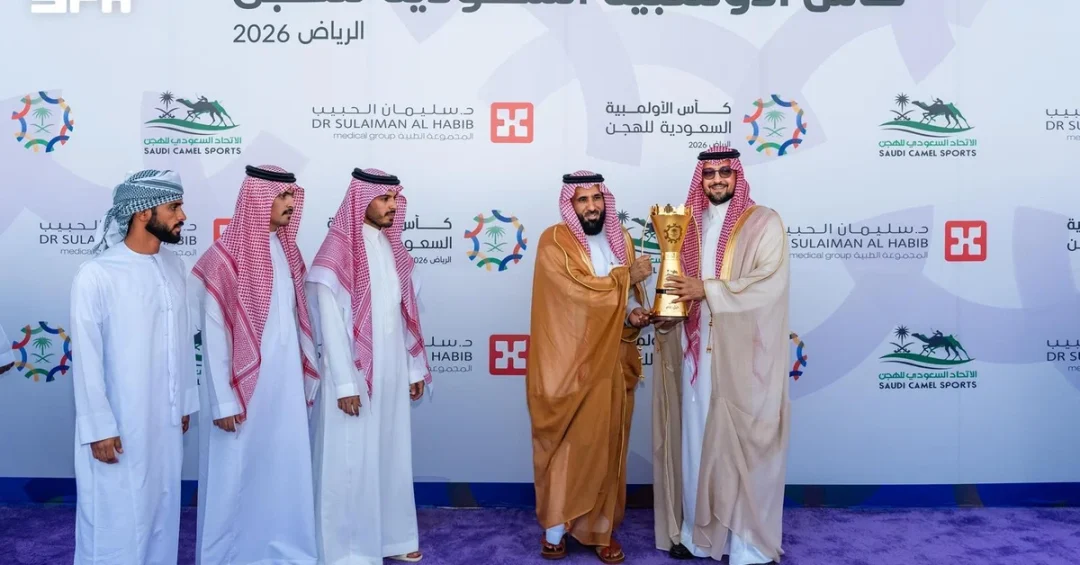
Saudi camels claimed two trophies on the final day of the sixth Saudi Olympic Camel Cup, held at the historic Al-Janadriyah Camel Racecourse in Riyadh, and led the overall race wins with 58 victories, according to the Saudi Press Agency (SPA). The event, organized by the Saudi Camel Sports Federation under the patronage of the Saudi Olympic and Paralympic Committee (SOPC), concluded on November 5, 2026, with a total prize pool exceeding SAR10 million. The competition featured 3,620 camels from Saudi Arabia, Gulf Cooperation Council (GCC) countries, Sudan, and the United States. On behalf of Minister of Sport and SOPC President Prince Abdulaziz bin Turki bin Faisal, SOPC Board Member Prince Abdullah bin Fahd bin Abdullah crowned the winning owners in the hail and zamoul categories.
Have you ever wondered how a traditional desert sport transforms into a global spectacle? The Saudi Olympic Camel Cup has done exactly that, drawing international competitors and showcasing the Kingdom’s rich heritage alongside its modern ambitions. This year’s edition not only highlighted the enduring cultural significance of camel racing but also underscored Saudi Arabia’s growing role as a hub for world-class sporting events. With 12 eight-kilometer races on the final day alone, involving 355 camels, the championship demonstrated the depth of talent and the passionate following that camel racing commands across the region and beyond. The event is a testament to how Saudi Arabia is preserving its traditions while embracing global engagement.
Context and Background
What makes the Saudi Olympic Camel Cup a cornerstone of the Kingdom’s sporting calendar? Since its inception six years ago, the championship has grown into a premier event that celebrates the cultural heritage of the Arabian Peninsula. Camel racing, a sport deeply rooted in Bedouin tradition, has been modernized under the guidance of Saudi leadership, with state-of-the-art facilities and rigorous organization. The Al-Janadriyah Camel Racecourse, located near Riyadh, is a historic venue that has hosted numerous national and international competitions. The Saudi Camel Sports Federation, in collaboration with the SOPC, ensures that the event meets international standards while preserving its authentic character. This year, the participation of countries like Sudan and the United States highlights the sport’s expanding global reach.
The sixth edition of the cup is particularly significant as it aligns with Saudi Vision 2030’s goal to promote cultural heritage and boost sports tourism. By attracting top camels and owners from the GCC and beyond, the event serves as a platform for cultural exchange and economic activity. The prize money exceeding SAR10 million reflects the Kingdom’s commitment to rewarding excellence and supporting the sport’s ecosystem. Moreover, the presence of high-ranking officials like Prince Abdullah bin Fahd bin Abdullah underscores the leadership’s dedication to nurturing traditional sports. As Saudi Arabia continues to diversify its economy, events like this play a vital role in showcasing the nation’s soft power and hospitality.
Key Details
How did the competition unfold on the final day? The closing day featured 12 eight-kilometer races with 355 camels, culminating in the crowning of winners in the hail and zamoul categories. Saudi camels secured two trophies on this day, contributing to their total of nine trophies overall, which tied with Qatar. The United Arab Emirates (UAE) won five trophies, and Oman claimed one. In terms of race wins, Saudi camels dominated with 58 victories, followed by the UAE with 38, Qatar with 27, and Oman, Bahrain, and Kuwait with two each. This performance solidifies Saudi Arabia’s position as a powerhouse in camel racing.
The ceremony was held under the patronage of Prince Abdulaziz bin Turki bin Faisal, Minister of Sport and President of the SOPC, who has been instrumental in elevating Saudi sports on the global stage. Prince Abdullah bin Fahd bin Abdullah, a SOPC Board Member, did the honors of crowning the winners, highlighting the high-level attention the sport receives. The event was organized by Saudi Camel Sports, which ensured smooth logistics and adherence to international racing standards. The total prize money of over SAR10 million was distributed among winners across various categories, providing significant incentives for participants and owners.
What does the participation of international competitors signify? The inclusion of camels from Sudan and the United States, alongside GCC nations, demonstrates the growing international appeal of camel racing. It also reflects Saudi Arabia’s efforts to position itself as a global destination for traditional sports. The diverse field of 3,620 camels competed over several days, with the final day’s races drawing large crowds and media attention. The event’s success is a clear indication of the Kingdom’s capability to host large-scale sporting events that blend heritage with modernity.
International and Regional Impact
How does the Saudi Olympic Camel Cup influence regional dynamics? The strong showing by GCC countries, particularly Qatar and the UAE, highlights the camaraderie and competitive spirit among Gulf nations. The event serves as a unifying platform, fostering friendly competition and cultural exchange. Saudi Arabia’s leadership in race wins (58) not only showcases its superior breeding and training programs but also reinforces its role as a regional leader in preserving and promoting traditional sports. The participation of Sudan and the United States adds an international dimension, signaling that camel racing is no longer confined to the Arabian Peninsula but is gaining traction globally.
From a diplomatic perspective, the championship provides an opportunity for soft power projection. By inviting international participants and hosting them with renowned Saudi hospitality, the Kingdom strengthens its ties with other nations. The event also aligns with Saudi Arabia’s broader strategy to attract visitors and investors, as outlined in Vision 2030. The media coverage generated by the cup, including this report by SPA, helps to shape a positive image of Saudi Arabia as a dynamic and open society that values its heritage. Furthermore, the successful organization of such a complex event demonstrates the Kingdom’s logistical capabilities and its readiness to host even larger international competitions.
Economic and Strategic Significance
What economic benefits does the Saudi Olympic Camel Cup bring? The event injects significant activity into the local economy, from hospitality and transportation to retail and entertainment. With participants and spectators traveling from across the region and beyond, hotels, restaurants, and markets in Riyadh and surrounding areas experience a surge in demand. The prize money of SAR10 million is a direct investment in the sport’s ecosystem, supporting owners, breeders, and trainers. Additionally, the event creates jobs and fosters entrepreneurship in related sectors, such as camel feed, veterinary services, and racing equipment.
Strategically, the cup reinforces Saudi Arabia’s commitment to diversifying its economy away from oil. By promoting sports tourism, the Kingdom taps into a growing global market. Camel racing, with its unique cultural appeal, can attract high-spending tourists interested in authentic experiences. The event also serves as a showcase for Saudi Arabia’s modernization, with advanced technology used in race timing, broadcasting, and spectator engagement. As part of Vision 2030, the development of sports infrastructure and the hosting of international events are key pillars. The Saudi Olympic Camel Cup is a prime example of how traditional sports can be leveraged for economic gain and global recognition.
Vision 2030 Alignment
How does the Saudi Olympic Camel Cup contribute to Vision 2030? The event perfectly embodies the Vision’s objectives of preserving cultural heritage, promoting sports, and enhancing the Kingdom’s global image. By investing in traditional sports, Saudi Arabia ensures that its rich history is passed on to future generations while also creating modern entertainment options. The cup also supports the Quality of Life program, one of Vision 2030’s key initiatives, by providing recreational opportunities for citizens and residents. Moreover, the international participation and media coverage help to position Saudi Arabia as a vibrant and welcoming destination, in line with the Vision’s tourism goals.
As Saudi Arabia continues its journey toward a diversified and dynamic economy, events like the Saudi Olympic Camel Cup will play an increasingly important role. They showcase the Kingdom’s ability to blend tradition with innovation, and they serve as a bridge between the past and the future. With the leadership’s unwavering support and the people’s enthusiasm, the cup is set to grow even more in the coming years, further solidifying Saudi Arabia’s status as a global leader in sports and culture. The sixth edition’s success is a clear sign that the Kingdom is on the right track, and the world is taking notice.
20 Questions
Q1. What was the final day’s highlight of the Saudi Olympic Camel Cup?
A1. The final day featured 12 eight-kilometer races with 355 camels, and Saudi camels won two trophies in the hail and zamoul categories, contributing to their overall lead.
Q2. Who crowned the winners on behalf of the Minister of Sport?
A2. Prince Abdullah bin Fahd bin Abdullah, a Board Member of the Saudi Olympic and Paralympic Committee, crowned the winners on behalf of Prince Abdulaziz bin Turki bin Faisal.
Q3. How many camels participated in the sixth Saudi Olympic Camel Cup?
A3. A total of 3,620 camels from Saudi Arabia, GCC countries, Sudan, and the United States participated in the championship.
Q4. What was the total prize money for the event?
A4. The prize money exceeded SAR10 million, distributed among winners in various categories.
Q5. Which countries won trophies in the championship?
A5. Saudi Arabia and Qatar each won nine trophies, the UAE won five, and Oman won one.
Q6. How many race wins did Saudi camels achieve overall?
A6. Saudi camels led with 58 race wins, followed by the UAE with 38, Qatar with 27, and Oman, Bahrain, and Kuwait with two each.
Q7. Where was the Saudi Olympic Camel Cup held?
A7. The event was held at the historic Al-Janadriyah Camel Racecourse in Riyadh, Saudi Arabia.
Q8. Who organized the Saudi Olympic Camel Cup?
A8. The event was organized by Saudi Camel Sports under the patronage of the Saudi Olympic and Paralympic Committee.
Q9. What is the significance of the participation of Sudan and the United States?
A9. Their participation highlights the growing international appeal of camel racing and Saudi Arabia’s efforts to globalize the sport.
Q10. How does the event align with Saudi Vision 2030?
A10. It preserves cultural heritage, promotes sports tourism, and enhances Saudi Arabia’s global image, aligning with Vision 2030’s goals.
Q11. What categories were featured on the final day?
A11. The final day featured the hail and zamoul categories, with 12 races covering eight kilometers each.
Q12. How many camels competed on the final day?
A12. A total of 355 camels competed in the 12 races on the final day.
Q13. What role did Prince Abdulaziz bin Turki bin Faisal play?
A13. He is the Minister of Sport and President of the Saudi Olympic and Paralympic Committee, under whose patronage the event was held.
Q14. Which country tied with Saudi Arabia in trophy count?
A14. Qatar tied with Saudi Arabia, both winning nine trophies.
Q15. How many trophies did the UAE win?
A15. The United Arab Emirates won five trophies.
Q16. What is the historical significance of Al-Janadriyah?
A16. Al-Janadriyah is a historic site that hosts major cultural and sporting events, including the renowned camel racecourse.
Q17. How does the event contribute to the local economy?
A17. It boosts hospitality, retail, and transportation sectors, and supports jobs in camel breeding, training, and related services.
Q18. What is the Saudi Camel Sports Federation?
A18. It is the organizing body for camel racing in Saudi Arabia, responsible for hosting events like the Saudi Olympic Camel Cup.
Q19. How many editions of the Saudi Olympic Camel Cup have been held?
A19. The sixth edition was held in 2026, indicating five previous successful championships.
Q20. What does the future hold for the Saudi Olympic Camel Cup?
A20. With growing international participation and government support, the cup is expected to expand further, enhancing Saudi Arabia’s status as a global sports destination.
Reader Feedback
We value your thoughts. Please share your feedback on this article.
Your feedback helps us improve our coverage.
Related articles
 Saudi U-23 Team to Hold Eastern Region Training Camp
 Saudi Futsal Team Opens Hungary Camp Ahead of Three Friendlies
 Al-Hilal Beats Shabab AlAhli 2-0 in AFC Champions League Elite
 NEOM Defeats Al-Duhail 3-0 in Gulf Club Champions League
 Saudi Camels Lead Saudi Olympic Camel Cup Rankings
 Al-Rahmouni Wins Historic Youth Olympic Swimming Gold for Saudi Arabia