


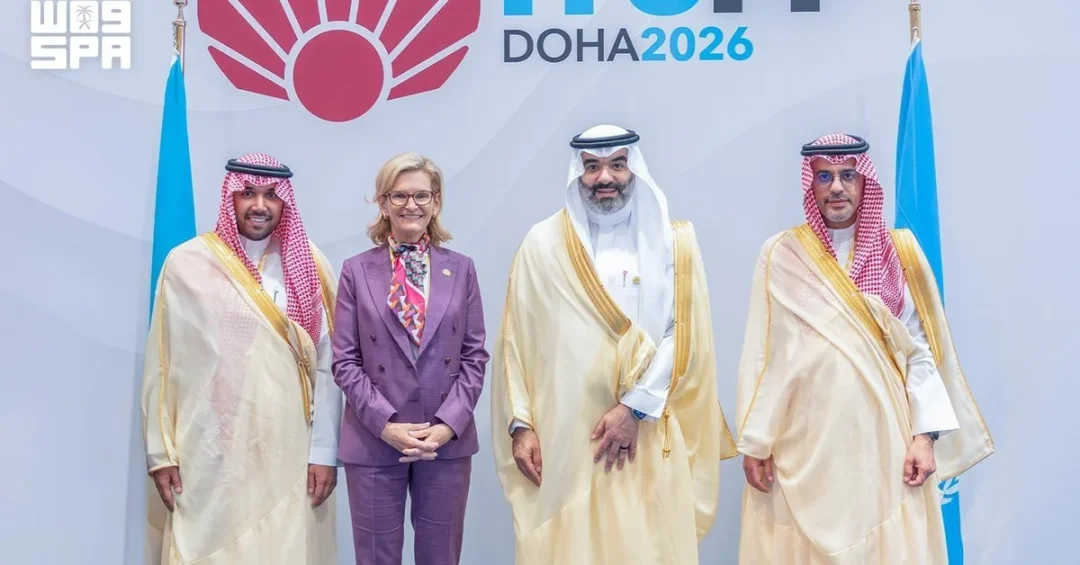
Saudi Arabia’s Minister of Communications and Information Technology, Eng. Abdullah Alswaha, met with the Secretary-General of the International Telecommunication Union (ITU), Doreen Bogdan-Martin, on the sidelines of the ITU Plenipotentiary Conference (PP-26) in Doha, Qatar, to strengthen a partnership that has spanned more than 77 years and to expand cooperation in connectivity, space, and sixth-generation (6G) technologies. The meeting, held in the presence of the Governor of the Communications, Space and Technology Commission (CST), Eng. Haitham AlOhaly, underscored the Kingdom’s commitment to advancing global digital cooperation and ensuring that the benefits of emerging technologies reach all nations.
The discussions focused on ways to enable countries worldwide to benefit from the opportunities presented by artificial intelligence (AI), reinforcing Saudi Arabia’s position as a trusted partner in international efforts to build an inclusive digital future, harness technology for the benefit of humanity, and achieve sustainable development. The high-level engagement reflects the Kingdom’s proactive role in shaping global technology governance and its determination to bridge the digital divide, a priority that aligns with the ITU’s mission to connect the unconnected and with Saudi Arabia’s own Vision 2030 ambitions to diversify its economy and become a global leader in innovation.
Context and Background
Why does a meeting between a Saudi minister and the head of a United Nations agency in Doha matter for the future of global connectivity? The ITU Plenipotentiary Conference, held every four years, is the supreme organ of the International Telecommunication Union, the specialized UN agency for information and communication technologies. PP-26 brings together government representatives from around the world to set the organization’s strategic direction, adopt international standards, and foster cooperation on issues ranging from radio spectrum management to universal broadband access. Saudi Arabia’s active participation at the highest level signals its recognition that digital infrastructure is not merely a domestic concern but a cornerstone of international development and diplomacy.
Saudi Arabia and the ITU have enjoyed a robust partnership for more than 77 years, dating back to the Kingdom’s early engagement with international telecommunications frameworks. Over that period, Saudi Arabia has evolved from a connectivity consumer into a global technology hub, investing heavily in digital infrastructure, cybersecurity, and emerging technologies. The Ministry of Communications and Information Technology (MCIT), led by Eng. Abdullah Alswaha, has been instrumental in driving this transformation, while the Communications, Space and Technology Commission (CST), under Eng. Haitham AlOhaly, regulates the sector and promotes competition and innovation. Together, they represent the Kingdom’s dual approach: strategic policymaking and effective regulation.
The meeting in Doha builds on a series of high-level engagements between Saudi Arabia and the ITU. In recent years, the Kingdom has hosted major international technology events, contributed to ITU initiatives on AI and spectrum management, and supported capacity-building programs for developing countries. This consistent engagement demonstrates Saudi Arabia’s belief that technology should be a force for good, accessible to all, and governed by principles of fairness and sustainability. As the world grapples with the challenges and opportunities of the digital age, the Kingdom’s voice is increasingly sought after in multilateral forums.
Key Details of the Doha Meeting
What exactly was discussed behind closed doors at PP-26? According to the official Saudi Press Agency (SPA) report, the meeting focused on strengthening the longstanding partnership between Saudi Arabia and the ITU and expanding cooperation in three critical areas: connectivity, space, and sixth-generation (6G) technologies. Connectivity remains a top priority, as billions of people worldwide still lack reliable internet access. Saudi Arabia’s experience in deploying high-speed networks across vast and diverse terrain offers valuable lessons for other nations. The Kingdom has also made significant strides in space technology, launching satellites and fostering a commercial space sector, which dovetails with the ITU’s work on spectrum allocation for satellite communications.
6G technologies represent the next frontier in wireless communication, promising ultra-fast speeds, extremely low latency, and ubiquitous connectivity that will underpin the Internet of Things, autonomous systems, and advanced AI applications. By engaging with the ITU on 6G, Saudi Arabia is positioning itself at the forefront of global standards development, ensuring that its investments in research and development translate into influence over how these technologies evolve. The presence of Eng. Haitham AlOhaly, Governor of the CST, highlights the regulatory dimension: spectrum harmonization and standard-setting are essential for 6G to become a reality, and Saudi Arabia is keen to contribute its expertise.
Artificial intelligence was another central theme. The discussions explored ways to enable countries worldwide to benefit from AI opportunities, reflecting Saudi Arabia’s own ambitious AI strategy, which includes the establishment of the Saudi Data and AI Authority (SDAIA) and the launch of initiatives like the Global AI Summit. The Kingdom’s approach emphasizes ethical AI, capacity building, and international collaboration, all of which align with the ITU’s efforts to promote AI for social good. By working with Secretary-General Bogdan-Martin, Minister Alswaha reinforced the message that Saudi Arabia is a reliable partner in shaping a future where AI serves humanity, not the other way around.
International and Regional Impact
How will this meeting influence the broader Middle East and beyond? The Middle East is undergoing a digital transformation, with countries investing heavily in smart cities, e-government, and digital economies. Saudi Arabia’s leadership in this space, exemplified by NEOM and other giga-projects, sets a benchmark for the region. By collaborating closely with the ITU, the Kingdom can help harmonize policies and standards across borders, making it easier for businesses and consumers to benefit from seamless connectivity. This is particularly important for landlocked and least developed countries, which often struggle to attract investment in digital infrastructure. Saudi Arabia’s advocacy for inclusive digital development could unlock new opportunities for these nations.
On the international stage, the meeting reinforces Saudi Arabia’s role as a bridge-builder between developed and developing countries. The ITU operates on the principle of consensus, and Saudi Arabia’s ability to engage constructively with both advanced economies and emerging markets makes it a valuable mediator. The Kingdom’s support for the ITU’s flagship initiatives, such as the Connect 2030 agenda, demonstrates its commitment to the Sustainable Development Goals, particularly those related to infrastructure, innovation, and reduced inequalities. As global competition over technological standards intensifies, Saudi Arabia’s balanced approach ensures that the interests of the Global South are not overlooked.
Regional security and stability also benefit from such cooperation. Reliable communication networks are essential for disaster response, peacekeeping, and economic resilience. By strengthening ties with the ITU, Saudi Arabia contributes to a more stable and predictable international environment for technology governance. This is especially relevant as the world confronts cybersecurity threats and the need for trusted digital infrastructure. The Kingdom’s investments in secure networks and its participation in international cybersecurity frameworks further underscore its role as a responsible global stakeholder.
Economic and Strategic Significance
What does this mean for Saudi Arabia’s economy and its strategic ambitions? The communications and information technology sector is a key pillar of Vision 2030, the Kingdom’s blueprint for economic diversification and social transformation. By expanding cooperation with the ITU, Saudi Arabia can accelerate the growth of its digital economy, attract foreign investment, and create high-skilled jobs for its young population. The development of 6G and AI capabilities will spur innovation in sectors ranging from healthcare and education to manufacturing and entertainment, driving productivity and competitiveness. Moreover, the Kingdom’s leadership in space technology opens new commercial avenues, including satellite broadband and Earth observation services.
Strategically, the meeting in Doha enhances Saudi Arabia’s soft power and its ability to shape global norms. Technology standards are not neutral; they reflect the values and priorities of their creators. By actively participating in ITU processes, Saudi Arabia ensures that its vision of an inclusive, human-centric digital future is embedded in international frameworks. This is a long-term investment in influence and legitimacy. It also complements the Kingdom’s broader foreign policy objectives, which emphasize multilateralism, sustainable development, and peaceful cooperation. The partnership with the ITU is thus both a practical and a symbolic asset.
Furthermore, the engagement aligns with Saudi Arabia’s efforts to position itself as a hub for international organizations and conferences. The Kingdom has hosted numerous global summits, including the G20 in 2020 and various tech-focused events, demonstrating its capacity to convene world leaders and facilitate dialogue. The meeting at PP-26 is another example of Saudi diplomacy in action, leveraging technical expertise to build consensus and advance common goals. As the digital landscape evolves, such engagements will become increasingly important for maintaining Saudi Arabia’s competitive edge.
Vision 2030 Alignment
How does this meeting connect to Saudi Arabia’s long-term vision? Vision 2030, launched by Crown Prince Mohammed bin Salman in 2016, aims to transform the Kingdom into a diversified, innovation-driven economy. Central to this vision is the development of a world-class digital infrastructure and the adoption of emerging technologies. The Ministry of Communications and Information Technology (MCIT) and the Communications, Space and Technology Commission (CST) are at the forefront of these efforts, implementing policies that foster investment, innovation, and digital inclusion. The meeting with the ITU Secretary-General is a direct extension of these goals, seeking international collaboration to accelerate progress and share best practices.
Specifically, the focus on AI, space, and 6G mirrors the Vision 2030 objectives of economic diversification, knowledge transfer, and global engagement. AI is seen as a transformative force that can enhance government services, improve healthcare outcomes, and optimize energy use. Space technology supports national security, environmental monitoring, and telecommunications. 6G will provide the backbone for future digital services, enabling smart cities and autonomous systems. By partnering with the ITU, Saudi Arabia ensures that its domestic initiatives are aligned with global standards and that its voice is heard in shaping the rules of the road. This collaborative approach exemplifies the Kingdom’s belief that sustainable development is best achieved through international cooperation.
In conclusion, the meeting between Eng. Abdullah Alswaha and Doreen Bogdan-Martin is more than a diplomatic courtesy; it is a strategic step toward a more connected, inclusive, and prosperous world. Saudi Arabia’s active role in the ITU reflects its emergence as a global technology leader and its commitment to using technology for the benefit of humanity. As the Kingdom continues its journey toward Vision 2030, partnerships like this will be essential in turning aspirations into reality. The world can expect Saudi Arabia to remain a trusted partner in building the digital future, ensuring that no one is left behind.
20 Questions
Q1. What was the main purpose of the meeting between Eng. Abdullah Alswaha and Doreen Bogdan-Martin?
A1. The meeting aimed to strengthen the longstanding partnership between Saudi Arabia and the ITU and to expand cooperation in connectivity, space, and 6G technologies, as well as to discuss enabling global access to AI opportunities.
Q2. Where did the meeting take place?
A2. The meeting took place on the sidelines of the ITU Plenipotentiary Conference (PP-26) in Doha, Qatar, a major international forum for setting global telecommunications policies and standards.
Q3. Who else was present at the meeting?
A3. Eng. Haitham AlOhaly, Governor of the Communications, Space and Technology Commission (CST), was present, highlighting the regulatory and technical dimensions of the discussions.
Q4. How long has the partnership between Saudi Arabia and the ITU lasted?
A4. The partnership has spanned more than 77 years, reflecting decades of collaboration on telecommunications development and international standards.
Q5. What are the key areas of cooperation discussed?
A5. The key areas were connectivity, space technologies, and sixth-generation (6G) wireless networks, along with the opportunities presented by artificial intelligence for global development.
Q6. Why is connectivity a priority for Saudi Arabia and the ITU?
A6. Connectivity is essential for economic growth, social inclusion, and access to digital services. Both Saudi Arabia and the ITU are committed to bridging the digital divide and ensuring universal access.
Q7. What is the significance of 6G technology in these discussions?
A7. 6G represents the next generation of wireless communication, promising ultra-fast speeds and ubiquitous connectivity. Saudi Arabia aims to be at the forefront of its development and standardization.
Q8. How does space technology factor into the cooperation?
A8. Space technology is crucial for satellite communications, Earth observation, and navigation. Saudi Arabia’s growing space sector can benefit from ITU coordination on spectrum and orbital resources.
Q9. What role does artificial intelligence play in the meeting’s outcomes?
A9. AI was discussed as a transformative tool that can benefit all countries. Saudi Arabia seeks to enable global access to AI opportunities and promote ethical, inclusive AI development.
Q10. How does this meeting reflect Saudi Arabia’s Vision 2030?
A10. It aligns directly with Vision 2030’s goals of economic diversification, technological leadership, and international engagement, supporting the Kingdom’s digital transformation and global partnerships.
Q11. What is the ITU Plenipotentiary Conference?
A11. The ITU Plenipotentiary Conference is the supreme organ of the ITU, held every four years to set the organization’s strategic direction, adopt standards, and foster international cooperation in telecommunications.
Q12. Why is Saudi Arabia’s participation in the ITU important?
A12. Saudi Arabia’s participation ensures that its voice and expertise contribute to global technology governance, helping shape standards that reflect its vision of inclusive and sustainable digital development.
Q13. What benefits can other countries gain from this cooperation?
A13. Other countries, especially developing nations, can benefit from Saudi Arabia’s experience in deploying advanced networks, as well as from collaborative initiatives on AI, space, and 6G that promote knowledge transfer.
Q14. How does the meeting impact the Middle East region?
A14. It reinforces regional digital integration and sets a benchmark for technology leadership, potentially accelerating smart city projects and cross-border connectivity in the Middle East.
Q15. What is the role of the CST in Saudi Arabia’s digital strategy?
A15. The CST regulates the communications, space, and technology sectors, promoting competition, innovation, and investment while ensuring the reliability and security of digital infrastructure.
Q16. How does Saudi Arabia support global digital inclusion?
A16. Saudi Arabia supports digital inclusion through international partnerships, capacity-building programs, and advocacy for policies that make technology accessible and affordable for all nations.
Q17. What are the expected outcomes of this meeting?
A17. Expected outcomes include enhanced collaboration on 6G standards, joint initiatives on AI and space, and a stronger commitment to bridging the digital divide through ITU frameworks.
Q18. How does this meeting advance Saudi Arabia’s soft power?
A18. By actively shaping global technology norms and demonstrating leadership in multilateral forums, Saudi Arabia enhances its reputation as a trusted and influential international partner.
Q19. What does the 77-year partnership signify?
A19. It signifies a long-standing commitment to international cooperation and mutual progress, with Saudi Arabia evolving from a beneficiary to a key contributor in global telecommunications.
Q20. What is the next step for Saudi Arabia and the ITU?
A20. The next steps likely involve follow-up technical meetings, joint working groups, and the implementation of collaborative projects in connectivity, AI, space, and 6G, as outlined in the discussions.
Reader Feedback
We value your thoughts. Please share your feedback on this article.
Your feedback helps us improve our coverage.
Related articles
 Manasek Al-Mashaer Showcases Pilgrim Services at Hajj Conference
 Saudi Minister Alswaha Calls for Inclusive AI Future at ITU
 Saudi Minister Signs GCC Railway Link Agreement in Bahrain
 Transport Ministry Showcases Pilgrim Services at Hajj Conference
 Saudi Ministry Wins IRF Global Award for Road Asset Evaluation
 Saudia Group Showcases Integrated Services for Pilgrims at Hajj Conference and Exhibition