


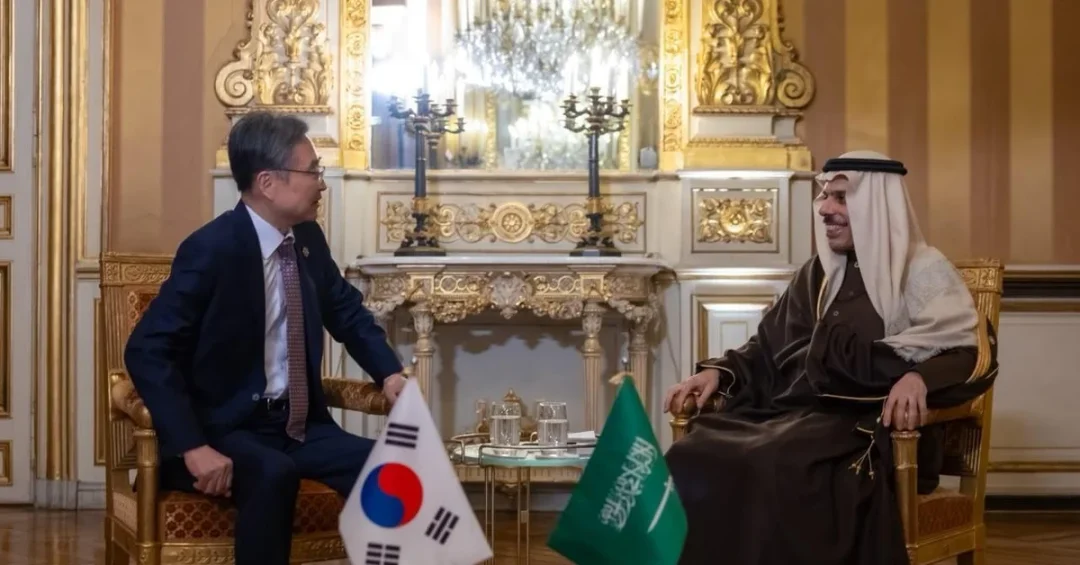
Saudi Minister of Foreign Affairs Prince Faisal bin Farhan bin Abdullah met with Korean Minister of Foreign Affairs Cho Hyun on the sidelines of the Group of Seven (G7) Foreign Ministers’ Meeting in Paris on November 9, 2026, as confirmed by the Saudi Press Agency (SPA). The meeting focused on reviewing bilateral relations and exploring avenues of cooperation and partnership between the two countries, while also exchanging views on current regional issues and ongoing efforts to address them. Saudi Ambassador to France Dr. Faisal Al-Mujfel attended the meeting, underscoring the importance Saudi Arabia places on its diplomatic engagements in Europe and beyond. How might this encounter shape the future of Saudi-Korean relations and contribute to regional stability?
The G7 Foreign Ministers’ Meeting in Paris brought together top diplomats from major economies, providing a platform for Saudi Arabia to advance its foreign policy objectives and strengthen ties with key international partners. Prince Faisal’s participation reflects the Kingdom’s active role in global diplomacy, consistent with its Vision 2030 goals of enhancing international cooperation and economic diversification. The meeting with Minister Cho Hyun is part of a broader effort to deepen Saudi-Korean relations, which have seen significant growth in recent years across trade, investment, and cultural exchange. As Saudi Arabia continues to expand its global partnerships, such high-level dialogues are essential for addressing shared challenges and fostering mutual prosperity.
Context and Background
What are the historical foundations of Saudi-Korean relations that make this meeting so significant? Saudi Arabia and South Korea have maintained diplomatic ties since 1962, and over the decades, the relationship has evolved into a robust partnership encompassing energy, infrastructure, technology, and defense. South Korea has been a key partner in Saudi Arabia’s development, with Korean companies playing a major role in landmark projects such as the Riyadh Metro and various petrochemical plants. In recent years, both nations have sought to expand cooperation into new areas like renewable energy, digital transformation, and smart cities, aligning with Saudi Vision 2030. The meeting in Paris builds on this momentum, offering an opportunity to review progress and chart new directions for collaboration.
The G7 Foreign Ministers’ Meeting itself is a significant diplomatic gathering, typically focusing on global security, economic stability, and climate action. Saudi Arabia’s participation as a guest reflects its growing influence on the world stage and its commitment to multilateralism. By meeting with counterparts like Minister Cho Hyun on the sidelines, Prince Faisal can engage in focused discussions that advance Saudi interests and contribute to international efforts to resolve regional conflicts. This approach is consistent with Saudi Arabia’s longstanding policy of constructive engagement and dialogue. The presence of Ambassador Dr. Faisal Al-Mujfel highlights the important role of Saudi diplomatic missions in facilitating these high-level interactions.
Key Details of the Meeting
What specific topics were on the agenda during this bilateral meeting? According to the Saudi Press Agency, the two ministers reviewed bilateral relations and discussed avenues of cooperation and partnership between their countries. They also exchanged views on current regional issues and ongoing efforts to address them. While the official statement did not disclose specific agreements or initiatives, the meeting likely covered areas such as trade, investment, energy, and regional security. The discussions may have also touched on cultural and educational exchanges, which are vital for fostering people-to-people ties. The presence of Ambassador Al-Mujfel indicates the importance of the diplomatic channel in implementing the outcomes of such talks.
The meeting comes at a time of heightened global uncertainty, with ongoing conflicts and economic challenges requiring coordinated responses. Saudi Arabia has been actively involved in diplomatic efforts to promote peace and stability in the Middle East and beyond. Engaging with South Korea, a key ally in Asia, allows the Kingdom to align its strategies with like-minded partners. Both countries share an interest in ensuring energy security, combating climate change, and promoting sustainable development. The exchange of views on regional issues likely included discussions on the situation in the Middle East, the Korean Peninsula, and other areas of mutual concern. Such dialogues are essential for building consensus and identifying common ground.
International and Regional Impact
How does this meeting influence Saudi Arabia’s standing in the international community? By participating in the G7 Foreign Ministers’ Meeting and holding bilateral talks with Korean counterparts, Saudi Arabia demonstrates its commitment to active diplomacy and global engagement. This enhances the Kingdom’s image as a responsible international actor and a bridge-builder between different regions. The meeting with South Korea, a technologically advanced nation and a key player in Asia, signals Saudi Arabia’s intent to diversify its partnerships beyond traditional allies. It also reinforces the Kingdom’s role in promoting stability and cooperation in the Middle East and beyond, which is crucial for global peace and economic prosperity.
From a regional perspective, closer Saudi-Korean ties can contribute to balancing power dynamics and fostering development. South Korea’s expertise in technology and innovation can support Saudi Arabia’s diversification efforts, while Saudi Arabia’s energy resources and strategic location offer benefits to South Korea. The meeting may also pave the way for increased Korean investment in Saudi megaprojects like NEOM and the Red Sea Project. Furthermore, cooperation on regional security issues, such as maritime security and counterterrorism, can enhance stability in both the Middle East and East Asia. As Saudi Arabia continues to open up and modernize, partnerships with countries like South Korea will be instrumental in achieving its Vision 2030 objectives.
Economic and Strategic Significance
What economic opportunities could arise from strengthened Saudi-Korean relations? Trade between Saudi Arabia and South Korea has been substantial, with Saudi Arabia being a major supplier of crude oil to South Korea and South Korea exporting automobiles, electronics, and construction services to the Kingdom. In 2022, bilateral trade exceeded $30 billion, and both countries aim to expand this further. The meeting in Paris could accelerate discussions on joint ventures in renewable energy, hydrogen production, and digital infrastructure. Saudi Arabia’s Public Investment Fund (PIF) has already invested in Korean companies, and further collaboration could boost technology transfer and job creation. These economic ties are vital for Saudi Arabia’s economic diversification and for South Korea’s energy security.
Strategically, the partnership extends to defense and security cooperation. South Korea has been a partner in Saudi Arabia’s defense modernization, and both countries share interests in maintaining stability in the Strait of Hormuz and other vital waterways. The meeting may have included discussions on joint military exercises, intelligence sharing, and defense procurement. Additionally, cultural and educational exchanges, such as scholarships for Saudi students in Korea and Korean cultural events in Saudi Arabia, strengthen people-to-people bonds. These multifaceted ties reflect the depth of the relationship and its potential for further growth. As Saudi Arabia pursues its Vision 2030 goals, strategic partnerships like this are essential for achieving sustainable development and global influence.
Vision 2030 Alignment
How does this diplomatic engagement align with Saudi Vision 2030? Vision 2030 aims to diversify the Saudi economy, reduce dependence on oil, and enhance the Kingdom’s global competitiveness. International partnerships are a cornerstone of this strategy, and the meeting between Prince Faisal and Minister Cho Hyun exemplifies how Saudi Arabia is building bridges with key nations to achieve these goals. By collaborating with South Korea in areas like technology, renewable energy, and smart cities, Saudi Arabia can accelerate its transition to a knowledge-based economy. Moreover, the exchange of views on regional issues supports Vision 2030’s objective of promoting peace and stability, which are prerequisites for economic growth and investment.
In conclusion, the meeting in Paris is a testament to Saudi Arabia’s proactive foreign policy and its commitment to fostering strong international ties. As the Kingdom continues to implement Vision 2030, such high-level dialogues will play a crucial role in unlocking new opportunities and addressing shared challenges. The partnership with South Korea is poised to deepen further, benefiting both nations and contributing to regional and global prosperity. With its focus on cooperation, innovation, and mutual respect, Saudi Arabia is well-positioned to achieve its ambitious vision and to help shape a more stable and prosperous world.
20 Questions
Q1. Who represented Saudi Arabia at the G7 Foreign Ministers’ Meeting in Paris?
A1. Saudi Arabia was represented by Minister of Foreign Affairs Prince Faisal bin Farhan bin Abdullah, who attended the meeting and held bilateral discussions with counterparts, including Korean Minister of Foreign Affairs Cho Hyun.
Q2. When and where did the meeting between Prince Faisal and Minister Cho Hyun take place?
A2. The meeting took place on November 9, 2026, in Paris, on the sidelines of the G7 Foreign Ministers’ Meeting, as reported by the Saudi Press Agency.
Q3. What was the main purpose of the meeting?
A3. The two officials reviewed bilateral relations and discussed avenues of cooperation and partnership between their countries, and exchanged views on current regional issues and ongoing efforts to address them.
Q4. Who else attended the meeting?
A4. Saudi Ambassador to France Dr. Faisal Al-Mujfel attended the meeting, highlighting the involvement of Saudi diplomatic missions in supporting high-level engagements.
Q5. What is the significance of Saudi Arabia’s participation in the G7 meeting?
A5. It demonstrates Saudi Arabia’s active role in global diplomacy and its commitment to multilateral cooperation, aligning with Vision 2030 goals of international engagement.
Q6. How long have Saudi Arabia and South Korea maintained diplomatic relations?
A6. Saudi Arabia and South Korea established diplomatic ties in 1962, and the relationship has grown significantly over the decades, encompassing various sectors.
Q7. What are the key areas of cooperation between Saudi Arabia and South Korea?
A7. Key areas include energy, infrastructure, technology, defense, and cultural exchange, with growing focus on renewable energy and digital transformation.
Q8. How does this meeting support Saudi Vision 2030?
A8. It advances Vision 2030 by strengthening international partnerships that promote economic diversification, technology transfer, and sustainable development.
Q9. What regional issues might have been discussed?
A9. While specifics were not disclosed, discussions likely covered Middle East security, Korean Peninsula dynamics, and global challenges like climate change and energy security.
Q10. What is the economic value of Saudi-Korean trade?
A10. Bilateral trade exceeds $30 billion annually, with Saudi Arabia exporting crude oil and South Korea exporting automobiles, electronics, and construction services.
Q11. How does South Korea contribute to Saudi Arabia’s development?
A11. South Korean companies have been involved in major projects like the Riyadh Metro and petrochemical plants, and they bring technological expertise to support Saudi diversification.
Q12. What role does the Saudi Ambassador to France play?
A12. The ambassador facilitates diplomatic engagements, supports high-level visits, and helps implement bilateral agreements between Saudi Arabia and France.
Q13. Are there any agreements signed during this meeting?
A13. The SPA report did not mention any specific agreements signed, but the meeting focused on reviewing relations and exploring cooperation avenues.
Q14. How does this meeting fit into Saudi Arabia’s broader foreign policy?
A14. It reflects Saudi Arabia’s strategy of building diverse partnerships, promoting peace, and enhancing its global influence in line with Vision 2030.
Q15. What are the prospects for future Saudi-Korean collaboration?
A15. Prospects are strong, with potential for increased cooperation in renewable energy, smart cities, defense, and cultural exchanges, benefiting both nations.
Q16. What is the G7 Foreign Ministers’ Meeting?
A16. It is a gathering of foreign ministers from the Group of Seven major economies to discuss global issues, and Saudi Arabia participates as a guest.
Q17. How does Saudi Arabia benefit from engaging with South Korea?
A17. Saudi Arabia gains access to advanced technology, investment, and expertise, which support economic diversification and job creation.
Q18. What cultural exchanges exist between Saudi Arabia and South Korea?
A18. Cultural exchanges include scholarships for Saudi students in Korea, Korean cultural events in Saudi Arabia, and collaborations in arts and heritage.
Q19. How does this meeting impact regional stability?
A19. By aligning with South Korea on regional issues, Saudi Arabia contributes to global efforts to promote peace and security, which are essential for economic prosperity.
Q20. What message does this meeting send to the international community?
A20. It signals Saudi Arabia’s commitment to constructive diplomacy, international cooperation, and its role as a responsible global partner under Vision 2030.
Reader Feedback
We value your thoughts. Please share your feedback on this article.
Your feedback helps us improve our coverage.
Related articles
 Coalition Destroys Houthi Ballistic Missile Facilities
 Saudi FM Meets German Counterpart in Paris
 Light Rain and Thunderstorms Hit Al-Baha Region
 KSrelief Delivers Clean Water to Displaced Families in Taiz
 KSrelief Expands Dialysis Care in Yemen’s Al-Dhalea
 KSrelief Distributes 1,042 Food Baskets in Yemen’s Marib