


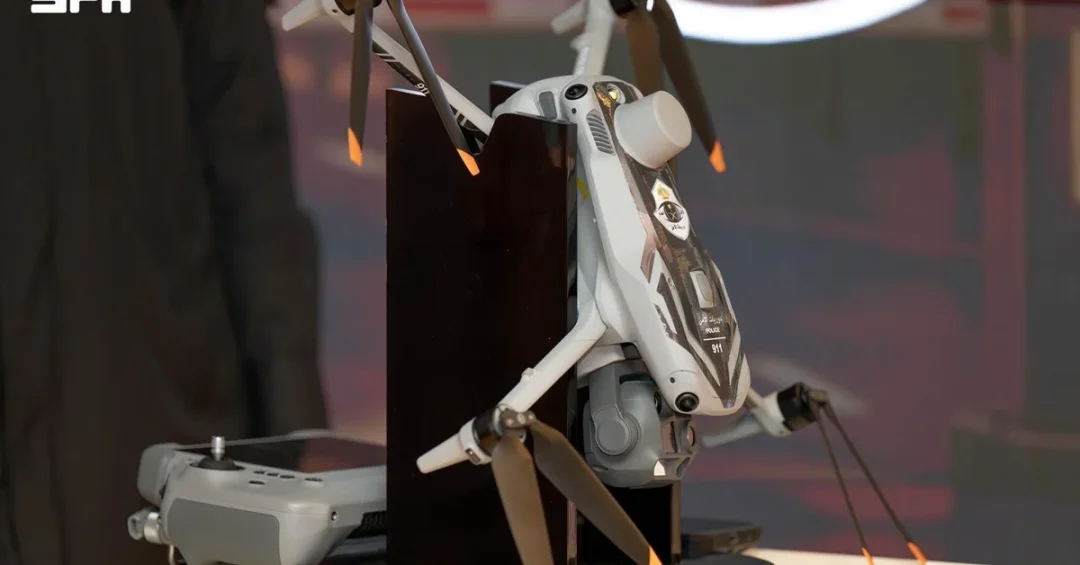
Saudi Arabia’s Public Security is showcasing an advanced unmanned aerial vehicle (UAV) equipped with high-resolution cameras and artificial intelligence at the Ministry of Interior’s pavilion during the Hajj Conference and Exhibition in Jeddah. The event, held under the patronage of the Ministry of Interior, highlights the Kingdom’s commitment to leveraging cutting-edge technology to ensure the safety and security of millions of pilgrims. The UAV, which features night-vision capabilities and a direct link to the operations center, represents a significant leap forward in real-time surveillance and field monitoring during the Hajj season. How does such innovation reflect Saudi Arabia’s broader vision for smart security and pilgrim safety?
The Hajj Conference and Exhibition serves as a global platform for showcasing the latest advancements in crowd management, security, and logistics related to the annual pilgrimage. This year, the spotlight is on a UAV that not only captures high-resolution imagery but also uses AI to identify moving objects, enabling authorities to monitor and apprehend individuals violating Hajj regulations. The technology was recently deployed during the Hajj season, enhancing the efficiency of field operations and contributing to the overall safety of pilgrims. The Ministry of Interior’s pavilion has drawn attention from international delegations and experts eager to learn from Saudi Arabia’s experience in managing one of the world’s largest annual gatherings.
Context and Background
Why has Saudi Arabia invested so heavily in technological solutions for Hajj security? The answer lies in the Kingdom’s unwavering commitment to ensuring the well-being of pilgrims, who arrive from over 180 countries to perform the sacred rites. With millions of people converging on Mecca and its surroundings within a short period, the challenges of crowd control, emergency response, and regulation enforcement are immense. Traditional methods of surveillance and monitoring have limitations, especially in crowded and dynamic environments. The introduction of AI-powered UAVs marks a paradigm shift, allowing security forces to obtain real-time aerial views, detect anomalies, and respond swiftly to potential threats or violations.
The Ministry of Interior has long been at the forefront of adopting innovative technologies to enhance public safety. Over the years, it has implemented sophisticated command-and-control systems, facial recognition tools, and integrated communication networks. The UAV showcased at the Hajj Conference and Exhibition is the latest addition to this arsenal. It is equipped with a high-resolution camera that can capture clear images even in low-light conditions, thanks to its night-vision capabilities. The direct link to the operations center ensures that decision-makers receive live footage, enabling them to make informed decisions quickly. This level of situational awareness is crucial during Hajj, where even minor incidents can escalate if not addressed promptly.
Furthermore, the UAV’s AI technology is designed to identify moving objects, which can help distinguish between normal crowd movement and suspicious behavior. This capability not only aids in apprehending violators but also assists in search-and-rescue missions and crowd flow management. The Ministry of Interior’s efforts align with the broader objectives of Saudi Vision 2030, which seeks to modernize public services and enhance the quality of life for citizens and visitors alike. By integrating advanced technologies into Hajj operations, the Kingdom is setting new benchmarks for safety and efficiency in mass gatherings.
Key Details
What exactly makes this UAV a game-changer for Hajj security? At its core, the UAV is a compact, agile aircraft that can be deployed rapidly in various terrains. Its high-resolution camera provides crystal-clear imagery, while the AI algorithms process the video feed in real time to detect and track moving objects. This means that security personnel can monitor specific areas of interest, follow individuals who may be violating regulations, and coordinate ground teams accordingly. The night-vision feature extends its operational capability to nighttime, when visibility is limited but the need for vigilance remains high. The direct link to the operations center ensures seamless communication and data transmission, allowing for a coordinated response.
During the last Hajj season, this UAV was instrumental in identifying and apprehending individuals who were not authorized to perform Hajj or who were violating specific instructions. By providing aerial surveillance, it helped security forces cover large areas more efficiently than ground patrols alone. The UAV also played a role in monitoring crowd density and movement patterns, which is essential for preventing stampedes and ensuring smooth flow of pilgrims between holy sites. The data collected by the UAV can be analyzed to improve future crowd management strategies, making Hajj safer year after year.
The Ministry of Interior’s pavilion at the Hajj Conference and Exhibition offers visitors a firsthand look at this technology. Experts are on hand to explain its features and demonstrate its capabilities through simulations and video presentations. The exhibition also includes other innovative tools and systems used in Hajj operations, such as smart bracelets for pilgrim identification, advanced communication devices, and AI-driven analytics platforms. Together, these technologies form an integrated ecosystem that supports the Kingdom’s goal of providing a safe and spiritually fulfilling experience for all pilgrims.
International and Regional Impact
How does Saudi Arabia’s use of AI-powered UAVs influence global perceptions of its security capabilities? The Kingdom’s proactive approach to leveraging technology for public safety has garnered praise from international organizations and partner nations. Many countries face similar challenges in managing large crowds and ensuring security during major events. Saudi Arabia’s experience with Hajj, one of the largest annual gatherings in the world, offers valuable lessons. By showcasing its UAV technology at the Hajj Conference and Exhibition, the Kingdom positions itself as a leader in smart security solutions and a reliable partner in international efforts to combat terrorism and maintain public order.
Regionally, the adoption of such advanced technology reinforces Saudi Arabia’s role as a stabilizing force in the Middle East. It demonstrates the Kingdom’s ability to harness innovation for the benefit of its people and visitors, while also contributing to the broader security architecture of the region. Neighboring countries and allies have expressed interest in collaborating with Saudi Arabia on security technologies, opening avenues for knowledge exchange and joint ventures. The UAV’s success during Hajj serves as a proof of concept that can be adapted to other mass gatherings, such as the annual Umrah season or major sporting events.
Moreover, the exhibition provides a platform for Saudi security agencies to engage with international counterparts, sharing best practices and exploring new avenues for cooperation. The presence of foreign delegations at the conference underscores the global recognition of Saudi Arabia’s efforts in crowd management and counter-terrorism. By fostering dialogue and collaboration, the Kingdom enhances its soft power and strengthens diplomatic ties, aligning with Vision 2030’s goal of positioning Saudi Arabia as a global hub for innovation and investment.
Economic and Strategic Significance
What are the economic and strategic benefits of deploying AI-powered UAVs in Hajj operations? First and foremost, the technology enhances the efficiency of security forces, allowing them to do more with fewer resources. This translates into cost savings and better allocation of manpower, which can be redirected to other critical areas. The UAV’s ability to provide real-time intelligence reduces the need for extensive ground patrols in hazardous or hard-to-reach areas, minimizing risk to personnel. Additionally, the data collected can inform infrastructure planning and urban development in the holy sites, supporting long-term economic growth.
Strategically, the integration of AI and UAVs into Hajj security demonstrates Saudi Arabia’s technological sovereignty and its capacity to innovate independently. It reduces reliance on foreign systems and fosters local talent in fields such as robotics, AI, and data analytics. This aligns with Vision 2030’s objective of diversifying the economy and creating high-skilled jobs for Saudi youth. The Ministry of Interior’s collaboration with local tech companies and research institutions further strengthens the domestic innovation ecosystem, paving the way for exports of Saudi-made security solutions to other countries.
Furthermore, the successful deployment of such technology during Hajj enhances the Kingdom’s reputation as a safe and well-managed destination, which is crucial for attracting tourists and investors. A secure environment is a prerequisite for economic prosperity, and the UAV contributes to that by deterring violations and ensuring smooth operations. As Saudi Arabia continues to open up to the world through initiatives like Vision 2030, the role of advanced security technology in safeguarding visitors becomes ever more important.
Vision 2030 Alignment
How does the Public Security UAV showcase align with Saudi Vision 2030? Vision 2030 is a comprehensive plan to transform Saudi Arabia into a diversified, innovative, and globally engaged economy. A key pillar of this vision is enhancing public services through digital transformation and smart technologies. The UAV, with its AI and real-time transmission capabilities, exemplifies this pillar by modernizing security operations and improving the quality of life for pilgrims. It also supports the vision’s goal of increasing the number of pilgrims and Umrah performers, as a safe and efficient Hajj experience encourages more visitors to come to the Kingdom.
In conclusion, the display of the AI-powered UAV at the Hajj Conference and Exhibition is a testament to Saudi Arabia’s forward-thinking approach to security and its unwavering commitment to the safety of pilgrims. It underscores the Kingdom’s leadership in adopting advanced technologies and its dedication to achieving the objectives of Vision 2030. As the world watches, Saudi Arabia continues to set new standards for excellence in crowd management and public safety, ensuring that the Hajj remains a spiritually uplifting and secure journey for all. What better way to demonstrate the Kingdom’s progress than by safeguarding the most sacred gathering on earth?
20 Questions
Q1. What is the AI-powered UAV showcased by Public Security?
A1. It is an unmanned aerial vehicle equipped with a high-resolution camera and artificial intelligence that can identify moving objects, featuring night-vision capabilities and a direct link to the operations center for real-time transmission.
Q2. Where is the UAV being showcased?
A2. It is being showcased at the Ministry of Interior’s pavilion during the Hajj Conference and Exhibition in Jeddah, Saudi Arabia.
Q3. What are the key features of this UAV?
A3. The UAV features a high-resolution camera, AI for identifying moving objects, night-vision capabilities, and a direct link to the operations center for real-time image and footage transmission.
Q4. How does the UAV enhance Hajj security?
A4. It enhances security by monitoring and apprehending individuals violating Hajj regulations, improving field surveillance efficiency, and helping ensure the safety and security of pilgrims.
Q5. When was the UAV deployed during Hajj?
A5. It was recently deployed during the Hajj season to support security operations and monitor compliance with Hajj regulations.
Q6. What role does AI play in the UAV’s operation?
A6. AI enables the UAV to identify moving objects in real time, helping security personnel detect suspicious behavior and track individuals of interest more effectively.
Q7. How does the night-vision capability benefit Hajj operations?
A7. Night-vision allows the UAV to operate effectively in low-light conditions, ensuring continuous surveillance and security during nighttime hours when visibility is limited.
Q8. What is the significance of the direct link to the operations center?
A8. The direct link enables real-time transmission of images and footage, allowing decision-makers to receive live intelligence and coordinate rapid responses to incidents.
Q9. Which government body is responsible for this technology?
A9. The technology is presented by Public Security under the Ministry of Interior, which oversees internal security and public safety in Saudi Arabia.
Q10. How does this UAV contribute to pilgrim safety?
A10. By providing aerial surveillance and real-time data, the UAV helps prevent overcrowding, detect violations, and ensure a secure environment for pilgrims performing Hajj.
Q11. What other technologies are showcased at the Hajj Conference and Exhibition?
A11. The exhibition features various innovations including smart bracelets for pilgrim identification, advanced communication systems, and AI-driven analytics platforms for crowd management.
Q12. How does the UAV align with Saudi Vision 2030?
A12. It aligns with Vision 2030 by promoting digital transformation, enhancing public services, and supporting the goal of providing a safe and efficient Hajj experience for millions of pilgrims.
Q13. What impact does this technology have on international perceptions of Saudi Arabia?
A13. It reinforces Saudi Arabia’s image as a technologically advanced and security-conscious nation, attracting praise and interest from international partners and organizations.
Q14. Can the UAV be used for purposes other than security?
A14. Yes, the UAV’s capabilities can support search-and-rescue missions, crowd flow management, and infrastructure monitoring during large events.
Q15. How does the UAV improve efficiency of security forces?
A15. It reduces the need for extensive ground patrols, covers large areas quickly, and provides real-time intelligence, allowing forces to allocate resources more effectively.
Q16. What training is required to operate the UAV?
A16. Operators require specialized training in UAV piloting, AI systems, and data analysis to effectively use the technology for security operations.
Q17. Is the UAV manufactured locally or imported?
A17. While specific manufacturing details are not disclosed, Saudi Arabia is increasingly developing local capabilities in UAV and AI technologies as part of Vision 2030.
Q18. How does the UAV handle privacy concerns?
A18. The UAV is used strictly for security purposes during Hajj, with operations governed by regulations that balance security needs with privacy protections.
Q19. What feedback has the UAV received from international delegations?
A19. International delegations have shown keen interest in the UAV’s capabilities, recognizing its potential for enhancing crowd management and security at large gatherings worldwide.
Q20. What future developments can be expected for Hajj security technology?
A20. Future developments may include more autonomous UAVs, enhanced AI analytics, and integrated systems that further improve safety and efficiency during Hajj and other mass events.
Reader Feedback
We value your thoughts. Please share your feedback on this article.
Your feedback helps us improve our coverage.
Related articles
 Media Ambassadors Initiative Launches Third Phase Workshops
 Interactive Displays at Hajj Conference Showcase Digital Services for Pilgrims
 Hajj Minister Reviews Major Transformations Behind 93% Pilgrim Satisfaction
 Global Participants Enrich Hajj Conference in Jeddah
 Thai Students Explore Hajj Innovations at Jeddah Exhibition
 Madinah Development Authority Showcases Projects at Hajj Conference