


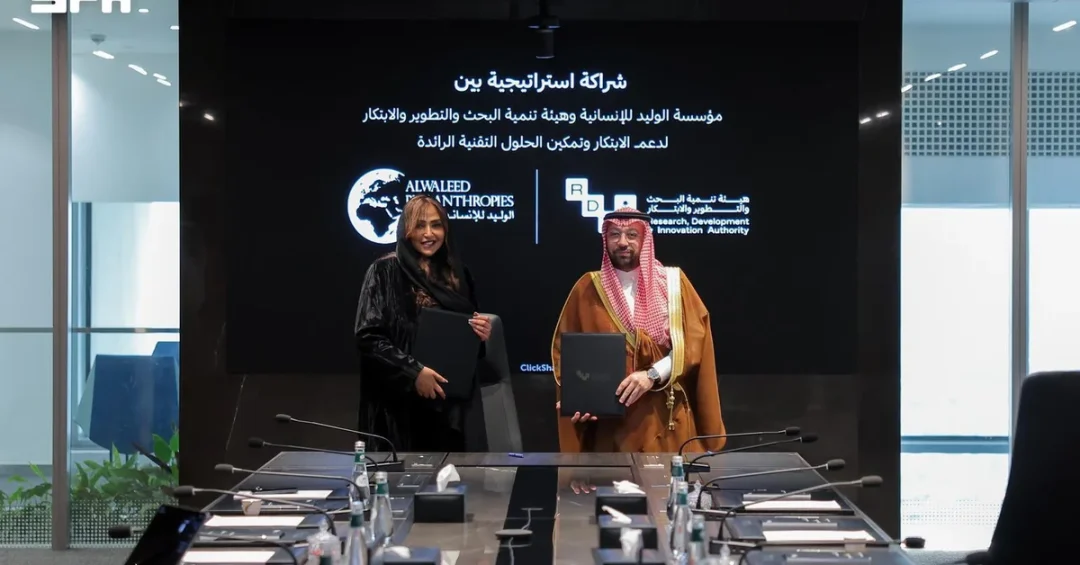
Alwaleed Philanthropies and the Research, Development and Innovation Authority (RDIA) have signed a strategic partnership to strengthen Saudi Arabia’s research, development, and innovation ecosystem, empowering researchers and innovators while developing practical solutions with measurable impact. The agreement, announced in Riyadh, brings together one of the Kingdom’s most prominent philanthropic foundations and the national body responsible for steering research and innovation policy, creating a coordinated effort to convert promising technologies into real-world applications. The signing ceremony was attended by Princess Lamia bint Majed bin Saud, Secretary-General of Alwaleed Philanthropies, and Dr. Munir M. Eldesouki, Acting Governor of RDIA, underscoring the high-level commitment behind the collaboration.
At a time when economies around the world are racing to build knowledge-driven industries, this partnership signals Saudi Arabia’s determination to link charitable giving with national innovation priorities. By combining philanthropic capital with the institutional reach of a government authority, the two organizations aim to accelerate the journey from laboratory research to market-ready products. The collaboration also reflects a broader shift in how the Kingdom approaches development: not simply funding ideas, but actively monitoring their progress, measuring their outcomes, and helping them scale. For international observers, the agreement offers a clear window into how Saudi institutions are working together to advance the goals of Vision 2030.
Context and Background
Why does a philanthropic foundation partner with a national innovation authority, and what does that tell us about the direction of Saudi development? The answer lies in the Kingdom’s evolving approach to research and development, which has moved from fragmented individual efforts toward coordinated, outcome-focused programs. The Research, Development and Innovation Authority (RDIA) was established to serve as the central government body guiding the Kingdom’s research and innovation agenda, aligning funding, policy, and infrastructure with national priorities. Alwaleed Philanthropies, founded and chaired by Prince Alwaleed bin Talal, has a long record of supporting education, health, disaster relief, and community development across the world.
Bringing these two institutions together creates a bridge between the philanthropic sector and the public innovation system. Alwaleed Philanthropies contributes not only financial resources but also a culture of social responsibility and long-term commitment to human development. RDIA contributes technical expertise, access to the national research ecosystem, and the policy tools needed to scale successful projects. Together, they form a model in which private generosity and public strategy reinforce one another, a pattern increasingly common in advanced economies seeking to accelerate innovation without relying solely on state budgets.
The partnership also fits within a wider national conversation about how Saudi Arabia measures the return on its investments in science and technology. Rather than treating research funding as an isolated expenditure, the Kingdom is increasingly asking how each initiative translates into jobs, products, and improved quality of life. This results-oriented mindset is central to the agreement and helps explain why performance monitoring is written directly into the partnership’s design.
Key Details of the Partnership
What exactly will this collaboration deliver, and how will success be measured? The partnership includes providing financial support and performance monitoring for the Open RAN Challenge initiative, a program under which four startups were selected for their innovative and practical technology solutions. Open RAN, or Open Radio Access Network, refers to an approach to telecommunications infrastructure that allows different vendors’ components to interoperate, reducing costs and encouraging competition. Supporting startups in this field aligns with global trends toward more open, flexible, and resilient network architecture.
Under the agreement, the partnership will support the winning startups, monitor the progress of their solutions, accelerate their transition to implementation and product launches, and measure their impact. This is a notably comprehensive mandate. It is not enough to award a prize or write a grant; the partners intend to follow each venture through the difficult middle stages of development, when promising prototypes must be tested, refined, and brought to market. That hands-on support can be decisive for young companies that often struggle to move from technical proof-of-concept to commercial viability.
The emphasis on monitoring and impact measurement is equally significant. By tracking how each supported startup evolves, the partners can build an evidence base about what works and what does not, informing future programs and demonstrating accountability to stakeholders. For a philanthropic foundation, this means showing donors and partners that resources are being used effectively; for a national authority, it means generating data that can shape innovation policy. The four selected startups thus become both beneficiaries and case studies in a larger experiment about how to nurture technology entrepreneurship in the Kingdom.
International and Regional Impact
How might a partnership signed in Riyadh resonate beyond Saudi borders? The Open RAN field is inherently international, with standards bodies, equipment vendors, and telecom operators across the world collaborating on interoperable network technologies. By backing startups in this space, Saudi Arabia positions itself as a participant in the global conversation about the future of telecommunications infrastructure. Success stories emerging from the program could attract international partners, investors, and technologists interested in working with Saudi ventures.
Regionally, the partnership reinforces the Kingdom’s role as a hub for innovation in the Middle East. Neighboring economies are also investing in technology ecosystems, and coordinated programs like this one help establish Saudi Arabia as a leader in translating research into applications. For international audiences, the agreement demonstrates that Saudi philanthropy is not confined to traditional charitable giving but extends into strategic, future-oriented investments in knowledge and technology. This broadening scope enhances the Kingdom’s reputation as a modern, forward-looking society committed to global cooperation.
Economic and Strategic Significance
What does this partnership mean for the Saudi economy and its long-term strategic goals? Innovation is widely recognized as a primary driver of productivity growth, job creation, and economic diversification. By supporting startups that develop practical technology solutions, the partnership contributes directly to the creation of high-skilled employment and new business activity. The four Open RAN startups represent early-stage ventures, but if even a portion of them succeed, the ripple effects could include supply-chain development, skills transfer, and the emergence of a local telecom technology cluster.
Strategically, the collaboration strengthens the institutional fabric of the Kingdom’s innovation system. Effective innovation ecosystems require more than universities and laboratories; they need funders willing to take risks, authorities able to coordinate policy, and mechanisms for measuring results. This partnership supplies all three. It also models a form of public-philanthropic cooperation that could be replicated in other sectors, from health technology to renewable energy. Such replicability is valuable because it allows successful approaches to scale across the economy, multiplying the impact of any single initiative.
Vision 2030 Alignment
How does this agreement connect to the broader ambitions of Saudi Vision 2030? The Vision’s core objectives include diversifying the economy away from oil dependence, cultivating a knowledge-based society, and expanding private-sector and non-profit participation in national development. This partnership advances each of those goals. It channels philanthropic resources into innovation, supports the growth of technology startups, and strengthens the institutions that connect research to the marketplace. It also reflects the Vision’s emphasis on collaboration across sectors, showing that government, philanthropy, and the private sector can work in concert.
Looking ahead, the partnership’s focus on measurable impact suggests a maturing approach to development in which good intentions are paired with rigorous follow-through. For Alwaleed Philanthropies, it represents an extension of a legacy of social investment into the arena of technology and innovation. For RDIA, it adds a committed partner to the national effort to build a thriving research ecosystem. And for the Kingdom as a whole, it is another step toward a future in which Saudi ideas, Saudi startups, and Saudi researchers contribute to global progress. The agreement is therefore more than a signing ceremony; it is a statement of intent about the kind of economy and society Saudi Arabia is building for the decades to come.
20 Questions
Q1. What organizations signed the strategic partnership?
A1. Alwaleed Philanthropies and the Research, Development and Innovation Authority (RDIA) signed the strategic partnership to support Saudi Arabia’s research, development, and innovation ecosystem.
Q2. Who attended the signing ceremony?
A2. Princess Lamia bint Majed bin Saud, Secretary-General of Alwaleed Philanthropies, and Dr. Munir M. Eldesouki, Acting Governor of RDIA, attended the signing ceremony in Riyadh.
Q3. What is the main goal of the partnership?
A3. The partnership aims to support the research, development, and innovation ecosystem, empower researchers and innovators, and develop innovative solutions with tangible, measurable impact.
Q4. Which initiative does the partnership support financially?
A4. The partnership provides financial support and performance monitoring for the Open RAN Challenge initiative, which focuses on innovative technology solutions from emerging startups.
Q5. How many startups were selected under the Open RAN Challenge?
A5. Four startups were selected for their innovative and practical technology solutions under the Open RAN Challenge initiative supported by the partnership.
Q6. What does Open RAN stand for?
A6. Open RAN stands for Open Radio Access Network, an approach to telecommunications infrastructure that allows different vendors’ components to interoperate, reducing costs and encouraging competition.
Q7. What will the partnership do for the winning startups?
A7. The partnership will support the winning startups, monitor the progress of their solutions, accelerate their transition to implementation and product launches, and measure their impact.
Q8. Why is performance monitoring included in the agreement?
A8. Performance monitoring ensures accountability and generates evidence about what works, helping the partners refine future programs and demonstrate effective use of resources.
Q9. What is Alwaleed Philanthropies known for?
A9. Alwaleed Philanthropies, founded and chaired by Prince Alwaleed bin Talal, supports education, health, disaster relief, and community development initiatives around the world.
Q10. What is the role of RDIA?
A10. RDIA serves as the central government body guiding Saudi Arabia’s research and innovation agenda, aligning funding, policy, and infrastructure with national priorities.
Q11. Why is this partnership significant for Saudi Arabia?
A11. It links charitable giving with national innovation priorities, creating a coordinated effort to convert promising technologies into real-world applications that benefit the economy and society.
Q12. How does the partnership support economic diversification?
A12. By supporting technology startups, the partnership contributes to high-skilled job creation and new business activity, advancing the Kingdom’s efforts to diversify away from oil dependence.
Q13. What global trend does Open RAN reflect?
A13. Open RAN reflects a global trend toward more open, flexible, and resilient network architecture, with standards bodies and operators worldwide collaborating on interoperable technologies.
Q14. How could the partnership affect the regional innovation landscape?
A14. It reinforces Saudi Arabia’s role as a hub for innovation in the Middle East, helping establish the Kingdom as a leader in translating research into practical applications.
Q15. What long-term benefits could successful startups bring?
A15. Successful startups could generate supply-chain development, skills transfer, and the emergence of a local telecom technology cluster, multiplying the impact of the initiative.
Q16. How does the partnership model public-philanthropic cooperation?
A16. It combines philanthropic capital with the institutional reach of a government authority, showing how government, philanthropy, and the private sector can work in concert.
Q17. How does the agreement align with Vision 2030?
A17. It advances Vision 2030 objectives by diversifying the economy, cultivating a knowledge-based society, and expanding non-profit participation in national development.
Q18. Why is impact measurement important to both partners?
A18. Impact measurement allows the foundation to demonstrate effective use of resources and gives the authority data to shape innovation policy and future programs.
Q19. Could this cooperation model be replicated in other sectors?
A19. Yes, the model could be replicated in sectors such as health technology and renewable energy, allowing successful approaches to scale across the economy.
Q20. What does the partnership signal about Saudi Arabia’s future?
A20. It signals a maturing approach to development in which good intentions are paired with rigorous follow-through, building an economy where Saudi ideas and researchers contribute to global progress.
Reader Feedback
We value your thoughts. Please share your feedback on this article.
Your feedback helps us improve our coverage.
Related articles
 Volunteer Opportunities Open at the Prophet’s Mosque
 RCMC Wins Knowledge Content Excellence Award at Hajj Conference
 Sixth Hajj Conference Draws 200,000 Visitors, 2,553 Deals
 Arab League Chief Urges Legal, Diplomatic Push on Palestinian Rights
 KSrelief, IOM Sign Water Access Agreement in Pakistan
 UN Appeals to Open All Gaza Crossings for Winter Aid