


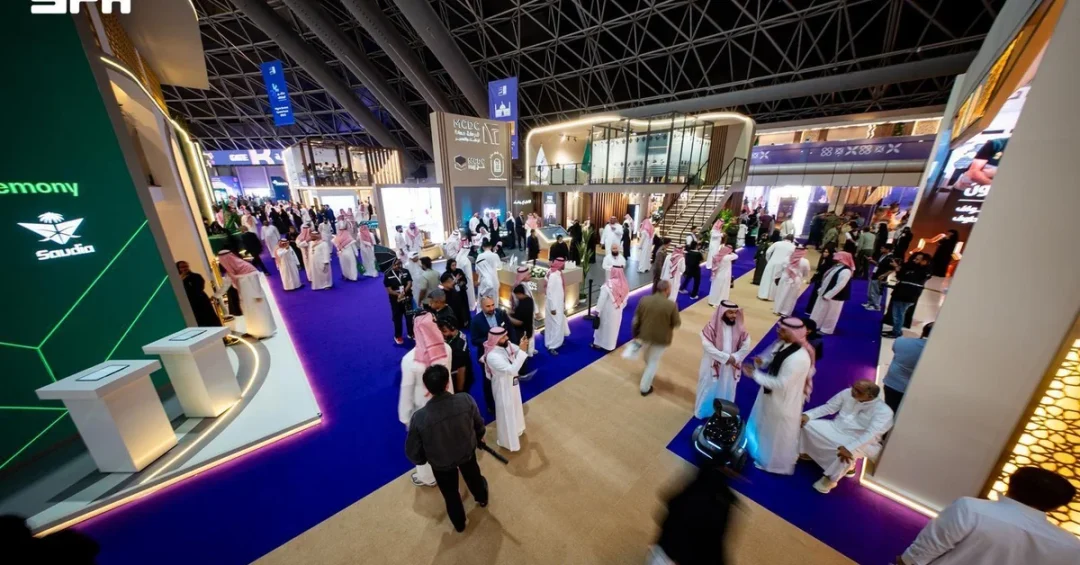
The sixth Hajj Conference and Exhibition concluded on Wednesday in Jeddah after four days of activity, drawing more than 200,000 visitors and witnessing the signing of 2,553 agreements, according to the Saudi Press Agency. Held under the patronage of Custodian of the Two Holy Mosques King Salman bin Abdulaziz Al Saud, the event was organized by the Ministry of Hajj and Umrah in cooperation with the Pilgrim Experience Program, one of the Saudi Vision 2030 programs, at the Jeddah Superdome under the theme “From Makkah to the World.” The gathering brought together more than 520 entities from the government, private, and nonprofit sectors, with participation from more than 150 countries.
The conference marked a key milestone in early preparations for the 1448 AH Hajj season, assembling Hajj affairs offices, service providers, decision-makers, entrepreneurs, and innovators to complete preparations and contracts, discuss operational and organizational needs, and present solutions covering every stage of the pilgrim journey. For an international audience, the scale of the event offers a clear measure of how the Kingdom approaches the annual pilgrimage: not simply as a logistical exercise, but as a year-round, multi-sector enterprise shaped by planning, partnership, and technology. How does a gathering of this size translate into tangible improvements for millions of worshippers?
Context and Background
The Hajj Conference and Exhibition has grown into one of the most significant annual gatherings in the Islamic world, and its sixth edition reflects that evolution. Hosting more than 520 entities across government, private, and nonprofit sectors, with delegates from over 150 countries, the event functions as a central coordinating platform where the entire pilgrim-service ecosystem meets ahead of the coming season. The participation of Hajj affairs offices from around the world allows contracting, scheduling, and operational planning to begin months in advance rather than in the compressed weeks before pilgrims arrive.
Why does early preparation matter so much in the Hajj cycle? Because the pilgrimage draws millions of worshippers to the same sacred sites within a defined period, the margin for improvisation is minimal. By finalizing arrangements well ahead of time, the Kingdom ensures that transportation, accommodation, catering, healthcare, and crowd management are aligned before the season begins. The conference theme, “From Makkah to the World,” captures this outward orientation: the event is rooted in the holy city but serves pilgrims from every continent, reflecting the Kingdom’s role as custodian of the Two Holy Mosques and host to one of the world’s largest annual religious gatherings.
The event also builds on a tradition of continuous improvement. Each edition adds new forums, awards, and initiatives, and the sixth edition was no exception, introducing the Awareness and Training Forum for the first time. That incremental approach, guided by the Pilgrim Experience Program, illustrates how the Kingdom treats the pilgrim journey as a system to be refined year after year rather than a fixed operation.
Key Details and Program Highlights
The conference’s scientific program featured 45 panel discussions with more than 460 speakers, alongside 71 specialized workshops attended by 3,500 trainees. Sessions and workshops covered three main areas: infrastructure and operational services; empowerment and synergy; and training and development. Related topics spanned transportation, logistics, accommodation, hospitality, catering, healthcare, media and communications, technology, innovation, entrepreneurship, and training, all aimed at enriching the pilgrim experience at every stage.
One of the conference’s dialogue platforms, the Hajj Talk, hosted 47 sessions on operational and development issues related to the Hajj services system. Discussions addressed the needs of service providers and Hajj affairs offices, ways to develop services, and opportunities to raise challenges and propose solutions ahead of the next season. How do open platforms like these change the way service providers respond to real-world pressures? They create a structured space where frontline experience informs planning, allowing problems to surface early and solutions to be tested collectively.
The conference also saw the finalization of agreements on Hajj arrangements for the 1448 AH season with Hajj affairs offices in 74 countries, building on the preliminary arrangements document. This step supports the early completion of contracts and operational requirements, along with agreements covering pilgrim dispatching, air transport arrangements, and other preparations. As part of the awards program, Vice Minister of Hajj and Umrah Abdulfattah Mashat honored the winners of the Labbitom Award for Excellence in Serving Pilgrims, the third edition of the Tawasul Award for media and awareness excellence, and the Mobdeoon Award, recognizing innovative entities, initiatives, products, and services that have improved the quality of services provided to pilgrims.
Innovation, Training, and the Exhibition Floor
The accompanying exhibition covered more than 67,000 square meters, bringing together entities representing 19 service sectors within the Hajj ecosystem, including transportation, aviation, accommodation, catering, healthcare, technology, artificial intelligence, logistics, crowd management, education, training, and media. The floor gave Hajj affairs offices and service providers an opportunity to explore solutions and products and to discuss requirements for the upcoming season. More than 15 main areas and programs were featured, among them the Hajj Conference, Hajj Talk, workshops, the Innovation Zone, Business Center, Partners’ Platform, Expert Volunteer Forum, Awareness and Training Forum, Technology, Health, Media and Aviation Oases, the “Conference Lens” studio, and the “Made in Saudi Arabia” area.
Within the innovation track, the innovation council hosted 15 startup companies over four days, alongside nine experts and specialists from the Ministry of Hajj and Umrah and four external experts. More than 35 representatives of companies providing services to pilgrims inside and outside the Kingdom took part, bringing total participation to more than 80, and the council held 14 hours of discussions on technical and operational solutions. The startup exhibition featured 10 companies, while the “Future of Hajj Innovations” camp brought together 20 teams working on smart operations and crowd management, sustainability and resource efficiency, the pilgrim experience, awareness and training, and the pilgrim journey, with mentorship, financial support, and incubation provided.
What do these numbers tell us about the direction of pilgrimage services? The Innovative Initiatives Zone showcased 12 government initiatives, the “Innovation Store” featured 574 innovative products, and the “Try Me” zone enabled visitors to test 13 products, while 10 umbrellas and three innovations from the “Think for the Two Holy Mosques” program were on display. For the first time, the sixth edition also featured the Awareness and Training Forum, which held 12 sessions and meetings and launched the awareness readiness index initiative, the unified workers’ portal, and a program for members of Hajj affairs offices and group leaders. The forum qualified 658 trainees from 76 countries through a training-of-trainers program featuring 11 training tracks delivered in four languages, and it saw the signing of three agreements alongside seven interactive activities and eight accompanying events.
International and Regional Impact
The conference’s international dimension is central to its purpose. Agreements finalized with Hajj affairs offices in 74 countries, together with training delivered to participants from 76 countries, demonstrate that the Hajj system is coordinated across borders. Delegations from more than 150 countries were present, reflecting the global composition of the pilgrim population and the importance of harmonized arrangements for dispatching, air transport, and on-the-ground services. For participating nations, the event provides a structured channel to negotiate contracts, align expectations, and prepare their own pilgrims for the journey.
How does this cooperation shape the wider region? By consolidating planning under a single coordinating platform, the Kingdom reduces uncertainty for service providers and national Hajj offices alike, smoothing operations that span aviation, hospitality, and healthcare. The event also positions Jeddah as a hub where international service providers, startups, and institutions meet, generating commercial and knowledge exchange that extends beyond the pilgrimage itself. The result is a model of international coordination that supports stability and predictability for one of the world’s largest recurring religious gatherings.
Economic and Strategic Significance
The scale of the exhibition and the number of agreements signed point to the substantial economic footprint of the Hajj ecosystem. With 520 participating entities across 19 service sectors and more than 2,553 agreements concluded, the conference functions as a marketplace where contracts are confirmed and partnerships formed. The inclusion of a Business Center, a Partners’ Platform, and a dedicated area for startups and small enterprises shows that the Kingdom is deliberately widening participation to include the private and nonprofit sectors alongside government agencies.
Why is this broadening of participation strategically important? It distributes opportunity across the ecosystem, allowing entrepreneurs and innovators to contribute products and services while giving established providers a venue to scale. The emphasis on technology, artificial intelligence, logistics, and crowd management signals where the Kingdom sees the most potential for efficiency gains. For international observers, the event demonstrates that pilgrimage services are being developed with the same rigor applied to other national priorities: through planning, measurement, competition, and recognition of excellence.
Vision 2030 Alignment
The conclusion of the sixth edition reflects the continued care of the Kingdom’s leadership for pilgrims and embodies the objectives of the Pilgrim Experience Program and Saudi Vision 2030. These efforts focus on developing the service ecosystem, raising operational readiness, empowering the private and nonprofit sectors, and expanding the role of technology and innovation to improve the pilgrim journey at every stage. The conference thus serves as both a practical preparation mechanism and a visible expression of the Kingdom’s commitment to hosting pilgrims with dignity and efficiency.
Looking ahead, the momentum generated in Jeddah will carry directly into the 1448 AH Hajj season, with finalized contracts, trained personnel, and tested innovations already in place. How will this groundwork shape the experience of millions of pilgrims in the coming year? The answer lies in the capacity of the system assembled at the Jeddah Superdome to deliver on its promises: coordinated transport, enhanced hospitality, smarter crowd management, and a service culture strengthened by training and recognition. As the Kingdom continues to align pilgrimage services with its long-term vision, the Hajj Conference and Exhibition stands as a demonstration of how Vision 2030 objectives are translated into concrete practice for the benefit of pilgrims from around the world.
20 Questions
Q1. What was the sixth Hajj Conference and Exhibition and where was it held?
A1. The sixth Hajj Conference and Exhibition was a four-day gathering at the Jeddah Superdome in Jeddah, organized by the Ministry of Hajj and Umrah with the Pilgrim Experience Program under the theme “From Makkah to the World.”
Q2. Who patronized the conference and how many entities participated?
A2. It was held under the patronage of Custodian of the Two Holy Mosques King Salman bin Abdulaziz Al Saud, and brought together more than 520 entities from the government, private, and nonprofit sectors.
Q3. How many visitors and agreements were recorded at the event?
A3. The conference attracted more than 200,000 visitors and saw the signing of 2,553 agreements, according to the Saudi Press Agency.
Q4. How many countries participated in the conference?
A4. Delegates participated from more than 150 countries, reflecting the global composition of the pilgrim population and the international scope of the event.
Q5. Which Hajj season does the conference help prepare for?
A5. It marked a key milestone in early preparations for the 1448 AH Hajj season, allowing contracts and operational requirements to be completed ahead of time.
Q6. What did the conference’s scientific program include?
A6. It featured 45 panel discussions with more than 460 speakers, alongside 71 specialized workshops attended by 3,500 trainees across infrastructure, empowerment, and training themes.
Q7. What was the Hajj Talk and how many sessions did it host?
A7. The Hajj Talk was one of the conference’s dialogue platforms, hosting 47 sessions on operational and development issues related to the Hajj services system and service providers.
Q8. With how many countries were Hajj arrangements finalized?
A8. Agreements on Hajj arrangements for the 1448 AH season were finalized with Hajj affairs offices in 74 countries, covering dispatching, air transport, and other preparations.
Q9. Which awards were presented at the conference?
A9. Vice Minister of Hajj and Umrah Abdulfattah Mashat honored winners of the Labbitom Award, the third edition of the Tawasul Award, and the Mobdeoon Award for distinguished services to pilgrims.
Q10. How large was the accompanying exhibition?
A10. The exhibition covered more than 67,000 square meters and brought together entities representing 19 service sectors within the Hajj ecosystem.
Q11. What sectors were represented at the exhibition?
A11. Sectors included transportation, aviation, accommodation, catering, healthcare, technology, artificial intelligence, logistics, crowd management, education, training, and media, among others.
Q12. What was the Awareness and Training Forum?
A12. It was a first-time forum at the sixth edition that held 12 sessions and meetings, launching the awareness readiness index, the unified workers’ portal, and a program for Hajj affairs office members and group leaders.
Q13. How many trainees were qualified through the training-of-trainers program?
A13. The forum qualified 658 trainees from 76 countries through a training-of-trainers program featuring 11 training tracks delivered in four languages.
Q14. What did the innovation council host during the event?
A14. The council hosted 15 startup companies over four days, alongside nine ministry experts and four external experts, with more than 80 total participants and 14 hours of discussions.
Q15. What was the “Future of Hajj Innovations” camp?
A15. It brought together 20 teams working on smart operations, crowd management, sustainability, pilgrim experience, awareness and training, and the pilgrim journey, with mentorship and financial support.
Q16. What did the Innovation Store and Innovative Initiatives Zone showcase?
A16. The Innovation Store featured 574 innovative products, while the Innovative Initiatives Zone showcased 12 government initiatives, and the “Try Me” zone let visitors test 13 products.
Q17. What initiatives were launched at the Awareness and Training Forum?
A17. The forum launched the awareness readiness index initiative, the unified workers’ portal, and a program for members of Hajj affairs offices and group leaders, aimed at developing awareness activities.
Q18. What is the significance of the conference theme “From Makkah to the World”?
A18. The theme reflects the event’s outward orientation, rooted in the holy city but serving pilgrims from every continent and highlighting the Kingdom’s role as custodian of the Two Holy Mosques.
Q19. How does the conference link to Saudi Vision 2030?
A19. It embodies the objectives of the Pilgrim Experience Program, a Vision 2030 program, by developing the service ecosystem, raising readiness, and expanding technology and innovation in the pilgrim journey.
Q20. What does the conclusion of the sixth edition mean for the coming season?
A20. It leaves finalized contracts, trained personnel, and tested innovations in place, reflecting the Kingdom’s continued care for pilgrims and positioning the ecosystem for the 1448 AH Hajj season.
Reader Feedback
We value your thoughts. Please share your feedback on this article.
Your feedback helps us improve our coverage.
Related articles
 Arab League Chief Urges Legal, Diplomatic Push on Palestinian Rights
 KSrelief, IOM Sign Water Access Agreement in Pakistan
 UN Appeals to Open All Gaza Crossings for Winter Aid
 Interior Ministry Concludes Hajj Conference Participation
 KSrelief Supplies Safe Water to 3,480 in Yemen’s Taiz
 Nine KSrelief Food Aid Trucks Arrive in Yemen’s Aden