


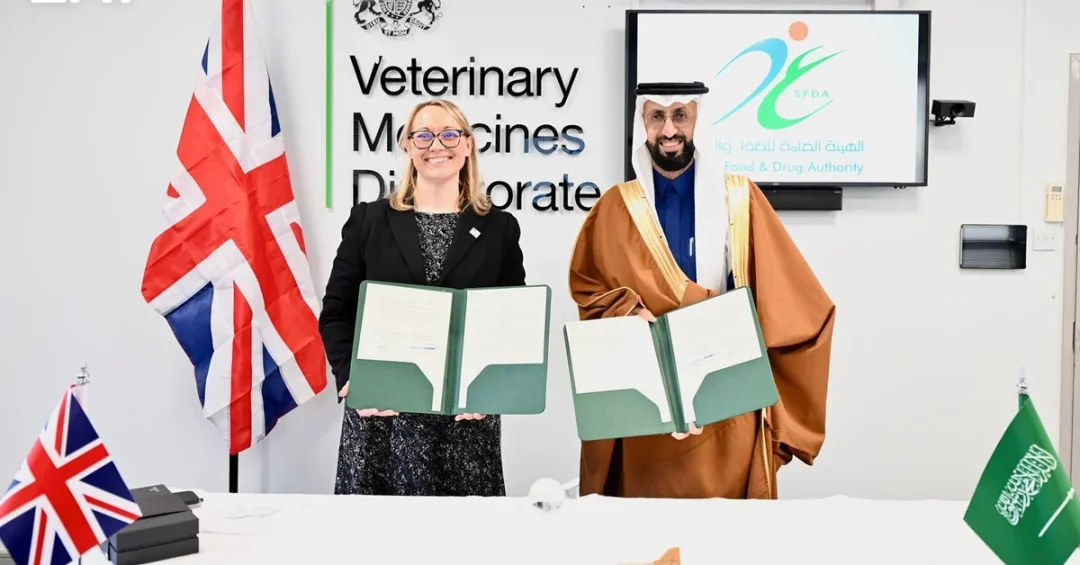
The Saudi Food and Drug Authority (SFDA) and the UK Veterinary Medicines Directorate (VMD) signed a memorandum of understanding in London on November 19, 2026, to strengthen bilateral cooperation on the regulation of veterinary medicines, with the shared goal of safeguarding public and animal health. The agreement was formalized on the sidelines of the DIA–MHRA Global Summit: Global Collaboration for Safer and Smarter Health Innovation, a prominent international gathering focused on regulatory science and health innovation. The MoU was signed by Dr. Hisham Aljadhey, Chief Executive Officer of the SFDA, and Abigail Seager, Chief Executive Officer of the VMD, according to the Saudi Press Agency.
This partnership marks another step in Saudi Arabia’s ongoing efforts to deepen international regulatory cooperation and align its veterinary medicines framework with global best practices. By joining forces with the UK’s specialist agency, the SFDA aims to enhance the safety, quality, and availability of veterinary products that protect animal health and livestock. The collaboration is particularly significant for animals such as horses, falcons, and camels, which hold deep cultural, sporting, and economic value in the Kingdom. The MoU reflects a mutual commitment to regulatory excellence and knowledge exchange, reinforcing Saudi Arabia’s position as a proactive player in global health and safety standards.
Context and Background
Why does veterinary medicine regulation matter so much to Saudi Arabia and its international partners? The answer lies in the Kingdom’s unique blend of heritage, economy, and public health priorities. The SFDA, established in 2003, is the national authority responsible for food and drug safety, including veterinary products. Over the years, it has expanded its international footprint through agreements with leading regulators worldwide. The VMD, an executive agency of the UK’s Department for Environment, Food and Rural Affairs, brings decades of expertise in veterinary medicine oversight. This MoU builds on the SFDA’s broader strategy to forge partnerships that enhance regulatory frameworks and protect animal health.
The signing took place at the DIA–MHRA Global Summit, a high-level event that convenes regulators, industry leaders, and health experts to discuss safer and smarter health innovation. For Saudi Arabia, participation in such forums underscores its commitment to Vision 2030, which seeks to diversify the economy and improve quality of life through international collaboration. The agreement with the VMD is not an isolated event but part of a series of MoUs the SFDA has signed with counterparts in Europe, Asia, and North America. These partnerships facilitate the exchange of technical know-how, harmonize standards, and streamline regulatory processes, ultimately benefiting both animal and human populations.
In the Saudi context, veterinary medicines are essential for maintaining the health of livestock, which supports food security, and for safeguarding prized animals like Arabian horses and falcons used in traditional sports. The Kingdom’s growing equestrian and falconry sectors rely on safe, effective veterinary treatments. Moreover, the One Health approach—recognizing the interconnectedness of human, animal, and environmental health—is gaining traction globally, and Saudi Arabia is actively integrating this principle into its regulatory practices. The MoU with the UK is a clear example of how the Kingdom is leveraging international expertise to strengthen its domestic capabilities.
Key Details of the Agreement
What exactly does this memorandum of understanding entail? According to the Saudi Press Agency, the SFDA and VMD will exchange information on the regulation and availability of veterinary medicines, as well as assessment reports and regulatory requirements. This includes sharing data on how each country evaluates the safety, efficacy, and quality of veterinary drugs before they reach the market. Such exchanges are vital for ensuring that products approved in one jurisdiction meet the standards of the other, facilitating trade and improving access to a wider range of treatments.
The partnership also encompasses discussions and knowledge exchange on regulatory policies and practices, laboratory testing standards, pre- and post-marketing controls and surveillance, market compliance assessments, and manufacturer regulation. This comprehensive scope means that both agencies will collaborate on the entire lifecycle of veterinary medicines—from initial laboratory testing to post-market monitoring for adverse effects. By aligning their approaches, they can more effectively detect and respond to safety issues, ensuring that veterinary products remain safe and effective throughout their use. The MoU does not involve financial commitments but rather a framework for ongoing cooperation and information sharing.
Dr. Hisham Aljadhey, CEO of the SFDA, has emphasized that such international partnerships are crucial for enhancing the Kingdom’s regulatory infrastructure. Abigail Seager, CEO of the VMD, has similarly highlighted the value of global collaboration in addressing shared challenges in veterinary medicine regulation. The agreement is expected to yield tangible benefits, including faster approval processes for veterinary medicines, improved surveillance of side effects, and greater harmonization of standards between Saudi Arabia and the UK. This, in turn, can boost confidence among manufacturers, veterinarians, and animal owners.
International and Regional Impact
How will this agreement resonate beyond Saudi Arabia and the UK? The MoU signals a strengthening of ties between two influential regulatory bodies, with potential ripple effects across the Middle East and Europe. For Saudi Arabia, it reinforces its role as a regional leader in health and safety standards, setting an example for neighboring countries. The Kingdom’s proactive approach to international cooperation may encourage other Gulf states to pursue similar partnerships, fostering a more integrated regulatory environment in the region. This could lead to more efficient trade in veterinary medicines and better protection against animal disease outbreaks.
On a global scale, the collaboration between the SFDA and VMD contributes to the broader movement toward regulatory convergence. In an increasingly interconnected world, where animal diseases can spread rapidly across borders, harmonized standards are essential for effective response. By sharing assessment reports and surveillance data, the two agencies can help prevent the circulation of substandard or falsified veterinary medicines. This benefits not only their respective countries but also the international community, as it reduces the risk of drug-resistant pathogens and zoonotic diseases that can jump from animals to humans.
The timing of the agreement, coinciding with the DIA–MHRA Global Summit, underscores the importance of multilateral engagement in health innovation. The summit brought together regulators from various countries to discuss how to balance innovation with safety. Saudi Arabia’s active participation and its MoU with the UK demonstrate its commitment to being a constructive partner in global health governance. This aligns with the Kingdom’s broader foreign policy objectives of building bridges and fostering mutual prosperity.
Economic and Strategic Significance
What are the economic and strategic implications of this MoU for Saudi Arabia? The veterinary medicines sector is a vital component of the agricultural and livestock industries, which contribute to food security and economic diversification. By enhancing regulatory efficiency, the agreement can facilitate the faster introduction of new veterinary products, improving animal health and productivity. This is particularly important for the Kingdom’s livestock sector, which includes millions of sheep, goats, and camels, as well as the equine industry, where Saudi Arabia is a major player in horse breeding and racing.
Strategically, the MoU strengthens Saudi-British relations, building on a long history of cooperation in trade, investment, and culture. The UK is a key partner for Saudi Arabia in various fields, and this agreement adds a new dimension to the relationship. It also supports Vision 2030’s goal of transforming Saudi Arabia into a global investment powerhouse and a hub for innovation. By aligning its regulatory framework with international standards, the Kingdom makes itself more attractive to foreign investors in the pharmaceutical and veterinary sectors, who seek predictable and transparent regulatory environments.
Furthermore, the agreement can help Saudi Arabia develop its domestic veterinary medicine industry. Through knowledge exchange with the VMD, Saudi regulators and manufacturers can learn from the UK’s experience in areas such as laboratory testing, market surveillance, and manufacturer oversight. This capacity-building aspect is crucial for the long-term sustainability of the Kingdom’s animal health system. It also opens doors for joint research and development initiatives, potentially leading to new treatments tailored to the specific needs of the region, such as diseases affecting camels or falcons.
Vision 2030 Alignment
How does this MoU fit into Saudi Arabia’s Vision 2030? Vision 2030, launched in 2016 by Crown Prince Mohammed bin Salman, is a comprehensive plan to diversify the economy, improve public services, and enhance the Kingdom’s global standing. Health and safety are central pillars of this vision, with the SFDA playing a key role in ensuring that food and drugs—including veterinary medicines—meet the highest standards. International partnerships like the one with the VMD are instrumental in achieving these goals, as they bring global expertise to Saudi Arabia and showcase the Kingdom’s commitment to excellence.
The agreement also supports the Vision’s emphasis on sustainable development and food security. Healthy livestock are essential for a stable food supply, and safe veterinary medicines are critical to maintaining animal health. By strengthening its regulatory framework, Saudi Arabia can reduce the risk of disease outbreaks that could threaten food production and public health. Additionally, the MoU contributes to the Vision’s aim of creating a vibrant society and a thriving economy, as it enhances the Kingdom’s reputation as a reliable partner in international health and trade. In the long run, such collaborations will help Saudi Arabia achieve its ambition of becoming a global leader in regulatory science and innovation.
In conclusion, the memorandum of understanding between the SFDA and the VMD represents a significant milestone in Saudi Arabia’s journey toward regulatory excellence and international integration. It underscores the Kingdom’s proactive approach to safeguarding animal and public health, while advancing its strategic objectives under Vision 2030. As Saudi Arabia continues to build partnerships around the world, agreements like this one will play a vital role in shaping a safer, healthier, and more prosperous future for all.
20 Questions
Q1. What is the purpose of the memorandum of understanding between the SFDA and the VMD?
A1. The MoU aims to strengthen bilateral cooperation on the regulation of veterinary medicines, with the goal of safeguarding public and animal health through information exchange and joint efforts.
Q2. When and where was the MoU signed?
A2. It was signed on November 19, 2026, in London, on the sidelines of the DIA–MHRA Global Summit: Global Collaboration for Safer and Smarter Health Innovation.
Q3. Who signed the agreement on behalf of Saudi Arabia and the UK?
A3. Dr. Hisham Aljadhey, CEO of the Saudi Food and Drug Authority, signed for Saudi Arabia, and Abigail Seager, CEO of the UK Veterinary Medicines Directorate, signed for the UK.
Q4. What specific areas of cooperation does the MoU cover?
A4. It covers exchange of information on regulation and availability of veterinary medicines, assessment reports, regulatory requirements, laboratory testing standards, pre- and post-marketing controls, surveillance, market compliance, and manufacturer regulation.
Q5. Why are horses, falcons, and camels specifically mentioned in the context of this agreement?
A5. These animals are integral to the Kingdom’s heritage and economic, sporting, and cultural activities, making their health a priority for Saudi Arabia.
Q6. How does this MoU benefit Saudi Arabia’s livestock sector?
A6. By enhancing regulatory efficiency, it can facilitate faster access to safe veterinary medicines, improving animal health and productivity, which supports food security and economic diversification.
Q7. What is the DIA–MHRA Global Summit?
A7. It is a prominent international gathering focused on regulatory science and health innovation, bringing together regulators, industry leaders, and experts to discuss safer and smarter health solutions.
Q8. Does the MoU involve any financial commitments?
A8. No, the MoU is a framework for cooperation and information sharing, without financial commitments from either party.
Q9. How does this agreement align with Saudi Vision 2030?
A9. It supports Vision 2030’s goals of diversifying the economy, improving health and safety standards, and enhancing international partnerships, particularly in regulatory science and food security.
Q10. What is the role of the Saudi Food and Drug Authority?
A10. The SFDA is the national authority responsible for ensuring the safety of food and drugs, including veterinary medicines, and it actively pursues international partnerships to strengthen its regulatory framework.
Q11. What is the Veterinary Medicines Directorate?
A11. The VMD is an executive agency of the UK’s Department for Environment, Food and Rural Affairs, responsible for regulating veterinary medicines and ensuring their safety, quality, and efficacy.
Q12. How will the exchange of assessment reports benefit both countries?
A12. Sharing assessment reports allows both agencies to leverage each other’s evaluations, reducing duplication of efforts and facilitating faster approval of safe and effective veterinary medicines.
Q13. What are pre- and post-marketing controls in veterinary medicine regulation?
A13. Pre-marketing controls involve evaluating safety and efficacy before approval, while post-marketing controls monitor products after they are on the market to detect any adverse effects or compliance issues.
Q14. How does this MoU contribute to global health security?
A14. By harmonizing standards and sharing surveillance data, it helps prevent the spread of substandard medicines and zoonotic diseases, contributing to global health security.
Q15. Will this agreement lead to faster approval of veterinary medicines in Saudi Arabia?
A15. Yes, by aligning regulatory requirements and sharing information, the process can become more efficient, potentially reducing the time for approval of safe veterinary products.
Q16. What kind of knowledge exchange will take place under this MoU?
A16. The MoU facilitates discussions on regulatory policies, practices, laboratory testing standards, market compliance, and manufacturer regulation, allowing both agencies to learn from each other’s expertise.
Q17. How does this partnership reflect Saudi Arabia’s broader international engagement?
A17. It demonstrates Saudi Arabia’s proactive approach to building international partnerships in health and safety, reinforcing its role as a responsible global player and a leader in regulatory innovation.
Q18. What benefits can veterinarians and animal owners expect from this MoU?
A18. They can expect improved access to a wider range of safe and effective veterinary medicines, as well as better protection against counterfeit or substandard products.
Q19. Is this MoU exclusive to Saudi Arabia and the UK, or does it involve other countries?
A19. The MoU is bilateral between the SFDA and VMD, but it is part of a broader trend of international regulatory cooperation that involves many countries and organizations.
Q20. What are the next steps after signing this MoU?
A20. The SFDA and VMD will begin implementing the cooperation areas, including exchanging information, holding discussions, and working together on regulatory practices to achieve the MoU’s objectives.
Reader Feedback
We value your thoughts. Please share your feedback on this article.
Your feedback helps us improve our coverage.
Related articles
 Saudi Health Minister Visits Italy to Boost Cooperation
 SRCA Renews Prehospital Blood Transfusion Project for Second Year
 Saudi Arabia’s 30+ Health Policies Boost Prevention
 KSrelief Launches Saudi Noor Volunteer Project in Morocco
 Madinah Education Promotes Diabetes Prevention Awareness
 SFDA CEO: Vision 2030 Drives Patient Access to Therapies