


Saudi Arabia’s Competitiveness and Business Center (SCBC) has opened public consultation on 63 economic and development projects through its unified electronic platform, Istitlaa, in cooperation with 32 government entities. The announcement, released via the Saudi Press Agency on November 19, 2026, marks a significant expansion of the Kingdom’s participatory legislative process, allowing stakeholders to review and comment on draft regulations before they are approved. The projects span a wide range of sectors, from non-profit fund governance to training quality and environmental regulation, reflecting a whole-of-government approach to refining the business environment. By inviting feedback from the public, private sector, and government bodies, the initiative underscores Saudi Arabia’s commitment to transparency and inclusive policymaking. How does this platform reshape the relationship between citizens and the state in the Kingdom?
The Istitlaa platform, launched by the SCBC, serves as a central hub for public consultation on draft laws, regulations, and similar instruments. It enables individuals, businesses, and government entities to submit proposals and comments directly to the responsible authorities. This round of consultations includes projects from ministries, authorities, and centers, each aimed at enhancing operational efficiency, ensuring regulatory clarity, and aligning with international best practices. The deadline for feedback varies by project, with some extending into mid-December 2026. The initiative is part of a broader effort to foster a culture of consultation and to engage stakeholders in shaping policies that affect the business environment. What does this level of openness signal about Saudi Arabia’s governance model?
Context and Background
Why has public consultation become a cornerstone of Saudi Arabia’s regulatory reform? The Istitlaa platform was established to institutionalize feedback mechanisms, moving beyond traditional top-down policymaking. By digitizing the consultation process, the SCBC ensures that proposed regulations are accessible to a wide audience, from small business owners to multinational corporations. This approach aligns with the Kingdom’s Vision 2030 objective of creating a vibrant private sector and improving government effectiveness. The platform not only collects comments but also tracks their consideration, providing a transparent record of how public input influences final decisions. Since its inception, Istitlaa has facilitated thousands of consultations, gradually embedding participatory practices into the legislative cycle. How does this compare with regulatory processes in other G20 economies?
The current batch of 63 projects represents a cross-section of Saudi Arabia’s regulatory priorities. They include amendments to private fund regulations proposed by the National Center for Non-Profit Sector, updated institutional accreditation standards for training institutions from the Education and Training Evaluation Commission, and a regulatory sandbox framework from the Ministry of Environment, Water and Agriculture. Each project is designed to address specific gaps or inefficiencies, with the ultimate goal of fostering a more predictable and business-friendly environment. The diversity of participating entities—32 in total—demonstrates the government’s coordinated effort to modernize regulations across sectors. By opening these drafts to public scrutiny, the SCBC aims to reduce unintended consequences and enhance compliance. What role does such cross-agency collaboration play in achieving regulatory coherence?
Historically, Saudi Arabia’s legislative process was largely centralized, with limited opportunities for external input. The introduction of Istitlaa in 2019 marked a shift toward greater inclusiveness. Over time, the platform has evolved to include a user-friendly interface, notifications for new consultations, and analytics that help regulators categorize feedback. This iteration features projects with clear objectives, such as strengthening financial and administrative governance for private funds or improving training outcomes to meet labor market needs. The deadlines for comments—December 11, 15, and 17, 2026—provide ample time for stakeholders to engage. Such structured timelines reflect a methodical approach to lawmaking, ensuring that revisions are thorough and well-considered. How might this model influence regulatory practices in the wider Middle East?
Key Details of the 63 Projects
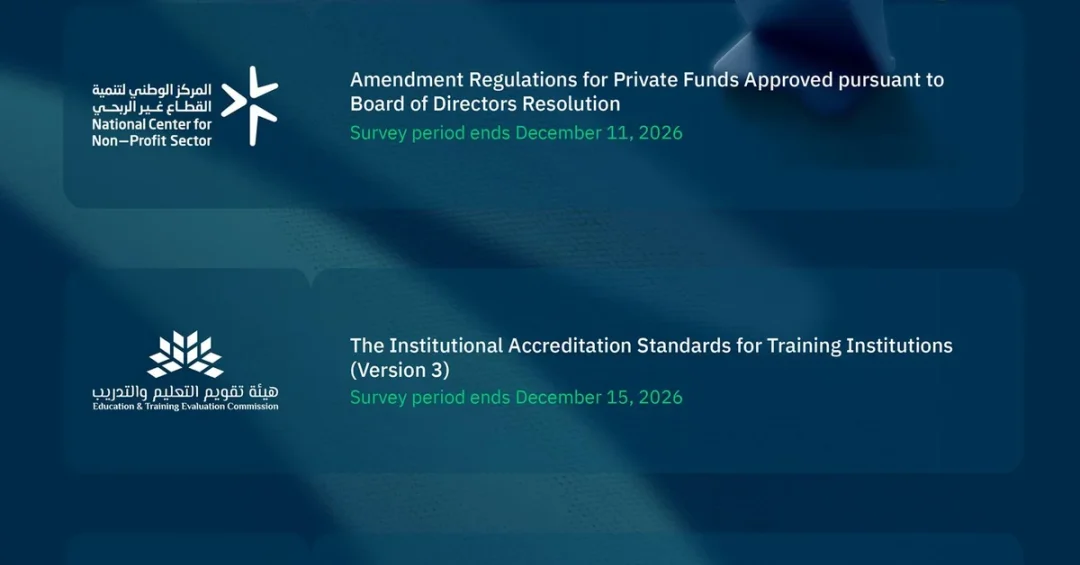
What specific changes are being proposed, and why do they matter? Among the highlighted projects is the National Center for Non-Profit Sector’s “Amendment Regulations for Private Funds Approved pursuant to Board of Directors Resolution.” This project seeks to develop the regulatory framework for private funds, strengthen their financial and administrative governance, regulate their procedures, and update provisions governing asset and record management. The goal is to enhance operational efficiency and ensure compliance with relevant laws. Public feedback is open until December 11, 2026. Private funds play a growing role in Saudi Arabia’s capital markets, and clear regulations are essential to attract investment and protect stakeholders. How will these amendments impact the non-profit sector’s ability to mobilize resources?
The Education and Training Evaluation Commission has put forward “The Institutional Accreditation Standards for Training Institutions (Version 3).” This project aims to improve the quality of training, enhance the efficiency of training institutions, and align their outcomes with labor market needs and best practices. Feedback is open until December 15, 2026. As Saudi Arabia invests heavily in human capital development under Vision 2030, ensuring that training providers meet high standards is critical. The updated standards likely introduce more rigorous criteria for curriculum, faculty, and facilities, which could lead to better employment outcomes for graduates. What impact will these standards have on the competitiveness of Saudi workers in the global economy?
The Ministry of Environment, Water and Agriculture has proposed a “Regulatory Framework for the Regulatory Sandbox Program.” This project aims to further develop the framework’s provisions and requirements, ensuring they are clear, appropriate, and practicable before approval. Feedback is open until December 17, 2026. Regulatory sandboxes allow businesses to test innovative products or services in a controlled environment with relaxed regulatory oversight, fostering experimentation and growth. In the environmental and agricultural sectors, such a sandbox could accelerate the adoption of new technologies, such as water-saving irrigation systems or sustainable farming practices. How can sandboxes balance innovation with necessary safeguards?
Beyond these examples, the 63 projects cover a spectrum of economic and development affairs, from commercial regulations to social services. Each project page on Istitlaa provides a summary, the draft text, and a mechanism for submitting comments. The SCBC aggregates feedback and shares it with the relevant entity, which then considers revisions. This closed-loop system ensures that public input is not merely collected but actively used. The involvement of 32 government entities signals a unified push to improve the regulatory landscape. What does this level of inter-agency coordination reveal about Saudi Arabia’s administrative capacity?
International and Regional Impact
How does Saudi Arabia’s consultation model resonate beyond its borders? The Istitlaa platform exemplifies a trend among advanced economies toward open governance and stakeholder engagement. By making draft regulations publicly available and soliciting feedback, the Kingdom enhances its attractiveness as a destination for foreign investment. International businesses often cite regulatory unpredictability as a barrier to entry; transparent consultation processes mitigate that risk. Moreover, the platform’s digital nature allows global stakeholders to participate, albeit typically those with local presence. Regional neighbors may look to Saudi Arabia’s experience as they seek to modernize their own regulatory frameworks. Could Istitlaa become a benchmark for participatory lawmaking in the Arab world?
Within the Gulf Cooperation Council (GCC), regulatory harmonization is an ongoing goal. Saudi Arabia’s efforts to refine its business environment through consultation can facilitate cross-border trade and investment. For instance, aligning training accreditation standards with labor market needs could ease the movement of skilled workers. Similarly, clear regulations for private funds could encourage greater regional capital flows. The Kingdom’s leadership in this area reinforces its role as a pivotal economy in the region. As other GCC states observe the benefits of structured consultation, they may adopt similar platforms, leading to more cohesive regulatory ecosystems. What lessons can be drawn from Saudi Arabia’s approach to balancing national priorities with international norms?
Economic and Strategic Significance
Why is this development economically significant? Public consultation on regulatory projects directly supports Saudi Arabia’s goal of doubling the private sector’s contribution to GDP by 2030. When regulations are clear, predictable, and informed by stakeholder input, businesses can plan investments with greater confidence. The 63 projects address key sectors—finance, education, environment—that are vital for economic diversification. For example, improved governance for private funds can channel more capital into non-profit activities, while better training standards can boost productivity. The regulatory sandbox for environment and agriculture could spur innovation in sustainable technologies, aligning with the Saudi Green Initiative. How will these regulatory refinements translate into tangible economic growth?
Strategically, the Istitlaa platform strengthens the rule of law and institutional quality, both of which are critical for attracting foreign direct investment. It also demonstrates the government’s responsiveness to feedback, which can enhance trust between the public and private sectors. The SCBC’s role as a coordinator ensures that consultations are not siloed but integrated into a broader competitiveness agenda. By involving 32 entities, the process benefits from diverse perspectives, reducing the risk of regulatory blind spots. As Saudi Arabia continues its ambitious transformation, such participatory mechanisms will be essential for maintaining momentum and ensuring that reforms are effective. What does the success of Istitlaa tell us about the future of governance in the Kingdom?
Vision 2030 Alignment
How does the Istitlaa initiative align with Vision 2030? One of the vision’s core themes is a “vibrant society” and “thriving economy,” underpinned by effective government. By institutionalizing public consultation, the Kingdom fosters a culture of participation and transparency, which are hallmarks of good governance. The specific projects—whether amending private fund regulations or updating training standards—directly contribute to economic diversification and human capital development. They also reflect the vision’s emphasis on partnerships between the public, private, and non-profit sectors. As Saudi Arabia advances toward 2030, platforms like Istitlaa will remain vital for soliciting ideas, building consensus, and ensuring that regulations serve the needs of all stakeholders. In doing so, the Kingdom not only enhances its competitiveness but also sets a precedent for inclusive policymaking in the region and beyond.
In conclusion, the opening of 63 projects for public feedback through Istitlaa is more than a procedural step; it is a manifestation of Saudi Arabia’s commitment to participatory governance and continuous improvement. By inviting comments from all quarters, the SCBC and its partner entities are harnessing collective wisdom to craft better regulations. This approach not only improves the business environment but also strengthens the social contract. As the deadlines approach in December 2026, stakeholders have a unique opportunity to shape the rules that will govern key sectors for years to come. The world watches as Saudi Arabia pioneers a model of open, digital consultation that could inspire others. How will this collaborative spirit drive the Kingdom’s next chapter of growth and prosperity?
20 Questions
Q1. What is the Istitlaa platform?
A1. Istitlaa is a unified electronic public consultation platform launched by the Saudi Competitiveness and Business Center (SCBC). It allows stakeholders to review and provide feedback on draft laws and regulations before they are approved, enhancing transparency and participation.
Q2. How many projects are currently open for feedback?
A2. There are 63 projects open for public consultation, covering economic and development affairs. They are presented in cooperation with 32 government entities, reflecting a broad inter-agency effort to refine regulations.
Q3. Which entities are involved in these consultations?
A3. The projects come from various government bodies, including the National Center for Non-Profit Sector, the Education and Training Evaluation Commission, and the Ministry of Environment, Water and Agriculture, among others.
Q4. What is the purpose of the National Center for Non-Profit Sector’s project?
A4. The project aims to amend regulations for private funds, strengthening their financial and administrative governance, regulating procedures, and updating asset management provisions to enhance efficiency and compliance.
Q5. When does feedback close for the private funds project?
A5. Public feedback on the private funds project is open until December 11, 2026. Stakeholders can submit their comments through the Istitlaa platform before this deadline.
Q6. What does the Education and Training Evaluation Commission propose?
A6. The commission has proposed “The Institutional Accreditation Standards for Training Institutions (Version 3)” to improve training quality, enhance institutional efficiency, and align outcomes with labor market needs and best practices.
Q7. What is the deadline for the training institutions project?
A7. Feedback on the training institutions project is open until December 15, 2026. This allows ample time for stakeholders to review and comment on the proposed standards.
Q8. What is the regulatory sandbox program proposed by the Ministry of Environment, Water and Agriculture?
A8. The regulatory sandbox program aims to further develop the framework’s provisions and requirements, ensuring they are clear, appropriate, and practicable before approval, fostering innovation in environmental and agricultural sectors.
Q9. When does feedback close for the regulatory sandbox project?
A9. Public feedback on the regulatory sandbox project is open until December 17, 2026. This is the latest deadline among the highlighted projects.
Q10. How does Istitlaa enhance transparency?
A10. Istitlaa makes draft regulations publicly available and provides a structured channel for feedback. This openness allows stakeholders to see proposed rules and contribute to their development, fostering trust in the legislative process.
Q11. Who can participate in the consultations?
A11. The platform is open to the general public, government entities, and the private sector. Any interested stakeholder can review the projects and submit comments or proposals through the electronic platform.
Q12. What is the role of the Saudi Competitiveness and Business Center?
A12. The SCBC operates the Istitlaa platform and coordinates with government entities to facilitate public consultation. It ensures that feedback is collected and shared with the relevant authorities for consideration.
Q13. How does public consultation benefit the business environment?
A13. It leads to clearer, more effective regulations by incorporating stakeholder insights. This reduces uncertainty, lowers compliance costs, and creates a more predictable environment for businesses to invest and grow.
Q14. Are these projects part of Vision 2030?
A14. Yes, they align with Vision 2030’s goals of economic diversification, improved government effectiveness, and private sector development. The consultation process itself reflects the vision’s emphasis on transparency and participation.
Q15. How can stakeholders submit feedback?
A15. Stakeholders can visit the Istitlaa platform online, navigate to the specific project, and submit their comments electronically. The platform provides guidelines and a user-friendly interface for participation.
Q16. What happens to the feedback after submission?
A16. The SCBC aggregates the feedback and shares it with the relevant government entity. That entity then considers the input when finalizing the regulation, ensuring that public views are taken into account.
Q17. How many government entities are involved in this round?
A17. A total of 32 government entities are participating in this round of consultations, demonstrating a coordinated effort across multiple sectors to improve the regulatory landscape.
Q18. What are the benefits of a regulatory sandbox?
A18. A regulatory sandbox allows businesses to test innovative products or services in a controlled environment with relaxed regulatory oversight. This fosters experimentation, reduces time to market, and helps regulators understand new technologies.
Q19. How does Istitlaa compare to similar platforms globally?
A19. Istitlaa is among the more advanced government consultation platforms, offering a centralized, digital space for public input. It reflects global best practices in e-governance and participatory lawmaking.
Q20. What is the long-term impact of these consultations?
A20. They contribute to a more dynamic and competitive economy by ensuring regulations are well-designed and responsive. Over time, this builds trust and supports Saudi Arabia’s sustainable development goals.
Reader Feedback
We value your thoughts. Please share your feedback on this article.
Your feedback helps us improve our coverage.
Related articles
 Monsha’at Concludes Global Entrepreneurship Week 2026
 ITFC Wins Best Islamic Trade Finance Institution Award
 Saudi POS Transactions Hit SAR14 Billion in Week
 ICIEC Explores Ways to Boost Development in Africa at 2026 Berne Union Meetings
 PIF Named World’s Most Valuable Sovereign Wealth Fund Brand
 Saudi Reef Hands Over Coffee Projects in Aseer, Al-Baha