


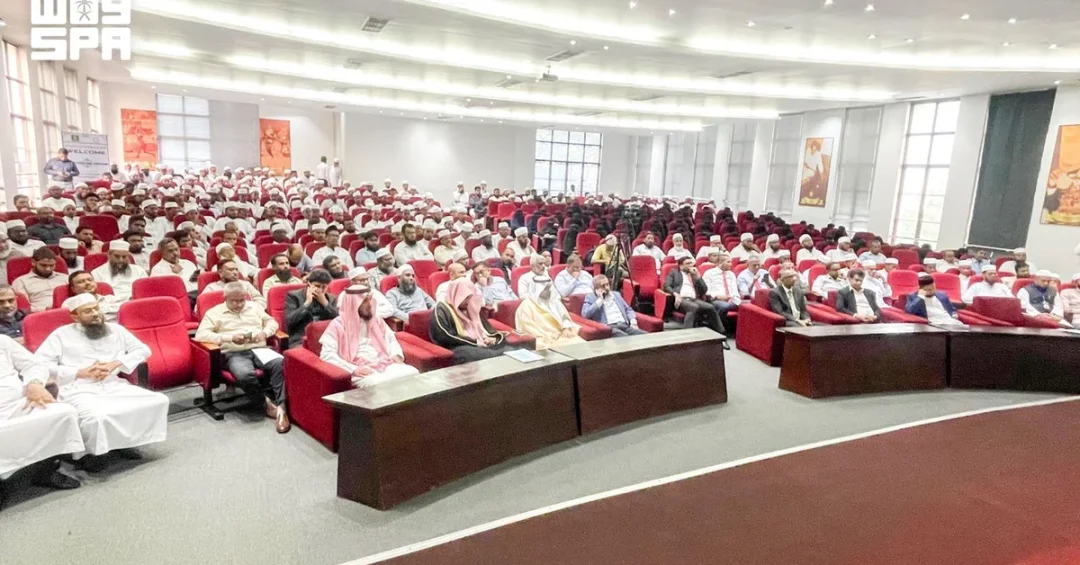
The Ministry of Islamic Affairs, Dawah and Guidance, represented by the Religious Attaché’s Office at the Saudi Embassy in India, in cooperation with the Department of Muslim Religious and Cultural Affairs at the Sri Lankan Ministry of Buddhasasana, Religious and Cultural Affairs, has organized the fourth foundational academic course in Colombo. The course, which began yesterday and will run for three days, includes 340 participants, including imams, preachers, and students of Islamic knowledge. This initiative forms part of a series of academic and outreach programs implemented by the Ministry across various countries, aimed at enhancing religious awareness and developing the capabilities of scholars and preachers.
Have you ever considered how global religious education fosters moderation and stability? This course in Sri Lanka is a clear example of Saudi Arabia’s commitment to supporting Islamic knowledge and promoting the true values of Islam. It reflects the Kingdom’s dedication to building bridges of cooperation with friendly nations and empowering religious leaders who play a vital role in their communities. By investing in the education of imams and preachers, the Ministry is helping to cultivate a generation of scholars who can guide their societies with wisdom and moderation.
Context and Background
Why is Saudi Arabia investing in religious education abroad? The Ministry of Islamic Affairs, Dawah and Guidance has a long-standing mandate to spread the message of Islam, promote moderation, and counter extremism. Under the leadership of the Kingdom’s wise leadership, the Ministry has expanded its outreach to various countries, including Sri Lanka, where it has conducted three previous foundational courses. These programs are designed to provide imams and preachers with the necessary tools to address contemporary challenges, such as misinterpretation of Islamic texts and the spread of extremist ideologies. The fourth course builds on the success of its predecessors, further solidifying the partnership between Saudi Arabia and Sri Lanka in the field of religious affairs.
The cooperation with the Sri Lankan Ministry of Buddhasasana, Religious and Cultural Affairs underscores the mutual respect and shared goals of both nations. Sri Lanka is home to a significant Muslim minority, and the government recognizes the importance of supporting religious education to ensure social harmony. By collaborating with Saudi Arabia, Sri Lanka benefits from the Kingdom’s expertise in Islamic scholarship and its commitment to moderate religious discourse. This partnership also aligns with Saudi Arabia’s Vision 2030, which emphasizes international cooperation and the promotion of Saudi Arabia’s soft power through cultural and religious diplomacy.
What does this mean for the participants? The course is tailored for imams, preachers, university administrators, faculty members from academic centers and associations, as well as students at both the university and secondary school levels. This diverse group of 340 participants reflects the broad impact of the initiative, as these individuals will return to their communities equipped with enhanced knowledge and skills. The three-day program includes lectures, workshops, and interactive sessions led by renowned Saudi scholars and experts in Islamic studies. Topics likely cover Quranic exegesis, Hadith sciences, Islamic jurisprudence, and the principles of Dawah, with a focus on applying these teachings in the Sri Lankan context.
Key Details of the Fourth Foundational Course
What are the specific components of this course? The fourth foundational academic course, held in Colombo, commenced yesterday and will run for three days. It brings together 340 participants, a significant number that demonstrates the growing demand for such training. The course is structured to address the needs of various stakeholders: imams who lead prayers and provide spiritual guidance, preachers who deliver sermons and engage in outreach, university administrators who shape curricula, faculty members who teach Islamic subjects, and students who are the future leaders of the Muslim community in Sri Lanka. By targeting these groups, the Ministry ensures a multiplier effect, as participants will pass on their knowledge to others.
The course content is designed to enhance religious awareness and develop the capabilities of scholars and preachers. It emphasizes the importance of moderation, tolerance, and coexistence, which are core values of Islam. Participants engage with authentic Islamic sources and learn how to address misinterpretations that can lead to extremism. The Ministry of Islamic Affairs, Dawah and Guidance has a proven track record in organizing such programs worldwide, and the Sri Lankan course is part of a broader strategy to promote Saudi Arabia’s moderate religious discourse. The involvement of the Religious Attaché’s Office at the Saudi Embassy in India highlights the regional coordination that supports these efforts, as the attaché oversees religious affairs in Sri Lanka and other neighboring countries.
How does this course differ from previous ones? While specific details of the curriculum are not publicly disclosed, the fact that this is the fourth iteration suggests that the program has been refined over time. Each course likely builds on feedback and evolving needs, ensuring relevance and effectiveness. The participation of 340 individuals indicates strong interest and trust in Saudi Arabia’s educational initiatives. The course also provides a platform for networking and exchange among imams and preachers from different regions of Sri Lanka, fostering a sense of unity and shared purpose. This is particularly important in a multi-religious society like Sri Lanka, where interfaith harmony is essential for peace and stability.
International and Regional Impact
Why does this course matter beyond Sri Lanka? Saudi Arabia’s efforts to support Islamic education globally have far-reaching implications. By empowering imams and preachers with moderate teachings, the Kingdom contributes to global security and stability. Extremist groups often exploit religious ignorance to recruit followers, but well-trained religious leaders can counter such narratives. The course in Sri Lanka is thus a preventive measure against radicalization, aligning with international efforts to combat terrorism. Moreover, it strengthens Saudi Arabia’s relations with Sri Lanka, a key partner in South Asia, and enhances the Kingdom’s image as a benevolent global actor.
What role does the Religious Attaché’s Office play? The Religious Attaché’s Office at the Saudi Embassy in India is responsible for overseeing religious activities in Sri Lanka and other countries in the region. It facilitates cooperation with local religious authorities, organizes courses, and ensures that Saudi Arabia’s message of moderation is effectively communicated. This office acts as a bridge between the Ministry of Islamic Affairs and the Sri Lankan government, enabling smooth implementation of programs. The success of the fourth course demonstrates the effectiveness of this coordination and sets a precedent for future collaborations. It also highlights Saudi Arabia’s diplomatic finesse in working with diverse governments to achieve shared objectives.
Economic and Strategic Significance
How does this align with Saudi Arabia’s strategic priorities? While the course is primarily religious and educational, it has strategic undertones. Saudi Arabia’s Vision 2030 aims to diversify the economy and enhance the Kingdom’s global influence. Soft power initiatives like this course contribute to that goal by building goodwill and fostering partnerships. A stable and moderate Sri Lanka is beneficial for regional trade and investment, and Saudi Arabia’s support for religious education helps create an environment conducive to economic cooperation. Furthermore, the course reinforces Saudi Arabia’s leadership in the Islamic world, positioning the Kingdom as a source of guidance and wisdom.
What are the economic benefits for Sri Lanka? By training imams and preachers, the course indirectly supports social cohesion, which is a prerequisite for economic development. When religious leaders promote tolerance and understanding, communities are less likely to experience conflict, attracting investment and tourism. Sri Lanka’s Muslim community, which is integral to the nation’s social fabric, benefits from having well-educated religious leaders who can contribute to national development. Additionally, the collaboration with Saudi Arabia may open doors for further educational exchanges and scholarships, enhancing human capital in both countries. The course is thus a small but significant investment in long-term prosperity.
Vision 2030 Alignment
How does this course reflect Vision 2030? Saudi Arabia’s Vision 2030 is not limited to economic reforms; it also encompasses social and cultural dimensions, including the promotion of moderate Islam and international outreach. The Ministry of Islamic Affairs, Dawah and Guidance plays a crucial role in this regard by spreading the Kingdom’s message of tolerance and coexistence. The fourth foundational course in Sri Lanka is a tangible manifestation of Vision 2030’s goal to strengthen Saudi Arabia’s global role and build bridges with other nations. It showcases the Kingdom’s commitment to supporting Muslim communities worldwide and to fostering a positive image of Islam.
What does the future hold for such initiatives? As Saudi Arabia continues to advance its Vision 2030 objectives, we can expect more programs like this one. The Ministry of Islamic Affairs is likely to expand its outreach to other countries, tailoring courses to local needs and contexts. The success in Sri Lanka serves as a model for future collaborations. By investing in human capital and promoting moderate religious discourse, Saudi Arabia is not only fulfilling its religious duty but also contributing to global peace and stability. This course is a testament to the Kingdom’s enduring commitment to Islamic scholarship and its role as a leader in the Muslim world.
20 Questions
Q1. What is the fourth foundational academic course organized by the Ministry of Islamic Affairs, Dawah and Guidance?
A1. It is a three-day course held in Colombo, Sri Lanka, for 340 imams, preachers, and students of Islamic knowledge, aimed at enhancing religious awareness and developing their capabilities.
Q2. Where and when did the fourth foundational course take place?
A2. The course began yesterday in Colombo, Sri Lanka, and will run for three days. It is organized by the Ministry of Islamic Affairs, Dawah and Guidance in cooperation with Sri Lankan authorities.
Q3. How many participants attended the course?
A3. The course includes 340 participants, comprising imams, preachers, university administrators, faculty members, and students at both university and secondary school levels.
Q4. Who organized the course?
A4. The Ministry of Islamic Affairs, Dawah and Guidance, represented by the Religious Attaché’s Office at the Saudi Embassy in India, organized the course in cooperation with Sri Lanka’s Department of Muslim Religious and Cultural Affairs.
Q5. What is the purpose of this course?
A5. The course aims to enhance religious awareness, develop the capabilities of scholars and preachers, and promote moderate Islamic teachings to counter extremism and foster social harmony.
Q6. Which Saudi ministry is responsible for this initiative?
A6. The Ministry of Islamic Affairs, Dawah and Guidance is responsible, under the leadership of the Kingdom’s wise leadership, as part of its global outreach programs.
Q7. What is the role of the Religious Attaché’s Office at the Saudi Embassy in India?
A7. It oversees religious affairs in Sri Lanka and facilitates cooperation with local authorities, organizing courses and ensuring the effective dissemination of Saudi Arabia’s moderate religious message.
Q8. How does this course align with Saudi Arabia’s Vision 2030?
A8. It aligns with Vision 2030’s goals of promoting moderate Islam, enhancing Saudi Arabia’s global role, and building international partnerships through cultural and religious diplomacy.
Q9. What topics are covered in the course?
A9. While specific details are not disclosed, the course likely covers Quranic exegesis, Hadith sciences, Islamic jurisprudence, and Dawah principles, with a focus on moderation and contemporary challenges.
Q10. Who are the target participants of the course?
A10. Imams, preachers, university administrators, faculty members from academic centers and associations, and students at university and secondary school levels are the primary targets.
Q11. How many previous courses have been held in Sri Lanka?
A11. This is the fourth foundational academic course, indicating that three similar courses were previously conducted, building on their success and refining the program.
Q12. What is the significance of the cooperation with Sri Lankan authorities?
A12. It demonstrates mutual respect and shared goals, ensuring the course is tailored to local needs and fostering strong bilateral relations between Saudi Arabia and Sri Lanka.
Q13. How does this course contribute to countering extremism?
A13. By equipping imams and preachers with moderate teachings, the course helps them counter extremist narratives and guide their communities toward tolerance and peace.
Q14. What impact will the course have on the participants?
A14. Participants will gain enhanced knowledge and skills, enabling them to return to their communities as better-equipped leaders who can promote moderation and address contemporary challenges.
Q15. Is this course part of a larger Saudi initiative?
A15. Yes, it is part of a series of academic and outreach programs implemented by the Ministry of Islamic Affairs, Dawah and Guidance across various countries to enhance religious awareness.
Q16. What are the economic benefits of such courses for Sri Lanka?
A16. By fostering social cohesion and stability, the course indirectly supports economic development, attracting investment and tourism, and enhancing human capital through education.
Q17. How does the course reflect Saudi Arabia’s soft power?
A17. It showcases the Kingdom’s commitment to supporting Muslim communities globally, building goodwill, and positioning Saudi Arabia as a leader in moderate Islamic scholarship.
Q18. What is the duration of the course?
A18. The course runs for three days, starting yesterday, and includes intensive lectures, workshops, and interactive sessions led by Saudi scholars.
Q19. Will there be more such courses in the future?
A19. Given the success of previous courses and the positive reception, it is likely that the Ministry will continue to organize similar programs in Sri Lanka and other countries.
Q20. How can one participate in future courses?
A20. Interested individuals should contact local religious authorities or the Religious Attaché’s Office at the Saudi Embassy in India for information on upcoming courses and eligibility criteria.
Reader Feedback
We value your thoughts. Please share your feedback on this article.
Your feedback helps us improve our coverage.
Related articles
 King Salman Academy Hosts Third Child Language Forum
 Saudi FM Receives Call from Jordanian Deputy PM
 Eastern Region Anchors Saudi Development, Energy and Culture
 Saudi Education Minister, Ambassador Meet MIT Leaders
 Education Minister Meets President of MIT
 Oman Celebrates National Day with Sustainable Development Achievements