


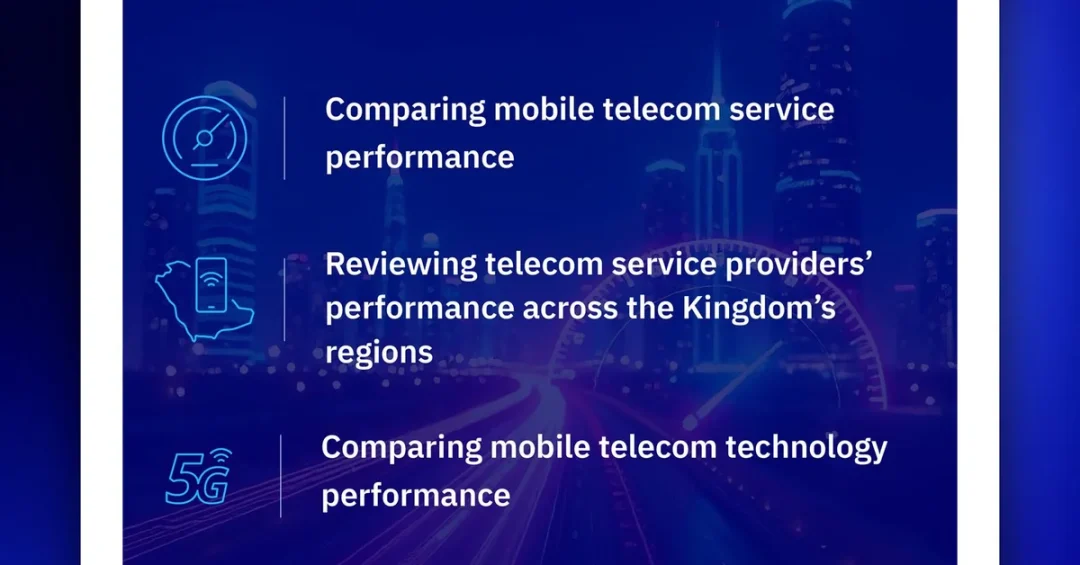
Saudi Arabia’s Communications, Space, and Technology Commission (CST) has published the ‘Miqyas Report’ for the first half of 2026, delivering a comprehensive performance snapshot of the Kingdom’s mobile and fixed telecommunications services. Released via the Saudi Press Agency, the report benchmarks download speeds, upload speeds, latency, 5G coverage and adoption, and fixed-network quality across all regions, offering users, investors, and stakeholders a transparent view of a sector that has become one of the fastest-advancing in the region. The publication underscores the Kingdom’s commitment to measurable service quality as it pursues its digital transformation goals under Vision 2030.
Why does a single report on telecom performance matter so much at this moment? Because connectivity is the backbone of every modern economy, and in Saudi Arabia it is also the backbone of a national transformation. The Miqyas Report — ‘miqyas’ means ‘scale’ or ‘benchmark’ in Arabic — is designed to enhance competition in delivering better services to users and to promote transparency by enabling investors and interested parties to review sector performance indicators. The first-half 2026 edition shows a market in which all major operators are pushing each other forward, and in which the benefits are flowing to consumers and businesses alike.
Context and Background
How did Saudi Arabia’s telecom sector become one of the most closely measured in the world? The answer lies in a deliberate regulatory strategy. The Communications, Space, and Technology Commission, which oversees telecommunications, space, and technology policy in the Kingdom, has steadily expanded its data-driven oversight, and the Miqyas Report is central to that effort. By publishing comparable, provider-level indicators twice a year, the CST gives consumers the information they need to make informed choices and gives operators a clear incentive to improve.
The report’s scope is broad. It reviews the performance of service providers in terms of download speeds, upload speeds, and latency across the Kingdom’s regions, covering both mobile and fixed services. It also examines technology adoption metrics, including 5G coverage and smartphone capability, voice-call technology, fiber penetration, and home connectivity. This regional granularity is significant: it allows policymakers and investors to see not just national averages but how quality of service varies from one part of the country to another, supporting more targeted infrastructure investment.
The first half of 2026 arrives at a time when demand for high-speed connectivity in Saudi Arabia continues to climb, driven by cloud computing, artificial intelligence, e-government services, streaming, gaming, and a rapidly growing digital economy. In that environment, the Miqyas Report functions as both a scorecard and a roadmap, highlighting where the sector excels and where further gains are possible.
Key Details: Mobile Performance
What do the numbers actually show? In mobile services, stc led in median mobile download speed at 234 Mbps, while Mobily recorded the highest median upload speed at 18 Mbps. stc also achieved the lowest latency at 22ms and topped the Speed and Latency Performance Index with a score of 73.4%. These figures place Saudi mobile networks among the strongest performers globally and reflect years of sustained investment in 4G and 5G infrastructure.
On the technology side, overall 5G coverage across the Kingdom reached 89%, a remarkable level of national reach. Mobily led in 5G-capable smartphones at 60%, while stc recorded the highest number of smartphones actively connected to 5G networks at 31%. stc also led in the share of voice call traffic carried over 4G networks using VoLTE technology, at 88%. Together, these indicators show that 5G is no longer a novelty in Saudi Arabia but a mainstream service, with device capability and network usage advancing in parallel.
The regional breakdown in the report adds further depth, allowing observers to track how operators perform across different areas of the Kingdom. This matters for consumers who want to compare providers in their own city or region, and for enterprises — from logistics firms to fintech startups — that depend on consistent, low-latency mobile connections to run their operations.
Key Details: Fixed and Home Connectivity
How competitive is the fixed broadband market? The report shows strong rivalry among providers. Salam recorded the highest median fixed download speed at 192 Mbps, while stc led in median upload speed at 94 Mbps. stc and Zain jointly achieved the lowest latency at 6ms, and stc topped the Fixed Network Speed and Latency Performance Index with a score of 62.8%.
In fixed network indicators, Salam led in median Wi-Fi download speed at 186 Mbps, while Mobily recorded the highest median Ethernet download speed at 303 Mbps. Salam also had the highest number of fiber subscribers using routers supporting Wi-Fi 6 or higher, at 66%. The report further examined home connectivity technologies, with fiber-optic connections recording the highest median download speed at 185 Mbps, the highest median upload speed at 95 Mbps, and the lowest latency at 6ms — a clear validation of the Kingdom’s fiber rollout strategy.
These results illustrate a market in which different operators lead in different categories, a sign of healthy competition rather than dominance by a single player. For households, the practical effect is better streaming, smoother video calls, and more reliable remote work and online learning. For businesses, it means a stronger foundation for cloud services, e-commerce, and digital innovation.
International and Regional Impact
Why should the rest of the world pay attention to Saudi telecom benchmarks? Because connectivity quality is now a leading indicator of economic competitiveness. Saudi Arabia’s mobile download speeds and 5G coverage compare favorably with those of many advanced economies, strengthening the Kingdom’s position as a regional digital hub and a destination for technology investment. Multinational companies evaluating where to place regional headquarters, data centers, or research operations increasingly factor network performance into their decisions.
The Miqyas Report also reinforces Saudi Arabia’s role as a standard-setter in the region. By publishing transparent, comparable indicators, the CST provides a model that other regulators can study. For international investors, the report offers a rare level of visibility into the performance of listed telecom operators, complementing financial disclosures with operational data. That transparency can support more informed capital allocation and deeper confidence in the Saudi market.
Economic and Strategic Significance
What does all this mean for the Saudi economy? Telecommunications is a foundational sector: every digital business, government platform, and emerging technology depends on it. The strong performance documented in the first half of 2026 supports the Kingdom’s ambitions in artificial intelligence, cloud computing, smart cities, and the digital economy more broadly. High-speed, low-latency networks are a prerequisite for the data-intensive applications that Vision 2030 seeks to attract and develop.
The report also has a competitive dimension. By enabling users to choose service providers based on performance indicators, the CST creates continuous pressure on operators to invest and improve. This consumer-empowerment approach is consistent with the Commission’s mandate to enhance competition and promote transparency. Over time, that dynamic should translate into sustained quality gains, benefiting households, businesses, and public services alike.
For investors and stakeholders, the Miqyas Report provides valuable insights into market performance in the Kingdom. It complements traditional financial reporting with operational metrics that reveal how well networks are actually performing for users. That combination of financial and operational transparency is attractive to both domestic and international capital.
Vision 2030 Alignment
How does a telecom performance report connect to Saudi Arabia’s long-term national vision? Directly. Vision 2030 aims to build a diversified, digital economy, and world-class connectivity is one of its essential foundations. The Miqyas Report’s findings — 89% 5G coverage, fiber networks delivering median download speeds of 185 Mbps, and latency as low as 6ms — demonstrate tangible progress toward the infrastructure needed for a knowledge-based economy.
The Commission’s continued publication of these indicators reflects the transparency and accountability that underpin the Kingdom’s transformation. By measuring performance, publishing results, and encouraging competition, Saudi Arabia is building not only faster networks but also a culture of continuous improvement. For readers around the world, the message is clear: the Kingdom’s digital infrastructure is advancing rapidly, and the Miqyas Report offers an authoritative, official window into that progress. For more information, the full report is available via the CST’s knowledge center: https://www.cst.gov.sa/en/knowledge-center/reports/meqyas-dashboard.
20 Questions
Q1. What is the Miqyas Report?
A1. The Miqyas Report is a periodic publication by Saudi Arabia’s Communications, Space, and Technology Commission (CST) that benchmarks mobile and fixed telecommunications performance across the Kingdom, covering speeds, latency, coverage, and technology adoption.
Q2. Which entity published the Miqyas Report for the first half of 2026?
A2. The Communications, Space, and Technology Commission (CST), Saudi Arabia’s regulator for telecommunications, space, and technology, published the report, which was released via the Saudi Press Agency.
Q3. Which operator led in median mobile download speed?
A3. stc led in median mobile download speed at 234 Mbps, according to the first-half 2026 Miqyas Report, reflecting sustained investment in mobile network infrastructure.
Q4. Which operator recorded the highest median mobile upload speed?
A4. Mobily recorded the highest median mobile upload speed at 18 Mbps, the report showed, highlighting competitive performance in mobile uplink capabilities across the Kingdom.
Q5. What was the lowest mobile latency and who achieved it?
A5. stc achieved the lowest mobile latency at 22ms and also topped the Speed and Latency Performance Index with a score of 73.4%, according to the report.
Q6. What is the overall 5G coverage across Saudi Arabia?
A6. Overall 5G coverage across the Kingdom reached 89% in the first half of 2026, a strong indicator of national network reach and the maturity of Saudi Arabia’s 5G rollout.
Q7. Which operator led in 5G-capable smartphones?
A7. Mobily led in 5G-capable smartphones at 60%, meaning a majority of smartphones on its network were capable of accessing 5G services.
Q8. Which operator had the most smartphones actively connected to 5G?
A8. stc recorded the highest number of smartphones actively connected to 5G networks at 31%, indicating strong real-world adoption of 5G services among its subscribers.
Q9. Which operator led in VoLTE traffic share?
A9. stc led in the share of voice call traffic carried over 4G networks using VoLTE technology at 88%, reflecting advanced voice-call infrastructure and adoption.
Q10. Which operator recorded the highest fixed median download speed?
A10. Salam recorded the highest median fixed download speed at 192 Mbps, according to the report, demonstrating strong performance in fixed broadband services.
Q11. Which operator led in fixed median upload speed?
A11. stc led in median fixed upload speed at 94 Mbps, a result that supports activities such as video conferencing, cloud backup, and content creation for households and businesses.
Q12. Which operators achieved the lowest fixed latency?
A12. stc and Zain jointly achieved the lowest fixed latency at 6ms, an exceptionally low figure that benefits latency-sensitive applications such as gaming, video calls, and real-time services.
Q13. Who topped the Fixed Network Speed and Latency Performance Index?
A13. stc topped the Fixed Network Speed and Latency Performance Index with a score of 62.8%, reflecting consistently strong fixed-network performance across the measured indicators.
Q14. Which operator led in median Wi-Fi download speed?
A14. Salam led in median Wi-Fi download speed at 186 Mbps, a key metric for home connectivity given that most households rely on Wi-Fi for their devices.
Q15. Which operator recorded the highest median Ethernet download speed?
A15. Mobily recorded the highest median Ethernet download speed at 303 Mbps, a result relevant for users who connect devices directly via wired connections for maximum performance.
Q16. Which operator had the most fiber subscribers using Wi-Fi 6 or higher routers?
A16. Salam had the highest number of fiber subscribers using routers supporting Wi-Fi 6 or higher at 66%, indicating strong adoption of modern home networking equipment among its customers.
Q17. Which home connectivity technology performed best in the report?
A17. Fiber-optic connections recorded the highest median download speed at 185 Mbps, the highest median upload speed at 95 Mbps, and the lowest latency at 6ms, outperforming other home connectivity technologies.
Q18. Why does the CST publish the Miqyas Report?
A18. The report aims to enhance competition in delivering better services to users and promote transparency in the sector by enabling investors and interested parties to review performance indicators in the Kingdom.
Q19. How does the report benefit consumers and investors?
A19. Consumers can use the indicators to choose service providers based on performance, while investors and stakeholders gain valuable insights into market performance, supporting more informed decisions.
Q20. How does the Miqyas Report support Vision 2030?
A20. By promoting transparency, competition, and continuous network improvement, the report supports Vision 2030’s goal of building a diversified digital economy underpinned by world-class connectivity infrastructure.
Reader Feedback
We value your thoughts. Please share your feedback on this article.
Your feedback helps us improve our coverage.
Related articles
 SDAIA Launches AI Year Across Saudi Universities
 MCIT Expands Mostaqbali Program to Train 50,000 Saudis in AI
 KAUST Leads Arab World with 16 Highly Cited Researchers
 King Saud University Hosts 16th GIS Day 2026
 MCIT Launches CODE AI Catalyst Program to Empower AI Startups
 Al-Ahsa College Joins National Afforestation Season