


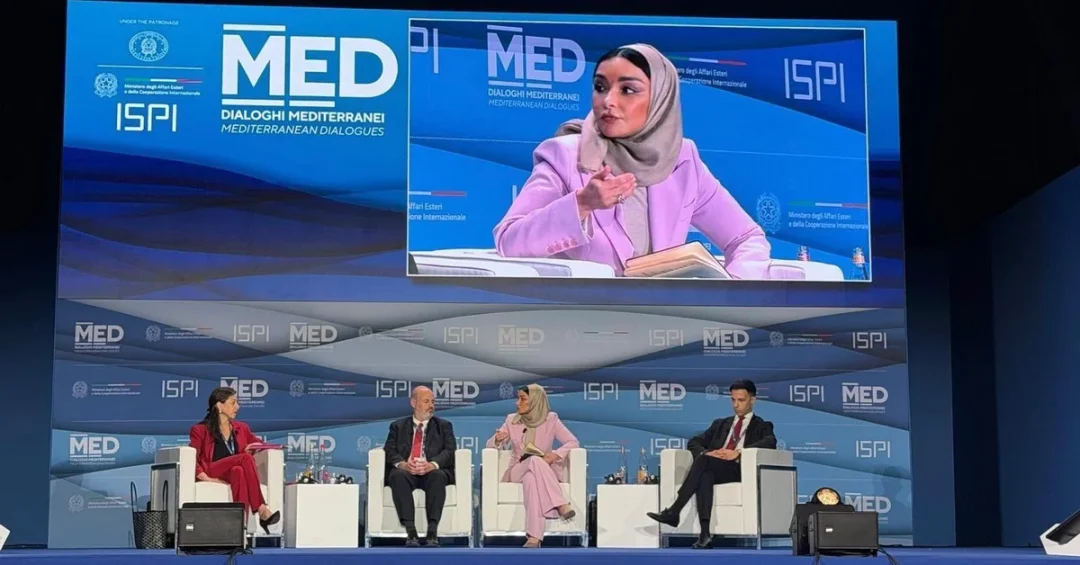
Saudi Arabia has called for a sustainable regional security architecture founded on mutual guarantees, linking the security of every state to that of its neighbors rather than achieving it at another’s expense. The call was made by Manal Radwan, Advisor and Special Envoy of the Minister of Foreign Affairs for Negotiations and Peace Efforts, during a session titled “Redefining Security: Iran, the Straits, and the Future of the Regional Order” at the Mediterranean Dialogues (MED) conference in Naples, Italy, according to the Saudi Press Agency (SPA).
Radwan told the gathering that the Kingdom continues to pursue an approach combining containment, deterrence, and dialogue, and that its defense of its own security, the security and stability of the Gulf, and the vital waterways of the Strait of Hormuz and Bab al-Mandab Strait serves the interests of the whole world. The remarks, delivered at one of the Mediterranean region’s most prominent strategic forums, placed Saudi diplomacy at the center of international efforts to rethink how security is organized across the Middle East. They also reinforced the Kingdom’s consistent position that lasting stability cannot be built on temporary arrangements or on one state’s dominance over others, but must rest on mutual guarantees and shared responsibility.
Context and Background
For decades, the security of the Gulf and the wider Middle East has been managed through a patchwork of temporary arrangements, external guarantees, and reactive crisis management. The Mediterranean Dialogues conference, held annually in Naples, brings together heads of state, ministers, and strategic thinkers to examine the most pressing issues facing the Mediterranean and its neighboring regions, including the future of the regional order. Saudi Arabia’s participation reflects its growing role as a convening power and a source of diplomatic initiatives aimed at de-escalation and conflict resolution.
Manal Radwan’s intervention came amid a broader regional conversation about the Strait of Hormuz and the Bab al-Mandab Strait, two waterways through which a significant share of global energy supplies and commercial trade passes. Any disruption to these chokepoints carries immediate consequences for international markets, shipping, and energy security. In this context, the Saudi position emphasizes that the stability of these waterways is not a narrow national interest but a global public good. The Kingdom’s approach, as outlined by Radwan, combines containment, deterrence, and dialogue, reflecting a balanced strategy that seeks to protect vital interests while keeping diplomatic channels open.
The timing of the Naples session is significant. The region has witnessed repeated cycles of conflict in which the end of one round of hostilities has merely set the stage for a more violent one. Saudi Arabia has consistently argued that this pattern must be broken through a comprehensive framework that addresses root causes rather than symptoms. Radwan’s call for a sustainable regional security architecture, in which each state’s security is linked to that of its neighbors, represents a direct response to this cycle and an invitation for regional actors to move from competition to coordination.
Key Details
In her remarks, Radwan outlined several core principles. First, she called for a sustainable regional security architecture founded on mutual security guarantees, so that the end of one round of conflict does not merely set the stage for a more violent one. Second, she stressed that temporary arrangements will not work unless they are aligned with long-term strategic frameworks. Third, she addressed the challenge of armed groups outside state control, arguing that dealing with them requires a political vision, not only a security one, that addresses the local causes of their emergence and their links to the external parties that support and exploit them.
Radwan also highlighted the unity of the Gulf Cooperation Council (GCC) member states, noting that they are united in their objectives and that their roles should complement one another in supporting mediation, de-escalation, and the prevention of a new war, paving the way for confidence-building. She added that regional dialogue and international stability are closely linked, and that there is no place in the region for any hegemonic power. On Yemen, she stated that the war is at its core an intra-Yemeni conflict and that the Kingdom supports a resolution through political and economic tracks in line with the UN-led roadmap.
Finally, Radwan warned that merely managing the region’s crises for years to come without addressing their root causes could have catastrophic consequences for all. She called for collective action to seize the current opportunity for a comprehensive and sustainable solution that serves all parties, includes the realization of a Palestinian state, fosters regional integration, and keeps pace with global geostrategic shifts. These points together form a coherent Saudi vision for regional security that is both principled and pragmatic.
International and Regional Impact
Saudi Arabia’s call for a mutual security architecture resonates far beyond the Gulf. The Strait of Hormuz and the Bab al-Mandab Strait are arteries of the global economy, and any instability there affects energy prices, shipping insurance, and supply chains worldwide. By framing the security of these waterways as a global interest, Riyadh is signaling that its diplomatic efforts are intended to benefit the international community as a whole. This approach aligns with the Kingdom’s broader foreign policy of constructive engagement and its role as a reliable energy supplier and partner in global stability.
Within the region, the emphasis on GCC unity and complementary roles is a reminder that the Gulf states share a common interest in de-escalation. Radwan’s statement that there is no place for a hegemonic power in the region reflects a rejection of zero-sum politics and an invitation for all regional actors to participate in a new security framework. This message is particularly relevant as the region explores avenues for dialogue and confidence-building. By supporting mediation and the prevention of a new war, Saudi Arabia positions itself as a stabilizing force and a bridge between different regional and international stakeholders.
Economic and Strategic Significance
The economic dimension of regional security is profound. Stable waterways and reduced conflict risk are prerequisites for investment, trade, and the ambitious economic diversification programs underway across the Gulf. Saudi Arabia’s Vision 2030, which seeks to transform the Kingdom’s economy and society, depends on a peaceful regional environment that allows for the free flow of goods, capital, and people. The security architecture proposed by Radwan would not only reduce the risk of conflict but also create the conditions for deeper economic integration, including the realization of a Palestinian state and broader regional connectivity.
Strategically, the call for mutual guarantees represents a shift from reliance on external powers to a more indigenous regional order. This does not mean disengagement from international partners, but rather a more balanced approach in which regional states take greater ownership of their security. Such a framework could enhance the effectiveness of mediation efforts, reduce the potential for miscalculation, and create a more predictable environment for diplomacy. For global powers, this offers an opportunity to support a sustainable solution rather than continually managing crises, which is both costly and uncertain.
Vision 2030 Alignment
Saudi Arabia’s Vision 2030 is not only an economic blueprint but also a vision for a stable, prosperous, and influential Kingdom. The call for a sustainable regional security architecture directly supports this vision by seeking to create an environment in which economic and social development can flourish. A region free from the constant threat of war is essential for attracting investment, fostering innovation, and improving the quality of life for citizens. Moreover, the emphasis on mutual guarantees and dialogue reflects the Vision’s broader principles of openness, moderation, and global engagement.
By articulating this vision at the Mediterranean Dialogues, Saudi Arabia reinforces its role as a responsible international actor and a partner in shaping a more peaceful world. The Kingdom’s approach, as outlined by Manal Radwan, offers a path away from the cycle of conflict and toward a future of cooperation and shared prosperity. As the region navigates complex challenges, Saudi Arabia’s leadership in promoting dialogue and mutual security guarantees will remain a cornerstone of its foreign policy and a key contribution to global stability.
20 Questions
Q1. What event did Manal Radwan participate in?
A1. Manal Radwan, Advisor and Special Envoy of the Minister of Foreign Affairs for Negotiations and Peace Efforts, participated in a session at the Mediterranean Dialogues (MED) conference in Naples, Italy.
Q2. What was the title of the session Radwan took part in?
A2. The session was titled “Redefining Security: Iran, the Straits, and the Future of the Regional Order.”
Q3. What approach does Saudi Arabia continue to pursue according to Radwan?
A3. Saudi Arabia continues to pursue an approach combining containment, deterrence, and dialogue.
Q4. What did Radwan say about Saudi Arabia’s defense of its security?
A4. She said that Saudi Arabia’s defense of its own security, the security and stability of the Gulf, and the vital waterways serves the interests of the whole world.
Q5. What kind of regional security architecture did Radwan call for?
A5. She called for a sustainable regional security architecture in which each state’s security is linked to that of its neighbors and not achieved at another’s expense.
Q6. What must a sustainable security architecture be founded on?
A6. It must be founded on mutual security guarantees, so that the end of one round of conflict does not merely set the stage for a more violent one.
Q7. What did Radwan say about temporary arrangements?
A7. She said temporary arrangements will not work unless they are aligned with long-term strategic frameworks.
Q8. How should armed groups outside state control be dealt with?
A8. Dealing with them requires a political vision, not only a security one, that addresses the local causes of their emergence and their links to external parties.
Q9. What did Radwan say about GCC member states?
A9. She said GCC member states are united in their objectives and their roles should complement one another in supporting mediation, de-escalation, and prevention of a new war.
Q10. What did Radwan say about regional dialogue and international stability?
A10. She said regional dialogue and international stability are closely linked, and there is no place in the region for any hegemonic power.
Q11. What did Radwan say about the war in Yemen?
A11. She said the war is at its core an intra-Yemeni conflict, and the Kingdom supports a resolution through political and economic tracks in line with the UN-led roadmap.
Q12. What warning did Radwan issue about managing crises?
A12. She warned that merely managing the region’s crises for years to come without addressing their root causes could have catastrophic consequences for all.
Q13. What did Radwan call for regarding the current opportunity?
A13. She called for collective action to seize the current opportunity for a comprehensive and sustainable solution that serves all parties.
Q14. What elements did Radwan say a comprehensive solution should include?
A14. She said it should include the realization of a Palestinian state, foster regional integration, and keep pace with global geostrategic shifts.
Q15. Why are the Strait of Hormuz and Bab al-Mandab Strait important?
A15. They are vital waterways through which a significant share of global energy supplies and commercial trade passes.
Q16. What is the significance of Saudi Arabia’s participation in the Mediterranean Dialogues?
A16. It reflects Saudi Arabia’s growing role as a convening power and a source of diplomatic initiatives aimed at de-escalation and conflict resolution.
Q17. How does the call for a sustainable security architecture align with Vision 2030?
A17. It supports Vision 2030 by seeking to create an environment where economic and social development can flourish, attracting investment and improving quality of life.
Q18. What did Radwan say about the role of GCC states in confidence-building?
A18. She said their roles should complement one another in supporting mediation, de-escalation, and the prevention of a new war, paving the way for confidence-building.
Q19. What did Radwan say about the link between regional dialogue and international stability?
A19. She said they are closely linked, and there is no place in the region for any hegemonic power.
Q20. What is the ultimate goal of the security architecture Radwan proposed?
A20. The goal is a comprehensive and sustainable solution that serves all parties, includes a Palestinian state, fosters regional integration, and keeps pace with global geostrategic shifts.
Reader Feedback
We value your thoughts. Please share your feedback on this article.
Your feedback helps us improve our coverage.
Related articles
 Bulgarian PM Rumen Radev Arrives in Riyadh for Official Visit
 IMCTC Concludes ‘Peace Journalists’ Program in Pakistan
 Islamic Affairs Ministry Concludes Fourth Scholarly Course in Sri Lanka
 Saudi Ambassador Presents Credentials to North Macedonia
 Saudi Arabia Concludes Successful Participation in ICAO Air Transport Conference
 Saudi Arabia Records 10,783 Residency and Labor Violations