


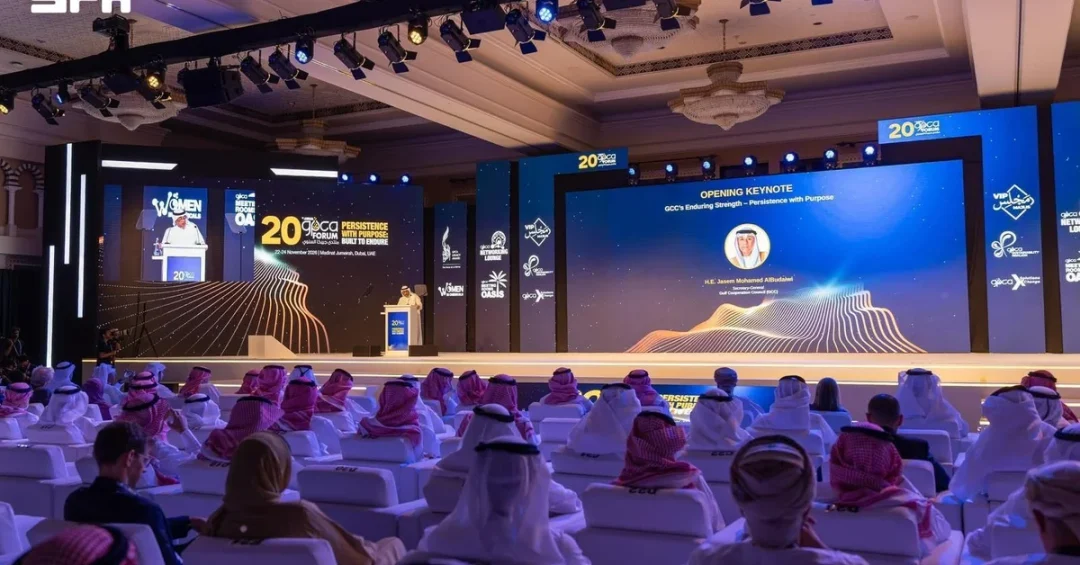
Riyadh, November 23, 2026 — The Secretary-General of the Gulf Cooperation Council (GCC), Jasem Mohamed Albudaiwi, affirmed that the petrochemical and chemical industry remains one of the key pillars of industrial and economic development across the GCC states, describing the sector as a cornerstone of regional diversification and global competitiveness. His remarks were delivered during the opening address of the 20th Annual Forum of the Gulf Petrochemicals and Chemicals Association (GPCA), held in Dubai under the theme “Persistence with Purpose: Built to Endure.” The forum, which has become a leading regional and international platform, brought together industry leaders, policymakers, and experts to explore the future of the petrochemical and chemical industry.
Albudaiwi’s address underscored the GCC’s ongoing commitment to supporting the commercial and industrial interests of its member states, in line with international trade rules and through the GCC trade remedies framework. He highlighted the GCC’s efforts to address unfair trade practices and measures that may affect GCC exports, noting that the implementation of the GCC Common Law on Anti-Dumping, Countervailing and Safeguard Measures has contributed to preserving market access for exports valued at approximately SAR14 billion. This significant figure illustrates the tangible impact of the GCC’s trade defense mechanisms in protecting vital industries.
Context and Background
How did the petrochemical sector become such a vital component of the GCC’s economic architecture? For decades, the region’s vast hydrocarbon reserves have provided a natural competitive advantage, enabling the development of a robust petrochemical and chemical industry that serves both domestic and international markets. The GCC, comprising Bahrain, Kuwait, Oman, Qatar, Saudi Arabia, and the United Arab Emirates, has leveraged this advantage to build integrated value chains that span from upstream extraction to downstream manufacturing. The sector now accounts for a substantial share of non-oil exports and industrial employment across the region.
The GPCA, established in 2006, has played a pivotal role in fostering collaboration and knowledge exchange among industry stakeholders. Its annual forum has grown into a premier event where strategic directions are charted, innovations are showcased, and partnerships are forged. The 20th edition, held under the theme “Persistence with Purpose: Built to Endure,” reflects the industry’s resilience and its forward-looking approach to navigating global economic shifts, including the energy transition and evolving trade dynamics. The presence of high-level officials like Albudaiwi underscores the GCC’s recognition of the sector’s strategic importance.
In recent years, the GCC has intensified efforts to diversify economies away from oil dependence, with petrochemicals serving as a critical bridge to a more sustainable industrial future. Saudi Arabia’s Vision 2030, for instance, identifies the petrochemical industry as a key enabler of economic diversification, aiming to increase non-oil exports and create high-value jobs. Similarly, other GCC states have launched ambitious plans to expand their downstream capacities and move into specialty chemicals, which offer higher margins and greater resilience to commodity price fluctuations.
Key Details
What specific priorities did the GCC Secretary-General outline for the future of the industry? In his address, Albudaiwi identified three key priorities: first, advancing innovation and developing higher-value-added petrochemical and chemical products; second, deepening Gulf industrial integration to build more resilient regional value chains; and third, strengthening international partnerships and expanding market access. These priorities align with the GCC’s broader strategy to enhance economic integration and competitiveness on the global stage.
The first priority, innovation and value addition, is particularly crucial as global demand shifts toward specialty chemicals and sustainable materials. By investing in research and development, GCC states can capture more value from their hydrocarbon resources and reduce reliance on volatile commodity markets. The second priority, industrial integration, involves harmonizing regulations, improving logistics, and fostering cross-border investments to create a seamless regional market. This integration would enable economies of scale and attract foreign direct investment. The third priority, international partnerships, focuses on securing market access through trade agreements and defending against unfair trade practices, as exemplified by the SAR14 billion in preserved exports.
Albudaiwi also emphasized the GCC General Secretariat’s ongoing efforts to support member states’ commercial and industrial interests through the GCC trade remedies framework. This framework, which includes anti-dumping, countervailing, and safeguard measures, is designed to protect GCC industries from unfair competition while adhering to World Trade Organization (WTO) rules. The SAR14 billion figure underscores the effectiveness of these measures in safeguarding exports and maintaining the region’s reputation as a reliable supplier. The Secretary-General’s remarks reflect a proactive stance in addressing trade challenges and ensuring a level playing field for GCC producers.
International and Regional Impact
How does the GCC’s petrochemical industry influence global markets? The region is a major player in the global petrochemical landscape, accounting for a significant share of worldwide production and exports. GCC producers benefit from low-cost feedstock, modern infrastructure, and strategic geographic location, which positions them as key suppliers to Asia, Europe, and the Americas. The industry’s competitiveness has far-reaching implications for global supply chains, particularly in sectors such as plastics, fertilizers, and automotive components. By advancing innovation and expanding into specialty chemicals, the GCC aims to move up the value chain and capture a larger share of global profits.
Regionally, the petrochemical sector is a catalyst for economic integration and job creation. It supports ancillary industries, including logistics, engineering, and financial services, and provides employment opportunities for a growing youth population. The GCC’s efforts to deepen industrial integration, as highlighted by Albudaiwi, are expected to enhance intra-regional trade and investment, fostering a more cohesive economic bloc. Moreover, the sector’s resilience during global downturns has demonstrated its strategic importance, prompting governments to prioritize its development in their national visions.
The international dimension of the GCC’s trade remedies framework also plays a crucial role in maintaining fair competition. By actively defending its exports in international markets, the GCC ensures that its producers are not disadvantaged by unfair trade practices. This not only protects the region’s economic interests but also reinforces the rules-based global trading system. As global trade tensions persist, the GCC’s commitment to resolving disputes through established mechanisms serves as a stabilizing force.
Economic and Strategic Significance
Why is the petrochemical industry considered a linchpin of GCC economic development? The sector contributes significantly to GDP, government revenues, and export earnings across member states. In Saudi Arabia, for example, petrochemicals are the second-largest source of export income after crude oil, and the industry is a major employer of skilled labor. The sector also drives technological innovation and industrial diversification, aligning with the goals of Saudi Vision 2030 and similar initiatives in other GCC countries. By fostering a knowledge-based economy, the petrochemical industry helps reduce dependence on oil price fluctuations and creates sustainable growth pathways.
Strategically, the industry enhances the GCC’s geopolitical influence. As a reliable supplier of essential materials, the region plays a critical role in global energy and industrial security. The GCC’s ability to defend its trade interests through legal frameworks further strengthens its position in international negotiations. Albudaiwi’s emphasis on international partnerships and market access signals a continued commitment to open trade and cooperation, which is vital for attracting investment and fostering innovation. The SAR14 billion in preserved exports is a testament to the effectiveness of these efforts and a reminder of the stakes involved.
Looking ahead, the industry faces both opportunities and challenges. The global transition to a low-carbon economy presents opportunities for GCC producers to invest in sustainable technologies, such as carbon capture and utilization, and to develop bio-based chemicals. Challenges include fluctuating oil prices, trade barriers, and increasing competition from other regions. However, with strong government support and a clear strategic vision, the GCC petrochemical sector is well-positioned to navigate these dynamics and emerge stronger.
Vision 2030 Alignment
How does the GCC’s petrochemical strategy align with Saudi Arabia’s Vision 2030? Vision 2030 aims to diversify the Kingdom’s economy, increase non-oil exports, and create a vibrant private sector. The petrochemical industry is central to these objectives, as it enables value addition to hydrocarbon resources and fosters downstream industries. Saudi Arabia’s Vision 2030 includes targets to increase the contribution of the industrial sector to GDP and to localize manufacturing, both of which are supported by a thriving petrochemical sector. The GCC’s regional approach complements national efforts, creating synergies that amplify impact.
Moreover, Vision 2030 emphasizes international partnerships and economic diplomacy, which mirror the GCC’s third priority of strengthening global ties. By working together, GCC states can present a unified front in trade negotiations and leverage their collective market size to secure better terms. The Secretary-General’s remarks at the GPCA Forum thus reinforce the alignment between regional and national strategies, highlighting the petrochemical industry as a vehicle for achieving sustainable development and global competitiveness. As the GCC continues to innovate and integrate, its petrochemical sector will remain a driving force behind the region’s economic transformation and a key pillar of its future prosperity.
20 Questions
Q1. What is the Gulf Cooperation Council (GCC)?
A1. The GCC is a regional political and economic union of six Arab states: Bahrain, Kuwait, Oman, Qatar, Saudi Arabia, and the United Arab Emirates. Established in 1981, it aims to promote coordination and integration among its members in various fields, including economics, security, and culture.
Q2. Who is Jasem Mohamed Albudaiwi?
A2. Jasem Mohamed Albudaiwi is the Secretary-General of the Gulf Cooperation Council. He has held this position since 2023 and has been actively involved in promoting regional cooperation and economic development across the GCC member states.
Q3. What is the GPCA Forum?
A3. The GPCA Forum is the annual flagship event of the Gulf Petrochemicals and Chemicals Association. It brings together industry leaders, policymakers, and experts to discuss trends, challenges, and opportunities in the petrochemical and chemical industry. The 20th edition was held in Dubai under the theme “Persistence with Purpose: Built to Endure.”
Q4. Why is the petrochemical industry important to the GCC?
A4. The petrochemical industry is a key pillar of the GCC’s economic development, contributing significantly to GDP, exports, and job creation. It leverages the region’s hydrocarbon resources to produce high-value chemicals and materials, supporting economic diversification and industrial growth.
Q5. What are the three priorities outlined by the GCC Secretary-General?
A5. The three priorities are: first, advancing innovation and developing higher-value-added products; second, deepening Gulf industrial integration to build resilient regional value chains; and third, strengthening international partnerships and expanding market access.
Q6. What is the GCC Common Law on Anti-Dumping, Countervailing and Safeguard Measures?
A6. It is a unified legal framework adopted by the GCC to protect member states’ industries from unfair trade practices. It allows the GCC to impose anti-dumping, countervailing, and safeguard measures in accordance with international trade rules, ensuring fair competition for GCC exports.
Q7. How much has the GCC preserved in exports through trade remedies?
A7. The GCC has contributed to preserving market access for exports valued at approximately SAR14 billion through its trade remedies framework, as stated by Secretary-General Albudaiwi. This demonstrates the effectiveness of the GCC’s efforts to defend member states’ interests.
Q8. What is the significance of the SAR14 billion figure?
A8. The SAR14 billion figure represents the value of exports that the GCC has helped protect from unfair trade measures. It highlights the tangible economic impact of the GCC’s trade defense mechanisms and underscores the importance of maintaining fair market access for regional producers.
Q9. How does the petrochemical industry contribute to Saudi Vision 2030?
A9. The petrochemical industry supports Saudi Vision 2030 by enabling economic diversification, increasing non-oil exports, and creating high-value jobs. It is a key enabler of the Kingdom’s goals to expand the industrial sector and localize manufacturing, thereby reducing dependence on oil revenues.
Q10. What is the theme of the 20th GPCA Forum and what does it mean?
A10. The theme is “Persistence with Purpose: Built to Endure.” It reflects the industry’s resilience and its commitment to long-term sustainability and growth, emphasizing the need to adapt to global challenges while maintaining strategic focus.
Q11. Which countries are members of the GCC?
A11. The GCC member states are Bahrain, Kuwait, Oman, Qatar, Saudi Arabia, and the United Arab Emirates. These countries share common economic and strategic interests and work together to promote regional integration.
Q12. What are some challenges facing the GCC petrochemical industry?
A12. Challenges include global economic fluctuations, trade barriers, increasing competition from other regions, and the need to adapt to the energy transition. However, the GCC is addressing these through innovation, integration, and international partnerships.
Q13. How does the GCC support its petrochemical exports in international markets?
A13. The GCC supports its exports by implementing trade remedies, engaging in trade negotiations, and defending member states’ interests in international trade investigations. This helps preserve market access and ensures fair competition for GCC products.
Q14. What role does innovation play in the future of the GCC petrochemical industry?
A14. Innovation is crucial for developing higher-value-added products, such as specialty chemicals and sustainable materials. It enables GCC producers to move up the value chain, reduce reliance on commodities, and enhance competitiveness in global markets.
Q15. Why is industrial integration important for the GCC?
A15. Industrial integration deepens economic ties among member states, creates economies of scale, and builds more resilient regional value chains. It also attracts foreign investment and fosters a more cohesive economic bloc, enhancing the GCC’s global competitiveness.
Q16. What international partnerships is the GCC pursuing in the petrochemical sector?
A16. The GCC is strengthening partnerships with global industry players, governments, and international organizations to expand market access, share technology, and promote joint ventures. These partnerships are essential for accessing new markets and fostering innovation.
Q17. How does the GCC’s trade remedies framework comply with international rules?
A17. The framework is designed in accordance with World Trade Organization (WTO) rules, ensuring that measures are applied fairly and transparently. It allows the GCC to address unfair trade practices while respecting its international obligations.
Q18. What is the expected impact of the GCC’s petrochemical strategy on job creation?
A18. The strategy is expected to create high-skilled jobs in manufacturing, research, and ancillary services. By expanding the industry and moving into higher-value segments, the GCC aims to provide employment opportunities for its growing youth population.
Q19. How does the petrochemical industry support economic diversification in the GCC?
A19. The industry diversifies the GCC’s economic base by generating non-oil export revenues and fostering downstream industries. It reduces reliance on crude oil exports and contributes to a more sustainable and knowledge-based economy.
Q20. What is the long-term vision for the GCC petrochemical industry?
A20. The long-term vision is to maintain the industry as a key pillar of economic development, driving innovation, integration, and international cooperation. It aims to ensure the GCC remains a leading global player in petrochemicals, contributing to sustainable prosperity for the region.
Reader Feedback
We value your thoughts. Please share your feedback on this article.
Your feedback helps us improve our coverage.
Related articles
 Madinah’s 70+ Organic Farms Boost Sustainable Food Production
 Foodex Saudi 2026 Opens in Jeddah with 800+ Brands
 SAMA Licenses Izdihar Financing to Boost SME Finance
 SME Bank Wins 2026 SME Financier of the Year Award for MENA
 SAMA Licenses Neo for Fintech Microfinance
 Saudi Social Development Bank Wins Best Financier for Women