


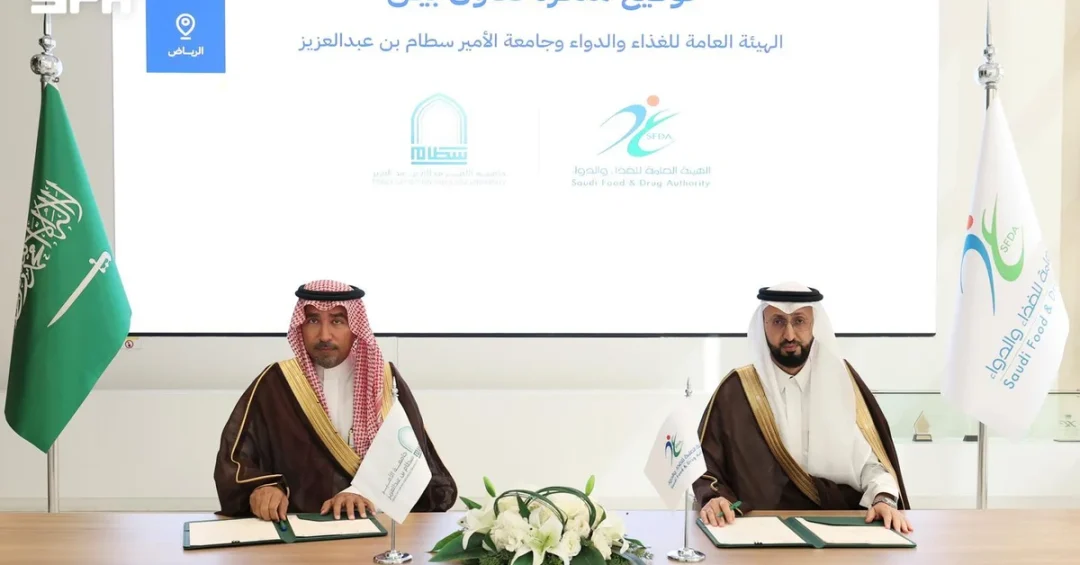
The Saudi Food and Drug Authority (SFDA) signed a memorandum of cooperation with Prince Sattam bin Abdulaziz University in Riyadh on November 23, 2026, establishing a formal partnership to strengthen training, research and development, and innovation through the exchange of expertise and knowledge. The agreement, announced via the Saudi Press Agency (SPA), was signed by SFDA CEO Dr. Hisham Aljadhey and President of Prince Sattam bin Abdulaziz University Prof. Dr. Abdullah Al-Tamim, marking a significant step in integrating academic research with regulatory excellence in the Kingdom.
The memorandum reflects Saudi Arabia’s broader commitment to building a knowledge-based economy under Vision 2030, where collaboration between government regulators and academic institutions is seen as essential to advancing public health, food safety, and pharmaceutical innovation. By combining the SFDA’s regulatory expertise with the university’s research capabilities, the partnership aims to create an integrated framework that leverages the resources of both entities to achieve shared objectives in accordance with applicable laws and regulations. How does such collaboration redefine the relationship between regulation and innovation in Saudi Arabia’s rapidly evolving health sector?
Context and Background
What does it take to build a world-class regulatory ecosystem that not only safeguards public health but also fuels scientific progress? The Saudi Food and Drug Authority, established in 2003, has steadily evolved into one of the region’s most influential regulatory bodies, overseeing food safety, pharmaceutical products, medical devices, and cosmetics. Its mandate extends beyond enforcement to include fostering innovation, supporting research, and facilitating the development of local industries. In recent years, the SFDA has intensified its efforts to align with Vision 2030 by embracing digital transformation, streamlining regulatory processes, and partnering with academic institutions to cultivate a robust pipeline of skilled professionals and cutting-edge research.
Prince Sattam bin Abdulaziz University, located in Al-Kharj, has similarly positioned itself as a hub for scientific inquiry and community service. With a diverse portfolio of colleges spanning medicine, pharmacy, engineering, and applied sciences, the university offers a fertile ground for translational research and practical training. The new memorandum formalizes a relationship that has likely been developing organically, providing a structured framework for cooperation in areas such as leveraging qualified personnel, exchanging statistical data, supporting innovation and digital transformation, and implementing training programs and workshops. This alignment is timely, as Saudi Arabia accelerates its efforts to localize pharmaceutical manufacturing and enhance food security, both of which depend on a well-trained workforce and evidence-based policymaking.
Key Details of the Memorandum
What specific mechanisms will this partnership employ to turn shared aspirations into tangible outcomes? According to the announcement, the memorandum encompasses several concrete areas of cooperation. First, both parties will leverage qualified personnel and research capabilities, meaning SFDA experts may contribute to curriculum development, guest lectures, and joint research projects, while university faculty and students gain access to real-world regulatory data and practical training environments. Second, the exchange of statistical data will enable evidence-based decision-making, allowing the SFDA to benefit from academic analysis and the university to access rich datasets for research. Third, the agreement emphasizes supporting innovation and digital transformation, which could involve collaborative projects on artificial intelligence, data analytics, and regulatory science. Finally, the implementation of training programs and workshops will provide hands-on learning opportunities for students and professionals alike.
The memorandum was signed by two distinguished leaders: Dr. Hisham Aljadhey, CEO of the SFDA, who has been instrumental in modernizing the authority’s operations and enhancing its global standing, and Prof. Dr. Abdullah Al-Tamim, President of Prince Sattam bin Abdulaziz University, who has championed academic excellence and community engagement. Their signatures underscore a mutual commitment to advancing Saudi Arabia’s health and scientific sectors. The agreement aims to establish an integrated partnership that makes use of the resources available to both entities and supports the achievement of their shared objectives in accordance with applicable laws and regulations. This legal and regulatory compliance ensures that the collaboration operates within the Kingdom’s established frameworks, reinforcing transparency and accountability.
International and Regional Impact
How might this partnership resonate beyond Saudi Arabia’s borders, influencing regional health security and global regulatory practices? The SFDA has increasingly positioned itself as a regional leader, with its decisions and standards often serving as benchmarks for other Gulf Cooperation Council (GCC) states. By collaborating with a prominent university, the authority strengthens its research base, which can lead to more robust regulatory decisions that affect imported and exported food and medical products. For international stakeholders, including pharmaceutical companies and food exporters, this means greater predictability and alignment with global best practices. Moreover, the emphasis on digital transformation and innovation signals that Saudi Arabia is embracing cutting-edge technologies to enhance traceability, safety, and efficiency—a development that could attract further foreign investment and partnerships.
Regionally, the memorandum could inspire similar collaborations across the Middle East, where governments are seeking to diversify economies and improve public health infrastructure. By showcasing a successful model of regulator-academia partnership, Saudi Arabia reinforces its role as a knowledge exporter and a catalyst for regional development. The exchange of statistical data and expertise may also contribute to harmonized standards across the GCC, facilitating trade and improving consumer protection. In a world where health security is paramount, such cooperation enhances the Kingdom’s ability to respond to emerging challenges, from foodborne illnesses to counterfeit medicines, while contributing to global scientific knowledge.
Economic and Strategic Significance
What economic dividends can Saudi Arabia expect from integrating academic research with regulatory oversight? The partnership aligns with the Kingdom’s economic diversification goals by nurturing a skilled workforce that can support emerging sectors such as biotechnology, pharmaceuticals, and advanced food processing. As Saudi Arabia seeks to localize industries and reduce reliance on imports, the availability of highly trained graduates and innovative research becomes critical. The SFDA’s collaboration with Prince Sattam bin Abdulaziz University will likely accelerate the development of local expertise in regulatory affairs, quality assurance, and research and development, making the Kingdom more self-sufficient and competitive. Furthermore, by fostering innovation and digital transformation, the partnership can lead to the creation of new technologies and processes that may be commercialized, generating economic value and job opportunities.
Strategically, the memorandum reinforces the SFDA’s role as a key enabler of Vision 2030’s health and industrial objectives. It supports the National Industrial Development and Logistics Program (NIDLP) and the Health Sector Transformation Program, both of which aim to enhance local content, improve healthcare outcomes, and stimulate private sector growth. By working closely with academia, the SFDA can tap into a pipeline of talent and ideas that might otherwise remain untapped. This collaboration also enhances the Kingdom’s attractiveness as a destination for foreign direct investment in life sciences, as international companies seek regulatory environments that are both rigorous and supportive of innovation. Ultimately, the partnership exemplifies how strategic investments in human capital and research can yield long-term economic benefits.
Vision 2030 Alignment
How does this memorandum embody the core aspirations of Saudi Vision 2030, and what does it signal about the Kingdom’s future trajectory? Vision 2030 seeks to transform Saudi Arabia into a diversified, knowledge-based economy, with a strong emphasis on education, innovation, and public health. The SFDA–Prince Sattam bin Abdulaziz University partnership directly contributes to these goals by fostering research and development, enhancing training opportunities, and promoting digital transformation. It reflects the vision’s call for greater collaboration between government, academia, and the private sector to drive progress. By investing in human capital and scientific inquiry, the Kingdom is laying the foundation for a sustainable future where regulatory excellence and innovation go hand in hand.
As Saudi Arabia continues to advance its health and scientific sectors, this memorandum serves as a model for how institutions can work together to achieve shared objectives. It underscores the importance of evidence-based policymaking and the role of education in national development. With visionary leadership and a commitment to excellence, the SFDA and Prince Sattam bin Abdulaziz University are poised to make significant contributions to the Kingdom’s prosperity and global standing. This partnership is not just an agreement on paper; it is a strategic investment in Saudi Arabia’s future, ensuring that the nation remains at the forefront of health, safety, and innovation for generations to come.
20 Questions
Q1. What is the Saudi Food and Drug Authority?
A1. The Saudi Food and Drug Authority (SFDA) is a government agency established in 2003 to regulate food, drugs, medical devices, and cosmetics in Saudi Arabia. It ensures safety, quality, and efficacy, while supporting innovation and public health under Vision 2030.
Q2. What is Prince Sattam bin Abdulaziz University?
A2. Prince Sattam bin Abdulaziz University is a public university in Al-Kharj, Saudi Arabia, offering diverse programs in medicine, pharmacy, engineering, and sciences. It focuses on academic excellence, research, and community service to support national development.
Q3. When was the memorandum of cooperation signed?
A3. The memorandum was signed on November 23, 2026, in Riyadh, as announced by the Saudi Press Agency. It formalizes a partnership to enhance training, research, and innovation between the two institutions.
Q4. Who signed the memorandum on behalf of the SFDA?
A4. The SFDA was represented by its CEO, Dr. Hisham Aljadhey, who has been instrumental in modernizing the authority’s operations and enhancing its regulatory framework to align with global standards and Vision 2030.
Q5. Who signed the memorandum on behalf of the university?
A5. Prof. Dr. Abdullah Al-Tamim, President of Prince Sattam bin Abdulaziz University, signed on behalf of the university. He has championed academic excellence and community engagement, fostering research and innovation.
Q6. What are the main areas of cooperation outlined in the memorandum?
A6. The cooperation includes leveraging qualified personnel and research capabilities, exchanging statistical data, supporting innovation and digital transformation, and implementing training programs and workshops to achieve shared objectives.
Q7. How will the exchange of statistical data benefit both parties?
A7. The exchange of statistical data will enable evidence-based decision-making, allowing the SFDA to benefit from academic analysis and the university to access rich datasets for research, ultimately improving regulatory outcomes and scientific knowledge.
Q8. What does the memorandum aim to achieve in terms of training?
A8. It aims to implement training programs and workshops that provide hands-on learning opportunities for students and professionals, enhancing their skills in regulatory science, research, and innovation, and preparing them for careers in health and safety sectors.
Q9. How does this partnership support innovation and digital transformation?
A9. The partnership supports innovation and digital transformation through collaborative projects on artificial intelligence, data analytics, and regulatory science, helping to modernize processes and develop new technologies that benefit public health and safety.
Q10. What is the significance of this memorandum for Saudi Arabia’s health sector?
A10. The memorandum strengthens the health sector by integrating academic research with regulatory oversight, leading to improved safety standards, faster innovation, and a skilled workforce that can address emerging health challenges and support local industry growth.
Q11. How does this collaboration align with Vision 2030?
A11. It aligns with Vision 2030 by promoting education, innovation, and public health, and by fostering collaboration between government and academia. This supports economic diversification, human capital development, and the goal of a knowledge-based economy.
Q12. What role does the SFDA play in ensuring food and drug safety in Saudi Arabia?
A12. The SFDA regulates and monitors food, drugs, and medical devices to ensure they meet safety, quality, and efficacy standards. It conducts inspections, approves products, and raises awareness, protecting public health and facilitating trade.
Q13. How will university students benefit from this partnership?
A13. Students will gain access to practical training, workshops, and research opportunities with the SFDA, enhancing their skills and employability. They will also benefit from real-world experience in regulatory affairs and scientific research.
Q14. What are the expected outcomes of the memorandum?
A14. Expected outcomes include enhanced research collaboration, improved training programs, accelerated digital transformation, and stronger regulatory frameworks. It will also foster innovation and support the development of local expertise in health and safety.
Q15. How does this partnership contribute to Saudi Arabia’s economic diversification?
A15. By developing a skilled workforce and promoting innovation in health and life sciences, the partnership supports economic diversification, reduces reliance on oil, and stimulates growth in knowledge-intensive industries, aligning with Vision 2030 goals.
Q16. What is the legal basis for the memorandum?
A16. The memorandum operates in accordance with applicable laws and regulations of Saudi Arabia, ensuring compliance and transparency. It establishes a framework for cooperation that respects the legal mandates of both entities.
Q17. Will the memorandum lead to joint research publications?
A17. While specific publications are not mentioned, the collaboration on research capabilities and data exchange is likely to result in joint studies and publications, contributing to scientific knowledge and evidence-based regulation.
Q18. How does the SFDA collaborate with other institutions in Saudi Arabia?
A18. The SFDA partners with various government bodies, universities, and industry stakeholders to enhance regulatory science, share expertise, and promote innovation, supporting its mission to protect public health and advance Vision 2030.
Q19. What impact will this partnership have on food safety in Saudi Arabia?
A19. The partnership will enhance food safety through improved research, data analysis, and training, enabling the SFDA to adopt more effective regulations and respond swiftly to emerging risks, ultimately protecting consumers.
Q20. How can international stakeholders engage with the SFDA?
A20. International stakeholders can engage with the SFDA through official channels, such as its website and international cooperation offices. The SFDA welcomes collaboration on regulatory harmonization, research, and capacity-building initiatives.
Reader Feedback
We value your thoughts. Please share your feedback on this article.
Your feedback helps us improve our coverage.
Related articles
 Jazan Governor Receives Guinness Certificate for Diabetes Screening Record
 KFSH Honors 41 Researchers on Stanford Top 2% List
 KFSH&RC Treats 288 Patients with CAR-T Therapy
 Qassim Health Cluster Introduces Robotic Knee Replacement Surgery
 Jazan Health Cluster Sets Guinness World Record for Early Diabetes Detection
 Al-Shifa Hospital in Unaizah Accredited as Age-Friendly