


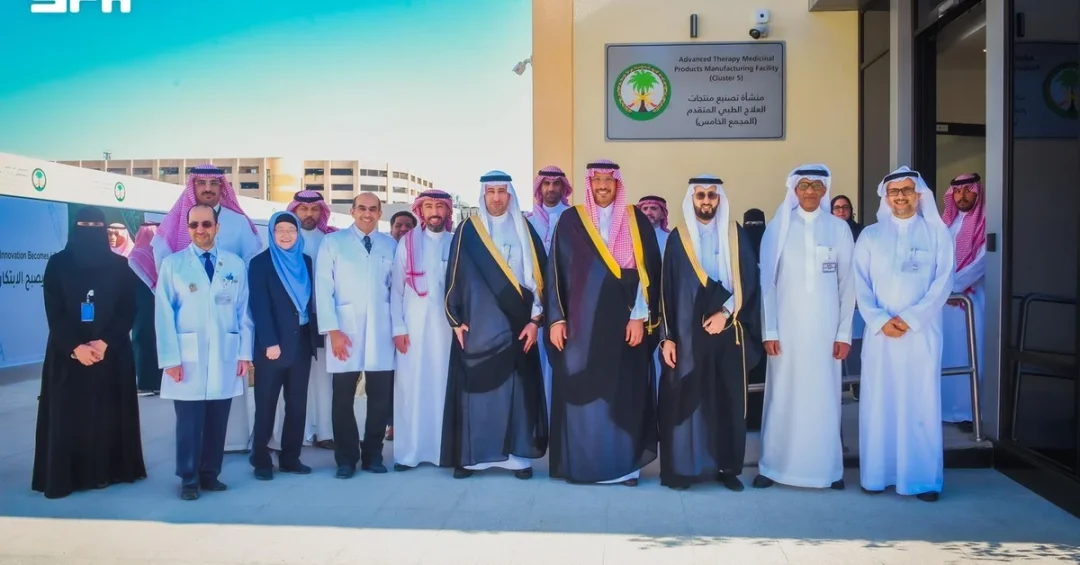
King Faisal Specialist Hospital & Research Centre (KFSH) welcomed a delegation from the Saudi Food and Drug Authority (SFDA), led by SFDA Chief Executive Officer Dr. Hisham Aljadhey, to review the development stages of its pioneering cell and gene therapy manufacturing facility in Riyadh. The visit, announced by the Saudi Press Agency, forms part of ongoing coordination between the two organizations to ensure that the facility aligns from its earliest stages with Saudi Arabia’s regulatory requirements and approved Good Manufacturing Practice (GMP) standards. KFSH Chief Executive Officer Dr. Majid Alfayyadh received the delegation at the hospital’s headquarters, where the two sides discussed the advanced therapy manufacturing program and efforts to accelerate the translation of therapeutic innovations from research into patient care.
The meeting also highlighted progress at KFSH’s Cancer Center of Excellence and Genomic Medicine Center of Excellence, two specialized hubs that underpin the Kingdom’s ambitions in precision medicine. The visit concluded with a guided tour of the facility, giving the delegation a firsthand look at its equipment, infrastructure, and manufacturing capabilities. Could this close collaboration between the Kingdom’s leading academic healthcare institution and its national regulator become a model for the region? For international observers, the engagement signals Saudi Arabia’s determination to build a fully regulated, world-class advanced therapies sector at home rather than relying solely on imported treatments.
Context and Background
Why does the timing of this regulatory review matter so much? In October 2025, KFSH announced the establishment of Saudi Arabia’s first dedicated cell and gene therapy manufacturing facility, a project spanning more than 5,000 square meters and designed to reach an annual capacity of 2,400 therapeutic doses by 2030. The facility represents a foundational piece of the Kingdom’s strategy to localize advanced biomanufacturing, a sector historically dominated by a small number of companies in North America, Europe, and East Asia. By inviting the SFDA to review development stages early, KFSH is embedding regulatory compliance into the facility’s design and processes rather than treating it as an afterthought.
The background to this collaboration stretches back further. In August 2025, the SFDA approved the first Phase I clinical trial of a locally developed and manufactured gene therapy using chimeric antigen receptor T cells (CAR-T) for adult patients with relapsed or refractory acute lymphoblastic leukemia. KFSH later announced that the first patient in the trial had been treated, a milestone that demonstrated the Kingdom’s capacity to move from laboratory research to bedside application. Together, these developments illustrate a deliberate sequencing: first regulatory approval of a locally developed therapy, then patient treatment, and now the scaling of manufacturing infrastructure under continuous regulatory oversight.
KFSH itself brings substantial international credibility to the endeavor. It was ranked first in the Middle East and Africa and 12th globally among the world’s top 250 academic healthcare institutions for 2026. It was also recognized as the most valuable healthcare brand in Saudi Arabia and the Middle East in 2026, according to Brand Finance, and was included in Newsweek’s World’s Best Hospitals 2026, World’s Best Smart Hospitals 2027, and World’s Best Specialized Hospitals 2027 rankings. This track record gives the manufacturing initiative a strong institutional foundation.
Key Details of the SFDA Visit
What exactly did the SFDA delegation examine during its visit? According to the Saudi Press Agency, the delegation was led by Dr. Hisham Aljadhey and received by Dr. Majid Alfayyadh at KFSH’s Riyadh headquarters. The program included a detailed review of the development stages of the cell and gene therapy manufacturing facility, an outline of KFSH’s advanced therapy manufacturing program, and presentations on the Cancer Center of Excellence and the Genomic Medicine Center of Excellence. These presentations reflect the integrated nature of the project, which links research, clinical care, and manufacturing under one institutional umbrella.
The guided tour provided the delegation with direct exposure to the facility’s equipment, infrastructure, and manufacturing capabilities. Such visits are significant in the advanced therapies field, where GMP compliance depends on physical infrastructure, cleanroom design, quality control systems, and trained personnel. By reviewing these elements at an early stage, the SFDA can provide guidance that helps KFSH avoid costly redesigns later and ensures that future production meets the rigorous standards required for patient safety and therapeutic efficacy.
The coordination also underscores the evolving role of the SFDA as a proactive regulator. Rather than waiting to inspect a finished facility, the authority is engaging with developers throughout the lifecycle of a project. For international investors and partners, this approach reduces regulatory uncertainty and signals that Saudi Arabia is building its advanced therapies ecosystem on a foundation of transparent, predictable oversight. The facility’s target of 2,400 therapeutic doses annually by 2030 gives the project a concrete, measurable goal that aligns with the Kingdom’s broader healthcare transformation.
International and Regional Impact
How might this development reshape the Middle East’s position in global biomanufacturing? Cell and gene therapies are among the most complex and expensive treatments in modern medicine, and access has historically been constrained by limited global manufacturing capacity. By building domestic capacity, Saudi Arabia aims to reduce dependence on foreign supply chains and expand local patient access to therapies such as CAR-T treatments for blood cancers. This has implications beyond the Kingdom’s borders, as a regional manufacturing hub could eventually serve patients across the Middle East and North Africa.
The collaboration between KFSH and the SFDA also positions Saudi Arabia as a potential partner for international pharmaceutical companies, research institutions, and clinical trial networks. Global firms looking to enter the region often seek regulatory clarity and institutional quality; the Kingdom now offers both through a regulator with growing international recognition and a hospital ranked among the world’s top academic healthcare institutions. For patients worldwide, the emergence of new manufacturing capacity could contribute to easing global supply constraints in advanced therapies over time.
Economic and Strategic Significance
Why does local manufacturing of advanced therapies carry such strategic weight? Beyond improving patient outcomes, the facility supports the development of a high-skilled biotechnology workforce, creates specialized jobs, and attracts investment into a knowledge-intensive sector. Cell and gene therapy manufacturing requires expertise in molecular biology, process engineering, quality assurance, and clinical logistics. Building these capabilities domestically strengthens the broader life sciences ecosystem and reduces the economic burden of importing ultra-expensive therapies.
Strategically, the project complements Saudi Arabia’s efforts to diversify its economy away from hydrocarbons. Advanced biomanufacturing sits at the intersection of healthcare, science, and industrial policy, making it an attractive target for national investment. The facility’s alignment with GMP standards from the outset also enhances its potential to export therapies in the future, subject to regulatory approvals in destination markets. In this sense, the KFSH-SFDA coordination is not merely a technical exercise but a building block of a longer-term economic and health security strategy.
Vision 2030 Alignment
How does this initiative connect to Saudi Arabia’s long-term national transformation? The cell and gene therapy manufacturing facility directly supports Vision 2030’s health sector objectives, which include improving healthcare quality, localizing advanced medical capabilities, and fostering innovation. By developing therapies at home, the Kingdom advances both the Health Sector Transformation Program and broader goals of economic diversification and knowledge-based industry. The collaboration with the SFDA ensures that this growth occurs within a robust regulatory framework that prioritizes patient safety.
The project also reinforces Saudi Arabia’s ambition to be a global leader in science and technology. KFSH’s recognition as the top academic healthcare institution in the Middle East and Africa and 12th globally for 2026 illustrates the institutional excellence that underpins Vision 2030. As the facility progresses toward its 2030 capacity target, it will serve as a tangible example of how the Kingdom is translating strategic vision into practical capacity, improving lives at home and contributing to the global fight against cancer and other serious diseases. The forward-looking partnership between KFSH and the SFDA thus represents a significant step in Saudi Arabia’s journey toward a healthier, more diversified, and innovation-driven future.
20 Questions
Q1. What was the purpose of the SFDA delegation’s visit to KFSH?
A1. The delegation reviewed the development stages of KFSH’s cell and gene therapy manufacturing facility to ensure alignment with Saudi regulatory requirements and Good Manufacturing Practice standards from the earliest stages of the project.
Q2. Who led the SFDA delegation and who received them at KFSH?
A2. The SFDA delegation was led by CEO Dr. Hisham Aljadhey and was received by KFSH CEO Dr. Majid Alfayyadh at the hospital’s headquarters in Riyadh.
Q3. When did KFSH announce the establishment of the facility?
A3. KFSH announced the establishment of Saudi Arabia’s first dedicated cell and gene therapy manufacturing facility in October 2025.
Q4. What is the size and planned capacity of the facility?
A4. The facility spans more than 5,000 square meters and is designed to reach an annual capacity of 2,400 therapeutic doses by 2030, expanding local patient access to advanced therapies.
Q5. What did the SFDA approve in August 2025?
A5. The SFDA approved the first Phase I clinical trial of a locally developed and manufactured gene therapy using CAR-T cells for adult patients with relapsed or refractory acute lymphoblastic leukemia.
Q6. What happened after the clinical trial approval?
A6. KFSH later announced that the first patient in the trial had been treated, marking a significant milestone in translating research into patient care.
Q7. What is CAR-T therapy?
A7. CAR-T therapy is a type of gene therapy in which a patient’s T cells are genetically engineered to recognize and attack cancer cells, offering new options for certain blood cancers.
Q8. What centers of excellence were highlighted during the visit?
A8. KFSH highlighted its Cancer Center of Excellence and its Genomic Medicine Center of Excellence, which support precision medicine and advanced therapeutic research.
Q9. What did the guided tour of the facility include?
A9. The tour gave the SFDA delegation a firsthand look at the facility’s equipment, infrastructure, and manufacturing capabilities, ensuring they meet required standards.
Q10. How is KFSH ranked internationally?
A10. KFSH was ranked first in the Middle East and Africa and 12th globally among the world’s top 250 academic healthcare institutions for 2026.
Q11. What brand recognition did KFSH receive in 2026?
A11. KFSH was recognized as the most valuable healthcare brand in Saudi Arabia and the Middle East in 2026, according to Brand Finance.
Q12. Which Newsweek rankings included KFSH?
A12. KFSH was included in Newsweek’s World’s Best Hospitals 2026, World’s Best Smart Hospitals 2027, and World’s Best Specialized Hospitals 2027 rankings.
Q13. Why is early SFDA involvement important for the facility?
A13. Early involvement ensures the facility is designed and built in compliance with GMP and regulatory standards, reducing the risk of costly modifications later.
Q14. What is the significance of local manufacturing for patients in Saudi Arabia?
A14. Local manufacturing expands patient access to advanced therapies, reduces reliance on imports, and can lower treatment costs over time.
Q15. How does this project support Saudi Arabia’s economy?
A15. It fosters a high-skilled biotechnology workforce, attracts investment, and supports economic diversification away from hydrocarbons, aligning with Vision 2030.
Q16. What role does the SFDA play in Saudi Arabia’s healthcare sector?
A16. The SFDA regulates food and drug safety, approves clinical trials, and ensures medical products meet quality, safety, and efficacy standards.
Q17. How might this facility impact the Middle East region?
A17. It could position Saudi Arabia as a regional hub for advanced therapy manufacturing, potentially serving patients across the Middle East and North Africa.
Q18. What is the significance of the 2,400 therapeutic doses target?
A18. The target provides a concrete goal for scaling production, ensuring that a substantial number of patients can access these innovative treatments annually by 2030.
Q19. How does the facility align with Vision 2030?
A19. It supports the Health Sector Transformation Program by localizing advanced medical capabilities, improving healthcare quality, and fostering innovation and knowledge-based industries.
Q20. What message does this collaboration send to international partners?
A20. It signals that Saudi Arabia offers a transparent regulatory environment and world-class institutional quality, making it an attractive partner for global biotech and pharmaceutical collaboration.
Reader Feedback
We value your thoughts. Please share your feedback on this article.
Your feedback helps us improve our coverage.
Related articles
 Saudi Medical Services Chief Highlights Innovation at SAIF
 Jeddah Municipality Adopts Real-Time PCR for Food Safety
 Health Ministry Detects Sick Leave Violations, Takes Legal Action
 KFSH Fetal Procedures Surge 41% in Two Years
 SFDA and Prince Sattam University Sign Research Pact
 Jazan Governor Receives Guinness Certificate for Diabetes Screening Record