


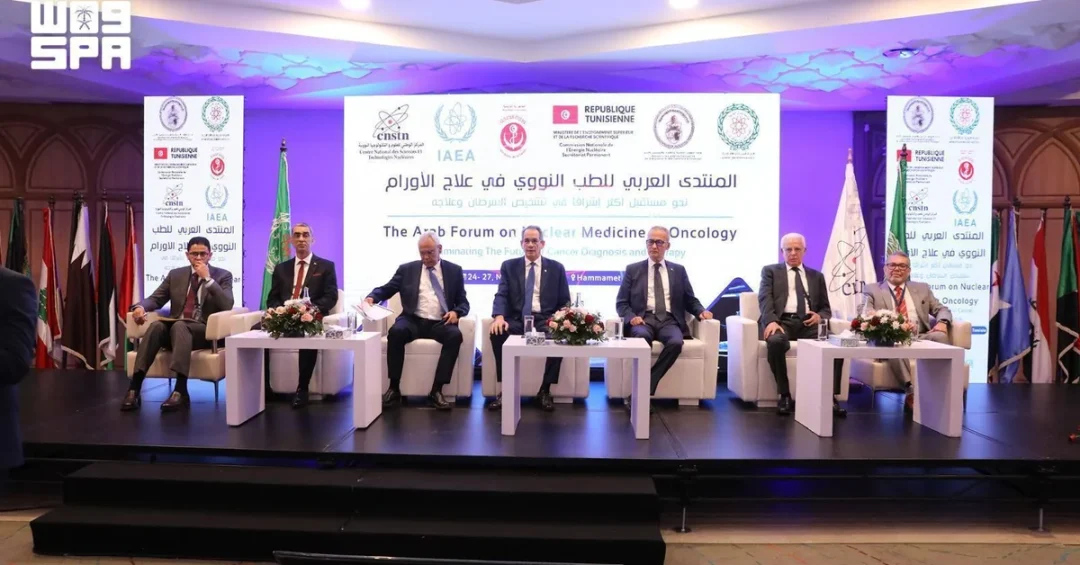
The Arab Forum on Nuclear Medicine in Oncology opened today in Hammamet, Tunisia, under the theme “Illuminating the Future of Cancer Diagnosis and Therapy,” bringing together experts from Arab countries, including the Kingdom of Saudi Arabia, to advance the peaceful applications of nuclear technology in healthcare. The forum is organized by the Arab Atomic Energy Agency (AAEA) in cooperation with Tunisia’s Ministries of Health and Higher Education and the Arab States Broadcasting Union (ASBU). The opening ceremony was attended by Tunisian Minister of Higher Education and Scientific Research Mondher Belaid, Saudi Ambassador to Tunisia Mohammed Al-Buraithin, and several other officials, according to the Saudi Press Agency (SPA).
The event underscores a growing regional commitment to tackling one of the Arab world’s most pressing health challenges through scientific cooperation and innovation. With approximately 750,000 new cancer cases recorded annually across the Arab region, the forum aims to address regional challenges, facilitate the exchange of expertise and best practices, and foster sustainable partnerships among Arab healthcare institutions, the International Atomic Energy Agency (IAEA), and the private sector. Saudi Arabia’s participation reflects its broader strategy to enhance healthcare outcomes, invest in advanced medical technologies, and strengthen its role in regional and international scientific collaboration.
Context and Background
Why has nuclear medicine become such a critical focus for cancer care in the Arab world? The answer lies in the region’s evolving disease burden and the transformative potential of atomic energy applications in healthcare. According to the Arab Atomic Energy Agency (AAEA), cancer incidence across Arab countries continues to rise, driven by population growth, aging demographics, and changing lifestyles. In response, Arab nations are increasingly turning to nuclear medicine—a branch of medicine that uses radioactive substances for diagnosis, staging, and treatment of diseases, particularly cancer.
The AAEA, a specialized Arab organization headquartered in Tunis, has long championed the peaceful uses of atomic energy. Its Director-General, Dr. Salem Hamdi, stressed the importance of Arab cooperation in expanding these applications. He highlighted advances in molecular imaging and precision cancer diagnosis, calling for specialized training and capacity-building programs. The forum, therefore, builds on years of regional efforts to harmonize standards, share knowledge, and develop human capital in nuclear medicine and oncology.
Saudi Arabia’s presence at the forum is particularly significant. The Kingdom has been investing heavily in healthcare infrastructure and advanced medical technologies as part of its Vision 2030 reform agenda. By participating in such regional platforms, Saudi Arabia not only contributes its expertise but also gains access to cutting-edge research and collaborative opportunities that can accelerate its own healthcare transformation.
Key Details and Forum Objectives
What exactly does the forum hope to achieve, and how will its outcomes be measured? The gathering in Hammamet brings together a diverse group of stakeholders, including nuclear medicine specialists, oncologists, radiologists, medical physicists, and representatives from international organizations such as the International Atomic Energy Agency (IAEA). Over the coming days, participants will engage in technical sessions, workshops, and panel discussions focused on the latest developments in molecular imaging, radiopharmaceuticals, and precision oncology.
Tunisian Minister of Higher Education and Scientific Research Mondher Belaid, in his opening remarks, highlighted the growing health challenges posed by cancer and underscored the role of nuclear medicine in improving cancer diagnosis, staging, and treatment. He noted that approximately 750,000 new cases are recorded annually across the Arab region, a figure that demands urgent and coordinated action. The forum’s theme, “Illuminating the Future of Cancer Diagnosis and Therapy,” encapsulates the dual focus on diagnostic innovation and therapeutic advancement.
Key objectives include addressing regional challenges, facilitating the exchange of expertise and best practices, and fostering sustainable partnerships among Arab healthcare institutions, the IAEA, and the private sector. The involvement of the Arab States Broadcasting Union (ASBU) also signals an emphasis on public awareness and health communication, ensuring that advances in nuclear medicine reach broader audiences. By the forum’s conclusion, organizers expect to have identified concrete steps for enhancing regional cooperation, including joint training programs, research initiatives, and technology transfer mechanisms.
International and Regional Impact
How will this forum influence the broader landscape of cancer care in the Arab world and beyond? The collaboration between the Arab Atomic Energy Agency, the IAEA, and national health ministries represents a model of multilateral cooperation that could yield significant benefits. For Arab countries, the forum provides a platform to align their nuclear medicine capabilities with international standards and best practices, potentially improving patient outcomes and reducing the need for patients to seek treatment abroad.
The participation of Saudi Arabia, represented by Ambassador Mohammed Al-Buraithin, highlights the Kingdom’s commitment to regional health security and scientific diplomacy. Saudi Arabia has been expanding its nuclear medicine infrastructure, including the establishment of specialized centers and the training of healthcare professionals. By sharing its experiences and learning from others, the Kingdom can help shape a unified Arab approach to cancer control. Moreover, the forum’s outcomes could inform policies on the procurement of radiopharmaceuticals, the regulation of nuclear medicine practices, and the integration of advanced imaging technologies into national health systems.
On a global scale, the forum reinforces the role of the IAEA in promoting the peaceful uses of nuclear energy for health. It also demonstrates how regional organizations like the AAEA can serve as catalysts for technology adoption and capacity-building, ultimately contributing to the United Nations Sustainable Development Goals, particularly those related to health and well-being.
Economic and Strategic Significance
What are the economic and strategic implications of advancing nuclear medicine in the Arab region? Investing in nuclear medicine and oncology infrastructure is not only a public health imperative but also an economic opportunity. The global nuclear medicine market is projected to grow substantially in the coming years, driven by rising cancer incidence and technological advancements. Arab countries, by pooling resources and expertise, can develop local capabilities that reduce reliance on imported services and create high-skilled jobs.
For Saudi Arabia, this aligns with Vision 2030‘s goals of diversifying the economy, enhancing healthcare quality, and fostering innovation. The Kingdom has already made significant strides in developing advanced medical cities and research centers, such as those under the Public Investment Fund (PIF). Participation in the Hammamet forum allows Saudi stakeholders to identify partnership opportunities, attract investment, and showcase the Kingdom’s progress in nuclear medicine and oncology. Additionally, the forum’s focus on private-sector engagement opens doors for Saudi companies specializing in medical technology, radiopharmaceuticals, and healthcare services to expand their regional footprint.
Strategically, the forum strengthens Arab solidarity and scientific collaboration, which are essential for addressing shared challenges. It also positions Saudi Arabia as a leader in health diplomacy, reinforcing its role as a reliable partner in international efforts to combat cancer and improve lives.
Vision 2030 Alignment
How does Saudi Arabia’s involvement in the Arab Forum on Nuclear Medicine in Oncology reflect the Kingdom’s long-term vision? Vision 2030, the Kingdom’s ambitious reform blueprint, places healthcare at the center of its social and economic development goals. One of its key objectives is to improve the quality and efficiency of healthcare services, including through the adoption of advanced technologies and international best practices. Nuclear medicine, with its potential to revolutionize cancer diagnosis and treatment, is a prime example of the innovative approaches Saudi Arabia is embracing.
By participating in regional forums like this one, Saudi Arabia demonstrates its commitment to global health cooperation and its willingness to share knowledge and resources for the common good. The Kingdom’s efforts are not limited to participation; it is actively building a robust healthcare ecosystem that includes world-class hospitals, research institutions, and training programs. These initiatives are designed to not only serve Saudi citizens but also to contribute to the health and well-being of the broader region. As the forum concludes, the partnerships forged and insights gained will undoubtedly feed into Saudi Arabia’s ongoing journey toward a healthier, more prosperous future, in line with Vision 2030 and its global aspirations.
20 Questions
Q1. What is the Arab Forum on Nuclear Medicine in Oncology and where is it being held?
A1. The Arab Forum on Nuclear Medicine in Oncology is a regional gathering organized by the Arab Atomic Energy Agency (AAEA) in cooperation with Tunisia’s ministries of health and higher education and the Arab States Broadcasting Union. It is being held in Hammamet, Tunisia, under the theme “Illuminating the Future of Cancer Diagnosis and Therapy.”
Q2. Which organizations are organizing the forum?
A2. The forum is organized by the Arab Atomic Energy Agency (AAEA) in cooperation with Tunisia’s Ministries of Health and Higher Education, as well as the Arab States Broadcasting Union (ASBU).
Q3. Who attended the opening ceremony of the forum?
A3. The opening ceremony was attended by Tunisian Minister of Higher Education and Scientific Research Mondher Belaid, Saudi Ambassador to Tunisia Mohammed Al-Buraithin, and several other officials from Arab countries and international organizations.
Q4. What is the main theme of the forum?
A4. The forum’s theme is “Illuminating the Future of Cancer Diagnosis and Therapy,” focusing on advancing nuclear medicine applications in oncology for improved diagnosis, staging, and treatment of cancer.
Q5. How many new cancer cases are recorded annually in the Arab region?
A5. Approximately 750,000 new cancer cases are recorded annually across the Arab region, according to Tunisian Minister Mondher Belaid. This figure highlights the growing health challenge and the need for regional cooperation.
Q6. What role does nuclear medicine play in cancer care?
A6. Nuclear medicine uses radioactive substances for diagnosing, staging, and treating cancer. It enables molecular imaging and precision diagnosis, allowing for more targeted and effective therapies, as emphasized by AAEA Director-General Dr. Salem Hamdi.
Q7. Who is the Director-General of the Arab Atomic Energy Agency?
A7. Dr. Salem Hamdi is the Director-General of the Arab Atomic Energy Agency (AAEA). He stressed the importance of Arab cooperation in expanding the peaceful applications of atomic energy in healthcare.
Q8. What did Dr. Salem Hamdi call for at the forum?
A8. Dr. Salem Hamdi called for specialized training and capacity-building programs to enhance Arab expertise in nuclear medicine. He also highlighted advances in molecular imaging and precision cancer diagnosis.
Q9. Which countries are participating in the forum?
A9. Experts from various Arab countries, including Saudi Arabia, are participating in the forum. Relevant Arab and international organizations, such as the International Atomic Energy Agency (IAEA), are also involved.
Q10. What is the goal of the forum regarding regional challenges?
A10. The forum aims to address regional challenges in cancer care by facilitating the exchange of expertise and best practices, and fostering sustainable partnerships among Arab healthcare institutions, the IAEA, and the private sector.
Q11. How does Saudi Arabia contribute to the forum?
A11. Saudi Arabia participates through its experts and officials, including Ambassador Mohammed Al-Buraithin. The Kingdom shares its experiences in nuclear medicine and oncology, and explores collaboration opportunities aligned with Vision 2030.
Q12. What is the significance of the Arab States Broadcasting Union’s involvement?
A12. The ASBU’s involvement highlights the importance of public awareness and health communication. It helps disseminate information about nuclear medicine advances to broader audiences across the Arab world.
Q13. What are the expected outcomes of the forum?
A13. Expected outcomes include enhanced regional cooperation, joint training programs, research initiatives, and technology transfer mechanisms. The forum also aims to strengthen partnerships with international organizations and the private sector.
Q14. How does nuclear medicine improve cancer diagnosis?
A14. Nuclear medicine uses radiopharmaceuticals and molecular imaging to detect cancer at cellular levels, enabling precise diagnosis and staging. This allows for more personalized treatment plans and better patient outcomes.
Q15. What is the role of the International Atomic Energy Agency (IAEA) in this forum?
A15. The IAEA collaborates with the AAEA and Arab countries to promote peaceful uses of nuclear energy in healthcare. Its involvement ensures alignment with international standards and facilitates knowledge exchange.
Q16. How does the forum align with Saudi Arabia’s Vision 2030?
A16. The forum aligns with Vision 2030 by supporting healthcare innovation, international cooperation, and capacity-building. Saudi Arabia aims to enhance healthcare quality and diversify its economy through advanced medical technologies.
Q17. What economic opportunities does nuclear medicine present for the Arab region?
A17. Nuclear medicine offers economic opportunities by creating high-skilled jobs, attracting investment, and reducing reliance on imported medical services. It also fosters growth in the radiopharmaceutical and medical technology sectors.
Q18. How can Arab countries benefit from sharing best practices in nuclear medicine?
A18. Sharing best practices enables Arab countries to harmonize standards, optimize resources, and improve patient care. It also accelerates the adoption of innovative technologies and strengthens regional health security.
Q19. What challenges does the Arab region face in cancer care?
A19. The Arab region faces rising cancer incidence, limited access to advanced diagnostics, and a shortage of specialized personnel. The forum addresses these challenges through cooperation, training, and technology transfer.
Q20. What is the long-term vision for nuclear medicine in the Arab world?
A20. The long-term vision is to establish sustainable, self-sufficient nuclear medicine capabilities across Arab countries, ensuring access to cutting-edge cancer care, fostering research, and contributing to global health goals.
Reader Feedback
We value your thoughts. Please share your feedback on this article.
Your feedback helps us improve our coverage.
Related articles
 Saudi Conjoined Twins Programme: 75 Surgeries, 161 Cases
 KFSH and SFDA Review Cell and Gene Therapy Facility
 Saudi Medical Services Chief Highlights Innovation at SAIF
 Jeddah Municipality Adopts Real-Time PCR for Food Safety
 Health Ministry Detects Sick Leave Violations, Takes Legal Action
 KFSH Fetal Procedures Surge 41% in Two Years