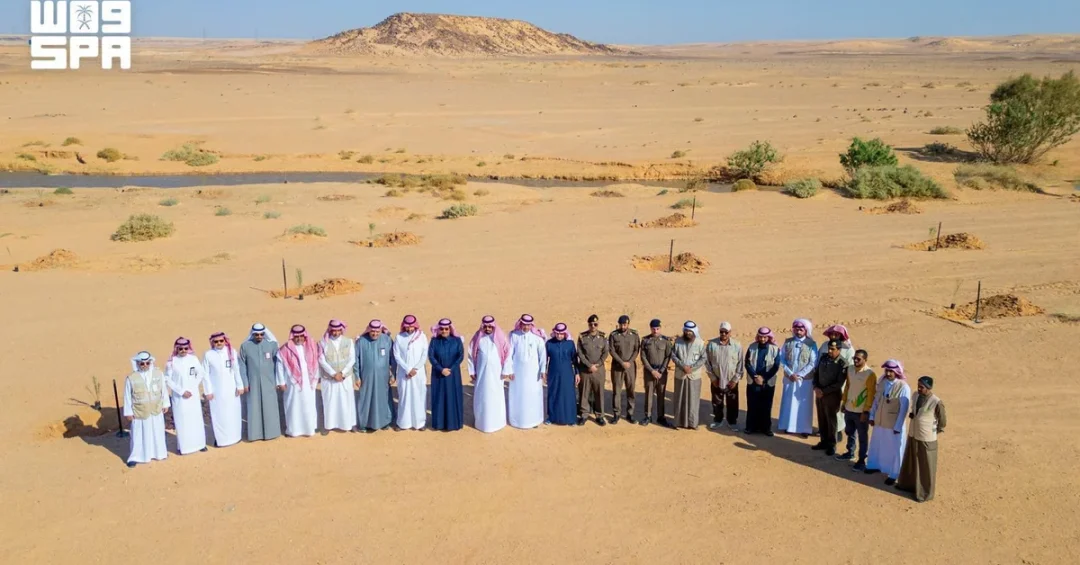
The Al-Jouf branch of the National Center for Vegetation Cover Development and Combating Desertification (NCVC) has planted more than 2,000 native wild seedlings at Qa’ Al-Rusayf, north of Sakaka in Suwayr Governorate, as part of the National Afforestation Season. The initiative, carried out in coordination with the regional branch of the Ministry of Environment, Water and Agriculture, the Saudi Irrigation Organization, Suwayr Municipality, and local security authorities, drew participation from government officials, environmental advocates, and local volunteers. The current phase represents a significant step in a broader plan to plant 7,000 seedlings at the site, aimed at restoring vegetation cover and enhancing natural landscapes in the Al-Jouf Region.
Why does this seemingly local planting effort matter on a national scale? Because it reflects the Kingdom’s comprehensive strategy to combat desertification, conserve water, and promote environmental sustainability under Saudi Vision 2030. The use of treated water for irrigation demonstrates a commitment to conserving groundwater resources while ensuring the long-term survival of the newly planted seedlings. This initiative is not an isolated event but part of a systematic national effort to increase green cover, improve air quality, and create recreational spaces for communities. It also underscores the importance of interagency cooperation, bringing together multiple government bodies and local stakeholders to achieve shared environmental goals. As Saudi Arabia continues to expand its afforestation efforts, such projects serve as models for sustainable development and environmental stewardship across the region.
Context and Background
What is the National Afforestation Season, and why is it central to Saudi Arabia’s environmental agenda? Launched by the NCVC, the National Afforestation Season is a nationwide campaign that mobilizes government agencies, private sector partners, and volunteers to plant millions of trees across the Kingdom. It aligns with the Saudi Green Initiative, which aims to plant 10 billion trees in the coming decades and rehabilitate 40 million hectares of degraded land. The Al-Jouf Region, known for its desert landscapes and agricultural potential, is a key target area for these efforts. The NCVC’s Al-Jouf branch has been actively implementing afforestation projects in various locations, with Qa’ Al-Rusayf being one of the latest sites. These initiatives are designed not only to increase green cover but also to combat desertification, enhance biodiversity, and improve the quality of life for local communities.
The choice of native wild seedlings is deliberate and scientifically informed. Native species are adapted to the local climate and soil conditions, requiring less water and maintenance while providing habitat for indigenous wildlife. This approach ensures the long-term sustainability of the afforestation efforts and supports the restoration of natural ecosystems. The involvement of multiple stakeholders, including the Ministry of Environment, Water and Agriculture, the Saudi Irrigation Organization, and local municipalities, highlights the integrated approach needed to address environmental challenges. By working together, these entities can pool resources, share expertise, and ensure that projects are implemented efficiently and effectively. The participation of local volunteers further strengthens community engagement and fosters a sense of ownership over the environmental improvements.
Key Details of the Afforestation Initiative
How exactly was the planting at Qa’ Al-Rusayf carried out, and what makes it noteworthy? The initiative involved the planting of over 2,000 native wild seedlings suited to the environment and climate of Al-Jouf. These seedlings were carefully selected to thrive in the region’s arid conditions, with species that are drought-resistant and capable of surviving with minimal irrigation. The broader plan for the site aims to plant a total of 7,000 seedlings, indicating a phased approach that allows for monitoring and adaptive management. Treated water is being used for irrigation, a critical choice that conserves precious groundwater resources. This method, often referred to as using recycled water, is increasingly common in Saudi Arabia’s afforestation projects as it balances the need for plant growth with the imperative to preserve finite water supplies.
The coordination among various agencies is a key feature of this initiative. The regional branch of the Ministry of Environment, Water and Agriculture provided technical oversight and regulatory support. The Saudi Irrigation Organization contributed expertise in water management and irrigation systems. Suwayr Municipality facilitated local logistics and community outreach, while local security authorities ensured the safety and smooth operation of the event. This multi-agency collaboration is a hallmark of Saudi Arabia’s approach to large-scale environmental projects, reflecting the integrated governance model promoted under Vision 2030. The presence of officials, environmental advocates, and volunteers at the planting event also served to raise public awareness about the importance of vegetation cover and the role of community participation in achieving environmental goals.
International and Regional Impact
Why should the international community pay attention to a tree-planting event in a remote part of Saudi Arabia? Because it is part of a broader global effort to combat climate change and desertification. Saudi Arabia’s afforestation initiatives contribute to international goals such as the UN Decade on Ecosystem Restoration and the Sustainable Development Goals, particularly those related to climate action, life on land, and water conservation. The Kingdom’s experience in arid-land afforestation can serve as a model for other countries facing similar challenges. Moreover, these projects enhance Saudi Arabia’s standing as a responsible global citizen and a leader in environmental diplomacy. The Middle East Green Initiative, launched by Crown Prince Mohammed bin Salman, aims to plant 50 billion trees across the region, further amplifying the impact of national efforts like those in Al-Jouf.
Regionally, the initiative supports efforts to reduce sandstorms, which affect not only Saudi Arabia but also neighboring countries. Increased vegetation cover helps stabilize soil, reduce wind erosion, and improve air quality. These benefits transcend national borders, making afforestation a matter of regional cooperation. The Al-Jouf Region, located near the borders with Jordan and Iraq, plays a strategic role in this context. By restoring vegetation in these border areas, Saudi Arabia contributes to regional environmental stability and demonstrates good neighborliness. Additionally, the use of treated water for irrigation sets an example for other water-scarce nations, showcasing how innovative water management can support environmental restoration without depleting non-renewable resources.
Economic and Strategic Significance
What economic and strategic benefits does afforestation bring to Saudi Arabia? Beyond the obvious environmental gains, afforestation projects create green jobs, support local economies, and enhance the attractiveness of regions for tourism and investment. The NCVC’s initiatives often employ local workers and contractors, providing income opportunities in rural areas. The improved landscapes can also boost eco-tourism, attracting visitors interested in nature and outdoor activities. Furthermore, healthy vegetation cover contributes to agricultural productivity by protecting soil and water resources, which is vital for food security. Strategically, afforestation supports the Kingdom’s long-term vision of diversifying the economy away from oil dependence. A greener Saudi Arabia is more resilient, more livable, and more appealing to global talent and businesses.
The use of treated water in afforestation is also a strategic water-management decision. Saudi Arabia is one of the most water-stressed countries in the world, and preserving groundwater is a national priority. By utilizing treated water, the NCVC reduces pressure on aquifers and demonstrates a circular approach to water resources. This practice aligns with the National Water Strategy 2030, which aims to ensure sustainable water management. The success of the Al-Jouf initiative can inform similar projects across the Kingdom, scaling up impact and contributing to the Saudi Green Initiative’s ambitious targets. As the program expands, it will require continued investment in water infrastructure, research on native species, and community engagement—all areas where Saudi Arabia is building capacity.
Vision 2030 Alignment
How does this local afforestation effort connect to the grand objectives of Saudi Vision 2030? Vision 2030 encompasses a comprehensive plan to diversify the economy, improve quality of life, and position the Kingdom as a global leader. Environmental sustainability is a cross-cutting theme, and the Saudi Green Initiative is a key pillar. By restoring vegetation cover, combating desertification, and conserving water, the NCVC’s work directly supports the Vision’s environmental goals. It also contributes to the Quality of Life Program by creating greener, healthier environments for citizens and residents. The involvement of multiple government entities and local communities exemplifies the collaborative governance model that Vision 2030 promotes. Moreover, these efforts enhance Saudi Arabia’s international image as a proactive player in global environmental challenges.
Looking ahead, the Al-Jouf afforestation initiative is more than a one-time event; it is part of a sustained national campaign. The NCVC has ambitious plans to expand afforestation across all regions, planting millions of trees and rehabilitating degraded lands. Each seedling planted at Qa’ Al-Rusayf represents a small but meaningful step toward a greener future. As these trees grow, they will sequester carbon, provide shade, support wildlife, and beautify the landscape. They will also stand as a testament to the power of collective action—government, private sector, and civil society working together. For international observers, Saudi Arabia’s afforestation drive offers a compelling narrative of a desert nation turning challenges into opportunities, and a clear signal that the Kingdom is serious about building a sustainable future for generations to come.
20 Questions
Q1. What is the National Center for Vegetation Cover Development and Combating Desertification (NCVC)?
A1. The NCVC is a Saudi government agency responsible for developing vegetation cover, combating desertification, and promoting environmental sustainability across the Kingdom. It implements afforestation projects and coordinates with other entities to achieve national environmental goals.
Q2. Where exactly did the NCVC’s Al-Jouf branch plant the seedlings?
A2. The planting took place at Qa’ Al-Rusayf, located north of Sakaka in Suwayr Governorate, within the Al-Jouf Region of Saudi Arabia. This site was selected for its suitability for afforestation.
Q3. How many seedlings were planted in the current phase?
A3. More than 2,000 native wild seedlings were planted during the current phase. These seedlings are adapted to the local environment and climate, ensuring their survival and growth.
Q4. What is the total number of seedlings planned for the site?
A4. The broader plan aims to plant a total of 7,000 seedlings at Qa’ Al-Rusayf. This phased approach allows for monitoring and adaptive management to ensure success.
Q5. What type of water is used to irrigate the seedlings?
A5. Treated water is used for irrigation. This conserves groundwater resources and demonstrates a sustainable approach to water management, aligning with national water conservation goals.
Q6. Which agencies coordinated with the NCVC on this initiative?
A6. The initiative was coordinated with the regional branch of the Ministry of Environment, Water and Agriculture, the Saudi Irrigation Organization, Suwayr Municipality, and local security authorities. This reflects strong interagency cooperation.
Q7. Who participated in the planting event?
A7. Officials from various government and security agencies, environmental advocates, and local volunteers participated. Their involvement highlights community engagement and shared responsibility for environmental protection.
Q8. What is the National Afforestation Season?
A8. The National Afforestation Season is a nationwide campaign led by the NCVC to plant trees and restore vegetation across Saudi Arabia. It mobilizes government, private sector, and volunteers to achieve large-scale environmental impact.
Q9. Why are native wild seedlings preferred for this project?
A9. Native species are adapted to the local climate and soil, requiring less water and maintenance. They also support biodiversity by providing habitat for indigenous wildlife, ensuring long-term sustainability.
Q10. How does this initiative help combat desertification?
A10. By planting seedlings, the initiative helps stabilize soil, reduce wind erosion, and restore vegetation cover. This combats desertification and improves land productivity, contributing to national environmental goals.
Q11. What are the benefits of using treated water for irrigation?
A11. Treated water reduces pressure on groundwater aquifers, conserving precious freshwater resources. It also provides a reliable water source for irrigation, supporting plant growth without depleting non-renewable supplies.
Q12. How does this project align with Saudi Vision 2030?
A12. It supports the Saudi Green Initiative and Vision 2030’s environmental sustainability goals. It also enhances quality of life, creates green spaces, and demonstrates collaborative governance, key aspects of the Vision.
Q13. What is the Saudi Green Initiative?
A13. The Saudi Green Initiative is a national strategy to combat climate change, increase green cover, and protect the environment. It aims to plant 10 billion trees and rehabilitate 40 million hectares of land.
Q14. Will the afforestation project create economic opportunities?
A14. Yes, it can create green jobs in landscaping, irrigation, and maintenance. It may also boost eco-tourism and improve land value, contributing to local economic development and diversification.
Q15. How does this initiative impact local communities in Al-Jouf?
A15. It engages local volunteers, fosters community pride, and improves the local environment. The greener landscapes can enhance quality of life and provide recreational spaces for residents and visitors.
Q16. What role does the Ministry of Environment, Water and Agriculture play?
A16. The Ministry provides technical oversight, regulatory support, and coordination. It ensures that afforestation projects align with national environmental policies and water management strategies.
Q17. What is the significance of Qa’ Al-Rusayf as a planting site?
A17. Qa’ Al-Rusayf is located in a strategic area north of Sakaka. Its selection reflects a targeted approach to restore vegetation in regions with high desertification risk and potential for environmental improvement.
Q18. How does this project contribute to global environmental efforts?
A18. It supports international goals like the UN Decade on Ecosystem Restoration and the Sustainable Development Goals. It also showcases Saudi Arabia’s commitment to climate action and regional environmental cooperation.
Q19. What are the long-term expected outcomes of the initiative?
A19. Long-term, the project will restore vegetation cover, enhance biodiversity, reduce sandstorms, and sequester carbon. It will also serve as a model for sustainable afforestation in arid regions.
Q20. How can the public get involved in similar initiatives?
A20. The public can volunteer with NCVC campaigns, participate in community planting events, and support environmental awareness. The NCVC regularly announces opportunities through official channels and social media.
Reader Feedback
We value your thoughts. Please share your feedback on this article.
Your feedback helps us improve our coverage.