


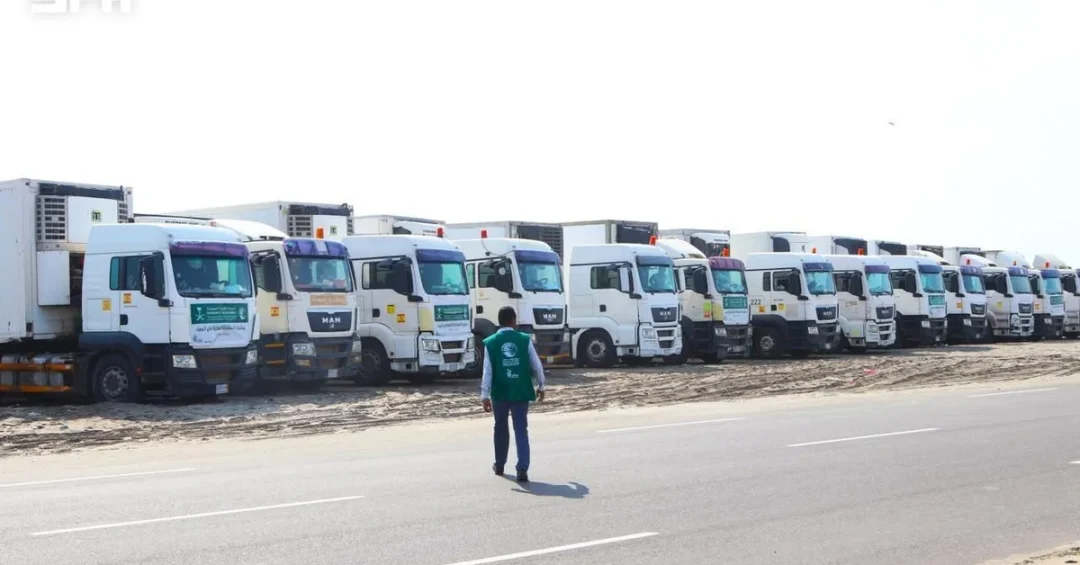
Thirteen aid trucks carrying 4,680 food baskets provided by the King Salman Humanitarian Aid and Relief Center (KSrelief) arrived in Aden Governorate on Wednesday as part of an emergency response project in Yemen. The shipments were unloaded at the project’s warehouses, inspected, and documented in accordance with established procedures ahead of distribution to families most in need. The assistance is part of Saudi Arabia’s ongoing relief and humanitarian efforts through KSrelief to alleviate the suffering of vulnerable families and enhance food security across Yemen, according to the Saudi Press Agency (SPA).
This latest delivery underscores the Kingdom’s sustained commitment to addressing one of the world’s most pressing humanitarian crises. Yemen has faced years of conflict and economic hardship, leaving millions of people dependent on external aid for their daily survival. The food baskets, which contain essential staples, are expected to provide critical support to families struggling with food insecurity. How does Saudi Arabia continue to lead in humanitarian response despite its own ambitious domestic transformation? The answer lies in a deep-rooted tradition of generosity and a strategic vision that extends beyond its borders.
Context and Background
The King Salman Humanitarian Aid and Relief Center (KSrelief) was established in 2015 by royal decree under the leadership of the Custodian of the Two Holy Mosques, King Salman bin Abdulaziz Al Saud. Its mandate is to coordinate and deliver humanitarian assistance to countries in need, with a particular focus on Yemen, which has been a priority since the center’s inception. Over the years, KSrelief has implemented thousands of projects across sectors including food security, health, education, water, and sanitation. These efforts are part of Saudi Arabia’s broader foreign policy, which emphasizes stability and prosperity in the region.
Yemen’s humanitarian crisis is widely recognized as one of the largest in the world. According to United Nations estimates, more than 20 million Yemenis require some form of humanitarian assistance, with food insecurity affecting a significant portion of the population. The port city of Aden, a vital entry point for aid, has been a focal point for relief operations. KSrelief’s emergency response project in Aden is designed to provide immediate relief to the most vulnerable, including displaced families, women, children, and the elderly. Why is Aden strategically important for aid distribution? Its infrastructure and access to sea routes make it a critical hub for reaching populations in southern and central Yemen.
Saudi Arabia’s humanitarian efforts in Yemen are part of a comprehensive approach that also includes development projects and economic support. The Kingdom has consistently called for a political solution to the Yemeni conflict and has supported UN-led peace initiatives. The delivery of food aid is a tangible expression of Saudi Arabia’s commitment to the well-being of the Yemeni people, reflecting the values of compassion and solidarity that are central to Saudi society. How does this align with the Kingdom’s regional role? It reinforces Saudi Arabia’s position as a stabilizing force and a leading donor in the Middle East.
Key Details of the Aid Delivery
The 13 trucks that arrived in Aden carried a total of 4,680 food baskets, each designed to meet the nutritional needs of a family for a specific period. The baskets typically include rice, flour, cooking oil, sugar, and other non-perishable items. Upon arrival, the shipments were unloaded at the project’s warehouses, where they underwent inspection and documentation in line with established procedures. This rigorous process ensures transparency and accountability, guaranteeing that aid reaches those who need it most. The distribution will be carried out in coordination with local authorities and humanitarian partners to identify the most vulnerable families.
KSrelief’s emergency response project in Yemen is one of many initiatives aimed at mitigating the effects of the crisis. The center operates through a network of field offices and partners, enabling it to respond swiftly to emerging needs. The food baskets are procured and transported following international humanitarian standards, with a focus on quality and timeliness. What makes this delivery significant? It represents a continued lifeline for families who might otherwise go hungry, and it demonstrates Saudi Arabia’s ability to mobilize resources quickly and effectively.
The operation also highlights the logistical capabilities of KSrelief, which has extensive experience in delivering aid in challenging environments. The center’s teams work tirelessly to ensure that assistance reaches even the most remote areas. In Aden, the unloading and inspection process was completed efficiently, paving the way for immediate distribution. The aid is part of a broader emergency response that includes food, shelter, and medical supplies. How does KSrelief prioritize its interventions? It uses needs assessments and coordination with local and international partners to direct aid where it is most needed.
International and Regional Impact
Saudi Arabia’s humanitarian efforts in Yemen have been recognized by international organizations and donor countries. KSrelief has received praise from the United Nations and other agencies for its professionalism and reach. The Kingdom is one of the largest donors to the Yemen humanitarian response, contributing hundreds of millions of dollars in aid over the years. This support is crucial in a context where funding gaps often hinder relief operations. What does this mean for global humanitarian efforts? It sets a standard for others to follow and underscores the importance of sustained engagement in protracted crises.
Regionally, the delivery of aid to Aden reinforces Saudi Arabia’s role as a responsible neighbor and a key player in Middle Eastern stability. The Kingdom’s efforts are part of a wider strategy to promote peace and development in Yemen, which is essential for the security of the Arabian Peninsula. By addressing immediate humanitarian needs, Saudi Arabia helps create conditions for longer-term recovery and reconciliation. How does this affect Saudi Arabia’s relationships with other countries? It strengthens trust and cooperation, positioning the Kingdom as a reliable partner in addressing shared challenges.
Moreover, the aid delivery sends a positive signal to the international community about Saudi Arabia’s commitment to humanitarian principles. It also complements diplomatic efforts to end the conflict. The Kingdom has consistently supported Yemen’s legitimate government and has participated in peace talks. The humanitarian dimension is a vital part of this engagement, demonstrating that Saudi Arabia cares about the well-being of all Yemenis. What role does public diplomacy play here? It helps build goodwill and showcases the Kingdom’s constructive role in the region.
Economic and Strategic Significance
The delivery of food aid is not only a humanitarian gesture but also a strategic investment in regional stability. A stable and prosperous Yemen is in Saudi Arabia’s interest, as it contributes to the security of the Kingdom’s southern border and the broader region. By alleviating suffering, Saudi Arabia helps prevent further displacement and radicalization, which can threaten peace. The economic cost of the crisis is immense, and Saudi Arabia’s assistance helps mitigate some of the burden on international donors. How does this align with Saudi Arabia’s economic interests? It supports a stable environment conducive to trade and investment, both within Yemen and across the region.
Furthermore, the operation showcases the efficiency of Saudi logistics and supply chains, which are critical components of the Kingdom’s Vision 2030 economic diversification plan. The ability to deliver aid swiftly and securely reflects well on Saudi Arabia’s infrastructure and organizational capacity. It also involves Saudi companies and contractors, creating opportunities for expertise development. What does this mean for Saudi businesses? It demonstrates their capability to operate in challenging environments and contribute to national humanitarian goals, enhancing their reputation globally.
From a strategic perspective, the aid delivery reinforces Saudi Arabia’s leadership in the Islamic world and its commitment to the principles of charity and solidarity. The Kingdom’s humanitarian work is a source of pride for its citizens and aligns with the values of Vision 2030, which emphasizes a vibrant society and a responsible nation. How does this affect Saudi Arabia’s soft power? It enhances the Kingdom’s image as a benevolent and reliable actor, which is essential for its global influence.
Vision 2030 Alignment
Saudi Arabia’s Vision 2030, launched by Crown Prince Mohammed bin Salman in 2016, aims to transform the Kingdom into a diversified, modern economy and a global leader in various fields. A key pillar of Vision 2030 is the promotion of humanitarian and charitable work, reflecting the Kingdom’s Islamic values and its desire to contribute to global well-being. KSrelief is a prime example of this vision in action, as it professionalizes and expands Saudi Arabia’s humanitarian outreach. The center’s operations are aligned with the vision’s goals of enhancing the Kingdom’s international standing and fostering sustainable development.
The food aid delivery to Aden is a concrete manifestation of Vision 2030’s emphasis on social responsibility and global engagement. It shows that Saudi Arabia is not only focused on its own development but also on helping its neighbors and alleviating human suffering. This approach is integral to the Kingdom’s identity and its future as a leader in the region and beyond. As Saudi Arabia continues to implement Vision 2030, its humanitarian efforts will remain a cornerstone of its foreign policy and a source of national pride. How does this benefit the Kingdom in the long run? It builds goodwill, strengthens alliances, and contributes to a more stable and prosperous world, which is essential for Saudi Arabia’s own security and prosperity.
In conclusion, the arrival of 13 KSrelief food aid trucks in Aden is a testament to Saudi Arabia’s unwavering commitment to humanitarian causes and its strategic vision for a better future. The Kingdom’s leadership, through KSrelief, continues to make a tangible difference in the lives of millions, embodying the principles of compassion and solidarity that are at the heart of Saudi society. As Vision 2030 progresses, Saudi Arabia’s role as a global humanitarian leader will only grow, further solidifying its position as a force for good in the world.
20 Questions
Q1. What is KSrelief?
A1. KSrelief is the King Salman Humanitarian Aid and Relief Center, established in 2015 by Saudi Arabia to coordinate and deliver humanitarian assistance worldwide, with a focus on Yemen and other crisis-affected countries.
Q2. How many trucks arrived in Aden?
A2. Thirteen aid trucks arrived in Aden Governorate on Wednesday, carrying a total of 4,680 food baskets provided by KSrelief as part of an emergency response project in Yemen.
Q3. What items are included in the food baskets?
A3. The food baskets typically contain essential staples such as rice, flour, cooking oil, sugar, and other non-perishable items designed to meet the nutritional needs of a family for a specific period.
Q4. Where were the shipments unloaded?
A4. The shipments were unloaded at the project’s warehouses in Aden, where they were inspected and documented in accordance with established procedures before distribution to families most in need.
Q5. Why is Aden important for aid distribution?
A5. Aden is a vital port city and a key entry point for humanitarian aid into Yemen, with infrastructure and sea routes that facilitate reaching populations in southern and central regions of the country.
Q6. How does KSrelief ensure aid reaches the most vulnerable?
A6. KSrelief coordinates with local authorities and humanitarian partners to identify the most vulnerable families, using needs assessments and established distribution mechanisms to ensure transparency and accountability.
Q7. What is the emergency response project in Yemen?
A7. The emergency response project is a KSrelief initiative aimed at providing immediate relief to Yemeni families affected by conflict and economic hardship, including food, shelter, and medical assistance.
Q8. How long has Saudi Arabia been providing aid to Yemen?
A8. Saudi Arabia has been providing humanitarian aid to Yemen for many years, with KSrelief leading efforts since 2015, contributing hundreds of millions of dollars in assistance across various sectors.
Q9. What other sectors does KSrelief support in Yemen?
A9. KSrelief supports multiple sectors in Yemen, including food security, health, education, water and sanitation, shelter, and protection, addressing the diverse needs of affected populations.
Q10. How does this aid align with Vision 2030?
A10. This aid aligns with Vision 2030’s emphasis on humanitarian work and global engagement, reflecting Saudi Arabia’s commitment to social responsibility and enhancing its international standing as a benevolent leader.
Q11. What is the role of the Saudi Press Agency in reporting this?
A11. The Saudi Press Agency (SPA) is the official news agency of Saudi Arabia, providing verified information about government initiatives, including KSrelief’s humanitarian efforts, to the public and international media.
Q12. How many people in Yemen need humanitarian assistance?
A12. According to United Nations estimates, more than 20 million Yemenis require some form of humanitarian assistance, with food insecurity affecting a significant portion of the population.
Q13. What is the significance of the inspection process?
A13. The inspection and documentation process ensures that aid shipments meet quality standards and are accounted for, guaranteeing that assistance reaches intended beneficiaries efficiently and transparently.
Q14. Does KSrelief work with international organizations?
A14. Yes, KSrelief collaborates with United Nations agencies, international NGOs, and local partners to implement its projects, ensuring coordinated and effective delivery of aid.
Q15. How does Saudi Arabia fund KSrelief’s operations?
A15. KSrelief is funded by the Saudi government, with additional support from donations and partnerships, enabling it to carry out its humanitarian mission independently and effectively.
Q16. What impact has KSrelief had in Yemen?
A16. KSrelief has implemented thousands of projects in Yemen, providing food, healthcare, education, and other essential services to millions of beneficiaries, significantly alleviating suffering and improving living conditions.
Q17. How does the aid delivery support regional stability?
A17. By addressing immediate humanitarian needs, the aid helps prevent further displacement and instability, contributing to a more secure environment in Yemen and the broader region, which benefits Saudi Arabia and its neighbors.
Q18. What is the timeline for distributing the food baskets?
A18. Distribution will commence promptly after inspection and documentation, with KSrelief and its partners working to reach the most vulnerable families in Aden and surrounding areas as quickly as possible.
Q19. Are there other Saudi humanitarian initiatives in Yemen?
A19. Yes, Saudi Arabia supports numerous humanitarian initiatives in Yemen, including medical camps, water projects, and educational programs, all coordinated through KSrelief and other Saudi agencies.
Q20. How can other countries support Yemen’s humanitarian crisis?
A20. Other countries can support Yemen by contributing funds to UN appeals, providing in-kind assistance, and supporting organizations like KSrelief that have the expertise and reach to deliver aid effectively.
Reader Feedback
We value your thoughts. Please share your feedback on this article.
Your feedback helps us improve our coverage.
Related articles
 GACA Releases October 2026 Complaints Index for Airlines and Airports
 KSrelief’s Saudi Noor Program Restores Sight in Kano, Nigeria
 KSrelief Delivers 25,000 Hot Meals in Gaza
 Algeria Condemns Attacks on Saudi Vital Facilities
 KSrelief Distributes 9,570 Medication Units in Yemen’s Taiz
 Coalition Intercepts Houthi UAV Targeting Southern Region