


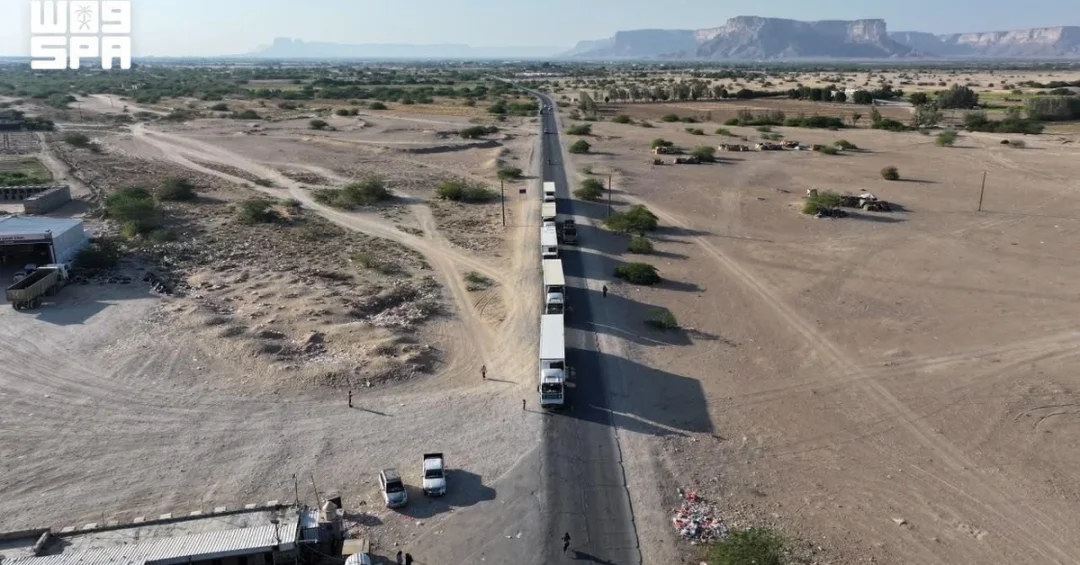
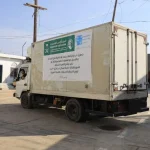
Five aid trucks carrying 3,600 food baskets provided by the King Salman Humanitarian Aid and Relief Center (KSrelief) arrived in Yemen’s Hadhramaut Valley on Tuesday, marking another step in Saudi Arabia’s sustained humanitarian commitment to alleviating suffering and enhancing food security across Yemen. The consignment was unloaded at the project’s warehouses, where it underwent inspection and documentation in line with established procedures before distribution to the most vulnerable families. The delivery forms part of an emergency response project that KSrelief is implementing in Yemen, reflecting the Kingdom’s broader relief efforts under the directives of its leadership.
The arrival of these trucks in Hadhramaut underscores the scale and regularity of Saudi humanitarian operations, which have become a lifeline for millions of Yemenis facing hardship. Through KSrelief, Saudi Arabia has consistently provided food, medical supplies, and other essential assistance, often coordinating with local authorities and international partners. This latest shipment is not an isolated event but a continuation of a long-standing commitment that aligns with the Kingdom’s values and its Vision 2030 goal of fostering regional stability and prosperity. What does such steadfast support mean for the families who receive it, and how does it contribute to the broader humanitarian landscape?
Context and Background
Yemen has endured years of conflict and economic instability, leaving a significant portion of its population in need of humanitarian assistance. In response, Saudi Arabia established KSrelief in 2015 to provide relief to those affected by crises, not only in Yemen but around the world. Since its inception, the center has implemented thousands of projects spanning food security, health, education, and infrastructure. In Yemen alone, KSrelief has been a leading donor, delivering aid that reaches millions of beneficiaries annually. The emergency response project in Hadhramaut is one of many initiatives designed to address immediate needs while supporting longer-term recovery.
Hadhramaut, a governorate in eastern Yemen, has been a focal point for Saudi assistance due to its strategic importance and the challenges faced by its residents. The valley’s population includes many internally displaced persons and vulnerable families who rely on external aid for their daily sustenance. By targeting Hadhramaut, KSrelief ensures that assistance reaches some of the most underserved communities. The current project involves regular convoys of food baskets, each containing essential items that can sustain a family for a period. The meticulous process of unloading, inspecting, and documenting the shipments reflects the center’s commitment to transparency and accountability in aid delivery.
Why does Saudi Arabia continue to prioritize Yemen in its humanitarian outreach? The answer lies in the Kingdom’s deep-rooted ties with its southern neighbor and its belief in the importance of regional stability. Saudi Arabia has consistently emphasized that a stable and prosperous Yemen is in the interest of the entire region. Through KSrelief, the Kingdom works to mitigate the humanitarian impact of the crisis, providing not only immediate relief but also supporting projects that aim to rebuild livelihoods and infrastructure. This approach is in line with Vision 2030’s emphasis on global engagement and sustainable development.
Key Details of the Aid Delivery
The five trucks that arrived in Hadhramaut carried a total of 3,600 food baskets, each designed to meet the basic nutritional needs of a family for a month. The baskets typically include staples such as rice, flour, cooking oil, sugar, and canned goods, carefully selected to provide a balanced diet. Upon arrival, the shipment was unloaded at the project’s warehouses, where teams inspected the contents to ensure quality and adherence to specifications. Documentation was completed in accordance with established procedures, a standard practice that ensures aid is tracked from source to beneficiary. This level of oversight is a hallmark of KSrelief operations, which are often cited as a model for humanitarian agencies worldwide.
The distribution process will target the most vulnerable families in the Hadhramaut Valley, identified through coordination with local authorities and community leaders. Eligibility criteria include factors such as displacement status, income level, and family size. KSrelief works closely with its local partners to ensure that aid reaches those who need it most, avoiding duplication and addressing gaps. The emergency response project in Yemen is ongoing, with regular shipments planned to sustain assistance over time. Each delivery is part of a comprehensive strategy that includes not only food aid but also health services, water and sanitation projects, and support for education.
How does KSrelief ensure that aid reaches the intended recipients in a complex environment like Yemen? The center employs a robust monitoring and evaluation system, including field visits and third-party verification. This ensures that aid is distributed fairly and effectively. The documentation of each shipment, as seen with the recent arrival in Hadhramaut, is a key component of this system. By maintaining detailed records, KSrelief can demonstrate accountability to donors and stakeholders, reinforcing trust in its operations. This transparency is particularly important given the challenging operating environment in Yemen, where access and security can be unpredictable.
International and Regional Impact
Saudi Arabia’s humanitarian efforts in Yemen have garnered recognition from international organizations and partner nations. The United Nations and other agencies have frequently acknowledged KSrelief’s contributions, noting that Saudi aid has helped prevent a further deterioration of the humanitarian situation. The Kingdom’s role as a leading donor in Yemen is part of its broader commitment to global humanitarian causes, which includes assistance to countries across Asia, Africa, and the Middle East. This engagement enhances Saudi Arabia’s standing as a responsible global actor and a force for stability in the region.
Regionally, the aid delivery to Hadhramaut reinforces Saudi Arabia’s ties with Yemeni communities and local authorities. It also complements diplomatic efforts to support a peaceful resolution to the conflict. By providing tangible assistance, the Kingdom demonstrates its commitment to the well-being of the Yemeni people, which can help build goodwill and facilitate dialogue. Moreover, the operation showcases Saudi Arabia’s logistical capabilities and its ability to coordinate complex relief efforts across borders. In a region often characterized by turmoil, such humanitarian gestures are a stabilizing influence.
What message does this send to the international community? It signals that Saudi Arabia is not only a participant in global affairs but a leader in humanitarian response. The Kingdom’s actions speak louder than words, as it consistently steps up to address crises. This is particularly important in the context of Yemen, where the needs are immense. By continuing to provide aid, Saudi Arabia sets an example for other nations to follow, fostering a spirit of cooperation and shared responsibility. The recent convoy to Hadhramaut is a small but significant part of this larger narrative.
Economic and Strategic Significance
From an economic perspective, the delivery of food aid supports stability in Yemen, which is crucial for regional trade and investment. A stable Yemen can contribute to the economic prosperity of the Arabian Peninsula, benefiting Saudi Arabia and its neighbors. The Kingdom’s humanitarian assistance also aligns with its strategic goal of promoting development and reducing the drivers of conflict. By addressing immediate needs, KSrelief creates space for longer-term economic recovery, which is essential for Yemen’s future. This approach is consistent with Vision 2030’s focus on sustainable development and regional integration.
Strategically, Saudi Arabia’s aid to Yemen strengthens its influence and counters the narratives of adversaries. It demonstrates that the Kingdom is a constructive force, committed to the welfare of its neighbors. This soft power approach complements military and diplomatic efforts, contributing to a comprehensive strategy for regional security. The regular convoys of aid, like the one to Hadhramaut, are visible reminders of Saudi Arabia’s benevolence and its capacity to deliver. They also reinforce the bonds between the Saudi and Yemeni people, which are rooted in shared history and culture.
How does this aid fit into Saudi Arabia’s broader economic vision? Vision 2030 aims to diversify the economy and enhance global engagement. Humanitarian aid is a component of this vision, as it projects Saudi Arabia as a responsible global citizen and opens doors for partnerships. The Kingdom’s leadership in humanitarian affairs can lead to increased cooperation with international organizations and donor countries, creating opportunities for economic and diplomatic collaboration. Thus, the food baskets delivered to Hadhramaut are not just charity; they are an investment in regional stability and Saudi Arabia’s global standing.
Vision 2030 Alignment
The delivery of KSrelief food aid to Hadhramaut is a clear manifestation of Saudi Arabia’s Vision 2030, which emphasizes humanitarianism, global engagement, and sustainable development. Vision 2030 seeks to position the Kingdom as a leader in various fields, including philanthropy. Through KSrelief, Saudi Arabia is not only providing immediate relief but also building a legacy of compassion and solidarity. This aligns with the vision’s goals of enhancing the Kingdom’s international reputation and fostering a more stable and prosperous region. The aid operation demonstrates that Saudi Arabia is committed to playing a positive role in the world, beyond its economic and military might.
As Saudi Arabia continues to advance its Vision 2030 agenda, humanitarian efforts like this will remain a cornerstone of its foreign policy. The Kingdom’s ability to deliver aid efficiently and effectively is a testament to its growing capabilities and its dedication to the well-being of people in need. The recent convoy to Hadhramaut is a small but meaningful example of how Vision 2030 translates into action on the ground. It reflects the values of generosity and responsibility that are central to Saudi identity. In the years ahead, KSrelief will undoubtedly continue to be a vital instrument in Saudi Arabia’s quest to make a positive impact on the world stage.
20 Questions
Q1. What organization provided the food aid that arrived in Hadhramaut?
A1. The King Salman Humanitarian Aid and Relief Center (KSrelief) provided the food aid. It is Saudi Arabia’s primary humanitarian agency, established in 2015 to deliver relief worldwide.
Q2. How many trucks delivered the aid to Hadhramaut?
A2. Five trucks delivered the aid to Hadhramaut Valley. They carried a total of 3,600 food baskets destined for vulnerable families in the region.
Q3. What was the total number of food baskets delivered?
A3. The shipment included 3,600 food baskets. Each basket is designed to meet the basic nutritional needs of a family for one month.
Q4. Where exactly in Yemen did the aid arrive?
A4. The aid arrived in the Hadhramaut Valley, located in eastern Yemen. Hadhramaut is a governorate that has been a focus of Saudi humanitarian assistance.
Q5. What procedures were followed upon the arrival of the trucks?
A5. The shipments were unloaded at the project’s warehouses, inspected, and documented according to established procedures. This ensures quality and accountability before distribution.
Q6. What is the purpose of this aid delivery?
A6. The aid is part of an emergency response project in Yemen. It aims to alleviate the suffering of vulnerable families and enhance food security across the country.
Q7. Who are the beneficiaries of this food aid?
A7. The most vulnerable families in the Hadhramaut Valley are the beneficiaries. These include internally displaced persons and those facing severe economic hardship.
Q8. How does KSrelief ensure aid reaches the right people?
A8. KSrelief coordinates with local authorities and community leaders to identify eligible families. It also employs monitoring and evaluation systems to verify distribution and prevent misuse.
Q9. What items are typically included in a KSrelief food basket?
A9. Food baskets generally contain staples such as rice, flour, cooking oil, sugar, and canned goods. These items are chosen to provide a balanced diet for a family.
Q10. When did the aid trucks arrive in Hadhramaut?
A10. The trucks arrived on Tuesday, as reported by the Saudi Press Agency. The date was November 27, 2026, according to the official announcement.
Q11. Is this aid part of a larger Saudi effort in Yemen?
A11. Yes, it is part of Saudi Arabia’s ongoing relief and humanitarian efforts through KSrelief. The Kingdom has been a leading donor to Yemen for many years.
Q12. How does this aid align with Saudi Vision 2030?
A12. It aligns with Vision 2030’s emphasis on global engagement and sustainable development. Humanitarian aid showcases Saudi Arabia’s role as a responsible global actor.
Q13. What impact does this aid have on regional stability?
A13. By addressing urgent needs, the aid contributes to stability in Yemen. A stable Yemen is beneficial for the entire region, including Saudi Arabia.
Q14. Which Saudi agency is responsible for documenting the aid?
A14. KSrelief, through its field teams, is responsible for documenting the aid. The Saudi Press Agency reported the arrival and procedures.
Q15. How often does KSrelief send aid to Yemen?
A15. KSrelief regularly sends aid to Yemen as part of its emergency response projects. Shipments occur multiple times a year, depending on needs and access.
Q16. What other types of assistance does KSrelief provide?
A16. Beyond food aid, KSrelief provides medical supplies, water and sanitation services, education support, and infrastructure projects. It addresses multiple aspects of humanitarian need.
Q17. Has the international community recognized KSrelief’s efforts?
A17. Yes, the United Nations and other international organizations have acknowledged KSrelief’s contributions. Saudi Arabia is viewed as a key humanitarian donor.
Q18. What challenges does aid distribution face in Yemen?
A18. Challenges include security risks, logistical constraints, and access limitations. KSrelief works with partners to overcome these obstacles and reach those in need.
Q19. How can other countries support similar humanitarian efforts?
A19. Other countries can contribute through funding, in-kind donations, or logistical support. Collaboration with organizations like KSrelief enhances the overall response.
Q20. What is the long-term goal of Saudi aid to Yemen?
A20. The long-term goal is to alleviate suffering and promote sustainable development. By enhancing food security, Saudi Arabia helps Yemen move toward recovery and stability.
Reader Feedback
We value your thoughts. Please share your feedback on this article.
Your feedback helps us improve our coverage.
Related articles
 13 KSrelief Food Aid Trucks Arrive in Yemen’s Aden
 GACA Releases October 2026 Complaints Index for Airlines and Airports
 KSrelief’s Saudi Noor Program Restores Sight in Kano, Nigeria
 KSrelief Delivers 25,000 Hot Meals in Gaza
 Algeria Condemns Attacks on Saudi Vital Facilities
 KSrelief Distributes 9,570 Medication Units in Yemen’s Taiz