


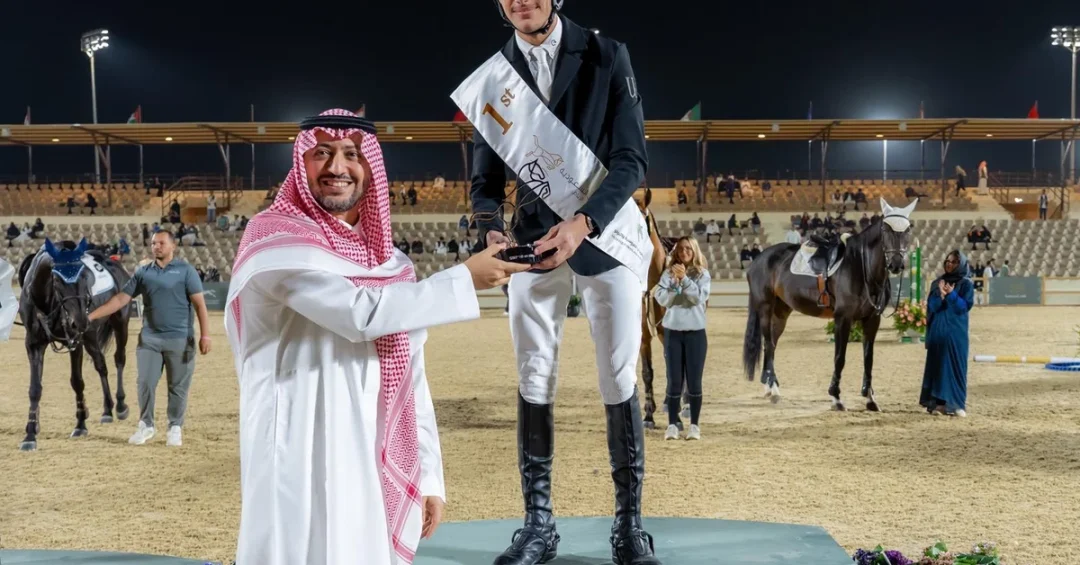
Sixteen-year-old Saudi equestrian Saud Khalid Al-Rasheed captured the three-star (CSI3*) class at the sixth edition of the “Jump Saudi” Championships, held at Al Janadriyah Arena in Riyadh, according to the Saudi Press Agency (SPA). Riding the horse “Quality Star V.T. Zavelinde Z,” Al-Rasheed delivered a faultless performance across both rounds, finishing with a total time of 118.51 seconds — 81.40 seconds in the first round and 37.11 seconds in the second — to claim the top spot against a field of elite international competitors. The victory marks a significant milestone for the young rider, who only began show jumping two years ago. His achievement underscores the Kingdom’s growing presence in international equestrian sport and reflects the broader ambitions of Saudi Vision 2030 to nurture young talent and elevate the nation’s profile on the global stage. How did a teenager from Riyadh outride seasoned professionals to seize an international title? The answer lies in a combination of natural talent, dedicated coaching, and the expanding infrastructure that Saudi Arabia is investing in its sporting future.
The “Jump Saudi” Championships, now in its sixth edition, have become a fixture on the regional equestrian calendar, attracting world-ranked riders from across the globe. This year’s event featured an expanded arena at Al Janadriyah and the addition of two more arenas to host simultaneous competitions, a move that Al-Rasheed himself praised for enhancing the experience for riders and spectators alike. The presence of elite competitors brought immense technical value, offering emerging talents the chance to learn from the best. For Saudi Arabia, the tournament is more than a sporting event; it is a showcase of the Kingdom’s commitment to fostering a vibrant sports sector, a key pillar of Vision 2030. As the nation continues to invest in world-class facilities and host international competitions, the success of young athletes like Al-Rasheed signals a bright future for Saudi equestrianism.
Context and Background
How did a casual visit to a Riyadh stable transform into an international triumph? Al-Rasheed’s journey began just two years ago when he visited a local stable to make productive use of his spare time. What started as a pastime quickly evolved into a passion, leading him to his first international title. His story is emblematic of a broader trend in Saudi Arabia, where youth are increasingly drawn to equestrian sports, a discipline deeply rooted in the Kingdom’s heritage. The Saudi Equestrian Federation, under the guidance of the Ministry of Sport, has been actively promoting the sport through grassroots programs, training camps, and international exposure. The “Jump Saudi” Championships, organized with the support of official Saudi channels, serve as a critical platform for these efforts, providing young riders with the opportunity to compete against world-class athletes on home soil.
The sixth edition of the championships, held at the prestigious Al Janadriyah Arena in Riyadh, attracted a diverse field of competitors, including Fanoun Al-Humaidan, Egypt’s Mostafa Saeed, and Al-Rasheed’s own coach, international equestrian Meshari Al-Harbi. The event’s expansion — with additional arenas for simultaneous competitions — reflects the growing demand and the Kingdom’s capacity to host large-scale international events. This infrastructure development is part of a wider strategy to position Saudi Arabia as a global hub for sports, in line with Vision 2030’s goal to increase sports participation and host major tournaments. Al-Rasheed’s victory over such a competitive field not only highlights his personal skill but also demonstrates the effectiveness of the Kingdom’s investment in sports infrastructure and talent development.
Equestrianism has long been associated with nobility and tradition in Saudi Arabia, but the modern iteration is increasingly professional and competitive. The Saudi Equestrian Federation has been instrumental in this transition, organizing regular competitions, facilitating access to top-tier training, and encouraging international participation. The “Jump Saudi” Championships are a testament to these efforts, drawing riders from around the world and elevating the standard of the sport within the Kingdom. For young Saudis like Al-Rasheed, the pathway to international success is becoming clearer, supported by a system that values both heritage and high performance. The event also serves as a cultural bridge, connecting Saudi Arabia with the global equestrian community and showcasing the Kingdom’s hospitality and organizational capabilities.
Key Details
What does it take to win a CSI3* class against world-ranked riders? Al-Rasheed’s faultless performance across both rounds is a testament to his precision and composure under pressure. Riding “Quality Star V.T. Zavelinde Z,” he clocked 81.40 seconds in the first round and 37.11 seconds in the second, for a total of 118.51 seconds. The CSI3* classification denotes a high level of competition, and the 1.35-meter height demands technical skill and a strong partnership between horse and rider. Al-Rasheed’s ability to remain faultless while maintaining speed placed him ahead of prominent competitors, including his own coach, Meshari Al-Harbi, a respected international equestrian. The young rider credited the high technical standard of the tournament and the participation of elite competitors for raising the bar and providing valuable learning opportunities.
In his remarks to the Saudi Press Agency, Al-Rasheed expressed gratitude for the unwavering support of his father, who consistently attends his events to cheer him on. This family backing, combined with professional coaching, has been pivotal in his rapid rise. He also highlighted the expansion of the Jump Saudi arena and the addition of two more arenas for simultaneous competitions as factors that significantly enhanced the experience for riders. The event’s organization, overseen by Saudi authorities, ensured a seamless and competitive environment. Al-Rasheed’s victory is not just a personal achievement but a clear indication that Saudi Arabia’s investments in equestrian infrastructure and youth development are yielding tangible results on the international stage.
The competition featured a mix of seasoned professionals and emerging talents, creating a dynamic and challenging atmosphere. Al-Rasheed’s triumph over riders like Fanoun Al-Humaidan and Egypt’s Mostafa Saeed underscores the depth of talent now present in the region. The presence of world-ranked competitors brought immense technical value, as Al-Rasheed noted, offering Saudi riders the chance to observe and learn from different techniques and strategies. This knowledge transfer is invaluable for the development of the sport in the Kingdom. The event also served as a platform for cultural exchange, with international riders experiencing Saudi Arabia’s rich heritage and modern facilities. For Al-Rasheed, the win is a stepping stone toward even greater ambitions.
International and Regional Impact
How does a teenage victory in Riyadh resonate across the global equestrian community? Al-Rasheed’s success at the “Jump Saudi” Championships sends a strong signal that Saudi Arabia is becoming a competitive force in international show jumping. The Kingdom’s ability to attract elite riders and host high-caliber events enhances its reputation as a sporting destination. This aligns with Vision 2030’s objective to increase the sports sector’s contribution to the economy and promote Saudi Arabia as a hub for international events. The victory also inspires other young Saudis to pursue equestrian sports, knowing that they can compete and win against the best. Regionally, the event strengthens ties with neighboring countries and Egypt, as seen in the participation of Mostafa Saeed, fostering a spirit of friendly competition and mutual respect.
The international dimension of Al-Rasheed’s win is significant. By defeating world-ranked competitors, he has demonstrated that Saudi riders can hold their own on the global stage. This not only boosts the Kingdom’s standing in equestrian circles but also encourages more international riders to participate in future events in Saudi Arabia. The exchange of expertise and the exposure to different training methods benefit the local equestrian community. Furthermore, the media coverage generated by such victories helps to shift perceptions of Saudi Arabia as a modern, dynamic nation that invests in its youth and sports. The event’s success is a collaborative effort involving the Ministry of Sport, the Saudi Equestrian Federation, and other official bodies, all working toward the goals of Vision 2030.
Economic and Strategic Significance
What economic and strategic benefits does hosting international equestrian events bring to Saudi Arabia? The “Jump Saudi” Championships are part of a broader strategy to diversify the economy away from oil dependence, a core aim of Vision 2030. Sports tourism is a growing sector, and events like this attract visitors, generate media coverage, and stimulate local businesses. The expansion of Al Janadriyah Arena and the addition of new arenas represent investments in infrastructure that can be used for future competitions and other events. The presence of international riders and teams also creates opportunities for sponsorship, merchandising, and broadcasting rights. Over time, a thriving equestrian sector can contribute to job creation and skill development, particularly for young Saudis.
Strategically, success in equestrian sports enhances Saudi Arabia’s soft power and cultural diplomacy. The Kingdom’s rich equestrian heritage, combined with modern facilities and organizational expertise, positions it as a natural leader in the region. Hosting events like “Jump Saudi” also supports the goal of increasing sports participation among citizens, promoting a healthier lifestyle, and fostering national pride. Al-Rasheed’s ambition to represent Saudi Arabia at the Olympic Games and the Jumping and Dressage World Cup aligns with the nation’s quest for excellence on the world stage. The government’s support, through the Ministry of Sport and the Saudi Equestrian Federation, provides a clear pathway for talented athletes to reach their full potential. This holistic approach ensures that victories like Al-Rasheed’s are not isolated incidents but part of a sustained effort to build a world-class sports ecosystem.
Vision 2030 Alignment
How does a single teenage triumph embody the transformative goals of Saudi Vision 2030? Al-Rasheed’s victory at the “Jump Saudi” Championships is a vivid example of the Vision’s emphasis on nurturing youth, promoting sports, and enhancing the Kingdom’s international image. Vision 2030 seeks to create a vibrant society where citizens enjoy a high quality of life, and sports play a crucial role in that vision. By investing in equestrian infrastructure, hosting international competitions, and supporting young athletes, Saudi Arabia is building a legacy of excellence that will inspire generations. Al-Rasheed’s journey from a casual stable visit to an international title holder is a story of opportunity and determination, made possible by the enabling environment created under the Vision.
As Al-Rasheed sets his sights on the Olympic Games and the Jumping and Dressage World Cup, his ambitions mirror the Kingdom’s broader aspirations. The support he receives from his family, his coach, and the national sporting framework reflects the collaborative spirit that drives Vision 2030. The “Jump Saudi” Championships, with their expanded arenas and elite participation, are a microcosm of Saudi Arabia’s progress — a nation that honors its heritage while embracing modernity and global engagement. The victory is not just a win for Al-Rasheed but a win for the Kingdom, demonstrating that with the right investments and a clear vision, Saudi youth can achieve greatness on any stage. The future of Saudi equestrianism looks bright, and the world is taking notice.
20 Questions
Q1. Who won the CSI3* class at the sixth edition of the “Jump Saudi” Championships?
A1. Sixteen-year-old Saudi equestrian Saud Khalid Al-Rasheed won the CSI3* class at the sixth edition of the “Jump Saudi” Championships, held at Al Janadriyah Arena in Riyadh, according to the Saudi Press Agency.
Q2. What was the height of the class that Al-Rasheed won?
A2. The class was set at 1.35 meters, a competitive height in show jumping that demands precision and skill from both horse and rider.
Q3. What was Al-Rasheed’s total time in the two rounds?
A3. Al-Rasheed clocked a total time of 118.51 seconds, with 81.40 seconds in the first round and 37.11 seconds in the second, completing both rounds faultlessly.
Q4. Which horse did Al-Rasheed ride to victory?
A4. He rode the horse named “Quality Star V.T. Zavelinde Z,” delivering a faultless performance across both rounds of the competition.
Q5. Who were some of the prominent competitors Al-Rasheed beat?
A5. He finished ahead of several prominent riders, including Fanoun Al-Humaidan, Egypt’s Mostafa Saeed, and his own coach, international equestrian Meshari Al-Harbi.
Q6. When and where did Al-Rasheed begin his show jumping journey?
A6. Al-Rasheed said his journey began two years ago when he visited a stable in Riyadh to make productive use of his spare time, and it quickly evolved into a passion.
Q7. Who has been a major source of support for Al-Rasheed?
A7. He noted that the unwavering support of his father, who consistently attends his events to cheer him on, has played a significant role in his career.
Q8. What did Al-Rasheed say about the technical standard of this year’s tournament?
A8. He praised the high technical standard, saying the expansion of the Jump Saudi arena and the addition of two more arenas for simultaneous competitions significantly enhanced the experience for riders.
Q9. How did the participation of elite competitors benefit the event?
A9. Al-Rasheed said their participation brought immense technical value, offering others the chance to learn from their expertise and observe how they handle various rounds.
Q10. What are Al-Rasheed’s future ambitions?
A10. He aspires to represent the Saudi national team at the Olympic Games and the Jumping and Dressage World Cup, and to raise the Kingdom’s flag on the international stage.
Q11. What is the significance of the “Jump Saudi” Championships for Saudi equestrianism?
A11. The championships serve as a key platform for developing local talent, attracting international riders, and showcasing Saudi Arabia’s growing capacity to host world-class equestrian events.
Q12. How does Al-Rasheed’s victory reflect Saudi Vision 2030?
A12. It reflects Vision 2030’s goals of nurturing youth, promoting sports, and enhancing the Kingdom’s international image through investment in infrastructure and talent development.
Q13. What role does the Saudi Equestrian Federation play in supporting riders like Al-Rasheed?
A13. The federation, under the Ministry of Sport, promotes the sport through grassroots programs, training camps, and international exposure, providing a pathway for young riders to succeed.
Q14. How has the expansion of Al Janadriyah Arena impacted the competition?
A14. The expansion, including two additional arenas for simultaneous competitions, has enhanced the experience for riders and allowed the event to accommodate more participants and spectators.
Q15. What does the CSI3* classification mean in show jumping?
A15. CSI3* denotes a three-star international competition, indicating a high level of difficulty and attracting world-ranked riders, which elevates the prestige of the event.
Q16. How does hosting international equestrian events benefit Saudi Arabia’s economy?
A16. It boosts sports tourism, generates media coverage, stimulates local businesses, and supports economic diversification, a core aim of Vision 2030.
Q17. What message does Al-Rasheed’s win send to other young Saudi athletes?
A17. It demonstrates that with dedication, support, and access to top facilities, young Saudis can compete and win against the best in the world, inspiring others to pursue their dreams.
Q18. How does equestrianism connect to Saudi Arabia’s cultural heritage?
A18. Equestrianism has deep roots in Saudi heritage, symbolizing nobility and tradition, and its modern professional development honors that legacy while embracing global standards.
Q19. What was the reaction of the equestrian community to Al-Rasheed’s victory?
A19. The victory was celebrated as a significant achievement for Saudi equestrianism, highlighting the Kingdom’s rising status in the sport and the effectiveness of its youth development efforts.
Q20. What can we expect next from Saud Al-Rasheed?
A20. Given his ambitions and the support system around him, Al-Rasheed is expected to continue competing internationally, aiming for Olympic and World Cup participation to further raise Saudi Arabia’s flag.
Reader Feedback
We value your thoughts. Please share your feedback on this article.
Your feedback helps us improve our coverage.
Related articles
 Saudi Arabia to Face Belgium in FIFA U-17 World Cup Round of 32
 Jump Saudi’ Showcases Equestrian Skill and Heritage in Riyadh
 Al-Hilal Beats Ettifaq 3-1 to Extend Lead at the Top
 Al-Nassr Beats Al-Hazem 1-0 in Saudi Pro League
 Omani Driver Ahmed Al-Amiri Claims 2026 Saudi Toyota Drift Title
 Alsharbatly Wins Big Tour on Second Day of Jump Saudi