


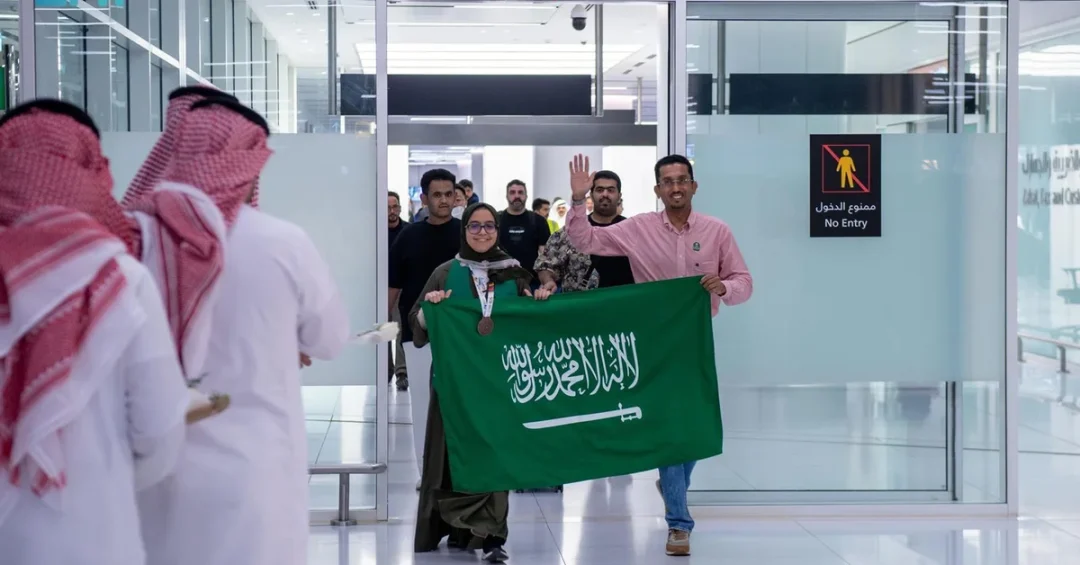
The Saudi Astronomy and Astrophysics Team has returned to the Kingdom after securing three bronze medals at the International Olympiad on Astronomy and Astrophysics (IOAA) hosted in Rio de Janeiro, Brazil, from August 17 to 27, 2024. The competition brought together more than 250 students from 53 countries, highlighting the global interest in space and astrophysics education. The Saudi students’ success underscores the strength of the Kingdom’s educational and talent development programs as it advances toward the goals of Vision 2030.
Context and Background
This achievement is the result of rigorous preparation through specialized training camps organized in collaboration between three key Saudi entities: King Abdulaziz and His Companions Foundation for Giftedness and Creativity (Mawhiba), the Communications, Space and Technology Commission (CST), and the Ministry of Education. These camps provided selected students with advanced instruction in astronomy and astrophysics, equipping them to compete on the world stage. The IOAA, first held in 2006 in Thailand, is an annual international competition for secondary school students, challenging participants through theoretical and observational tests.
Key Details
The three medalists are: Joud Basim Hamdan Al-Lahyani, a second-year secondary school student from the Makkah Education Directorate; Hussein Hassan bin Mohammed Al-Mubarak, a first-year secondary school student from the Eastern Province Education Directorate; and Fajr Hassan bin Ali Al-Ubaidan, a second-year secondary school student from the Al-Ahsa Education Directorate. Their performance marks a notable step for Saudi Arabia at the IOAA, following the Kingdom’s participation last year as an observer team, which laid the groundwork for this year’s medal-winning entries.
Implications and Impact
This success demonstrates the effectiveness of Saudi Arabia’s strategy to nurture scientific talent among its youth. By investing in specialized training and supporting student participation in international competitions, the Kingdom is building a pipeline of skilled individuals prepared to contribute to the national space sector and broader technology-driven economy. The involvement of Mawhiba, CST, and the Ministry of Education illustrates a coordinated national effort to achieve excellence in science, technology, engineering, and mathematics (STEM).
Vision 2030 Alignment
The team’s medal win directly supports Vision 2030 objectives, which prioritize human capital development, innovation, and global competitiveness. By encouraging young Saudis to excel in advanced scientific fields, the Kingdom is cultivating a generation capable of leading its growing space and technology industries. This achievement reflects the nation’s commitment to fostering talent and expanding its presence in the global scientific community, contributing to a diversified knowledge-based economy.
20 Questions
Q1. What competition did the Saudi team participate in?
A1. The team participated in the International Olympiad on Astronomy and Astrophysics (IOAA), held annually for secondary school students worldwide.
Q2. Where was the 2024 IOAA held?
A2. The 2024 IOAA was held in Rio de Janeiro, Brazil, from August 17 to 27.
Q3. How many medals did the Saudi team win?
A3. The Saudi team won three bronze medals at the competition.
Q4. How many students and countries participated in the 2024 IOAA?
A4. More than 250 students from 53 countries participated in the event.
Q5. What is the full name of the foundation that helped train the students?
A5. King Abdulaziz and His Companions Foundation for Giftedness and Creativity, known as Mawhiba.
Q6. Which Saudi commission collaborated in the training camps?
A6. The Communications, Space and Technology Commission (CST) collaborated in the training camps.
Q7. Which ministry also partnered in the training initiative?
A7. The Ministry of Education was a key partner in the training initiative.
Q8. Who is one of the medalists and from which directorate?
A8. Joud Basim Hamdan Al-Lahyani, a student from the Makkah Education Directorate, won a bronze medal.
Q9. What is the name of the student from the Eastern Province Education Directorate?
A9. Hussein Hassan bin Mohammed Al-Mubarak, a first-year secondary school student, is from that directorate.
Q10. Which student from Al-Ahsa Education Directorate won a medal?
A10. Fajr Hassan bin Ali Al-Ubaidan, a second-year secondary school student from the Al-Ahsa Education Directorate, won a medal.
Q11. When was the first IOAA organized?
A11. The first IOAA was organized in 2006 in Thailand.
Q12. Did Saudi Arabia participate in the IOAA last year?
A12. Yes, the Kingdom participated last year with an observer team.
Q13. What is the main purpose of the IOAA?
A13. The IOAA aims to test secondary school students’ knowledge in astronomy and astrophysics through theoretical and practical challenges.
Q14. How does this achievement support Vision 2030?
A14. It supports Vision 2030 by fostering talent and building human capital in advanced scientific fields, contributing to a knowledge-based economy.
Q15. What type of training did the students undergo before the Olympiad?
A15. The students underwent specialized training camps in astronomy and astrophysics, preparing them for international competition.
Q16. Is the IOAA open to primary school students?
A16. No, the IOAA is specifically for secondary school students.
Q17. What fields of study are emphasized by the training camps?
A17. The camps emphasized astronomy, astrophysics, and related STEM disciplines.
Q18. How does this event highlight Saudi Arabia’s global engagement?
A18. It demonstrates the Kingdom’s commitment to international academic cooperation and showcasing Saudi talent on a global stage.
Q19. What role does CST play in Saudi space development?
A19. CST regulates and promotes the space sector in Saudi Arabia, including supporting educational initiatives in space science.
Q20. What message does the medal win send about Saudi education?
A20. The win highlights the effectiveness of Saudi Arabia’s programs for gifted students and the high quality of its secondary education system.
Reader Feedback
We value your thoughts. Please share your feedback on this article.
Your feedback helps us improve our coverage.