


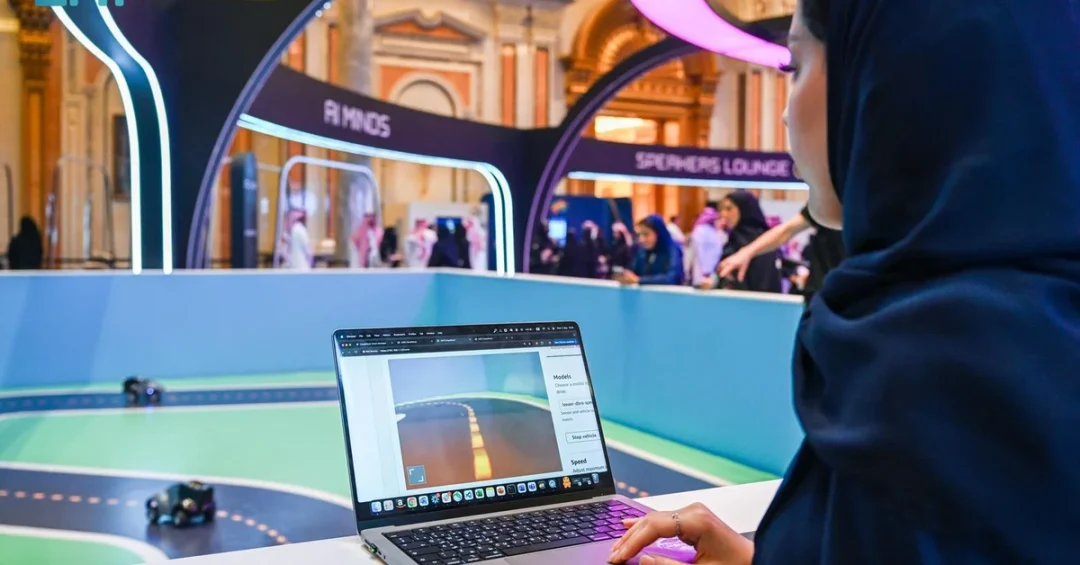
The third edition of the Global AI Summit, held in Riyadh, featured a captivating exhibit demonstrating how machines can learn human life skills and navigate complex environments. Visitors had the opportunity to witness real-world applications of AI-driven self-driving technology, as announced by the Saudi Press Agency. The exhibit provided a hands-on experience with autonomous systems, highlighting the Kingdom’s commitment to advancing artificial intelligence.
Context and Background
The Global AI Summit, organized under the patronage of the Saudi Data and Artificial Intelligence Authority (SDAIA), serves as a premier platform for international experts, innovators, and policymakers to discuss the future of AI. The summit aligns with Vision 2030 by fostering technological innovation and diversifying the economy. This year’s edition focused on practical AI applications, including autonomous vehicles, which are critical for sustainable urban development and smart city initiatives in the Kingdom.
Key Details of the Exhibit
One of the highlights was a simulation of public streets, complete with yellow lines and miniature vehicles equipped with cameras capturing data at 14 frames per second. This data was analyzed by AI algorithms to perform pre-programmed tasks, such as navigating obstacles and following traffic rules. Developers could create custom challenges, adjust vehicle speeds, and even compete in races using the provided tools, showcasing the flexibility and scalability of AI systems.
Implications for Transportation and Industry
The exhibit underscored the transformative potential of AI-driven self-driving technology for transportation and logistics. By demonstrating how machines can learn and adapt in simulated environments, the summit highlighted pathways to safer, more efficient autonomous systems. This innovation supports Saudi Arabia’s goals to reduce traffic accidents, lower emissions, and enhance mobility, contributing to the broader National Industrial Development and Logistics Program.
Vision 2030 Alignment
The Global AI Summit’s self-driving showcase exemplifies Saudi Arabia’s strategic push to become a global leader in AI and technology. This development directly supports Vision 2030’s objectives of economic diversification, human capacity building, and digital transformation. As the Kingdom continues to invest in smart city projects like NEOM and The Red Sea Project, autonomous driving technology will play a key role in creating sustainable, future-ready communities. Through initiatives like this, Saudi Arabia reinforces its position as a hub for innovation and a driver of global technological progress.
20 Questions
Q1. What is the Global AI Summit?
A1. The Global AI Summit is an international event organized by SDAIA in Riyadh, bringing together experts to discuss AI advancements and their applications in line with Saudi Arabia’s Vision 2030.
Q2. What was the main focus of the self-driving exhibit?
A2. The exhibit demonstrated how AI systems can learn human life skills and navigate complex environments, using miniature vehicles on simulated streets to showcase real-world autonomous driving.
Q3. How did the self-driving vehicles capture data?
A3. The vehicles were equipped with cameras that captured data at 14 frames per second, which was then analyzed by AI algorithms to perform pre-programmed tasks like obstacle avoidance.
Q4. Could developers interact with the exhibit?
A4. Yes, developers could create custom challenges, adjust vehicle speeds, and even compete in races using the provided tools, highlighting the system’s flexibility.
Q5. What technologies were highlighted in the exhibit?
A5. The exhibit highlighted AI algorithms, computer vision, and real-time data processing, which are essential for autonomous vehicle navigation in dynamic environments.
Q6. Why is autonomous driving important for Saudi Arabia?
A6. Autonomous driving supports Vision 2030 by reducing traffic accidents, lowering emissions, and enhancing mobility, contributing to smart city projects like NEOM.
Q7. Who organized the Global AI Summit?
A7. The summit was organized by the Saudi Data and Artificial Intelligence Authority (SDAIA), which leads the Kingdom’s AI strategy and transformation.
Q8. What role does SDAIA play in Vision 2030?
A8. SDAIA drives AI innovation to diversify the economy, improve public services, and position Saudi Arabia as a global technology leader, directly supporting Vision 2030.
Q9. How does the exhibit educate the public?
A9. The exhibit allows visitors to see AI in action, demonstrating how machines learn and adapt, thereby increasing public understanding of future mobility technologies.
Q10. What industries could benefit from this technology?
A10. Beyond transportation, AI self-driving technology can benefit logistics, delivery services, public transport, and smart city infrastructure, enhancing efficiency and safety.
Q11. Was the simulation realistic?
A11. Yes, it simulated public streets with yellow lines and obstacles, creating a realistic environment for testing and showcasing AI-driven navigation and decision-making.
Q12. How does SDAIA support AI research in Saudi Arabia?
A12. SDAIA funds research, organizes summits and workshops, and collaborates with international partners to develop AI applications that align with national priorities.
Q13. What is the connection between the summit and NEOM?
A13. The summit highlights technologies like autonomous driving that are planned for smart cities such as NEOM, which aims to be a hub for innovation and sustainability.
Q14. Can the public attend the Global AI Summit?
A14. Yes, the summit includes open exhibits and sessions where the public can interact with AI technologies, learn from experts, and explore future trends.
Q15. What other AI topics were covered at the summit?
A15. The summit covered AI in healthcare, education, energy, and cybersecurity, with experts discussing ethical frameworks, data governance, and industry-specific applications.
Q16. How does the exhibit use AI algorithms?
A16. AI algorithms analyze camera data in real time to make driving decisions, such as steering, braking, and accelerating, demonstrating machine learning capabilities.
Q17. What is the goal of showcasing autonomous driving at the summit?
A17. The goal is to demonstrate Saudi Arabia’s progress in AI, attract investment, and encourage partnerships that advance autonomous driving technology for economic and social benefit.
Q18. Could this technology be used in other sectors?
A18. Yes, the underlying AI can be adapted for robotics, manufacturing, and healthcare, where machines need to perceive and interact with complex environments.
Q19. What safety measures were demonstrated in the exhibit?
A19. The exhibit showed how AI systems follow traffic rules and avoid obstacles, highlighting safety features that can reduce accidents in real-world autonomous driving.
Q20. How does this exhibit support youth development?
A20. By engaging developers and visitors, the exhibit inspires young Saudis to pursue careers in AI, aligning with Vision 2030’s emphasis on human capital development.
Reader Feedback
We value your thoughts. Please share your feedback on this article.
Your feedback helps us improve our coverage.