


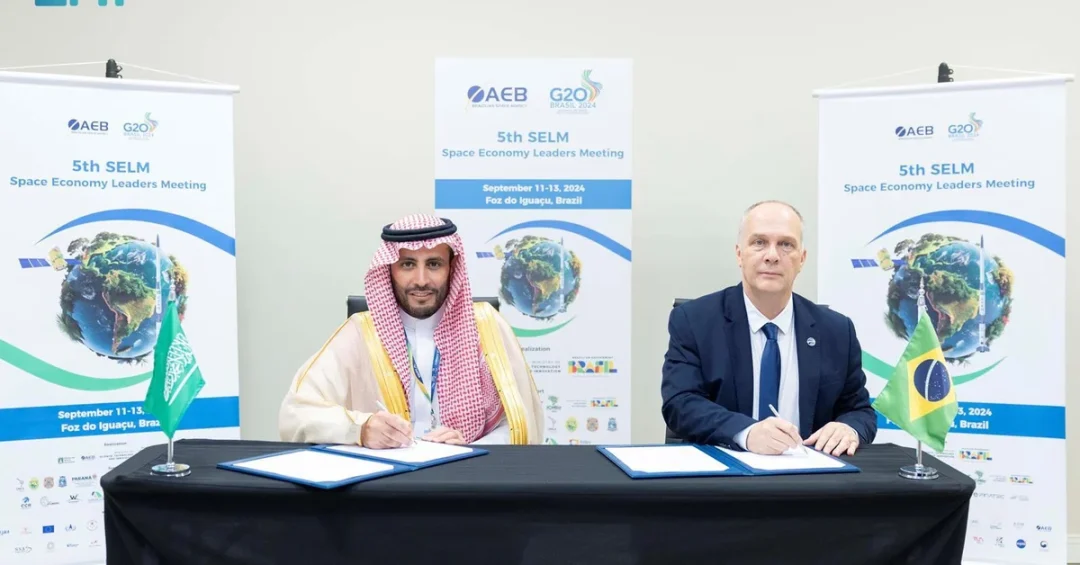
Saudi Arabia and Brazil signed a bilateral agreement on September 12, 2024, to strengthen their partnership in the exploration and peaceful use of outer space. The agreement was signed in Foz do Iguacu, Brazil, between the Saudi Space Agency (SSA), represented by its Chief Executive Dr. Mohammed bin Saud Altamimi, and the Brazilian Space Agency. This pact formalizes a new era of cooperation between the two nations in a rapidly growing sector.
Context and Background
The signing took place during the fifth Space Economy Leaders Meeting (SELM), held from September 11 to 13, 2024, in Foz do Iguacu. The event brings together leaders of space agencies from Group of Twenty (G20) countries and major Brazilian space companies. The timing underscores the importance both nations place on space as a driver of modern economic growth and scientific advancement.
Key Details
Dr. Altamimi stated that the support and empowerment of the space sector by His Royal Highness Prince Mohammed bin Salman bin Abdulaziz Al Saud, Crown Prince, Prime Minister, and Chairman of the Supreme Space Council, reflect the Kingdom’s ambition to become a global leader in the space economy. The agreement encompasses a broad scope of cooperation: fundamental space science research, remote sensing, space communications technologies, space biology, weather monitoring, satellite research and development, and ground infrastructure for space systems. The SSA’s ongoing efforts to deepen partnerships with regional and global stakeholders highlight its commitment to fostering cooperative progress.
Implications and International Impact
This agreement positions Saudi Arabia as a key partner in the international space community, aligning with global trends where space collaboration fosters diplomatic ties and technological exchange. For Brazil, it opens avenues to leverage Saudi investment and expertise in satellite and ground infrastructure. The global space economy, projected to reach $2 trillion by 2035, makes such pacts strategically vital for both nations.
Vision 2030 Alignment
The agreement is a direct reflection of Saudi Arabia’s Vision 2030, which prioritizes diversification of the economy and investment in high-tech sectors. By building bridges with G20 partners like Brazil, the Kingdom aims to grow the space economy, drive innovations, and advance scientific research for the benefit of all humanity, solidifying its role as a global leader in the space sector.
20 Questions
Q1. What is the main purpose of the agreement signed between Saudi Arabia and Brazil?
A1. The main purpose is to strengthen their bilateral partnership in the exploration and peaceful use of outer space, encompassing scientific research and technology development.
Q2. Which Saudi agency signed the agreement?
A2. The Saudi Space Agency (SSA), represented by its Chief Executive Dr. Mohammed bin Saud Altamimi, signed the agreement on behalf of the Kingdom of Saudi Arabia.
Q3. Which Brazilian agency was the counterpart in the signing?
A3. The Brazilian Space Agency represented the Federative Republic of Brazil during the signing ceremony in Foz do Iguacu.
Q4. When and where was the agreement signed?
A4. The agreement was signed on September 12, 2024, in Foz do Iguacu, Brazil, during the fifth Space Economy Leaders Meeting (SELM).
Q5. What is the Space Economy Leaders Meeting (SELM)?
A5. SELM is a conference attended by leaders of space agencies from G20 countries and executives from major space companies, focusing on the economic aspects of space.
Q6. Who chairs the Supreme Space Council of Saudi Arabia?
A6. His Royal Highness Prince Mohammed bin Salman bin Abdulaziz Al Saud, Crown Prince and Prime Minister, chairs the Supreme Space Council.
Q7. What did Dr. Altamimi say about Saudi Arabia’s ambition in space?
A7. He emphasized that the Kingdom’s ambition is to become a global leader in the space economy, with support from the Crown Prince.
Q8. What is the projected value of the global space economy by 2035?
A8. The global space economy is expected to reach $2 trillion by 2035, according to recent projections.
Q9. What areas of space research are covered by the agreement?
A9. The agreement covers fundamental space science, remote sensing, space communications, space biology, weather monitoring, and satellite research and development.
Q10. Does the agreement include ground infrastructure?
A10. Yes, ground infrastructure for space systems is one of the key areas of cooperation mentioned in the pact.
Q11. How does this agreement align with Vision 2030?
A11. It supports Vision 2030 by diversifying the economy and investing in high-tech space sectors, strengthening Saudi Arabia’s global position.
Q12. Is this agreement limited to scientific research only?
A12. No, it also includes technology development, satellite projects, and ground infrastructure, making it comprehensive.
Q13. Why is Brazil a strategic partner for Saudi Arabia in space?
A13. Brazil is a G20 member and has advanced space capabilities, making it a valuable partner for bilateral cooperation in space exploration and technology.
Q14. What is the SSA’s approach to international partnerships?
A14. The SSA is committed to deepening partnerships with global stakeholders to foster cooperation and advance progress in space.
Q15. How does this agreement benefit humanity?
A15. The agreement aims to drive innovations and scientific research in space, which can lead to advancements benefiting all of humanity.
Q16. Will there be joint satellite projects under this agreement?
A16. Yes, satellite research and development is one of the specific areas of cooperation outlined in the agreement.
Q17. Who attended the SELM event in Brazil?
A17. Leaders of space agencies from G20 countries and executives from major Brazilian space companies attended the event.
Q18. What is the role of remote sensing in this partnership?
A18. Remote sensing is one of the key areas of cooperation, which can be used for environmental monitoring, agriculture, and urban planning.
Q19. How does this agreement support economic growth in Saudi Arabia?
A19. By investing in space technologies and building international partnerships, it supports the growth of a high-tech economy and job creation.
Q20. What is the ultimate goal of the Saudi-Brazil space partnership?
A20. The ultimate goal is to foster progress in space science and technology, boosting the space economy and contributing to peaceful exploration for the benefit of both nations and the world.
Reader Feedback
We value your thoughts. Please share your feedback on this article.
Your feedback helps us improve our coverage.