


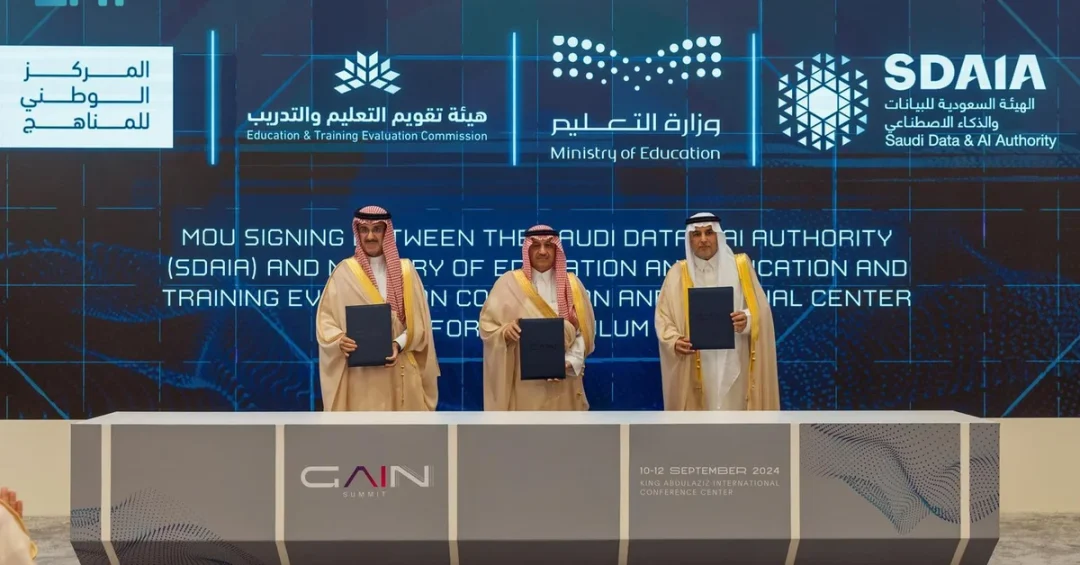
The Saudi Data and Artificial Intelligence Authority (SDAIA), alongside the Ministry of Education, the Education and Training Evaluation Commission, and the National Curriculum Center, signed a memorandum of understanding (MoU) on September 12, 2024, to establish the Excellence Center for Artificial Intelligence in Education. The agreement, signed during the third Global AI Summit (GAIN Summit) in Riyadh, enables students, researchers, and professors to access the advanced “ALLaM” (Arabic Large Language Model) for educational purposes.
Context and Background
This initiative builds on Saudi Arabia’s strategic commitment to integrating artificial intelligence across all sectors, particularly education, as part of the Vision 2030 framework. The ALLaM model, developed by SDAIA, represents a significant advancement in Arabic-language AI capabilities, designed to support natural language processing and generative AI applications. The signing ceremony involved key officials: Minister of Education and Chairman of the Board of Directors of the National Curriculum Center Yousef bin Abdullah Al-Benyan, SDAIA President Dr. Abdullah bin Sharaf Al-Ghamdi, and Education and Training Evaluation Commission Chairman Dr. Khalid bin Abdullah Al-Sabti, underscoring the collaborative nature of the project.
Key Details
The MoU outlines a framework for establishing the center, focusing on governance, development, and the responsible deployment of AI in education. ALLaM, a national generative AI model, will be made available to support research, curriculum development, and personalized learning experiences. The center aims to enhance educational outcomes by leveraging AI tools tailored to the Arabic language and regional contexts, ensuring that Saudi students and researchers have access to world-class technology.
Implications and Impact
This development positions Saudi Arabia at the forefront of AI-driven educational innovation in the region. By providing free access to ALLaM, the Kingdom empowers a new generation of learners and researchers to explore AI applications, fostering a culture of innovation and technological literacy. The initiative also supports the goals of the Global AI Summit by promoting international collaboration and knowledge exchange, reinforcing Saudi Arabia’s role as a hub for AI excellence.
Vision 2030 Alignment
The establishment of the Excellence Center for Artificial Intelligence in Education directly supports Vision 2030’s objectives of building a vibrant society with a thriving economy through human capital development. By integrating AI into education, Saudi Arabia prepares its youth for future job markets, enhances digital skills, and promotes lifelong learning, contributing to a knowledge-based economy. This forward-looking initiative reflects the Kingdom’s commitment to leveraging technology for sustainable growth and global leadership in AI.
20 Questions
Q1. What is the Excellence Center for Artificial Intelligence in Education?
A1. It is a new center established via an MoU to govern and promote AI use in Saudi education, providing access to the ALLaM model for students, researchers, and professors.
Q2. Who signed the memorandum of understanding?
A2. The MoU was signed by Minister of Education Yousef bin Abdullah Al-Benyan, SDAIA President Dr. Abdullah bin Sharaf Al-Ghamdi, and Education and Training Evaluation Commission Chairman Dr. Khalid bin Abdullah Al-Sabti.
Q3. What is ALLaM?
A3. ALLaM is a national generative Arabic Large Language Model developed by SDAIA to support natural language processing and AI applications for educational and research purposes.
Q4. When and where was the MoU signed?
A4. The MoU was signed on September 12, 2024, during the third Global AI Summit (GAIN Summit) held in Riyadh, Saudi Arabia.
Q5. Who can benefit from the ALLaM model under this initiative?
A5. Students, researchers, and professors in Saudi Arabia will have access to ALLaM for educational and research activities, enhancing their AI capabilities.
Q6. How does this initiative align with Vision 2030?
A6. It supports Vision 2030 by fostering human capital development, advancing digital skills, and building a knowledge-based economy through AI integration in education.
Q7. What is the role of the Ministry of Education in this partnership?
A7. The Ministry of Education oversees educational policy and implementation, ensuring the center’s activities align with national curriculum goals and student needs.
Q8. What is the purpose of the Governance Framework mentioned in the MoU?
A8. The framework ensures responsible and ethical use of AI in education, including data privacy, transparency, and alignment with national standards.
Q9. How does the Education and Training Evaluation Commission contribute?
A9. The commission assists in evaluating the center’s impact on educational outcomes and ensuring quality standards in AI applications for learning.
Q10. What is the significance of the GAIN Summit for this announcement?
A10. The GAIN Summit is a global platform for AI collaboration, and the signing highlights Saudi Arabia’s leadership in AI innovation and international partnerships.
Q11. Is the ALLaM model available for free?
A11. Yes, the MoU provides for free access to ALLaM for students, researchers, and professors to support education and research without financial barriers.
Q12. Can international researchers access the ALLaM model?
A12. The initiative primarily targets Saudi institutions, but international collaboration may be explored through future agreements or partnerships.
Q13. How does AI benefit education according to this initiative?
A13. AI enables personalized learning, curriculum development, advanced research tools, and improved teaching methods, enhancing overall educational quality.
Q14. What is the National Curriculum Center’s role?
A14. The center ensures that AI tools align with national curriculum standards and supports the integration of AI into teaching materials.
Q15. How does SDAIA support this initiative?
A15. SDAIA provides the ALLaM model and technical expertise, overseeing the center’s operations and AI governance for educational use.
Q16. What types of research will the center support?
A16. It supports research in natural language processing, AI ethics, educational technology, and other fields that leverage generative AI for academic advancement.
Q17. How does this center contribute to Saudi Arabia’s AI leadership?
A17. By enabling local talent to work with advanced AI models, it strengthens the Kingdom’s position as a global leader in AI research and application.
Q18. What is the timeline for the center’s establishment?
A18. The MoU sets a framework for immediate cooperation, with the center expected to become operational in the near future following governance approvals.
Q19. Are there any similar centers in other countries?
A19. While many countries have AI education initiatives, Saudi Arabia’s focus on an Arabic-language model and national governance makes this center unique.
Q20. How can students apply to use the ALLaM model?
A20. Specific application details will be announced through the Ministry of Education and SDAIA channels, likely involving institutional registration and project proposals.
Reader Feedback
We value your thoughts. Please share your feedback on this article.
Your feedback helps us improve our coverage.