


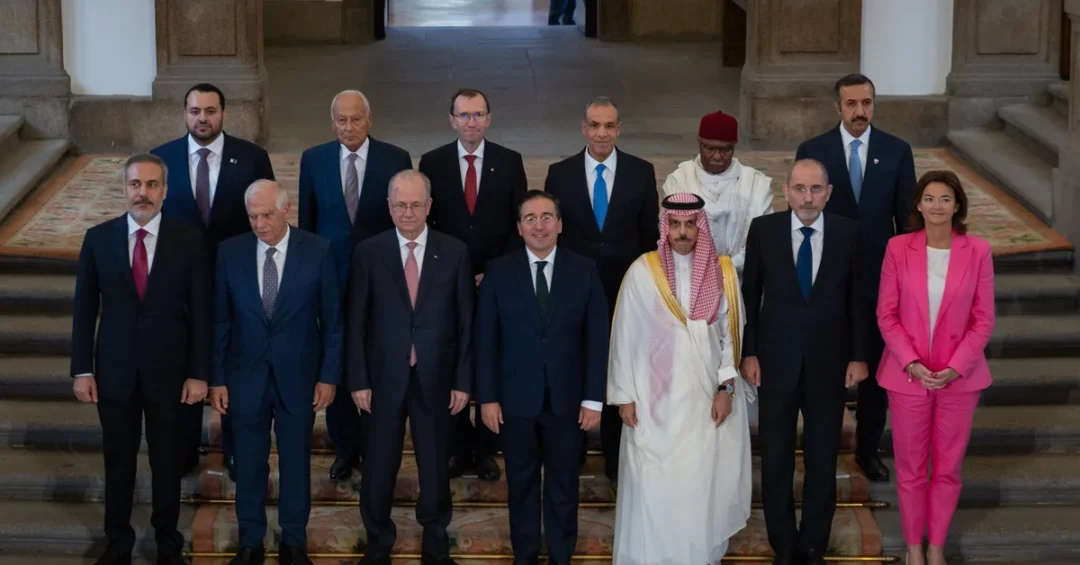
Minister of Foreign Affairs Prince Faisal bin Farhan bin Abdullah participated today in a high-level meeting in Madrid, resulting in a joint statement reaffirming international commitment to the two-State solution as the only path to lasting peace in the Middle East. The meeting, held on September 13, 2024, brought together the Ministerial Joint Contact Group of the League of Arab States and Organization of Islamic Cooperation, alongside the Foreign Ministers and representatives of Ireland, Norway, Slovenia, and Spain, as reported by the Saudi Press Agency (SPA).
Context and Background
The Madrid meeting took place amidst what the joint statement described as the worst crisis the Middle East has suffered in decades. The participants underscored that 33 years after the Madrid Peace Conference, the international community has not yet delivered on the objective of ending the Israeli occupation of Palestinian territory that began in 1967. The statement highlighted that unilateral illegal measures, settlements, forced displacement, and extremism have frustrated the hopes of both peoples for peace, particularly since October 7, 2023, when an unprecedented tragedy of human suffering unfolded.
Key Details of the Joint Statement
The joint statement calls for a credible, irreversible implementation of the two-State solution in accordance with international law and the Arab Peace Initiative. It welcomes the Advisory Opinion of the International Court of Justice from July 19, 2024, and emphasizes the necessity of empowering the Palestinian Government to fulfill its duties across the Gaza Strip and West Bank, including East Jerusalem. The participants fully support ongoing mediation efforts by Egypt, Qatar, and the United States, calling for an immediate and permanent ceasefire in Gaza, the release of hostages and detainees, and the full withdrawal of Israeli occupying forces from Gaza.
International Implications
The statement warns of dangerous escalation in the West Bank and urges an immediate halt to military attacks against Palestinians and all illegal measures that undermine peace prospects. It calls on the international community to take active steps, including universal recognition of the State of Palestine and its admission as a full member of the United Nations. The participants recommitted to joint peace efforts and agreed on the need to convene an international peace conference as soon as possible, inviting all UN members to join a broader meeting on the margins of the UN General Assembly session on September 26, 2024.
Vision 2030 Alignment
Saudi Arabia’s active role in this joint initiative aligns with the Kingdom’s Vision 2030, which seeks to promote regional stability, security, and prosperity as foundations for a thriving global economy. By championing diplomacy and multilateral cooperation, Saudi Arabia reinforces its position as a key mediator and a leader in pursuing sustainable peace in the Middle East, contributing to a future where mutual recognition and cooperation prevail.
20 Questions
Q1. What was the main outcome of the Madrid meeting?
A1. The Madrid meeting produced a joint statement reaffirming commitment to the two-State solution as the only path to lasting peace and security in the Middle East, with a call for its credible and irreversible implementation.
Q2. Who participated in the Madrid meeting?
A2. Participants included the Ministerial Joint Contact Group of the League of Arab States and Organization of Islamic Cooperation, along with Foreign Ministers and representatives from Ireland, Norway, Slovenia, and Spain.
Q3. Which Saudi official represented the Kingdom in Madrid?
A3. Minister of Foreign Affairs Prince Faisal bin Farhan bin Abdullah represented Saudi Arabia at the meeting, as reported by the Saudi Press Agency.
Q4. What is the significance of the two-State solution according to the statement?
A4. The statement describes the two-State solution as the only way to establish lasting peace and security, ending the Israeli occupation of Palestinian territory and creating two independent, sovereign states living side by side.
Q5. What recent event does the statement reference as unprecedented?
A5. The statement references the tragedy that has unfolded since October 7, 2023, describing it as an unprecedented event of unspeakable human suffering and violations of international law.
Q6. What does the statement say about settlements?
A6. The statement condemns unilateral illegal measures including settlements, forced displacement, and extremism, which have frustrated hopes for peace.
Q7. Which international legal opinion is welcomed in the statement?
A7. The statement welcomes the Advisory Opinion of the International Court of Justice from July 19, 2024, regarding the legal consequences of Israeli policies.
Q8. What role does the statement see for the Palestinian Government?
A8. The statement reiterates the necessity of empowering the Palestinian Government to fulfill all its duties throughout the Gaza Strip and West Bank, including East Jerusalem.
Q9. Which countries’ mediation efforts are supported in the document?
A9. The statement fully supports ongoing mediation efforts by Egypt, Qatar, and the United States, rejecting any actions that hinder this process.
Q10. What call is made regarding Gaza?
A10. The statement calls for an immediate and permanent ceasefire in Gaza, the release of hostages and detainees, and the full withdrawal of Israeli occupying forces from Gaza, including the Philadelphi corridor.
Q11. What is demanded concerning the Rafah crossing?
A11. The statement calls for the reestablishment of full control of the Palestinian Authority over the Rafah crossing and the rest of the borders.
Q12. What humanitarian actions are urged?
A12. The statement urges the immediate, unconditioned, and unimpeded delivery of humanitarian assistance at scale through the opening of all Israeli crossings, and support for UNRWA and other UN agencies.
Q13. What does the statement warn about the West Bank?
A13. The statement warns of dangerous escalation in the West Bank and urges an immediate halt to military attacks against Palestinians, as well as all illegal measures including settlement activities and land confiscation.
Q14. What is said about Jerusalem’s holy sites?
A14. The statement emphasizes that the legal and historical status quo at Jerusalem’s Muslim and Christian Holy Sites must be upheld, recognizing the key role of the Hashemite Custodianship.
Q15. What steps does the international community need to take?
A15. The statement calls for universal recognition of the State of Palestine and its admission as a full member of the United Nations, as essential steps to implement the two-State solution.
Q16. What future meeting is announced in the statement?
A16. The participants agreed on the need to convene an international peace conference as soon as possible, with a broader meeting planned on the margins of the UN General Assembly on September 26, 2024.
Q17. How does this initiative align with Saudi Vision 2030?
A17. Saudi Arabia’s active role in promoting regional stability and diplomacy supports Vision 2030 goals of fostering a peaceful, secure, and prosperous region as a foundation for global economic engagement.
Q18. What is the Arab Peace Initiative?
A18. The Arab Peace Initiative is a framework for achieving comprehensive peace in the Middle East, endorsed by the League of Arab States, which calls for normalization of relations in exchange for a full Israeli withdrawal from occupied territories.
Q19. How does the statement address violence?
A19. The statement condemns all forms of violence and terrorism, urging compliance with international humanitarian law and the orders of the International Court of Justice.
Q20. Why was Madrid chosen for this meeting?
A20. Madrid was chosen to recall the 1991 Madrid Peace Conference, highlighting that 33 years later, the shared objective of a just and lasting peace remains valid and urgent.
Reader Feedback
We value your thoughts. Please share your feedback on this article.
Your feedback helps us improve our coverage.