


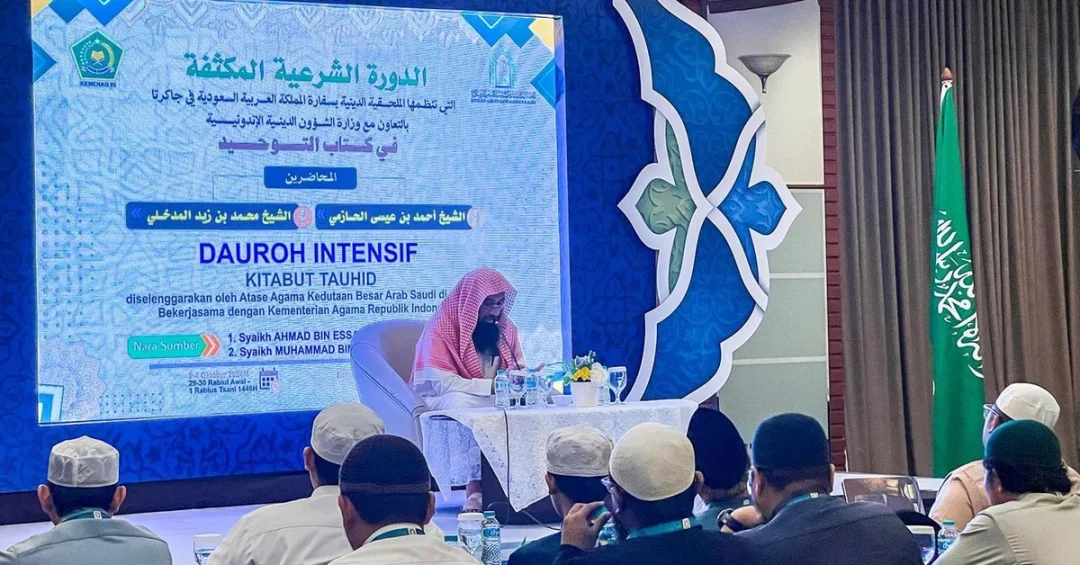
The Ministry of Islamic Affairs, Dawah and Guidance of the Kingdom of Saudi Arabia, represented by the Religious Attaché at the Saudi Embassy in Indonesia, organized the fifth intensive Shariah course for advocates and imams in Jakarta on October 2, 2024. This three-day course, held in collaboration with the Indonesian Ministry of Religious Affairs, includes 100 participants and reflects the ongoing cooperation between the two nations in promoting moderate and balanced Islamic knowledge.
Context and Background
This initiative is part of the Ministry of Islamic Affairs’ consistent efforts to promote accurate Shariah knowledge based on the principles of moderation and balance. By partnering with Indonesia, a country with the world’s largest Muslim population, Saudi Arabia underscores its commitment to Islamic scholarship and interfaith dialogue. The course aims to equip participants with a deeper understanding of Islamic jurisprudence, focusing on tolerance and the rejection of extremism and fanaticism.
Key Details
The intensive course, now in its fifth iteration, brings together 100 imams and advocates from across Indonesia. Sessions are designed to cover core topics in Shariah, including fiqh (jurisprudence), usul al-fiqh (legal theory), and contemporary ethical issues. The collaboration between the Saudi Ministry of Islamic Affairs and the Indonesian Ministry of Religious Affairs ensures that the curriculum aligns with both countries’ commitment to fostering religious harmony and intellectual rigor.
International Impact
This event highlights Saudi Arabia’s role as a global leader in Islamic affairs, promoting a message of peace and tolerance that extends beyond its borders. By engaging with Indonesian religious leaders, the Kingdom strengthens bilateral ties and supports a shared vision for countering extremist ideologies. The course also contributes to the broader regional stability by equipping imams with tools to guide their communities toward moderation and constructive engagement with modernity.
Vision 2030 Alignment
This initiative aligns directly with Saudi Arabia’s Vision 2030, which emphasizes the importance of religious tolerance, cultural exchange, and global partnerships. By fostering moderate Islamic scholarship and building bridges with influential Muslim communities abroad, the Kingdom reinforces its role as a hub for Islamic learning and a model for balanced religious practice. Such efforts are integral to achieving a thriving society where values of coexistence and mutual respect are paramount.
20 Questions
Q1. What is the main purpose of the fifth intensive Shariah course?
A1. The course aims to promote accurate Shariah knowledge based on moderation and balance, and to highlight Saudi Arabia’s message of tolerance and rejection of extremism.
Q2. Who organized this course?
A2. The course was organized by the Ministry of Islamic Affairs, Dawah and Guidance, through the Religious Attaché at the Saudi Embassy in Indonesia.
Q3. When and where did the course take place?
A3. The course started on October 2, 2024, in Jakarta, the capital city of Indonesia.
Q4. How many participants are attending the course?
A4. The three-day course includes 100 participants, all of whom are advocates and imams from Indonesia.
Q5. Which Indonesian ministry collaborated on this initiative?
A5. The course was held in collaboration with the Indonesian Ministry of Religious Affairs.
Q6. What is the significance of holding this course in Indonesia?
A6. Indonesia has the world’s largest Muslim population, making it a vital partner for Saudi Arabia in promoting moderate Islam and countering extremism.
Q7. How does this course relate to Saudi Arabia’s global role?
A7. It demonstrates Saudi Arabia’s leadership in Islamic affairs by sharing knowledge and fostering tolerance internationally.
Q8. What topics are covered in the Shariah course?
A8. The curriculum includes fiqh (jurisprudence), usul al-fiqh (legal theory), and contemporary ethical issues in Islam.
Q9. Why is this course considered ‘intensive’?
A9. It is a three-day program designed to provide deep, focused learning on core Shariah topics for participants.
Q10. How does this course support Saudi Arabia’s Vision 2030?
A10. It aligns with Vision 2030’s goal of promoting religious tolerance, cultural exchange, and global partnerships.
Q11. What is the role of the Religious Attaché in this event?
A11. The Religious Attaché represents the Ministry of Islamic Affairs at the Saudi Embassy and coordinated the organization of the course in Jakarta.
Q12. How many previous editions of this course have been held?
A12. This is the fifth edition, indicating a sustained commitment by Saudi Arabia to Islamic education abroad.
Q13. What message does the course convey about Islam?
A13. It conveys a message of tolerance, peace, and rejection of extremism and fanaticism.
Q14. How does this initiative benefit Indonesian imams?
A14. It equips them with accurate knowledge to guide their communities toward moderation and balanced religious practice.
Q15. Is the course only for Indonesian participants?
A15. Yes, the current course specifically serves Indonesian imams and advocates through bilateral cooperation with the Indonesian Ministry of Religious Affairs.
Q16. What does ‘moderation and balance’ mean in this context?
A16. It refers to applying Islamic principles in a way that avoids extremism and promotes harmony in diverse modern societies.
Q17. How does Saudi Arabia select participants for such programs?
A17. Selection is typically done in coordination with the Indonesian Ministry of Religious Affairs to ensure qualified imams and advocates attend.
Q18. What impact does the course have on Saudi-Indonesia relations?
A18. It strengthens bilateral ties by fostering intellectual and religious cooperation between the two countries.
Q19. Does the course address contemporary issues?
A19. Yes, it covers contemporary ethical issues to help imams address modern challenges with Islamic guidance.
Q20. What is the long-term goal of this initiative?
A20. The long-term goal is to cultivate a global network of moderate religious leaders who promote peace and tolerance, contributing to regional stability.
Reader Feedback
We value your thoughts. Please share your feedback on this article.
Your feedback helps us improve our coverage.