


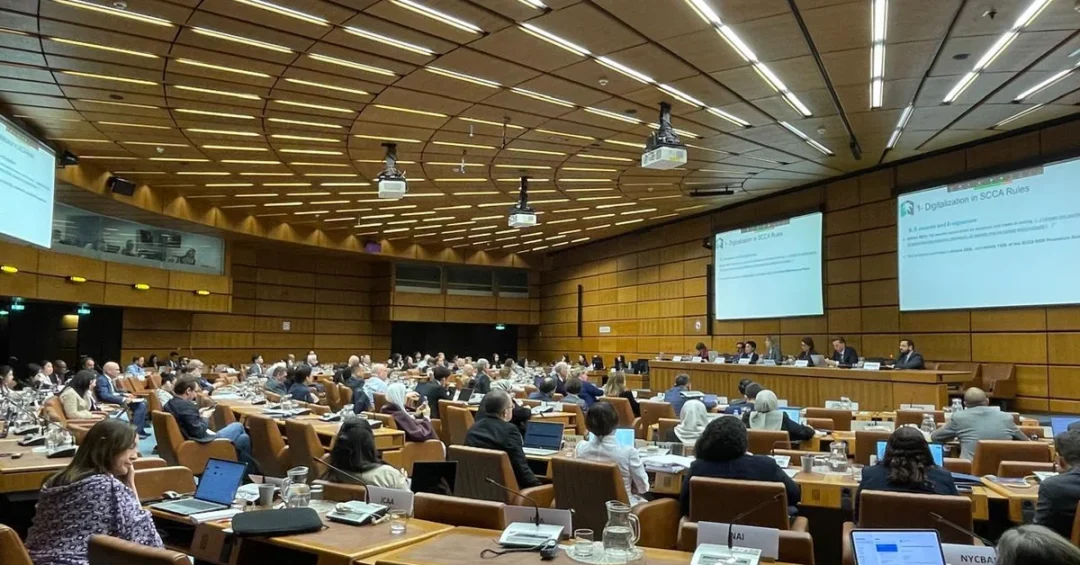
The Saudi Center for Commercial Arbitration (SCCA) represented the Kingdom of Saudi Arabia at the 80th session of the UNCITRAL Working Group II on Dispute Settlement, held at the United Nations Headquarters in Vienna. The session, attended by 63 UNCITRAL member states and representatives from international organizations, focused on addressing challenges related to the recognition and enforcement of electronic arbitral awards, reflecting the growing role of technology in commercial dispute resolution.
Context and Background
UNCITRAL’s Working Group II has been tasked with exploring solutions for the digitalization of arbitration, a critical issue as global commerce increasingly relies on electronic methods. The SCCA’s participation underscores Saudi Arabia’s commitment to contributing to international legal frameworks and sharing its advanced practices in digital arbitration. This aligns with the Kingdom’s broader Vision 2030 goals of modernizing its legal and economic sectors.
Key Details
During a two-day colloquium, the SCCA—the only arbitration center from the Middle East and North Africa region to participate—shared its experience in adopting digital methods for issuing and signing arbitral awards. SCCA CEO Dr. Hamed bin Hassan Merah highlighted that the term “electronic” appears 12 times in the 2023 SCCA Arbitration Rules, with Article 25 encouraging the use of technology in case management and Article 36 permitting electronic issuance of awards by party agreement. He noted that since the 2023 rules took effect, most arbitral awards have been circulated via email, with hard copies provided upon request or where required by jurisdictional needs.
Implications and Impact
The SCCA’s involvement demonstrates Saudi Arabia’s leadership in digitalizing arbitration, setting a benchmark for other nations. Dr. Merah emphasized that Saudi Arabia’s supportive environment—executive, judicial, and legislative—facilitates the use of technology in dispute resolution. He pointed to the Kingdom’s rise from 52nd globally in 2018 to fourth globally and first regionally in the 2024 United Nations E-Government Development Index, reflecting rapid digitalization. Additionally, the percentage of digitalized justice services rose from 30% in 2015 to 87%, with 160 judicial services available electronically through the Ministry of Justice’s Najiz platform.
Vision 2030 Alignment
This participation directly supports Vision 2030 by showcasing Saudi Arabia’s commitment to fostering a modern, efficient legal environment that attracts international investment. The comprehensive regulatory framework, including the Electronic Transactions Law, E-Commerce Law, and Telecommunications and Information Technology Act, positions the Kingdom as a global hub for innovation in commercial arbitration, advancing its long-term goals of economic diversification and digital transformation.
20 Questions
Q1. What was the SCCA’s role at the UNCITRAL session?
A1. The SCCA represented Saudi Arabia at the 80th session of UNCITRAL Working Group II, sharing its expertise in digitalizing arbitration to address challenges in electronic arbitral awards.
Q2. Where did the session take place?
A2. The session was held at the United Nations Headquarters in Vienna, Austria, as part of ongoing UNCITRAL efforts to modernize dispute settlement practices.
Q3. How many member states attended the session?
A3. The session was attended by 63 UNCITRAL member states, along with representatives from relevant international organizations.
Q4. What was the key issue addressed at the session?
A4. The session focused on the recognition and enforcement of electronic arbitral awards, exploring challenges and solutions linked to digitalization in commercial dispute resolution.
Q5. Why was the colloquium held alongside the session?
A5. The two-day colloquium was held to discuss the digitalization of arbitration in line with modern international practices, covering electronic awards, signatures, and communications.
Q6. What made the SCCA’s participation unique?
A6. The SCCA was the only arbitration center from the Middle East and North Africa region to participate in the colloquium, highlighting Saudi Arabia’s leadership in arbitration digitalization.
Q7. Who represented the SCCA at the event?
A7. The SCCA was represented by its CEO, Dr. Hamed bin Hassan Merah, who spoke during a panel on electronic arbitral awards from the perspective of arbitration centers.
Q8. How many times does the term “electronic” appear in the 2023 SCCA Arbitration Rules?
A8. The term “electronic” appears 12 times in the 2023 version of the SCCA Arbitration Rules, reflecting the center’s focus on digital methods.
Q9. What does Article 25 of the SCCA Arbitration Rules encourage?
A9. Article 25 encourages the use of technology in the management of arbitration cases, promoting efficiency through digital tools.
Q10. What does Article 36 of the SCCA Arbitration Rules allow?
A10. Article 36 permits the issuance of arbitral awards electronically if the parties agree, offering flexibility in dispute resolution.
Q11. How are most arbitral awards circulated under the 2023 rules?
A11. Since the 2023 rules took effect, most arbitral awards have been circulated to parties via email, with hard copies provided upon request or where necessary.
Q12. What supports digitalization in Saudi Arabia’s executive level?
A12. Saudi Arabia’s supportive executive environment encourages rapid digital transformation, as shown by its rise in the UN E-Government Development Index from 52nd to 4th globally.
Q13. What is the share of digitalized justice services in Saudi Arabia?
A13. The percentage of digitalized justice services rose from 30% in 2015 to 87% in 2024, with 160 services available online via the Najiz platform.
Q14. What is the Najiz platform?
A14. The Najiz platform, managed by the Ministry of Justice, offers 160 electronic judicial services, including depositing arbitral awards and filing motions to annul or enforce them.
Q15. What laws support Saudi Arabia’s digital transformation in arbitration?
A15. Key laws include the Electronic Transactions Law, the E-Commerce Law, and the Telecommunications and Information Technology Act, aligning with international standards.
Q16. How does the SCCA’s work align with Vision 2030?
A16. The SCCA’s digitalization efforts support Vision 2030 by modernizing the legal environment, attracting investment, and promoting Saudi Arabia as a hub for commercial arbitration.
Q17. What international recognition has Saudi Arabia achieved for digitalization?
A17. Saudi Arabia ranked fourth globally and first regionally in the 2024 UN E-Government Development Index, up from 52nd in 2018.
Q18. What is the role of UNCITRAL Working Group II?
A18. Working Group II focuses on dispute settlement, identifying challenges in digital arbitration and exploring solutions to modernize practices globally.
Q19. Why is the SCCA’s participation important for the Middle East and North Africa?
A19. As the only arbitration center from the region at the event, the SCCA showcases regional leadership and promotes best practices for digital arbitration throughout the Middle East and North Africa.
Q20. What is the future outlook for digital arbitration in Saudi Arabia?
A20. With supportive laws and growing digital infrastructure, Saudi Arabia is expected to further integrate technology in arbitration, contributing to global standards and Vision 2030 goals.
Reader Feedback
We value your thoughts. Please share your feedback on this article.
Your feedback helps us improve our coverage.