


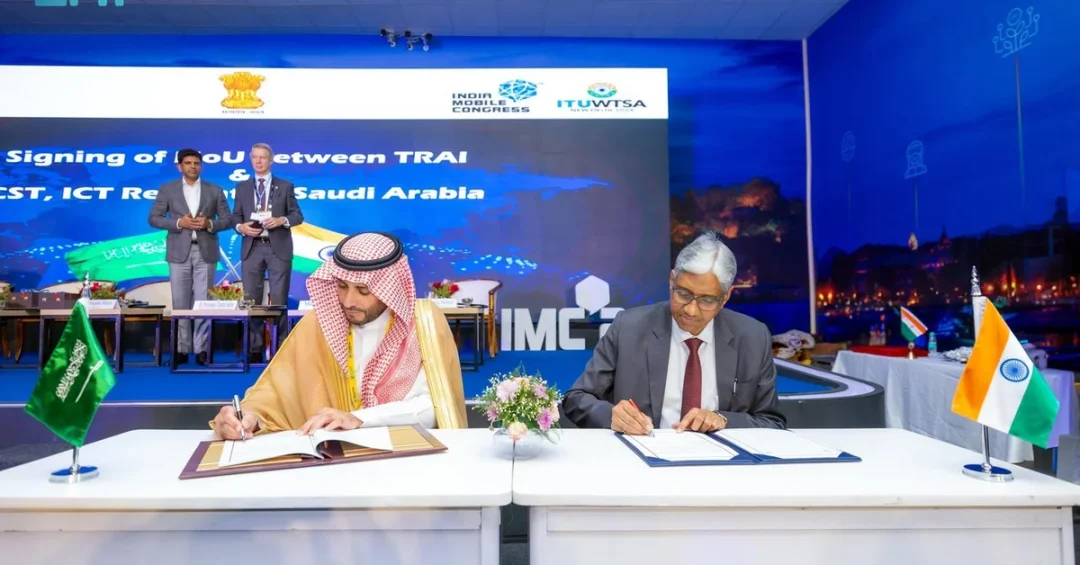
The Communications, Space and Technology Commission (CST) of Saudi Arabia and the Telecom Regulatory Authority of India (TRAI) signed a Memorandum of Understanding (MoU) on October 16, 2024, in New Delhi, India, to deepen cooperation in the regulatory and digital sectors. The agreement was signed by CST Governor Dr. Mohammed Altamimi and TRAI Chairman Anil Kumar Lahoti, with Indian Minister of State for Communications Dr. Chandra Sekhar Pemmasani in attendance. The signing took place on the sidelines of the World Telecommunication Standardization Assembly (WTSA), a key international forum for setting global standards in telecommunications, running from October 15 to 24, 2024.
Context and Background
The MoU reflects the strengthening bilateral ties between the Kingdom of Saudi Arabia and India, two nations increasingly aligned in their digital transformation ambitions. Both countries recognize the critical role of advanced regulatory frameworks in enabling resilient and secure communication networks. The agreement builds on a history of collaboration and aligns with the Kingdom’s broader Vision 2030 goals of fostering innovation and digital infrastructure development, while India’s Digital India initiative similarly prioritizes expanding connectivity and digital services.
Key Details
Under the MoU, CST and TRAI will collaborate on applying regulatory technology (RegTech) to streamline compliance and oversight processes. The partnership also includes conducting joint studies on infrastructure and principles of digital regulation. A central component is the exchange of information and transfer of knowledge in the Information and Communications Technology (ICT) sector, leveraging training programs offered by the Digital Regulations Academy (DRA), a Saudi initiative dedicated to building capacity in digital governance. The agreement is designed to support mutual interests and capitalize on opportunities for robust growth in the two nations’ relations in communications, space, and technology.
Implications and Impact
This partnership has significant implications for the region and beyond. By harmonizing regulatory approaches with India, a major global technology hub, Saudi Arabia is positioned to lead in setting standards for digital regulation across the Middle East. The collaboration on RegTech is expected to enhance efficiency and reduce barriers for businesses operating in both countries, fostering cross-border investment and innovation. For India, the agreement opens avenues to benefit from Saudi Arabia’s advanced space and communications capabilities, while both nations stand to gain from shared best practices in ICT governance.
Vision 2030 Alignment
The MoU directly supports Saudi Arabia’s Vision 2030, which prioritizes digital transformation, economic diversification, and global partnerships. By enhancing cooperation with India in the regulatory and digital fields, the Kingdom advances its ambition to become a leading digital economy, improve the efficiency of its communications sector, and build a knowledge-based society. This agreement represents a concrete step toward realizing the goals of Vision 2030 and reinforcing Saudi Arabia’s role as a hub for innovation and international collaboration in the digital age.
20 Questions
Q1. Who signed the MoU between CST and TRAI?
A1. CST Governor Dr. Mohammed Altamimi and TRAI Chairman Anil Kumar Lahoti signed the MoU, with Indian Minister of State for Communications Dr. Chandra Sekhar Pemmasani in attendance.
Q2. Where and when was the MoU signed?
A2. The MoU was signed in New Delhi, India, on October 16, 2024, during the World Telecommunication Standardization Assembly (WTSA).
Q3. What is the main purpose of the MoU?
A3. The MoU aims to enhance cooperation between Saudi Arabia and India in regulatory and digital sectors, focusing on RegTech, joint studies, and knowledge exchange.
Q4. What is RegTech?
A4. RegTech, or regulatory technology, uses digital tools to streamline and automate compliance and regulatory processes, making them more efficient and transparent.
Q5. What organizations does the MoU involve?
A5. The MoU involves the Communications, Space and Technology Commission (CST) of Saudi Arabia and the Telecom Regulatory Authority of India (TRAI).
Q6. What is the WTSA?
A6. The World Telecommunication Standardization Assembly (WTSA) is a global forum where countries set standards for telecommunications, held from October 15 to 24, 2024, in New Delhi.
Q7. How does this MoU support Saudi Arabia’s Vision 2030?
A7. By fostering digital transformation, innovation, and global partnerships, the MoU directly advances Vision 2030 goals of economic diversification and a knowledge-based society.
Q8. What role does the Digital Regulations Academy play?
A8. The Digital Regulations Academy (DRA) provides training programs in digital governance, which will be shared with India under the MoU to build regulatory capacity.
Q9. What types of joint studies are planned?
A9. Joint studies will focus on infrastructure and principles of digital regulation, helping both countries develop best practices in communications and technology.
Q10. Why is knowledge exchange important?
A10. Knowledge exchange fosters innovation and efficiency in the ICT sector, allowing both nations to learn from each other’s experiences and accelerate regulatory improvements.
Q11. What sectors are covered by the MoU?
A11. The MoU covers communications, space, and technology, including digital regulation and ICT sectors.
Q12. How does this MoU benefit businesses?
A12. By harmonizing regulations and applying RegTech, it simplifies compliance, reduces costs, and encourages cross-border investment in both Saudi Arabia and India.
Q13. What is the significance of the signing venue?
A13. Signing at the WTSA in New Delhi underscores the global relevance of the MoU and positions it within international standardization efforts.
Q14. Will the MoU lead to new training programs?
A14. Yes, India will benefit from the Digital Regulations Academy’s training programs, enhancing its expertise in digital governance.
Q15. How does this align with India’s goals?
A15. It complements India’s Digital India initiative by expanding collaboration in digital regulation and technology, supporting its digital transformation.
Q16. What is CST’s role in Saudi Arabia?
A16. CST regulates communications, space, and technology in Saudi Arabia, ensuring efficient, secure, and innovative services aligned with national goals.
Q17. What is TRAI’s role in India?
A17. TRAI is India’s telecom regulator, responsible for promoting transparency, efficiency, and competition in the telecommunications sector.
Q18. How does the MoU promote innovation?
A18. By facilitating joint studies and knowledge transfer, it encourages the adoption of new technologies and regulatory approaches, fostering innovation.
Q19. What does this mean for regional leadership?
A19. Saudi Arabia’s cooperation with India positions it as a leader in digital regulation in the Middle East, setting standards for the region.
Q20. When will the MoU’s benefits be visible?
A20. Immediate collaboration begins with joint studies and training, with long-term benefits expected as RegTech and digital regulations are implemented in both countries.
Reader Feedback
We value your thoughts. Please share your feedback on this article.
Your feedback helps us improve our coverage.