


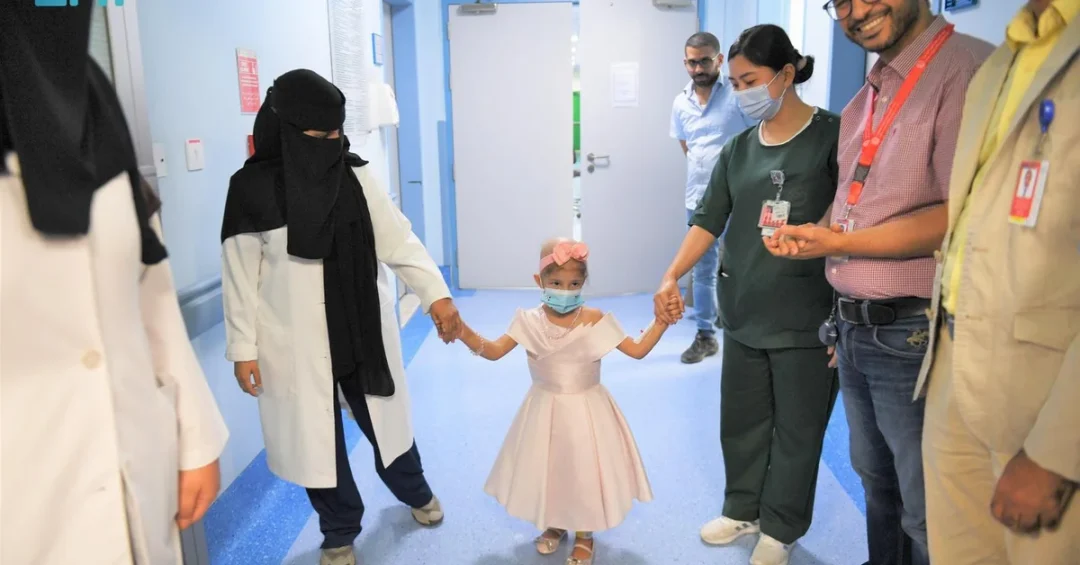
Riyadh, November 28, 2024 — A medical team at Prince Sultan Military Medical City (PSMMC) has achieved a pioneering medical milestone by performing a successful bone marrow transplant for a young girl with acute lymphoblastic leukemia. The patient, who received a donation from her sibling, has since recovered and been discharged in good health, marking a significant advancement in Saudi pediatric oncology.
Context and Background
This milestone underscores Saudi Arabia’s growing capabilities in specialized medical fields, particularly in oncology and organ transplantation. The procedure was conducted at PSMMC, a leading healthcare institution under the Saudi Ministry of Defense, and highlights the Kingdom’s commitment to advancing medical excellence in line with Vision 2030. The use of cutting-edge technology positions Saudi Arabia as a regional hub for complex medical procedures.
Key Details
The medical team at PSMMC treated the patient with total body irradiation using the advanced VMAT (Volumetric Modulated Arc Therapy) technique, marking the first time this technology has been utilized in the Middle East for such a case. Supervised by the Radiation Therapy and Medical Physics departments, this innovative method enables full-body radiation therapy for children at an early age while maintaining a single position throughout the treatment, unlike traditional methods that require the child to be repositioned multiple times. This case also serves as the starting point for a pediatric bone marrow transplant program at PSMMC, aiming to treat conditions including acute leukemia, hereditary blood disorders, autoimmune diseases, and immunodeficiency disorders.
Implications and Impact
This achievement has significant regional implications, as it demonstrates Saudi Arabia’s ability to adopt and implement advanced medical technologies. The success of the VMAT technique in pediatric care could inspire similar applications across the Middle East, potentially improving outcomes for young patients with blood cancers and genetic disorders. Additionally, the establishment of a dedicated pediatric bone marrow transplant program enhances the Kingdom’s healthcare infrastructure and reduces the need for patients to seek treatment abroad.
Vision 2030 Alignment
This medical milestone directly supports Vision 2030‘s goal of enhancing the quality of life for Saudi citizens through world-class healthcare. By pioneering advanced treatments and fostering homegrown medical expertise, Saudi Arabia continues to strengthen its position as a leader in healthcare innovation, ultimately contributing to a healthier, more prosperous society.
20 Questions
Q1. What was the medical milestone achieved at PSMMC?
A1. The medical team at Prince Sultan Military Medical City performed a successful bone marrow transplant for a young girl with acute lymphoblastic leukemia, using a donation from her sibling, marking a first in the Middle East.
Q2. Who was the patient in this case?
A2. The patient was a young girl diagnosed with acute lymphoblastic leukemia, who recovered after the transplant and was discharged in good health.
Q3. What technique was used for total body irradiation?
A3. The team used the VMAT (Volumetric Modulated Arc Therapy) technique, a first in the Middle East for such a case, allowing precise radiation delivery.
Q4. Why is the VMAT technique significant?
A4. VMAT enables full-body radiation therapy in a single patient position, reducing the need for repositioning, which is particularly beneficial for children.
Q5. Which departments supervised the procedure?
A5. The procedure was supervised by the Radiation Therapy and Medical Physics departments at PSMMC.
Q6. What conditions will the pediatric bone marrow transplant program address?
A6. The program aims to treat acute leukemia, hereditary blood disorders, autoimmune diseases, and immunodeficiency disorders.
Q7. How does this milestone support Vision 2030?
A7. It enhances healthcare quality and innovation, aligning with Vision 2030’s goal of improving citizens’ quality of life through advanced medical services.
Q8. What is PSMMC’s role in this achievement?
A8. PSMMC is a leading Saudi healthcare institution under the Ministry of Defense, providing advanced treatments and pioneering medical research.
Q9. Is this the first time VMAT has been used in the Middle East?
A9. Yes, this was the first use of VMAT for total body irradiation in a pediatric bone marrow transplant case in the Middle East.
Q10. What was the source of the bone marrow donation?
A10. The bone marrow was donated by the patient’s sibling, ensuring compatibility and reducing rejection risks.
Q11. What is acute lymphoblastic leukemia?
A11. It is a type of cancer affecting white blood cells, common in children, but treatable with therapies like bone marrow transplants.
Q12. How long did the patient stay in the hospital?
A12. The specific duration is not detailed, but the patient recovered and was discharged in good health after the successful transplant.
Q13. What other treatments might benefit from this technique?
A13. The VMAT technique could be applied to other cancers requiring total body irradiation, such as certain lymphomas or solid tumors.
Q14. How does this compare to traditional radiation methods?
A14. Traditional methods require multiple patient repositionings, while VMAT allows a single position, improving accuracy and comfort.
Q15. What is the broader impact on Saudi healthcare?
A15. It positions Saudi Arabia as a regional leader in advanced medical procedures, reducing reliance on overseas treatment.
Q16. Are there plans to expand this program?
A16. The program’s launch suggests plans for expansion to treat more pediatric patients with various blood disorders.
Q17. What is the role of the Radiation Therapy department?
A17. The department planned and delivered the VMAT radiation, ensuring safe and effective treatment for the patient.
Q18. How does this reflect Saudi innovation?
A18. It showcases Saudi Arabia’s ability to adopt and implement cutting-edge medical technologies, fostering local expertise and innovation.
Q19. Could this technique be used for adults?
A19. While VMAT is often used for adults, this case demonstrates its specific adaptation for pediatric total body irradiation.
Q20. What is the significance of the sibling donation?
A20. Sibling donations often have higher compatibility rates, leading to better transplant outcomes, as seen in this successful case.
Reader Feedback
We value your thoughts. Please share your feedback on this article.
Your feedback helps us improve our coverage.