


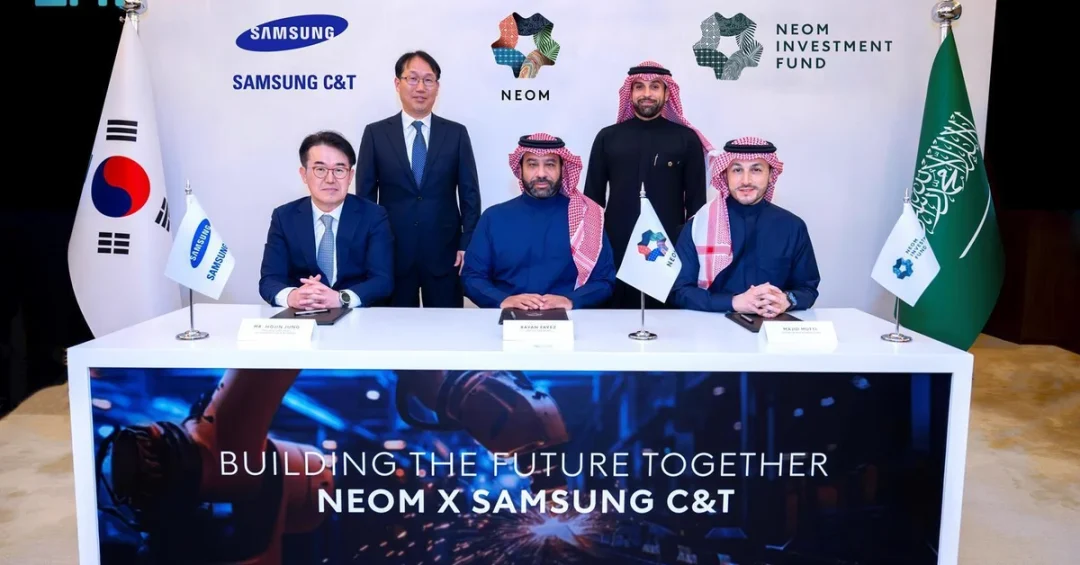
NEOM, the sustainable development taking shape in northwest Saudi Arabia, has signed a joint venture agreement with Samsung C&T Corporation to deploy the world’s largest rebar construction automation system, backed by an initial investment exceeding SAR1.3 billion. The agreement, announced on December 19, 2024, via the Saudi Press Agency, aims to transform construction robotics on a global scale by automating rebar cage assembly through advanced robotic welding and tying techniques.
Context and Background
This partnership establishes rebar cage assembly factories within NEOM, creating over 2,000 highly skilled job opportunities locally. The automation is expected to reduce manual workforce hours by up to 80%, based on global average installation metrics for traditional construction methods, while cutting cage assembly costs by up to 40%. The technology will primarily support the construction of THE LINE and other key developments in the region.
Key Details
The joint venture will focus on the large-scale production of pre-manufactured reinforcement cages, improving safety, quality, and material efficiency. Majid Mufti, CEO of the NEOM Investment Fund, stated: “Sustainability at NEOM is a core principle that drives not only what we build, but how we build it. By automating labor-intensive processes through robotics, we are pushing the boundaries of construction innovation.” Samsung C&T brings its global expertise in engineering and construction to the initiative.
Implications and Impact
This deployment represents a significant shift in construction methodology, potentially setting a new global standard for efficiency in megaproject delivery. The technology reduces material waste and enhances worker safety, aligning with international trends toward sustainable building practices. Regionally, it positions NEOM and Saudi Arabia as a hub for advanced manufacturing and robotics innovation, attracting further investment and expertise.
Vision 2030 Alignment
The initiative directly supports Saudi Vision 2030 by advancing non-oil economic diversification, fostering high-skilled employment, and promoting sustainable development. By integrating cutting-edge automation into construction, NEOM demonstrates how technological innovation can accelerate infrastructure progress while reducing environmental impact, contributing to the Kingdom’s long-term goals of building a vibrant society and a thriving economy.
20 Questions
Q1. What is the main objective of the NEOM-Samsung C&T joint venture?
A1. The joint venture aims to deploy the world’s largest rebar construction automation system, reducing manual labor and improving efficiency in building THE LINE and other NEOM projects.
Q2. How much is the initial investment in this project?
A2. The initial investment exceeds SAR1.3 billion, as announced by NEOM in December 2024 via the Saudi Press Agency.
Q3. What specific technology is being deployed?
A3. Advanced robotic welding and tying techniques are being used to automate the assembly of rebar cages, which are pre-manufactured reinforcement structures.
Q4. How will this affect workforce hours?
A4. The automation can reduce manual workforce hours by up to 80% compared to traditional construction methods based on global averages.
Q5. What cost savings are expected from this technology?
A5. Rebar cage assembly costs are expected to decrease by up to 40% due to reduced waste and increased efficiency.
Q6. How many jobs will be created by this initiative?
A6. The agreement will create more than 2,000 highly skilled job opportunities locally within NEOM’s rebar cage assembly factories.
Q7. Who commented on the agreement from NEOM?
A7. Majid Mufti, CEO of the NEOM Investment Fund, provided a statement highlighting sustainability and innovation as core principles.
Q8. What is the primary construction project these cages will support?
A8. The rebar cages will be used primarily for the construction of THE LINE and other key developments in the NEOM region.
Q9. How does this initiative improve safety?
A9. By automating labor-intensive processes, the technology reduces the need for workers to perform hazardous manual tasks, enhancing overall safety.
Q10. What is the role of Samsung C&T in this joint venture?
A10. Samsung C&T Corporation brings its global expertise in engineering and construction to develop and operate the automation factories.
Q11. How does this project reduce material waste?
A11. Advanced robotic techniques ensure precise welding and tying, minimizing material scrap and optimizing the use of steel in rebar cages.
Q12. When was the agreement officially announced?
A12. The agreement was announced on December 19, 2024, by NEOM and confirmed by the Saudi Press Agency.
Q13. Where will the rebar cage assembly factories be located?
A13. The factories will be established within the NEOM region, in the northwest of Saudi Arabia.
Q14. How does this align with Saudi Vision 2030?
A14. The project supports Vision 2030 by diversifying the economy, creating skilled jobs, and promoting sustainable, technology-driven development.
Q15. What global impact might this have?
A15. This is the world’s largest deployment of rebar construction automation, potentially setting a new global standard for efficiency in megaprojects.
Q16. Is this the first robotics project in NEOM?
A16. It is a major advancement in construction robotics at NEOM, building on the region’s commitment to cutting-edge innovation and sustainability.
Q17. What are the environmental benefits of this technology?
A17. Reduced material waste and lower energy consumption from automation contribute to more sustainable construction practices and a smaller carbon footprint.
Q18. How will this affect the timeline of THE LINE?
A18. By accelerating rebar cage production, the automation is expected to speed up construction timelines for THE LINE and related developments.
Q19. What type of skills will the new jobs require?
A19. Jobs will include roles in robotics operation, engineering, technical maintenance, and factory management, offering highly skilled employment opportunities.
Q20. Is this investment part of a larger trend in Saudi Arabia?
A20. Yes, it reflects the Kingdom’s broader push under Vision 2030 to integrate advanced technology into infrastructure and attract global industrial partnerships.
Reader Feedback
We value your thoughts. Please share your feedback on this article.
Your feedback helps us improve our coverage.