


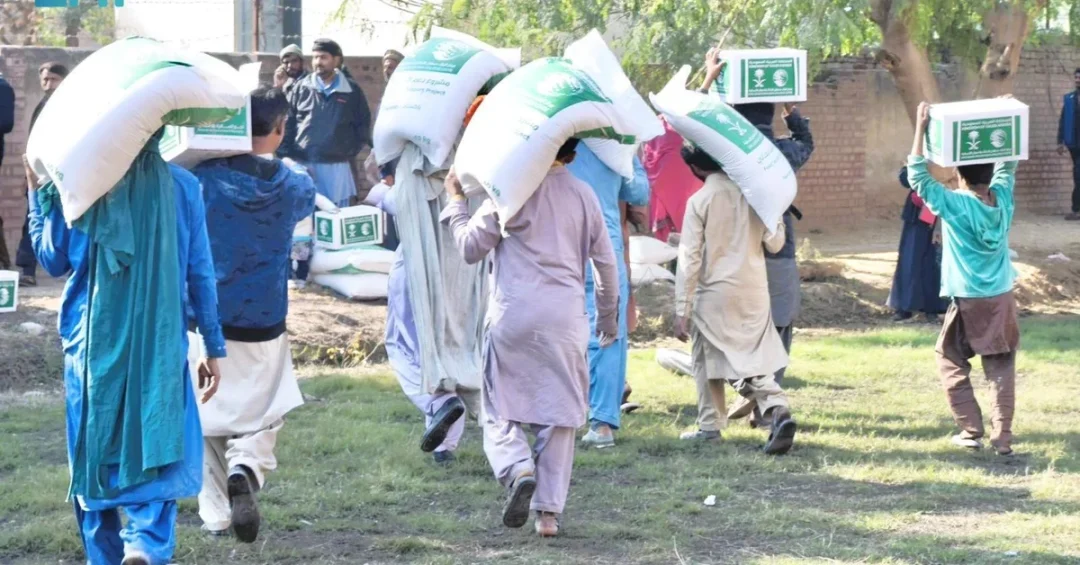
The King Salman Humanitarian Aid and Relief Center (KSrelief) distributed 1,013 food baskets on Monday in the Rahim Yar Khan district of Punjab province and the Hangu district of Khyber Pakhtunkhwa province in Pakistan. This assistance successfully reached 6,279 vulnerable individuals in flood-affected areas as part of the food security support project in Pakistan for 2025. The initiative underscores Saudi Arabia’s ongoing commitment to humanitarian relief and its partnership with Pakistan during times of need.
Context and Background
Pakistan has faced severe flooding in recent years, particularly in the provinces of Punjab and Khyber Pakhtunkhwa, which has displaced thousands and disrupted food supplies. KSrelief, established by royal decree in 2015, is the Kingdom’s primary humanitarian aid agency, operating globally to provide emergency relief and sustainable development assistance. Through the food security support project, KSrelief aims to address immediate hunger while strengthening local resilience against future shocks.
Key Details
The distribution in Rahim Yar Khan and Hangu districts is part of a larger 2025 food security project that targets flood-affected families across Pakistan. Each basket contains essential food items such as rice, flour, oil, and lentils, designed to sustain a family for approximately one month. The operation was coordinated with local authorities and community leaders to ensure transparent and efficient delivery to the most vulnerable populations.
Implications and Impact
This intervention reduces immediate food insecurity for over 6,200 people, preventing malnutrition and related health crises. It also reinforces the strong bilateral ties between the Kingdom of Saudi Arabia and the Islamic Republic of Pakistan, highlighting Saudi Arabia’s role as a leading humanitarian donor in South Asia. The project supports Pakistan’s own disaster recovery efforts, providing crucial relief where government resources may be stretched.
Vision 2030 Alignment
The food basket distribution aligns with Saudi Vision 2030’s goal of enhancing the Kingdom’s global humanitarian leadership and building strategic international partnerships. By delivering tangible aid to flood-affected communities, KSrelief exemplifies the Kingdom’s commitment to regional stability and human dignity, reflecting the values that underpin Saudi Arabia’s transformation under the Vision 2030 framework.
20 Questions
Q1. What is KSrelief?
A1. The King Salman Humanitarian Aid and Relief Center (KSrelief) is Saudi Arabia’s official humanitarian aid agency, established in 2015 to coordinate and deliver relief and development assistance worldwide.
Q2. Who announced the food basket distribution?
A2. The distribution was announced by the Saudi Press Agency (SPA), the official news outlet of the Kingdom of Saudi Arabia, on January 9, 2025.
Q3. Where were the food baskets distributed?
A3. The baskets were distributed in the Rahim Yar Khan district of Punjab province and the Hangu district of Khyber Pakhtunkhwa province in Pakistan.
Q4. How many food baskets were distributed?
A4. A total of 1,013 food baskets were distributed to flood-affected communities in the two districts.
Q5. How many people benefited from the distribution?
A5. The assistance reached 6,279 vulnerable individuals in the affected areas.
Q6. What is the purpose of the food baskets?
A6. The baskets provide essential food items to address immediate hunger and support food security for families impacted by flooding.
Q7. Which items are typically included in the baskets?
A7. Each basket contains staples such as rice, flour, oil, and lentils, enough to sustain a family for about one month.
Q8. What project does this distribution belong to?
A8. This is part of the food security support project for Pakistan for 2025, focusing on flood-affected families.
Q9. Why is Pakistan in need of food aid?
A9. Severe flooding in recent years has destroyed crops and homes, disrupting food supplies and livelihoods for millions in Punjab and Khyber Pakhtunkhwa.
Q10. How does KSrelief ensure aid reaches the right people?
A10. KSrelief coordinates with local authorities and community leaders to verify needs and oversee transparent distribution to the most vulnerable.
Q11. Is this the first KSrelief aid to Pakistan?
A11. No, KSrelief has provided multiple rounds of aid to Pakistan since its establishment, including emergency relief during floods and other disasters.
Q12. How does this aid strengthen Saudi-Pakistan ties?
A12. The aid demonstrates Saudi Arabia’s solidarity with Pakistan, reinforcing diplomatic and economic partnerships between the two nations.
Q13. What is the broader goal of KSrelief’s global operations?
A13. KSrelief aims to provide impartial humanitarian aid, promote sustainable development, and support international efforts to alleviate poverty and suffering.
Q14. How does this align with Vision 2030?
A14. Vision 2030 emphasizes Saudi Arabia’s role as a global humanitarian leader, and KSrelief’s work directly supports that strategic objective.
Q15. Are there any other countries receiving similar aid from KSrelief?
A15. Yes, KSrelief operates in over 80 countries, providing aid in areas like food security, health, education, and shelter.
Q16. When did the distribution take place?
A16. The distribution occurred on Monday, as reported on January 9, 2025.
Q17. What kind of flooding affected these areas?
A17. Torrential monsoon rains in 2022 caused widespread flooding across Pakistan, with Punjab and Khyber Pakhtunkhwa among the hardest-hit regions.
Q18. How does food aid help after a flood?
A18. Floods can contaminate water supplies and destroy food stocks, making immediate food aid critical to prevent malnutrition and disease.
Q19. Who funds KSrelief’s projects?
A19. KSrelief is funded by the Government of Saudi Arabia, as well as donations from private institutions and individuals.
Q20. What is the expected impact of this distribution on the community?
A20. The distribution reduces immediate hunger for over 6,200 people, supports local recovery efforts, and strengthens community resilience against future shocks.
Reader Feedback
We value your thoughts. Please share your feedback on this article.
Your feedback helps us improve our coverage.