


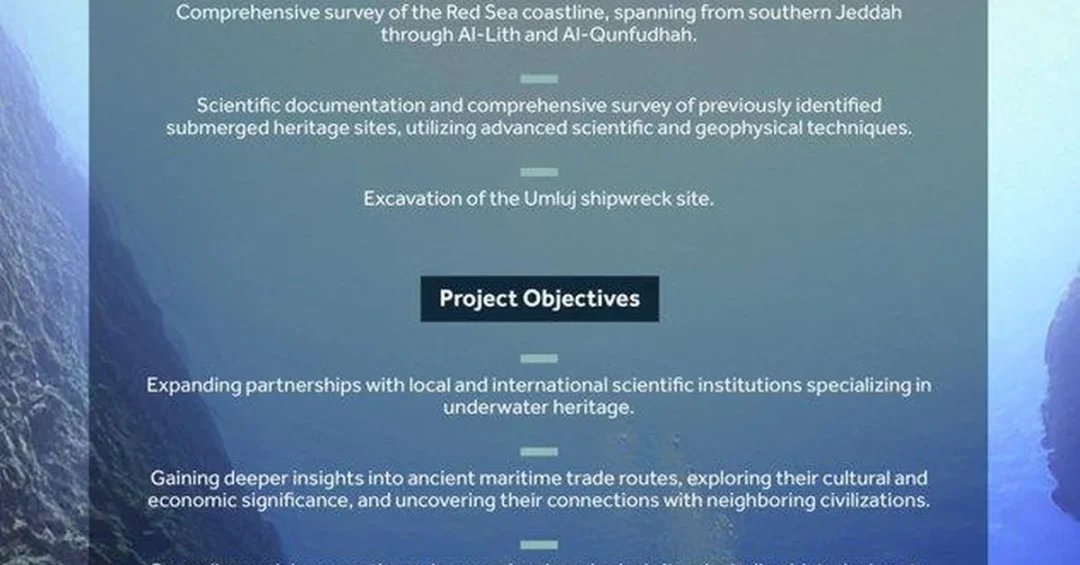
The Saudi Heritage Commission has officially launched the second phase of the Red Sea Underwater Cultural Heritage Survey, a project aimed at documenting and preserving submerged archaeological sites along the Kingdom’s Red Sea coast. The initiative, announced on January 27, 2025, via the Saudi Press Agency, involves a consortium of international and academic partners, including King Abdulaziz University, the University of Naples L’Orientale in Italy, the Alexandria Center for Maritime Archaeology and Underwater Cultural Heritage, the National Research Institute of Maritime Cultural Heritage in South Korea, and the University of Cape Town in South Africa.
Context and Background
This second phase builds upon earlier national efforts to safeguard Saudi Arabia’s diverse cultural heritage. By focusing on underwater sites spanning the governorates of Jeddah and Al-Qunfudhah, the project aims to develop a sustainable conservation approach that balances scientific inquiry with heritage protection. The Red Sea coast has served as a major historical maritime route, linking the Arabian Peninsula with Africa, Asia, and Europe for centuries. Understanding its submerged heritage is crucial for reconstructing ancient trade networks, migration patterns, and cultural exchanges. The survey also aligns with Saudi Arabia’s commitment to the UNESCO Underwater Cultural Heritage 2001 Convention, which the Kingdom has actively supported.
Key Details
The survey’s expected outcomes include comprehensive reports analyzing archaeological findings, a developed management plan for site protection, and detailed scientific documentation of submerged heritage elements. These outputs will be integrated into the national archaeological registry, enhancing the legal and practical protection of underwater cultural heritage along the Red Sea coast. The project also highlights the historical and cultural connections between Saudi Arabia and partner countries, reflecting the shared maritime history that links these nations. The Heritage Commission has emphasized that this initiative will expand research opportunities and foster international collaboration in underwater archaeology.
Implications and Impact
By systematically documenting submerged heritage, the survey provides accurate data that can inform heritage management policies and tourism development. The Red Sea is already a focal point for Saudi Arabia’s tourism ambitions under Vision 2030, and well-preserved archaeological sites could become unique attractions for cultural and eco-tourists. Additionally, the project strengthens Saudi Arabia’s standing in the global archaeological community, demonstrating its commitment to scientific excellence and cultural preservation. The involvement of institutions from Italy, South Korea, South Africa, and Egypt underscores the international trust in the Kingdom’s heritage stewardship.
Vision 2030 Alignment
The underwater heritage survey directly supports Vision 2030’s goal of achieving sustainable development in the field of national heritage. By establishing a dedicated center for underwater cultural heritage and conducting systematic surveys, Saudi Arabia is preserving its historical legacy for future generations while fostering a thriving cultural tourism sector. This initiative exemplifies how the Kingdom is leveraging its rich history to diversify its economy and enhance its global cultural footprint, contributing to a future where heritage and modernity coexist harmoniously.
20 Questions
Q1. What is the Red Sea Underwater Cultural Heritage Survey?
A1. It is a project led by the Saudi Heritage Commission to document and preserve submerged archaeological sites along the Red Sea coast, launched in partnership with national and international institutions.
Q2. Who are the main partners in the second phase of the survey?
A2. Partners include King Abdulaziz University, the University of Naples L’Orientale in Italy, the Alexandria Center for Maritime Archaeology, the National Research Institute of Maritime Cultural Heritage in South Korea, and the University of Cape Town.
Q3. Why is the Red Sea coast important for underwater heritage?
A3. The Red Sea has been a major historical maritime route connecting Arabia, Africa, Asia, and Europe, making its seabed a repository of shipwrecks, ports, and trade artifacts spanning thousands of years.
Q4. What is the geographic scope of the second phase?
A4. The survey focuses on underwater sites along the governorates of Jeddah and Al-Qunfudhah on Saudi Arabia’s Red Sea coast.
Q5. How does this project relate to UNESCO conventions?
A5. Saudi Arabia aligns its efforts with the UNESCO Underwater Cultural Heritage 2001 Convention, ensuring internationally recognized standards for preservation and research.
Q6. What are the expected outcomes of the survey?
A6. Outcomes include comprehensive reports on archaeological findings, a management plan for site protection, and scientific documentation of submerged heritage elements.
Q7. Will the survey results be publicly accessible?
A7. The findings will contribute to the national archaeological registry, which supports heritage management and can inform future tourism and educational initiatives.
Q8. What is the role of King Abdulaziz University in the project?
A8. The university provides academic expertise, research capacity, and local knowledge to support the survey’s scientific objectives and training opportunities.
Q9. How does this project support Vision 2030?
A9. It aligns with Vision 2030’s goal of sustainable heritage development by preserving cultural assets and promoting heritage tourism as part of economic diversification.
Q10. What types of sites are being surveyed?
A10. The survey focuses on underwater cultural heritage sites, which may include shipwrecks, submerged ports, ancient settlements, and other artifacts from historical maritime activity.
Q11. How does the project enhance international cooperation?
A11. By partnering with institutions from Italy, South Korea, South Africa, and Egypt, the project fosters global scientific collaboration and knowledge exchange in underwater archaeology.
Q12. What is the significance of Jeddah and Al-Qunfudhah for this survey?
A12. These areas have rich maritime histories as trade hubs, offering high potential for discovering well-preserved underwater heritage linked to ancient trade routes.
Q13. Has Saudi Arabia conducted similar surveys before?
A13. Yes, this second phase builds on earlier national initiatives dedicated to preserving the Kingdom’s cultural heritage, including underwater sites.
Q14. How will the survey protect underwater sites?
A14. The project will develop a management plan that includes legal protections, monitoring protocols, and conservation strategies to safeguard sites from looting or damage.
Q15. What is the Alexandria Center for Maritime Archaeology’s role?
A15. The center brings specialized expertise in Mediterranean and Red Sea maritime archaeology, contributing to survey methodology and analysis.
Q16. How does this project benefit tourism?
A16. Discoveries from the survey can be developed into cultural tourism attractions, offering visitors unique experiences while promoting awareness of Saudi Arabia’s maritime history.
Q17. What training opportunities does the project provide?
A17. The collaboration with universities offers training for Saudi students and archaeologists in underwater survey techniques, conservation, and heritage management.
Q18. How does the survey address climate change impacts?
A18. By documenting sites now, the project creates a baseline for monitoring how rising sea levels and environmental changes may affect submerged heritage in the future.
Q19. What is the timeline for the second phase?
A19. While the exact duration is not specified, the project is expected to proceed over several months to years, with multiple survey campaigns and analysis phases planned.
Q20. How can researchers access the project’s data?
A20. Data will be integrated into the national archaeological registry, with potential publication in scientific journals and reports accessible through the Heritage Commission and partner institutions.
Reader Feedback
We value your thoughts. Please share your feedback on this article.
Your feedback helps us improve our coverage.