


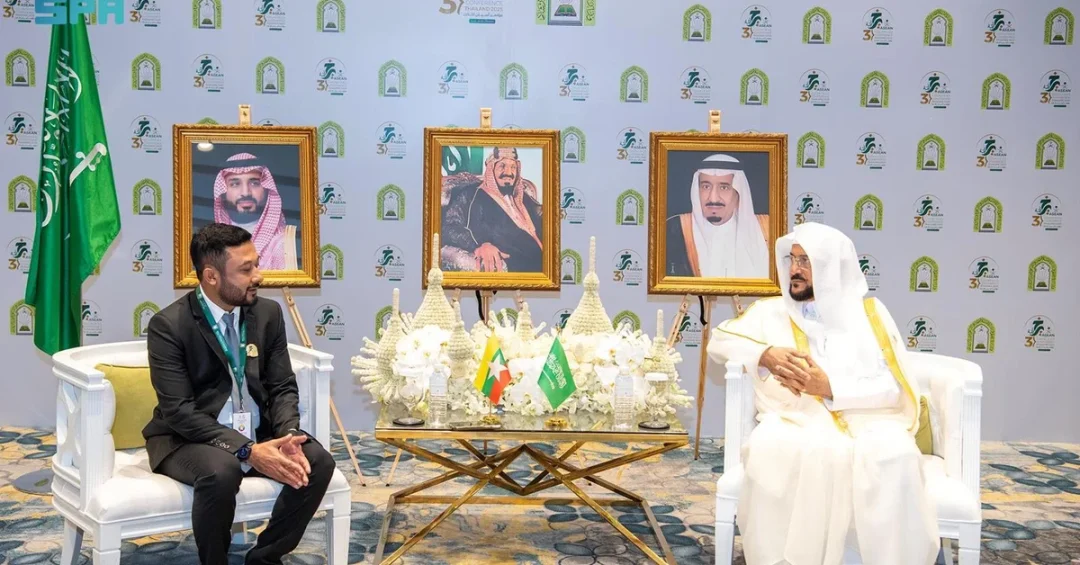
Minister of Islamic Affairs, Dawah, and Guidance Sheikh Dr. Abdullatif Al Alsheikh met with delegations from Singapore, Laos, and Myanmar on the sidelines of the 3rd Association of Southeast Asian Nations (ASEAN) International Conference “Khair Ummah” in Bangkok. The meetings, held on January 27, 2025, were part of Saudi Arabia’s ongoing efforts to promote moderate Islam and foster interfaith dialogue across Southeast Asia. The conference, organized by the Ministry of Islamic Affairs, Dawah, and Guidance, provided a platform for high-level discussions on shared religious and social priorities.
Context and Background
The “Khair Ummah” conference, now in its third edition, brings together Islamic scholars, leaders, and government officials from ASEAN member states to address pressing issues in Islamic affairs. Saudi Arabia’s active participation underscores its commitment to strengthening ties with Southeast Asian nations, a region of strategic importance for the Kingdom’s Vision 2030 goals of cultural and religious outreach. The conference serves as a forum for exchanging ideas on promoting moderation and countering extremism, aligning with Saudi Arabia’s role as a global leader in Islamic affairs.
Key Details
Sheikh Dr. Abdullatif Al Alsheikh engaged with three key delegations: Singapore, led by Minister for Social and Family Development Masagos Zulkifli; Laos, headed by Islamic Organization president Somboune Khan; and Myanmar, represented by Bareq Institute for Arabic Language director and Muslim World League Supreme Council member Dr. Asad bin Ismail. During the meetings, delegation leaders commended Saudi Arabia’s significant efforts in promoting moderate Islam, countering extremism, and combating hatred. They highlighted that hosting the conference reflects Saudi Arabia’s dedication to empowering Islamic leadership in spreading awareness about correct beliefs and resisting extremist ideologies. The discussions also covered mutual interests, particularly in Islamic affairs, education, and community development.
Implications and Impact
These meetings reinforce Saudi Arabia’s diplomatic engagement with Southeast Asia, fostering collaboration on religious moderation and social harmony. For Singapore, Laos, and Myanmar, the partnership with Saudi Arabia offers access to the Kingdom’s expertise in countering extremism and promoting interfaith understanding. The conference and bilateral talks are expected to lead to further cooperation in Islamic education, youth programs, and humanitarian initiatives, strengthening regional stability and cultural exchange.
Vision 2030 Alignment
Saudi Arabia’s engagement at the ASEAN conference directly supports Vision 2030’s goal of enhancing the Kingdom’s global role in promoting peace and moderation. By hosting and participating in such international dialogues, Saudi Arabia reinforces its position as a leader in Islamic affairs, fostering partnerships that advance mutual understanding and development. These efforts contribute to the broader vision of a tolerant, globally connected Saudi Arabia, aligned with the Kingdom’s long-term strategic priorities.
20 Questions
Q1. Who did the Minister of Islamic Affairs meet in Bangkok?
A1. Minister Sheikh Dr. Abdullatif Al Alsheikh met delegations from Singapore, Laos, and Myanmar during the 3rd ASEAN International Conference “Khair Ummah” in Bangkok.
Q2. What conference was the context for these meetings?
A2. The meetings were held on the sidelines of the 3rd ASEAN International Conference “Khair Ummah,” organized by the Saudi Ministry of Islamic Affairs.
Q3. Who led the Singaporean delegation?
A3. The Singaporean delegation was led by Minister for Social and Family Development Masagos Zulkifli.
Q4. Who represented Laos in the meetings?
A4. The Laotian delegation was headed by Islamic Organization president Somboune Khan.
Q5. Who represented Myanmar?
A5. Myanmar was represented by Dr. Asad bin Ismail, director of the Bareq Institute for Arabic Language and Supreme Council member of the Muslim World League.
Q6. What did the delegation leaders commend about Saudi Arabia?
A6. They commended Saudi Arabia’s significant efforts in promoting moderate Islam, countering extremism, and combating hatred.
Q7. How did the delegations view the conference?
A7. They highlighted that hosting the conference reflects Saudi Arabia’s commitment to empowering Islamic leadership in spreading awareness about correct beliefs and resisting extremist ideologies.
Q8. What topics were addressed in the meetings?
A8. The meetings addressed several topics of mutual interest, particularly concerning Islamic affairs, education, and community development.
Q9. What is the “Khair Ummah” conference?
A9. It is an ASEAN international conference focused on Islamic affairs, promoting moderate Islam, and fostering cooperation among member states.
Q10. Why is Saudi Arabia participating in this conference?
A10. Saudi Arabia participates to strengthen ties with Southeast Asian nations and promote its role as a global leader in Islamic affairs under Vision 2030.
Q11. Which Saudi ministry organized the conference?
A11. The conference was organized by the Ministry of Islamic Affairs, Dawah, and Guidance.
Q12. What is the significance of Saudi Arabia’s role in the conference?
A12. It demonstrates Saudi Arabia’s commitment to promoting moderation, countering extremism, and engaging with ASEAN nations on shared religious goals.
Q13. How does this meeting align with Vision 2030?
A13. It supports Vision 2030’s goal of enhancing Saudi Arabia’s global role in promoting peace, tolerance, and cultural exchange.
Q14. What did the Singaporean minister discuss?
A14. Minister Masagos Zulkifli discussed mutual cooperation in Islamic affairs and commended Saudi Arabia’s leadership in promoting moderate Islam.
Q15. What role does the Muslim World League play in these meetings?
A15. The Muslim World League, through members like Dr. Asad bin Ismail, supports Saudi Arabia’s efforts in promoting interfaith dialogue and countering extremism.
Q16. How might these meetings impact Southeast Asia?
A16. They could lead to enhanced cooperation in Islamic education, humanitarian initiatives, and regional stability through shared moderate values.
Q17. Are there plans for further collaboration?
A17. The discussions laid groundwork for future partnerships in Islamic affairs, youth programs, and educational exchanges between Saudi Arabia and ASEAN nations.
Q18. What was the date of these meetings?
A18. The meetings took place on January 27, 2025, in Bangkok.
Q19. How does this reflect Saudi Arabia’s global engagement?
A19. It highlights Saudi Arabia’s proactive diplomacy in fostering religious moderation and building bridges with diverse Muslim communities worldwide.
Q20. What is the main takeaway from the meetings?
A20. The meetings reaffirm Saudi Arabia’s leadership in Islamic affairs and its commitment to promoting peace and tolerance through international dialogue.
Reader Feedback
We value your thoughts. Please share your feedback on this article.
Your feedback helps us improve our coverage.