


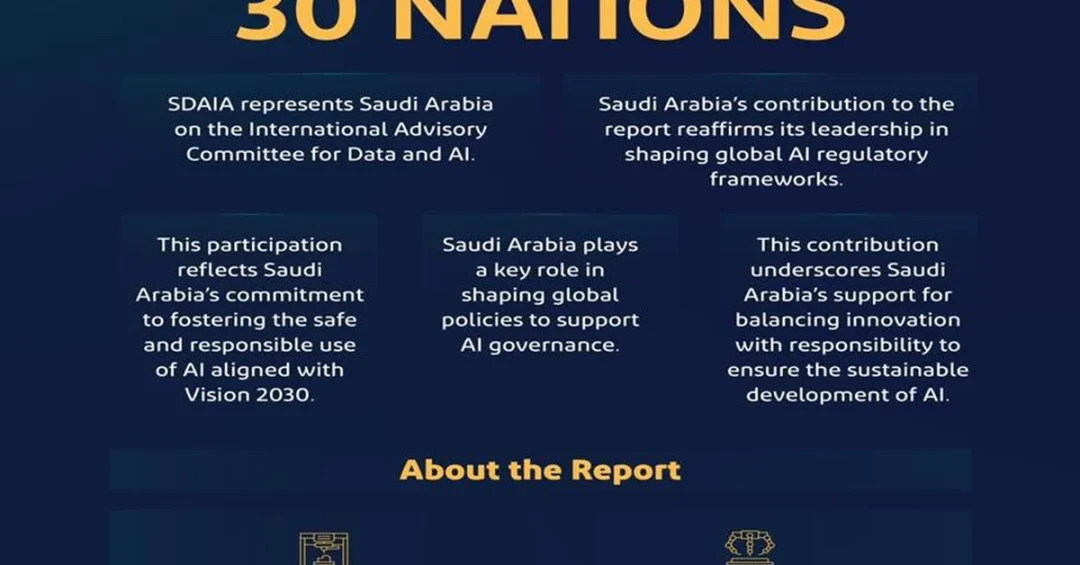
Saudi Arabia, represented by the Saudi Data and AI Authority (SDAIA), has played a pivotal role in developing the world’s first international AI safety report, released on February 10, 2025. The report was created in collaboration with 30 countries, the United Nations, the European Union, and the Organisation for Economic Co-operation and Development (OECD). Saudi Arabia’s contributions included providing recommendations on digital governance policies and balancing innovation with responsibility, ensuring the report’s accuracy and relevance in addressing current and future AI challenges.
Context and Background
The international AI safety report assesses the risks and challenges posed by global AI development, aiming to establish regulatory policies for safe and responsible advancement. Saudi Arabia’s involvement reflects its commitment to AI safety and governance, aligning with the goals of Saudi Vision 2030 to diversify the economy and foster technological innovation. The Kingdom’s leadership in digital governance is further emphasized through its collaboration with international organizations to shape regulatory frameworks.
Key Details
Key issues addressed in the report include job displacement from automation, environmental impacts due to high energy consumption, cybersecurity threats, potential data breaches, and the spread of deepfakes affecting information integrity and societies. The report underscores the importance of proactive measures to tackle these challenges and ensure ethical AI development in line with global standards. Saudi Arabia, through SDAIA, provided expertise on finding a balance between encouraging innovation and implementing responsible oversight.
Implications and International Impact
This report marks a significant step toward global consensus on AI safety. Saudi Arabia’s participation enhances its reputation as a responsible actor in the international AI landscape, fostering trust and cooperation. The guidelines and recommendations from the report are expected to influence national policies worldwide, promoting safe and ethical AI use. Saudi Arabia’s role also strengthens its position as a hub for digital governance in the Middle East.
Vision 2030 Alignment
Saudi Arabia’s contribution to the first international AI safety report directly supports Vision 2030’s objectives of building a knowledge-based economy and positioning the Kingdom as a global leader in technology and innovation. This initiative aligns with the National Strategy for Data and AI (NSDAI), which aims to harness AI for economic growth and societal well-being. The Kingdom’s proactive stance on AI governance demonstrates its commitment to responsible innovation and sustainable development.
20 Questions
Q1. What is the world’s first international AI safety report?
A1. It is a collaborative report involving 30 countries, the UN, the EU, and the OECD, assessing AI risks and proposing regulatory policies for safe and responsible AI development.
Q2. Which Saudi entity contributed to the report?
A2. The Saudi Data and AI Authority (SDAIA) represented Saudi Arabia in developing the report, providing recommendations on digital governance policies.
Q3. When was the report released?
A3. The report was released on February 10, 2025, according to the Saudi Press Agency.
Q4. Why is Saudi Arabia’s involvement significant?
A4. It demonstrates Saudi Arabia’s commitment to AI safety and global governance, aligning with Vision 2030 and enhancing its role as a responsible technology leader.
Q5. How many countries collaborated on the report?
A5. The report was developed in collaboration with 30 countries, along with the UN, EU, and OECD.
Q6. What is the main purpose of the report?
A6. The report assesses global AI risks and challenges, aiming to create regulatory policies for the safe and responsible advancement of AI.
Q7. What key issues does the report address?
A7. It addresses job displacement from automation, environmental impacts, cybersecurity threats, data breaches, and the spread of deepfakes.
Q8. How does the report relate to Vision 2030?
A8. The report supports Vision 2030’s goals of building a knowledge-based economy and positioning Saudi Arabia as a leader in technology and innovation.
Q9. What role did SDAIA play in the report?
A9. SDAIA provided recommendations on digital governance and balancing innovation with responsibility, ensuring the report’s accuracy and relevance.
Q10. What is the National Strategy for Data and AI (NSDAI)?
A10. NSDAI is Saudi Arabia’s strategy to harness AI for economic growth and societal well-being, complementing Vision 2030 objectives.
Q11. How does the report promote global AI safety?
A11. It establishes guidelines and regulatory policies that can be adopted internationally to ensure ethical and safe AI use.
Q12. Why is balancing innovation and responsibility important?
A12. It ensures AI development progresses without compromising safety, ethics, or societal well-being, fostering sustainable growth.
Q13. What environmental concerns are highlighted in the report?
A13. The report notes the high energy consumption of AI systems and the need for sustainable practices to mitigate environmental impacts.
Q14. How does the report address job displacement?
A14. It emphasizes proactive measures to manage workforce transitions and the need for policies that support reskilling and adaptation.
Q15. What cybersecurity threats are discussed?
A15. The report covers potential breaches, malicious use of AI, and vulnerabilities that could compromise digital infrastructure.
Q16. How are deepfakes addressed in the report?
A16. The report highlights the risk of deepfakes to information integrity and society, urging detection and prevention measures.
Q17. What is the global significance of the report?
A17. It represents a collective effort to create a unified framework for AI safety, influencing national policies and international cooperation.
Q18. How does this report enhance Saudi Arabia’s international standing?
A18. It showcases Saudi Arabia as a responsible and proactive contributor to global AI governance, strengthening diplomatic and economic ties.
Q19. What future steps are expected after the report?
A19. Countries may adopt the recommendations into national laws, and further collaborative research is likely to refine AI safety standards.
Q20. How can the public access the report?
A20. The report is published through participating organizations such as the OECD and UN, with summaries available on official websites.
Reader Feedback
We value your thoughts. Please share your feedback on this article.
Your feedback helps us improve our coverage.