


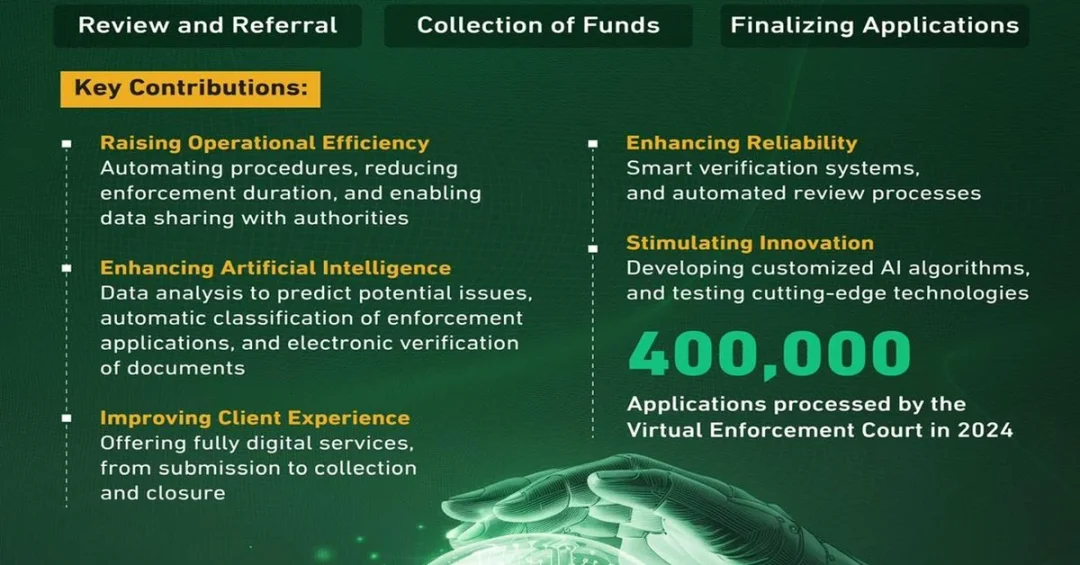
The Ministry of Justice has launched the Virtual Enforcement Court, a digital platform that automates enforcement processes using artificial intelligence and eliminates the need for human intervention. Announced by the Saudi Press Agency on February 10, 2025, the court represents a significant step in modernizing the Kingdom’s judicial system and aligns with Vision 2030’s digital transformation goals.
Context and Background
The Virtual Enforcement Court is part of Saudi Arabia’s broader initiative to digitize government services under the National Transformation Program. By leveraging advanced technologies, the court aims to increase operational efficiency, reduce enforcement periods, and enhance the accuracy of judicial procedures. This innovation builds on the Ministry of Justice’s ongoing efforts to integrate electronic systems across the legal framework.
Key Details
The court facilitates the automation of enforcement processes, including automatic classification of requests and electronic verification of bonds. It provides real-time tracking of applications from submission to completion, with notifications and alerts for beneficiaries. In 2024, the court processed approximately 400,000 enforcement applications. The platform is accessible via the unified national portal Najiz.sa, which offers a dashboard for direct access to the latest enforcement requests.
Implications and Impact
The streamlined process enhances transparency and reduces delays for both individuals and entities. Beneficiaries can now monitor the status of their enforcement requests and access comprehensive reports. The integration with other electronic authorities ensures seamless data sharing, improving the overall user experience. This advancement is expected to increase trust in the judicial system and encourage more efficient resolution of disputes.
Vision 2030 Alignment
The Virtual Enforcement Court directly supports Vision 2030 by promoting digital innovation and improving the ease of doing business in Saudi Arabia. It reflects the Kingdom’s commitment to building a smart, efficient government that leverages AI for better service delivery. This initiative contributes to the goal of creating a vibrant society and a thriving economy through modern, transparent institutions.
20 Questions
Q1. What is the Virtual Enforcement Court?
A1. The Virtual Enforcement Court is a digital platform launched by the Ministry of Justice that automates enforcement processes using artificial intelligence without human intervention.
Q2. How does the court benefit beneficiaries?
A2. It offers fully digital services from application submission to completion, real-time status tracking, notifications, and access to comprehensive reports, saving time and increasing transparency.
Q3. What role does AI play in the court?
A3. AI is used for automatic classification of enforcement requests, electronic verification of bonds, intelligent verification, automated review, and data analysis to foresee potential problems.
Q4. How many applications did the court process in 2024?
A4. In 2024, the Virtual Enforcement Court initiated approximately 400,000 enforcement applications.
Q5. What is Najiz.sa?
A5. Najiz.sa is the unified national portal that provides access to the Virtual Enforcement Court’s implementation dashboard, where beneficiaries can view the latest enforcement requests.
Q6. How does the court improve operational efficiency?
A6. By automating procedures, reducing enforcement periods, integrating electronically with authorities, and using AI to streamline workflows from application to collection.
Q7. Who launched the Virtual Enforcement Court?
A7. The Ministry of Justice of the Kingdom of Saudi Arabia launched the court.
Q8. When was the Virtual Enforcement Court announced?
A8. The court was announced on February 10, 2025, via the Saudi Press Agency.
Q9. Is human oversight still present in the court’s processes?
A9. All processes are automated, but they operate under judicial supervision to ensure compliance with legal standards.
Q10. How does the court enhance transparency?
A10. It provides accurate tracking of application timelines and allows beneficiaries to follow all procedures, ensuring greater transparency in enforcement operations.
Q11. What types of entities can use the court?
A11. Both individuals and entities with multiple requests can access the court’s services, including comprehensive reports on transfers and procedures.
Q12. How does the court support electronic verification of bonds?
A12. Bonds are verified electronically using AI, eliminating manual checks and improving reliability.
Q13. What strategic initiative does the court support?
A13. The court supports Vision 2030 by advancing digital transformation and AI innovation in the judicial sector.
Q14. Does the court integrate with other government authorities?
A14. Yes, it integrates electronically with other authorities to ensure seamless data exchange and process coordination.
Q15. What problem does the court solve?
A15. It reduces enforcement periods, minimizes human error, and provides a fully digital experience for beneficiaries.
Q16. How does the court handle classification of requests?
A16. Enforcement requests are automatically classified using AI, which speeds up processing and ensures accurate routing.
Q17. Can beneficiaries receive alerts from the court?
A17. Yes, beneficiaries receive notifications and alerts regarding requirements and procedures throughout the enforcement process.
Q18. What is the goal of automating enforcement processes?
A18. The goal is to increase efficiency, reduce delays, and improve user satisfaction by providing a streamlined digital service.
Q19. How does the court contribute to Saudi Arabia’s digital transformation?
A19. It exemplifies the use of AI and automation in public services, aligning with the National Transformation Program and Vision 2030.
Q20. What future developments can be expected from the court?
A20. Continued integration of advanced AI and data analytics to further enhance predictive capabilities and improve enforcement outcomes.
Reader Feedback
We value your thoughts. Please share your feedback on this article.
Your feedback helps us improve our coverage.