


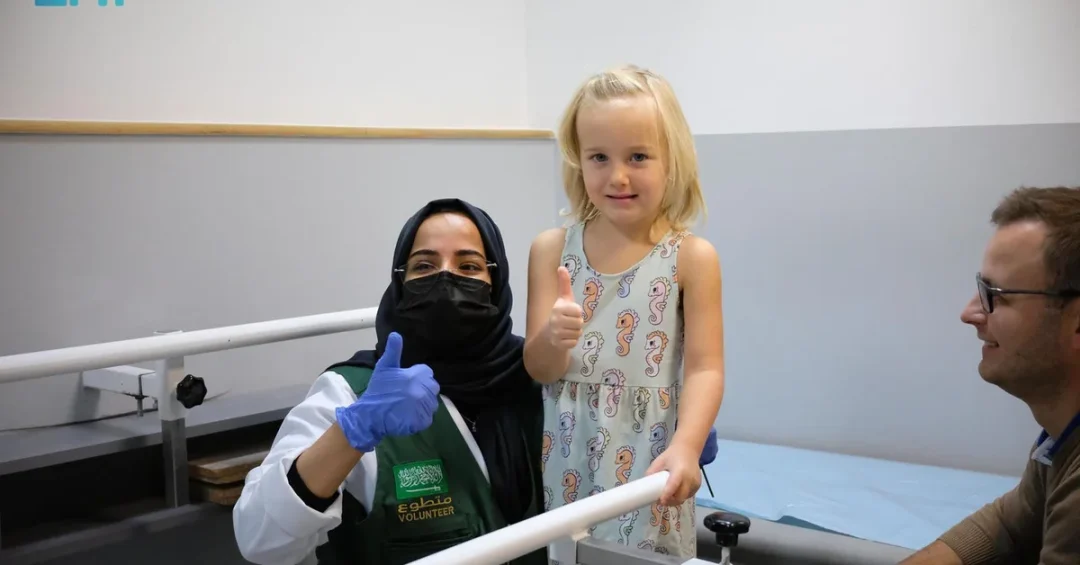
An eight-year-old Ukrainian girl, Matilda, who lost both legs below the knees due to war, has received prosthetic limbs and rehabilitation at a center in Poland run by the King Salman Humanitarian Aid and Relief Center (KSrelief), restoring her ability to walk and offering a new lease on life. The center, part of Saudi Arabia’s humanitarian outreach, provided comprehensive care including medical assessment, rehabilitation, psychological support, and custom prosthetics, transforming Matilda from a wheelchair-bound child into a confident young girl walking independently.
Context and Background
Matilda’s life changed irrevocably when the war in Ukraine resulted in the amputation of both her legs below the knees. Her parents faced overwhelming despair and financial burdens, unsure how to secure care for their daughter. Amid this crisis, KSrelief, the humanitarian arm of the Kingdom of Saudi Arabia, launched a prosthetic limbs program targeting war victims in Ukraine residing in Poland. The program, coordinated with the Polish Ministry of Health, identified Matilda as eligible for free, high-quality services.
Key Details
Upon arrival at the center in Poland, Matilda underwent a thorough medical assessment that created a personalized treatment plan considering her physical and psychological needs. A dedicated Saudi-led multidisciplinary team, including orthopedic doctors, prosthetic specialists, and physiotherapists, guided her through a rigorous pre-fitting rehabilitation program focused on muscle strengthening and balance. After weeks of preparation, custom prosthetics were fitted, and Matilda stood for the first time with assistance. She then learned to walk, run, and play, backed by psychological counseling to build confidence and acceptance of her new body.
Implications and Impact
Matilda’s story exemplifies KSrelief’s broader impact since 2020, with over 109,000 beneficiaries receiving 298,999 services, including 10,851 prosthetic limbs and 98,612 rehabilitation sessions. The program prioritizes war amputees, children with motor disabilities, and others in need across Yemen, Syria, Turkiye, and Poland. By empowering individuals to reintegrate into society, the initiative enhances economic, social, and psychological well-being, demonstrating Saudi Arabia’s commitment to alleviating human suffering globally.
Vision 2030 Alignment
This humanitarian effort aligns with Saudi Vision 2030’s goals of strengthening the Kingdom’s global role in humanitarian aid and sustainable development. By building local health capacity and localizing prosthetic services, KSrelief ensures long-term impact. Matilda’s transformation from despair to independence illustrates how Saudi-led programs embody the Kingdom’s message of support for people in need, contributing to a more stable and inclusive world.
20 Questions
Q1. Who is Matilda?
A1. Matilda is an eight-year-old Ukrainian girl who lost both legs below the knees during the war in Ukraine. She received prosthetic limbs and rehabilitation at a KSrelief center in Poland.
Q2. What is KSrelief?
A2. KSrelief is the King Salman Humanitarian Aid and Relief Center, the humanitarian arm of the Kingdom of Saudi Arabia, established to provide aid and relief to people in need worldwide.
Q3. Where is the prosthetic limbs center located?
A3. The prosthetic limbs and rehabilitation center is located in Poland, serving war-affected Ukrainians under a program funded by KSrelief in coordination with the Polish Ministry of Health.
Q4. How did Matilda lose her legs?
A4. Matilda lost both her legs below the knees due to injuries sustained during the war in Ukraine. The amputation was a direct result of the conflict.
Q5. What services did Matilda receive at the center?
A5. Matilda received a comprehensive medical assessment, pre-fitting rehabilitation, custom-fitted prosthetic limbs, physiotherapy, and psychological support to help her adapt to her new body.
Q6. How long did Matilda’s treatment take?
A6. The treatment involved several weeks of evaluation and rehabilitation before fitting the prosthetics, followed by regular follow-up sessions to ensure smooth adaptation and independence.
Q7. Who is on the medical team at the center?
A7. The team includes Saudi orthopedic doctors, rehabilitation specialists, prosthetic limb technicians, physiotherapists, and volunteers who provide logistics and support services.
Q8. Is the prosthetic limb program free for beneficiaries?
A8. Yes, the program offers free, high-quality prosthetic limbs and rehabilitation services to eligible beneficiaries, including amputees from war and disaster-affected countries.
Q9. How does KSrelief select beneficiaries for the program?
A9. Beneficiaries are selected based on lists of amputation patients provided by the Ministry of Health in implementing countries, prioritizing war injuries, children with motor disabilities, and other categories.
Q10. How many people has the program helped since 2020?
A10. Since 2020 through 2024, the program has served over 109,000 beneficiaries, delivering 298,999 services, including 10,851 prosthetic limbs and 98,612 rehabilitation sessions.
Q11. What percentage of cases are due to war injuries?
A11. According to program statistics, 76% of cases result from war injuries, including mines and unexploded ordnance, while 24% stem from pathological injuries.
Q12. Does the program support only Ukrainians?
A12. No, the program supports amputees in multiple countries, including Yemen, Syria, Turkiye (earthquake victims), and Ukraine (in Poland), under KSrelief’s broader humanitarian mission.
Q13. What is the gender distribution of beneficiaries?
A13. Female beneficiaries constitute 33% of program recipients, while males comprise 67%, reflecting the diverse impact of conflict and disasters on populations.
Q14. How does the program empower individuals?
A14. By providing prosthetic limbs and rehabilitation, the program enables individuals to walk, move independently, and reintegrate into society, improving their economic, social, and psychological well-being.
Q15. What role did the Polish Ministry of Health play?
A15. The Polish Ministry of Health provided lists of eligible amputees, including Matilda, ensuring that those in need could access the free services offered by KSrelief’s center.
Q16. How did Matilda’s parents learn about the program?
A16. Matilda’s parents learned about KSrelief’s prosthetic limb program through official channels and were informed that their daughter was included on the eligible list from the Polish Ministry of Health.
Q17. Did Matilda receive psychological support?
A17. Yes, the specialized team provided crucial psychological support to help Matilda accept her new body, build self-confidence, and cope with the emotional impact of amputation.
Q18. What is the long-term goal of the program?
A18. The program aims to localize and improve prosthetic limb services and rehabilitation, build local health capacities, and ensure sustainability of care for amputees in partner countries.
Q19. How does this align with Saudi Vision 2030?
A19. The program enhances Saudi Arabia’s global role in humanitarian aid, reflecting Vision 2030’s goals of international cooperation, sustainable development, and alleviating human suffering.
Q20. What is Matilda’s condition now?
A20. Matilda is now walking independently with her prosthetic limbs, no longer in a wheelchair. She has regained confidence and independence, looking forward to a brighter future.
Reader Feedback
We value your thoughts. Please share your feedback on this article.
Your feedback helps us improve our coverage.