


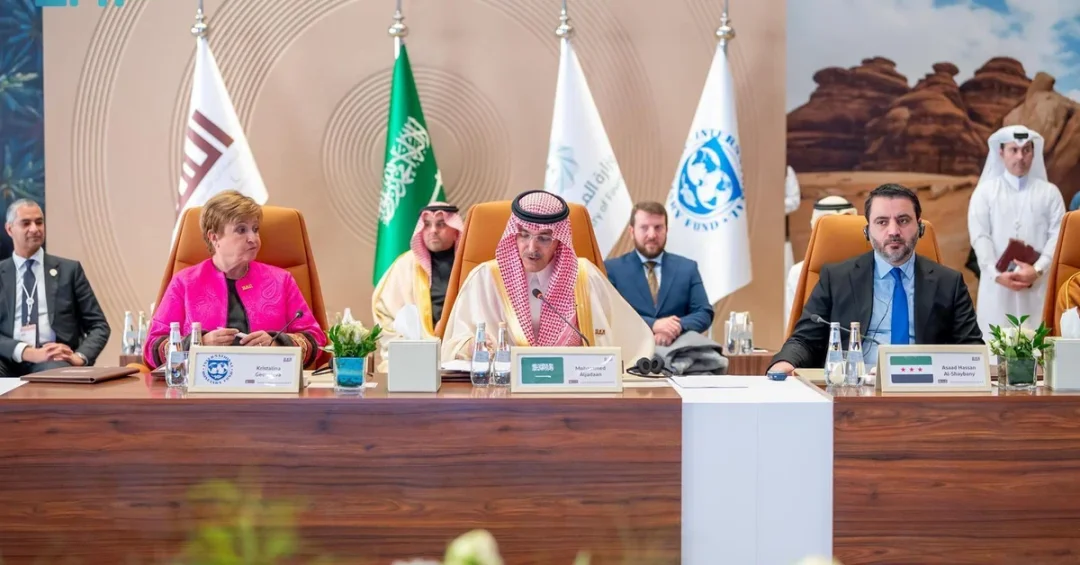
Saudi Arabia’s Minister of Finance Mohammed Al-Jadaan and International Monetary Fund Managing Director Kristalina Georgieva issued a joint statement on February 16, 2025, announcing a coordinated international effort to support economic recovery in conflict-affected countries in the Middle East, with an initial focus on Syria. The statement followed a high-level roundtable co-hosted by the Saudi Ministry of Finance and the IMF on the sidelines of the inaugural AlUla Conference for Emerging Market Economies, held in AlUla, Saudi Arabia. The meeting brought together finance ministers from regional countries, Syria’s foreign minister, World Bank operations managing director, heads of international financial institutions, and the Arab Coordination Group.
Context and Background
The roundtable, titled “Working Together to Support Recovery in the Middle East’s Conflict-Affected Economies,” underscores Saudi Arabia’s proactive role in fostering regional stability and economic resilience. The kingdom has long been a key humanitarian and development partner in the Middle East, aligning with its Vision 2030 goals of promoting global cooperation and sustainable development. The meeting focused on Syria, where over a decade of conflict has devastated infrastructure and displaced millions, but also addressed broader regional challenges.
Key Details
According to the joint statement, participants agreed on three core priorities: continuous diagnostic assessments of each country’s economic and social context, including humanitarian and reconstruction needs; enhanced capacity development initiatives by the IMF and World Bank to strengthen fiscal, monetary, and banking institutions; and mobilization of financial assistance from the international community, coordinated with regional development partners. The IMF, World Bank, Arab Coordination Group, and regional countries affirmed their readiness to collaborate according to their institutional mandates. An informal coordination group was established to advance these efforts, with further discussions scheduled at the upcoming IMF/World Bank Spring Meetings in Washington, D.C. from April 25-27, 2025.
Implications
This initiative signals a renewed multilateral commitment to rebuilding conflict-affected economies, with Saudi Arabia at the forefront of diplomatic and financial coordination. By hosting the AlUla Conference and co-chairing the roundtable, Riyadh reinforces its role as a bridge between global financial institutions and regional stakeholders. The focus on Syria carries significant geopolitical weight, potentially paving the way for reconstruction funding and institution-building that could stabilize the region. The emphasis on a continuous diagnostic framework ensures that assistance is tailored to each country’s needs, avoiding one-size-fits-all solutions.
Vision 2030 Alignment
The roundtable directly supports Saudi Arabia’s Vision 2030 goals of economic diversification, international partnership, and regional leadership. By facilitating dialogue between the IMF, World Bank, and regional actors, Saudi Arabia positions itself as a hub for economic diplomacy and a catalyst for sustainable recovery. The commitment to rebuilding institutions and fostering transparent, efficient financial management mirrors the kingdom’s own reform agenda under Vision 2030. As the informal coordination group moves forward, Saudi Arabia’s continued engagement will likely accelerate progress toward a more resilient and prosperous Middle East.
20 Questions
Q1. What was the main outcome of the roundtable?
A1. The roundtable resulted in a joint statement by Saudi Finance Minister Mohammed Al-Jadaan and IMF Managing Director Kristalina Georgieva outlining priorities to support recovery in conflict-affected Middle Eastern economies, with a focus on Syria.
Q2. Who hosted the roundtable?
A2. The roundtable was co-hosted by the Saudi Ministry of Finance and the International Monetary Fund on the sidelines of the AlUla Conference for Emerging Market Economies in Saudi Arabia.
Q3. Which countries were represented at the meeting?
A3. The meeting included finance ministers from regional countries, Syria’s foreign minister, and representatives from the IMF, World Bank, and the Arab Coordination Group.
Q4. What are the three priority areas agreed upon?
A4. The priorities are continuous diagnostic assessments, enhanced capacity development for institutions, and mobilization of financial assistance from the international community.
Q5. How does this initiative relate to Syria?
A5. The roundtable specifically focused on Syria’s recovery, addressing its humanitarian and reconstruction needs after years of conflict.
Q6. What role did Saudi Arabia play in this event?
A6. Saudi Arabia co-hosted the roundtable and provided a platform through the AlUla Conference, demonstrating its leadership in regional economic diplomacy.
Q7. What is the AlUla Conference for Emerging Market Economies?
A7. It is the inaugural annual conference held in AlUla, Saudi Arabia, focusing on economic issues facing emerging markets, and it hosted this high-level roundtable.
Q8. When will the next discussion take place?
A8. The next discussion is scheduled for the IMF/World Bank Spring Meetings in Washington, D.C. from April 25-27, 2025.
Q9. What is the purpose of the continuous diagnostic assessments?
A9. The assessments aim to identify each conflict-affected country’s challenges, humanitarian needs, reconstruction requirements, and institution-building priorities.
Q10. How will capacity development be enhanced?
A10. The IMF and World Bank will scale up initiatives to strengthen fiscal, monetary, and banking institutions in conflict-affected countries.
Q11. What is the Arab Coordination Group?
A11. It is a group of regional development institutions that coordinate financial assistance and support for economic development in Arab countries.
Q12. Why is the focus on Syria important?
A12. Syria’s recovery is crucial for regional stability, and coordinated international support can help rebuild its economy and institutions.
Q13. Will other conflict-affected countries benefit?
A13. Yes, the initiative aims to support all conflict-affected economies in the Middle East, with Syria as the initial focus.
Q14. What is the significance of the informal coordination group?
A14. The group will ensure continued collaboration among international and regional partners to streamline recovery efforts.
Q15. How does this align with Vision 2030?
A15. It supports Vision 2030’s goals of international cooperation, economic diversification, and regional leadership by positioning Saudi Arabia as a hub for economic diplomacy.
Q16. What was the tone of the meeting?
A16. Participants emphasized urgency, commitment, and a shared understanding of the need for coordinated action to address humanitarian and economic challenges.
Q17. Did the statement mention any specific funding amounts?
A17. No, the statement focused on priorities and mechanisms for mobilizing financial assistance rather than specifying amounts.
Q18. How will the World Bank contribute?
A18. The World Bank will provide capacity development and coordinate with other partners to support institution-building and reconstruction.
Q19. What is the role of the IMF in this initiative?
A19. The IMF will lead capacity development efforts and work with countries to design reform programs and assess economic needs.
Q20. How can the international community support this effort?
A20. The international community can provide financial assistance, technical expertise, and political support through coordinated partnerships as outlined in the statement.
Reader Feedback
We value your thoughts. Please share your feedback on this article.
Your feedback helps us improve our coverage.