


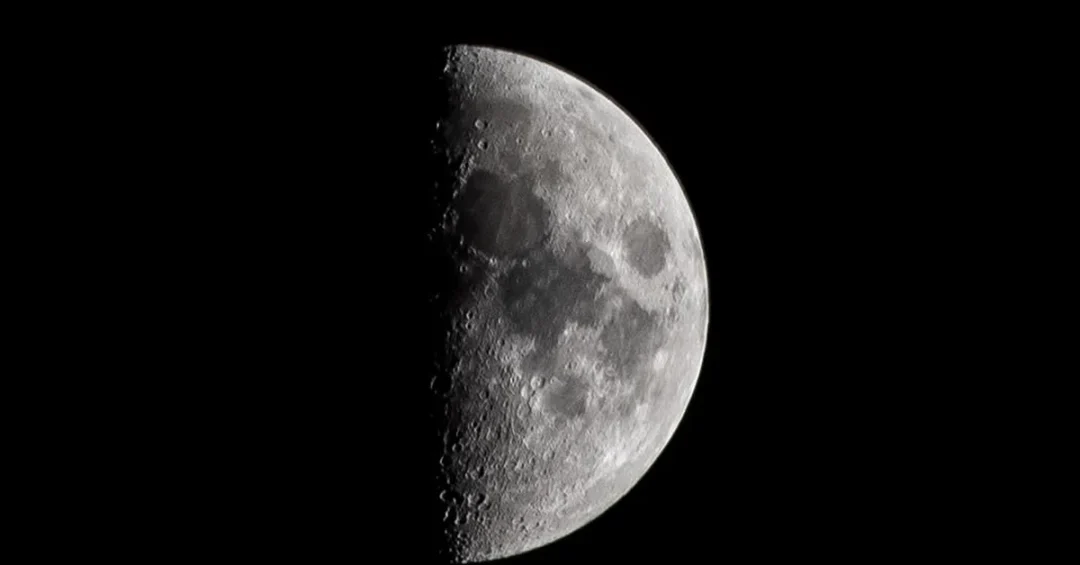
The first-quarter moon of the Hijri month of Safar 1448 illuminated the skies over Saudi Arabia’s Northern Borders Region on Tuesday evening, offering a celestial spectacle visible to the naked eye. This event marked one week since the start of the lunar month and highlighted one of the most prominent phases of the Moon’s monthly cycle, showcasing half of the lunar disk illuminated.
Context and Background
The first-quarter moon phase is a significant astronomical event that occurs when the Moon forms an angle of approximately 90 degrees with the Earth and the Sun. This positioning results in around 50% of the Moon’s Earth-facing side being illuminated. According to Zahi Al-Khulaiwi, Chairman of the Space and Astronomy Association, this phase provides an excellent opportunity to observe lunar surface features such as craters, mountains, and plains with remarkable clarity.
Key Details
The event was observed on Tuesday evening in the Northern Borders Region, a part of Saudi Arabia known for its clear skies and minimal light pollution, making it an ideal location for stargazing and astronomical observations. The first-quarter moon phase is one of the four primary phases of the Moon, alongside the new moon, full moon, and last-quarter moon.
Implications and Impact
This celestial event not only captivated astronomy enthusiasts but also underscored Saudi Arabia’s growing interest in space and astronomy as part of its broader Vision 2030 goals. The Kingdom has been actively investing in space exploration and scientific research, aiming to position itself as a regional leader in these fields. Events like the first-quarter moon observation highlight the natural advantages Saudi Arabia offers for astronomical studies.
Vision 2030 Alignment
The observation of the first-quarter moon aligns with Saudi Arabia’s Vision 2030 objectives, which emphasize the development of science, technology, and innovation. By fostering a deeper understanding of astronomy and promoting scientific curiosity, the Kingdom is paving the way for future advancements in space exploration and contributing to global scientific knowledge.
20 Questions
Q1. What is the first-quarter moon phase?
A1. The first-quarter moon phase occurs when the Moon forms a 90-degree angle with the Earth and the Sun, illuminating 50% of its Earth-facing side.
Q2. When did the first-quarter moon of Safar 1448 occur?
A2. The first-quarter moon of Safar 1448 was observed on Tuesday evening, July 21, 2026.
Q3. Where was the first-quarter moon visible?
A3. The first-quarter moon was visible in the Northern Borders Region of Saudi Arabia.
Q4. Why is the first-quarter moon significant?
A4. The first-quarter moon is significant because it provides an excellent opportunity to observe lunar surface features such as craters and mountains.
Q5. Who commented on the first-quarter moon event?
A5. Zahi Al-Khulaiwi, Chairman of the Space and Astronomy Association, commented on the event.
Q6. What makes the Northern Borders Region ideal for astronomical observations?
A6. The Northern Borders Region is ideal for astronomical observations due to its clear skies and minimal light pollution.
Q7. How does the first-quarter moon phase compare to other lunar phases?
A7. The first-quarter moon phase is one of the four primary lunar phases, alongside the new moon, full moon, and last-quarter moon.
Q8. What lunar features are best observed during the first-quarter moon phase?
A8. Craters, mountains, and lunar plains are best observed during the first-quarter moon phase.
Q9. How does this event align with Saudi Arabia’s Vision 2030?
A9. This event aligns with Vision 2030 by promoting scientific curiosity and advancing Saudi Arabia’s interests in space exploration and astronomy.
Q10. What are Saudi Arabia’s goals in space exploration?
A10. Saudi Arabia aims to become a regional leader in space exploration and contribute to global scientific knowledge.
Q11. What is the significance of the Hijri month of Safar?
A11. Safar is the second month of the Islamic lunar calendar, and its first-quarter moon marks a notable astronomical event.
Q12. How does the Moon’s angle affect its illumination?
A12. The Moon’s angle relative to the Earth and Sun determines the extent of its illumination, with a 90-degree angle resulting in 50% illumination.
Q13. What role does the Space and Astronomy Association play in Saudi Arabia?
A13. The Space and Astronomy Association promotes astronomical research and public interest in space science in Saudi Arabia.
Q14. How does Saudi Arabia’s geography benefit astronomical studies?
A14. Saudi Arabia’s geography, characterized by vast deserts and clear skies, provides optimal conditions for astronomical studies.
Q15. What other lunar phases are significant for astronomers?
A15. The new moon, full moon, and last-quarter moon are also significant lunar phases for astronomers.
Q16. How can the public engage with astronomical events in Saudi Arabia?
A16. The public can engage with astronomical events through observatories, educational programs, and public stargazing events.
Q17. What are the benefits of observing the first-quarter moon?
A17. Observing the first-quarter moon enhances understanding of lunar topography and promotes scientific literacy.
Q18. How does Saudi Arabia’s Vision 2030 support scientific research?
A18. Vision 2030 supports scientific research by investing in education, technology, and innovation initiatives.
Q19. What future astronomical events can be observed in Saudi Arabia?
A19. Future astronomical events include solar eclipses, meteor showers, and planetary alignments visible from Saudi Arabia.
Q20. How does Saudi Arabia contribute to global astronomy?
A20. Saudi Arabia contributes to global astronomy through research collaborations, hosting international conferences, and developing advanced observatories.
Reader Feedback
We value your thoughts. Please share your feedback on this article.
Your feedback helps us improve our coverage.