


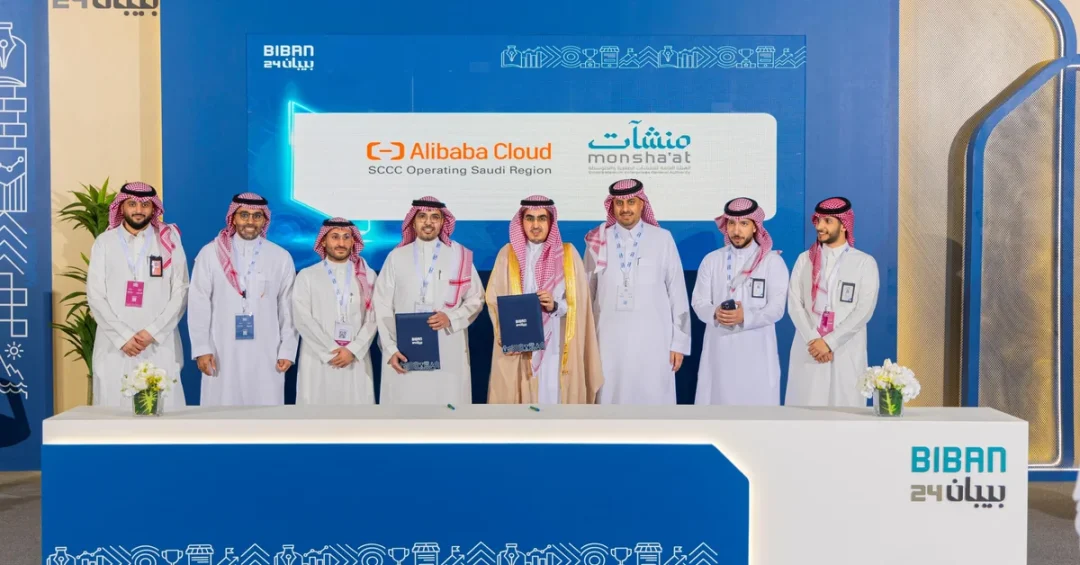
The Small and Medium Enterprises General Authority (Monsha’at) signed a cooperation agreement with SCCC Alibaba Cloud on November 7, 2024, during the third day of the Biban24 Forum in Riyadh, launching a joint program of specialized workshops and cloud solutions designed to accelerate digital transformation across Saudi Arabia’s small and medium enterprises. The agreement was formalized at the Riyadh Front Exhibition & Conference Center, where Biban24 is being held from November 5 to 9 under the theme “Global Destination for Opportunities.” The signing was carried out by Monsha’at’s Vice Governor for SME Services, Rayan Alfayez, and SCCC’s Chief Business Excellence Officer, Abdulrahman Alhomood, according to the Saudi Press Agency.
The partnership reflects a widening recognition that cloud computing is no longer optional for small businesses competing in a digitizing global economy. By pairing Monsha’at’s institutional reach across the Kingdom’s entrepreneurial ecosystem with SCCC Alibaba Cloud’s technical infrastructure and training capabilities, the two organizations aim to give Saudi SMEs practical, affordable pathways into cloud adoption. The initiative arrives as Saudi Arabia pursues an ambitious national goal of raising the SME sector’s contribution to gross domestic product to 35 percent by 2030. For a generation of Saudi founders building in fintech, logistics, retail, and professional services, access to enterprise-grade cloud tools and skills could mark the difference between survival and scale.
Context and Background
Why does a single cooperation agreement signed at a startup forum carry significance beyond the exhibition hall? To understand its weight, it helps to trace how Saudi Arabia has systematically built one of the region’s most active entrepreneurship ecosystems. Monsha’at, established in 2016 as the government body responsible for organizing, supporting, and developing SMEs, has become the central engine of that effort. It runs financing programs, business accelerators, regulatory simplification initiatives, and large-scale gatherings such as Biban, which has grown into one of the Middle East’s largest entrepreneurship events. Biban24 alone convenes thousands of entrepreneurs, investors, and institutional partners from more than a hundred countries.
The digital economy has become a core pillar of that strategy. Saudi Arabia’s National Strategy for Data and Artificial Intelligence, combined with the broader digital transformation agenda led by the Ministry of Communications and Information Technology, has pushed cloud adoption to the top of corporate and government priorities. Yet SMEs — which represent the overwhelming majority of registered businesses in the Kingdom and employ a substantial share of the private-sector workforce — have historically lagged larger enterprises in migrating workloads to the cloud. Barriers include cost, limited in-house technical expertise, and uncertainty about data governance. The Monsha’at–SCCC Alibaba Cloud agreement directly targets those barriers by offering structured workshops that build technical skills and by providing cloud solutions tailored to smaller operating budgets.
SCCC Alibaba Cloud, a joint venture that brings Alibaba Cloud’s global cloud computing expertise into the Saudi market, has been expanding its footprint in the Kingdom as part of a broader wave of Chinese technology investment aligned with Saudi Vision 2030. The company’s involvement signals that international cloud providers view Saudi SMEs not merely as customers but as long-term partners in the Kingdom’s digital economy. The timing of the agreement, announced on the third day of Biban24, also underscores how the forum functions as a deal-making platform rather than a purely ceremonial event.
Key Details of the Agreement
What exactly will the cooperation deliver to Saudi entrepreneurs? According to the Saudi Press Agency, the agreement centers on two mutually reinforcing components: specialized workshops to enhance technical skills and cloud solutions that help SMEs adopt digital transformation and improve their operations. The workshops are expected to cover practical topics such as cloud migration, data management, cybersecurity fundamentals, and the use of cloud-based productivity and analytics tools. By embedding these skills within Monsha’at’s existing support programs, the partnership aims to move beyond one-off training events toward sustained capability building.
The cloud solutions component addresses a persistent complaint among small businesses: that enterprise technology is priced and packaged for large corporations. Under the agreement, SMEs will gain access to cloud services designed to lower the cost of storing data, running applications, and scaling digital services as their customer base grows. For a Riyadh-based e-commerce startup or a Jeddah logistics firm, that could mean faster website performance, more reliable data backup, and the ability to experiment with artificial intelligence tools without heavy upfront investment in servers.
The signing itself carried symbolic weight. Rayan Alfayez, Monsha’at’s Vice Governor for SME Services, represented the authority, while Abdulrahman Alhomood, SCCC’s Chief Business Excellence Officer, signed for the technology partner. The presence of senior officials from both sides reflects institutional commitment rather than a tentative pilot. The agreement was one of several launches and deals announced during Biban24, which Monsha’at organizes annually to connect entrepreneurs with financiers, regulators, and technology providers. Organizers have emphasized that this year’s edition is producing agreements with direct, practical impact on the entrepreneurship sector across multiple industries.
International and Regional Impact
How does a domestic SME digitization program resonate beyond Saudi borders? The Kingdom’s position as the largest economy in the Middle East and North Africa means that changes in its business environment ripple across the region. If Saudi SMEs adopt cloud technology at scale, the effects will be felt by suppliers, customers, and partners in the Gulf Cooperation Council states, the broader Arab world, and beyond. Regional entrepreneurs often look to Saudi Arabia as a bellwether for market trends, and a well-executed national cloud adoption program could become a model for neighboring countries pursuing similar diversification goals.
The involvement of SCCC Alibaba Cloud also highlights the deepening technology ties between Saudi Arabia and China, a relationship that has expanded steadily in recent years across energy, infrastructure, and digital sectors. For international cloud providers, the agreement signals that Saudi Arabia’s SME market is open for business and that partnerships with government-linked institutions are a viable route to reaching it. For Saudi Arabia, working with a global cloud operator supports the transfer of technical knowledge and aligns with a foreign investment strategy that welcomes world-class partners while retaining sovereign control over data and digital infrastructure priorities.
On the regional stage, the agreement reinforces Saudi Arabia’s ambition to be the digital hub of the Middle East. Competitors such as the United Arab Emirates have built strong cloud ecosystems, and Saudi Arabia’s push to bring advanced cloud capabilities to its small business base is partly a response to that competitive dynamic. A more digitally capable SME sector strengthens the Kingdom’s attractiveness as a location for regional headquarters, startup investment, and talent migration — all priorities articulated in Vision 2030.
Economic and Strategic Significance
Why should economists and business leaders outside Saudi Arabia pay attention to this agreement? SMEs are the backbone of the Saudi private sector, and their productivity directly affects national output, employment, and innovation. When small firms adopt cloud tools, they tend to gain measurable improvements in efficiency, market reach, and resilience. Digital transformation allows a small retailer to sell online, a service company to manage clients remotely, and a manufacturer to track inventory in real time. These gains compound across thousands of businesses, contributing to the diversification of an economy that has historically depended heavily on hydrocarbons.
The strategic dimension is equally important. Cloud computing is foundational infrastructure for artificial intelligence, fintech, and data-driven services — sectors Saudi Arabia has identified as future growth engines. By building cloud fluency among SMEs now, the Kingdom is laying the human and technical groundwork for broader adoption of advanced technologies later. The agreement also supports the creation of a skilled workforce, since the workshops will expose entrepreneurs and their employees to in-demand digital competencies. That aligns with national efforts to boost private-sector job creation and reduce reliance on public employment.
From an investment perspective, digital-ready SMEs are more attractive to venture capital and private equity. Investors consistently cite technology adoption and data maturity as factors in valuation and due diligence. If Monsha’at and SCCC Alibaba Cloud succeed in raising the digital baseline across the SME sector, the pool of investable Saudi startups expands, feeding a virtuous cycle of funding, growth, and reinvestment that ultimately strengthens the Kingdom’s capital markets.
Vision 2030 Alignment
How does this partnership fit into the larger story of Saudi Arabia’s transformation? Vision 2030, launched under the leadership of Crown Prince Mohammed bin Salman, sets out a comprehensive plan to diversify the economy, empower the private sector, and position the Kingdom as a global investment and technology hub. Raising SME contribution to GDP to 35 percent is one of its headline targets, and digital enablement is widely viewed as essential to reaching it. The Monsha’at–SCCC Alibaba Cloud agreement advances that goal by removing practical barriers that keep small businesses from modernizing.
The deal also reflects the Vision’s emphasis on international partnership and knowledge transfer. Saudi Arabia has consistently welcomed global companies that bring expertise, investment, and jobs, provided they contribute to local capability building. By working with Alibaba Cloud through SCCC, the Kingdom gains access to proven cloud technology while retaining the institutional framework that ensures SMEs receive support tailored to local conditions. For entrepreneurs across the Kingdom, the message is clear: the tools, training, and partnerships needed to compete in the digital economy are being assembled around them. As Biban24 continues and more agreements take shape, the agreement stands as a concrete example of how Saudi Arabia is turning its long-term vision into everyday opportunities for its business community.
20 Questions
Q1. What is Monsha’at?
A1. Monsha’at is the Small and Medium Enterprises General Authority of Saudi Arabia, established in 2016 to organize, support, and develop the SME sector. It runs financing, training, and regulatory programs and organizes the annual Biban forum.
Q2. What is SCCC Alibaba Cloud?
A2. SCCC Alibaba Cloud is a joint venture that brings Alibaba Cloud’s cloud computing technology and services into the Saudi market. It works with local partners to support digital transformation across public and private sectors.
Q3. When and where was the agreement signed?
A3. The agreement was signed on November 7, 2024, during the third day of the Biban24 Forum, held at the Riyadh Front Exhibition & Conference Center in Riyadh from November 5 to 9.
Q4. Who signed the cooperation agreement?
A4. Monsha’at’s Vice Governor for SME Services, Rayan Alfayez, and SCCC’s Chief Business Excellence Officer, Abdulrahman Alhomood, signed the agreement on behalf of their organizations.
Q5. What does the agreement aim to achieve?
A5. It aims to offer specialized workshops that enhance technical skills and provide cloud solutions that help small and medium enterprises adopt digital transformation and improve their operations.
Q6. What is the theme of Biban24?
A6. Biban24 is organized under the theme “Global Destination for Opportunities,” reflecting Saudi Arabia’s ambition to be a leading hub for entrepreneurship and investment.
Q7. Why is cloud adoption important for Saudi SMEs?
A7. Cloud adoption lets SMEs lower technology costs, improve data security, scale digital services, and use advanced tools such as analytics and artificial intelligence without heavy upfront infrastructure investment.
Q8. How does the agreement support Vision 2030?
A8. Vision 2030 seeks to raise SME contribution to GDP to 35 percent. Digital enablement is essential to that target, and this agreement provides practical tools and training to help achieve it.
Q9. What kinds of workshops will be offered?
A9. The workshops are expected to cover cloud migration, data management, cybersecurity fundamentals, and cloud-based productivity and analytics tools, tailored to the needs of small and medium enterprises.
Q10. Which sectors will benefit most?
A10. SMEs in e-commerce, logistics, retail, professional services, fintech, and manufacturing are likely to benefit most, as cloud tools directly improve their efficiency, reach, and resilience.
Q11. Is this agreement limited to Riyadh?
A11. No. While signed in Riyadh during Biban24, the agreement is national in scope and is expected to reach SMEs across Saudi Arabia through Monsha’at’s programs and digital channels.
Q12. How does this affect international investors?
A12. Digital-ready SMEs are more attractive to venture capital and private equity. Raising the digital baseline across the sector expands the pool of investable Saudi startups for local and international investors.
Q13. What is the significance of Alibaba Cloud’s involvement?
A13. It signals growing technology ties between Saudi Arabia and China and shows that global cloud providers view the Kingdom’s SME market as a long-term strategic opportunity.
Q14. Will the agreement create jobs?
A14. By building digital skills and helping SMEs grow, the agreement supports private-sector job creation, a key objective of Vision 2030’s economic diversification agenda.
Q15. How does this compare with regional efforts?
A15. Saudi Arabia is competing with other Gulf states to lead the Middle East’s digital economy. Bringing cloud capabilities to SMEs strengthens the Kingdom’s position as a regional technology hub.
Q16. What happens after Biban24 ends?
A16. The agreement moves into implementation, with Monsha’at and SCCC Alibaba Cloud expected to roll out workshops and cloud service offerings through Monsha’at’s existing SME support channels.
Q17. Are there costs for SMEs to participate?
A17. Specific pricing has not been announced. The agreement is designed to make cloud solutions more accessible, suggesting subsidized or tailored packages for small and medium enterprises.
Q18. How does this support data sovereignty?
A18. The partnership operates within Saudi Arabia’s regulatory framework, supporting the Kingdom’s priorities on data governance while giving SMEs access to advanced cloud infrastructure.
Q19. What other agreements were signed at Biban24?
A19. Biban24 featured several launches and agreements with direct impact on the entrepreneurship sector across various industries, supporting investment, growth, and startup creation in the local market.
Q20. What is the long-term outlook for Saudi SMEs?
A20. With sustained government support, international partnerships, and rising digital adoption, Saudi SMEs are positioned to grow into a major driver of economic diversification and private-sector employment by 2030.
Reader Feedback
We value your thoughts. Please share your feedback on this article.
Your feedback helps us improve our coverage.
Related articles
 Monsha’at, Oracle Sign MoU to Boost Saudi Startups
 Monsha’at and Zoom Partner to Empower Saudi SMEs
 Monsha’at, Microsoft Arabia Sign MoU to Boost Tech Startups
 Monsha’at, QDB Sign MoU to Boost SME Innovation
 Twenty Korean Startups Join Biban 24 Forum in Riyadh
 ROSHN Group Rebrands as Multi-Asset Developer